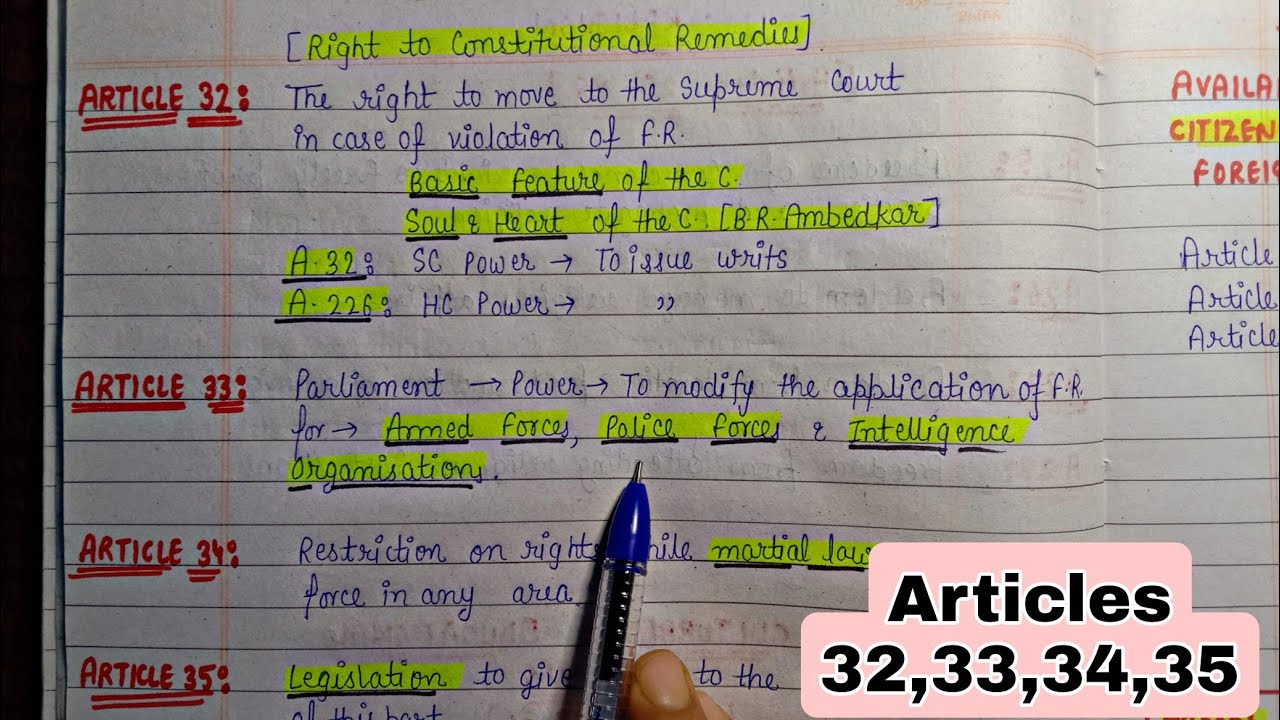
The relationship between the Armed Forces and Fundamental Rights in India represents a careful constitutional balance. On one side, the country needs strong, disciplined forces to protect national security. On the other side, every citizen, including a person serving in the forces, has certain basic freedoms under the Constitution of India. Articles 33 and 34 explain how the Indian Parliament can manage this balance when military discipline, emergency situations, or martial law are involved. This topic is especially important for UPSC, State PSC, and law students studying the Constitution of India and the limits placed on fundamental rights.
🎯 In this chapter, you will understand:
- How Article 33 allows Parliament to restrict or abrogate certain fundamental rights for members of the armed forces.
- Why discipline, operational efficiency, and national security require special rules for armed forces personnel.
- The difference between Martial Law and a National Emergency under the Indian constitutional system.
- How Article 34 allows Parliament to indemnify persons for acts done during martial law.
💡 Why this topic matters: This topic explains why soldiers, sailors, air personnel, and certain support staff may have fewer civil freedoms than ordinary citizens. It also shows how the Constitution prepares the country for extreme situations where normal civil administration may fail.
🧠 Core Idea: The Constitution gives Parliament special powers to maintain discipline in the armed forces through Article 33 and to protect actions taken during martial law through Article 34. These powers are meant to protect national stability while still operating within a constitutional framework.
Armed Forces and Fundamental Rights in India – Article 33 and Article 34 Detailed Analysis
The constitutional narrative of Article 33 gives the Parliament a special authority to restrict or even take away certain fundamental rights for people serving in the armed forces. This power exists because military service is not like ordinary civilian life. A soldier may need to follow orders immediately, remain available at unusual hours, avoid political activities, and maintain strict discipline. If every member of the armed forces could freely exercise all civil rights in the same way as a civilian, it could affect unity, obedience, and operational readiness. Therefore, the Constitution allows Parliament to make special laws for the forces so that duty and discipline can remain strong.
This legislative power serves as a cornerstone for national integrity. It recognises that military service demands a different standard of constitutional application than civilian life. By ensuring that operational efficiency is not weakened by the unrestricted exercise of individual liberty, the Constitution of India creates a framework in which duty and discipline come before personal freedoms for security personnel. However, this does not mean that armed forces personnel lose every right. It means Parliament may make special laws to limit selected rights where necessary for discipline and proper functioning of the forces.
Scope and Effect of Article 33 Restrictions
Article 33 is important because it clearly identifies who has the power to make such restrictions. It does not allow every government body to interfere with the rights of armed forces personnel. Instead, it keeps this authority with Parliament alone. This centralised control helps maintain a uniform system of discipline across the country and prevents different states from creating different rules for the armed forces.
- (i) Under the provisions of Article 33, the exclusive power to modify or restrict rights rests solely with the Parliament. State Legislatures are specifically excluded from this jurisdiction, meaning they cannot make laws that restrict the fundamental rights of armed forces personnel under this article.
- (ii) A significant feature of this article is that laws enacted under its authority are generally immune from judicial review on the specific ground that they violate fundamental rights. In simple words, a person cannot easily challenge such a law in court only by saying that it limits a fundamental right.
- (iii) The legal manifestations of this power include the Army Act, 1950, the Navy Act, 1950, and the Air Force Act, 1950, along with the Police Forces (Restriction of Rights) Act, 1966 and the Border Security Force Act. These laws help maintain discipline, service conditions, and proper conduct among members of these forces.
- (iv) These legislative acts strictly regulate and often curtail the following liberties:
- The right to freedom of speech and expression.
- The right to form unions, associations, or political groups.
- The right to participate in political activities or elections.
- The right to communicate with the press or digital media platforms.
- The right to attend public meetings or join demonstrations.
- (v) Crucially, the definition of “members of the armed forces” is broad. It includes not only combatants, such as soldiers directly involved in military operations, but also essential support staff such as barbers, mechanics, tailors, and chowkidars. This wide meaning ensures that all persons serving within the armed forces system can be governed by the same disciplinary framework.
- (vi) Furthermore, legal determinations made by a court-martial under these specific laws are protected and cannot be contested in High Courts or the Supreme Court based on fundamental rights violations. A court-martial is a military court that deals with offences and disciplinary matters connected with armed forces personnel.
Martial Law vs National Emergency in the Indian Constitution
The Indian Constitution treats Martial Law and National Emergency as two different constitutional responses to crisis. Both can affect fundamental rights, but they work in very different ways. Martial law is mainly connected with restoring public order through military control. A National Emergency, on the other hand, is a wider constitutional situation that changes the relationship between the Centre and the States and can affect many areas of governance.
Understanding this difference is essential because students often confuse the two. A National Emergency is formally declared under Article 352, while martial law is not described in the same detailed way in the Constitution. This difference makes martial law an exceptional and limited mechanism, whereas a National Emergency is a clearly structured constitutional provision.

Detailed Comparison of Martial Law and National Emergency Mechanisms
While both mechanisms are responses to crisis, Martial Law focuses on the restoration of civil order through military control, whereas National Emergency is a broader constitutional status invoked under Article 352. Martial law is generally local and temporary, while a National Emergency can affect the entire country and alter the working of the federal system.
- (i) Martial Law primarily restricts fundamental rights. However, a National Emergency has a much wider impact because it can alter Centre–State relations, revenue distribution, and legislative competencies. This means that during a National Emergency, the Union may gain greater control over matters that are normally handled by the States.
- (ii) During Martial Law, civil administration and ordinary courts are typically suspended in the affected area. Conversely, during a National Emergency, the civil machinery continues to operate. The regular government structure does not disappear; it simply functions under special constitutional conditions.
- (iii) The goal of Martial Law is specifically to restore internal order. A National Emergency, however, is triggered by war, external aggression, or armed rebellion. Thus, martial law responds mainly to a breakdown of peace and administration, while emergency responds to a serious threat to the nation.
- (iv) Martial Law is geographically targeted at specific disturbed zones. A National Emergency can be applied to the entire country. This makes martial law more limited in area, while emergency can have a nationwide effect.
- (v) While Martial Law is an implicit concept derived from common law, National Emergency is explicitly detailed in Part XVIII of the Constitution. This means the Constitution explains emergency provisions clearly, but it does not lay down a detailed procedure for declaring martial law.
Article 34 and the Legalities of Martial Law in India
Article 34 acts as a protective shield for actions taken during periods of martial law. It allows the Parliament to indemnify individuals for acts performed in the name of restoring order. The word indemnify means to protect a person from legal responsibility or loss for something done while performing an official duty. In this context, Parliament can make a law to protect officials who acted during martial law to restore peace and stability.
This protection is important because military authorities may have to take strict actions during a serious breakdown of law and order. Without Article 34, such officials could face legal cases after normal administration returns. The article therefore helps ensure that persons working to stabilise a disturbed region are not punished later for actions taken under martial law, provided Parliament decides to indemnify them.
Scope and Nature of Article 34 Protections
This article ensures that when martial law is active, Parliament can legalise or “indemnify” actions that might otherwise be considered unlawful. This prevents legal retaliation against officials working to stabilise a region under military rule and helps prioritise national stability. The protection is not automatic in every case; it depends on Parliament making an indemnity law for the relevant acts.
- (i) The concept is rooted in English common law, which allowed the military to step in when civil authorities could no longer maintain peace. The idea is that in an extreme breakdown of governance, military intervention may become necessary to protect life, property, and public order.
- (ii) It results in the temporary replacement of civil government with military tribunals and orders. In practical terms, military authorities may take charge of administration in the affected area until normal civilian control can be restored.
- (iii) It is important to distinguish this from military law. Military law is a permanent set of rules for service members and applies regardless of whether there is a law-and-order crisis. Martial law, however, is an extraordinary arrangement used only when ordinary civil administration fails.
Conditions for Declaring Martial Law
The Constitution does not explicitly list the triggers for martial law. This absence of a detailed list means that its use depends on historical practice, legal understanding, and the seriousness of the situation. However, legal precedents suggest that martial law is reserved for the most extreme breakdowns of the state’s machinery, when normal police and civil authorities are unable to control the situation.
- (a) Situations of actual War or foreign invasion, where the security of the country or a region is directly threatened.
- (b) Internal insurrection or widespread armed rebellion, where organised violence challenges the authority of the government.
- (c) Violent riots that overwhelm the local police forces and make it impossible for civil authorities to maintain peace.
- (d) Any form of violent resistance that threatens the authority of the state and prevents the normal functioning of government.
Judicial Interpretation and the Effects of Military Rule
The Supreme Court has played a pivotal role in interpreting the boundaries of such power. The Court has maintained that martial law should not become an excuse for the absolute suspension of rights such as habeas corpus. Habeas corpus is a legal protection that prevents a person from being detained without proper legal justification. Even during military rule, the final objective must remain the swift restoration of the civilian constitutional framework.
Specific Objectives of Military Governance
Military governance during martial law is not meant to permanently replace democratic government. Its purpose is limited and temporary. The military steps in only to handle a situation that civil authorities cannot manage, and it must work towards bringing back normal constitutional administration as soon as possible.
- (i) Purpose: The primary aim is always the restoration of law and order through temporary military intervention. The military does not take over governance for personal or political gain; it acts to restore peace.
- (ii) Extent: The application is strictly limited to those specific regions where civil power has collapsed. Martial law should not be extended to peaceful areas where the ordinary administration is functioning properly.
- (iii) Judicial Note: Courts maintain that military authorities must aim for the earliest possible handover back to civil administration. This ensures that martial law remains an emergency measure rather than a permanent system of rule.
⚡ Quick Revision Capsule: Articles 33, 34, Martial Law and National Emergency
This quick revision capsule brings together the main differences and key provisions in one place. It is useful for last-minute revision before examinations, especially for questions related to fundamental rights, armed forces, emergency provisions, and martial law.
| Aspect | Martial Law | National Emergency |
|---|---|---|
| Main purpose | To restore civil order through temporary military control. | To respond to war, external aggression, or armed rebellion. |
| Constitutional basis | An implicit concept derived from common law; not detailed like emergency provisions. | Explicitly provided under Article 352 in Part XVIII of the Constitution. |
| Area of application | Limited to specific disturbed zones where civil authority has broken down. | Can be applied to the entire country. |
| Effect on administration | Civil administration and ordinary courts may be suspended in the affected area. | Civil machinery continues to operate, though Centre–State relations may change. |
| Effect on rights and governance | Primarily restricts fundamental rights and may involve military tribunals; Article 34 allows Parliament to provide indemnity. | Has a wider impact on Centre–State relations, revenue distribution, and legislative competencies. |
📝 Summary
The synergy between the Armed Forces and Fundamental Rights, as outlined in Articles 33 and 34, illustrates how the Constitution of India balances national security with individual liberty. Article 33 gives Parliament the tools to maintain discipline among members of the armed forces by restricting selected rights. Article 34 protects the state during times of martial law by allowing Parliament to indemnify persons for acts done to restore order. Together, these provisions show that the Constitution recognises extraordinary needs during military service and civil breakdown, while still aiming to return to normal democratic governance.
🚀 Quick Revision Points
Essential facts to review before examinations:
- (i) Article 33 empowers only Parliament to restrict or abrogate fundamental rights of members of the armed forces to ensure discipline.
- (ii) Laws under Article 33 include the Army Act, 1950, Navy Act, 1950, Air Force Act, 1950, Police Forces (Restriction of Rights) Act, 1966, and Border Security Force Act.
- (iii) The term “members of the armed forces” includes combatants and support staff such as barbers, mechanics, tailors, and chowkidars.
- (iv) Article 34 allows Parliament to indemnify persons for acts done during martial law, while Article 352 governs the declaration of a National Emergency.
- 💡 Exam Tip: Remember the simple contrast: Article 33 deals with discipline in the armed forces, while Article 34 deals with indemnity during martial law. Also remember that martial law is local and temporary, whereas a National Emergency under Article 352 can affect the entire country and Centre–State relations.
❓ Frequently Asked Questions (FAQ)
Q1: Who has the power to restrict fundamental rights of armed forces personnel under Article 33?
A1: Only the Parliament has this exclusive power. State Legislatures cannot make laws under Article 33 to restrict or abrogate the fundamental rights of armed forces personnel.Q2: What is the difference between martial law and military law?
A2: Martial law is an extraordinary arrangement used when civil administration fails and military control is needed to restore order. Military law is a permanent set of rules that governs members of the armed forces in ordinary times as well.Q3: What does Article 34 allow Parliament to do during martial law?
A3: Article 34 allows Parliament to indemnify persons for acts done during martial law to restore order. This means Parliament can protect such persons from legal consequences for those acts through a law made for that purpose.