The General Agreement on Trade in Services (GATS) is a landmark 1995 initiative that completely reshaped global services trade. By driving liberalisation and creating clear, structured rules for foreign service providers, it opened up new pathways for cross-border commerce. If you are preparing for competitive exams, mastering its key principles, modes of supply, and the direct role of the WTO is incredibly important, as this framework forms the bedrock of modern international trade policy.
General Agreement on Trade in Services (GATS) and Its Liberalisation Framework 1995
Think of the GATS framework as the moment services finally got their official passport into the multilateral trading system. Launched back in 1995 primarily through the push of developed countries, this agreement set out to systematically lower government barriers on foreign service firms. Instead of sudden, chaotic market openings, it gave nations a highly regulated, step-by-step method to offer market access to global players.
- Balancing Trade and Local Rules
GATS works hard to chop down unfair barriers for foreign firms, but it doesn't strip governments of their power. It carefully ensures that essential national regulations stay intact to protect local consumers and quality standards.
- A Dual Approach to Commitments
The entire framework splits its rules into two clean sets: general obligations that everyone must follow across the board, and specific commitments that apply only to the precise sectors a country chooses to open up.
- Building a Predictable Global Market
By locking down these rules, GATS provides a solid foundation for ongoing international talks. It replaces backroom deals with deep transparency and real cooperation among member nations.
General and Specific Obligations under GATS
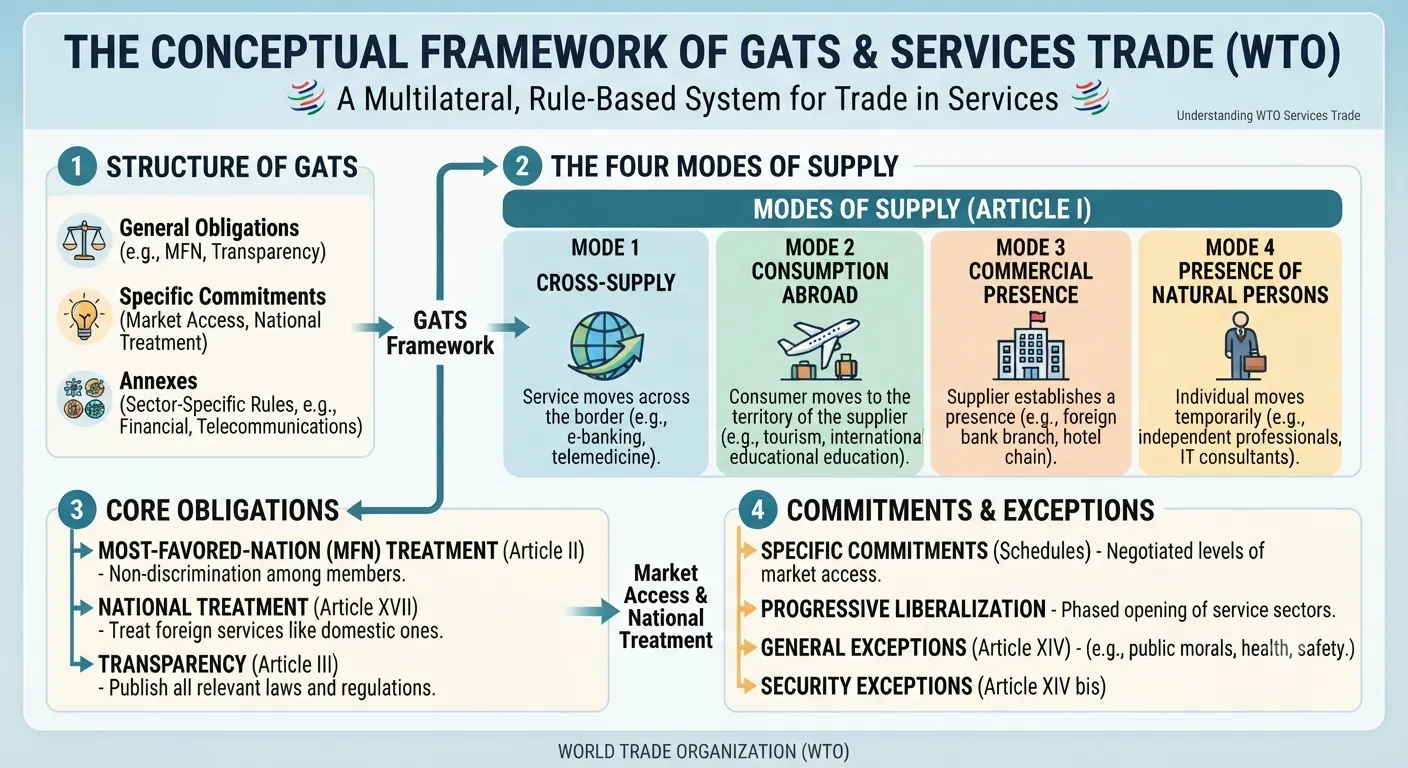
To keep things running smoothly, GATS divides its structural expectations into two main categories. This ensures that countries understand their baseline duties while retaining control over their sensitive domestic industries.
General Obligations
The general obligations set up a fair baseline of play for every single member country, keeping the focus entirely on non-discrimination and reliable international standards.
- (i) The core principle of Most-Favoured-Nation (MFN) status ensures you can't play favorites; you cannot treat one trading partner less favourably than another.
- (ii) It sets clear rules on how nations recognize professional qualifications and standards, making sure cross-border professionals aren't blocked by arbitrary red tape.
- (iii) It drives overall consistency across regulatory frameworks, which naturally builds trust and makes international business far more predictable.
Specific Commitments in Selected Service Sectors
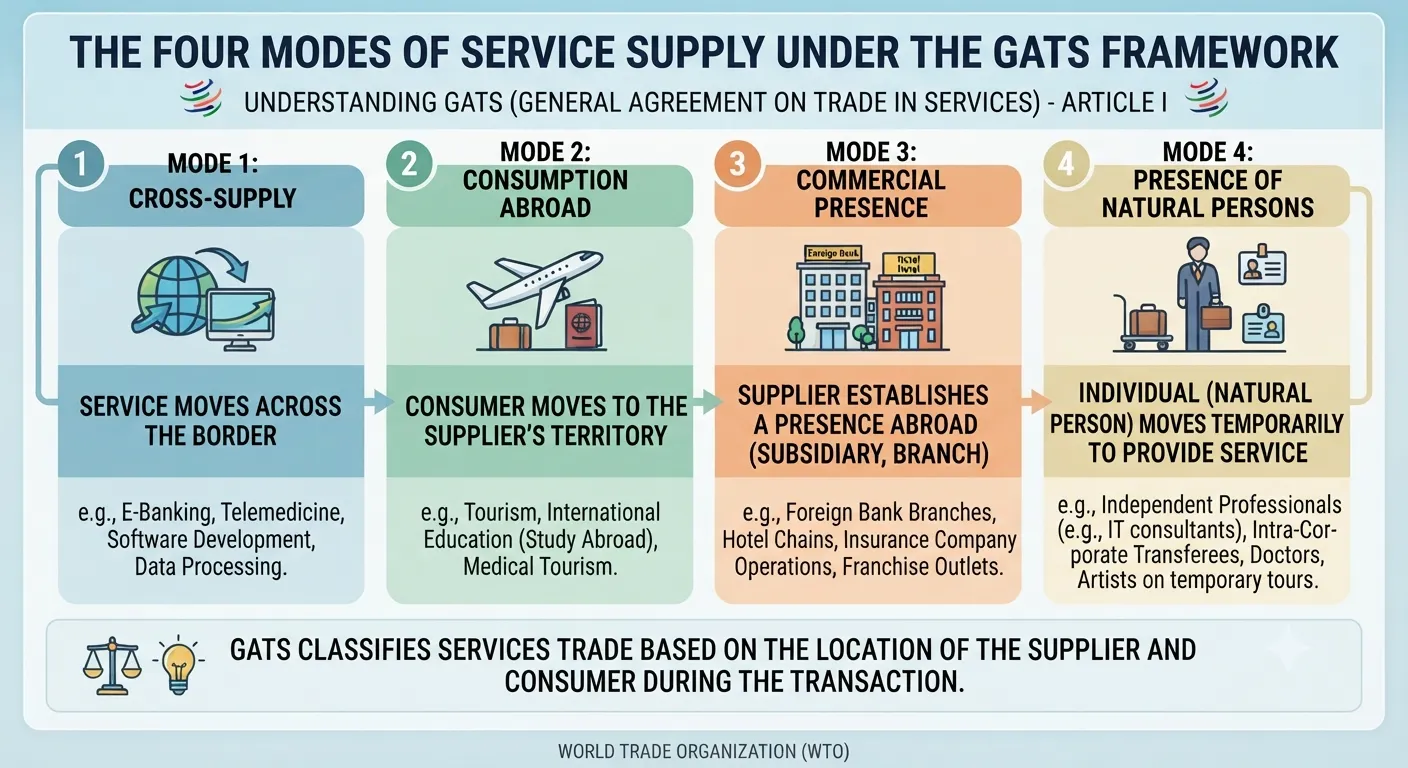
When a country is ready to open a specific sector, it makes specific commitments. These are strictly organized around four distinct modes of supply that dictate exactly how a service crosses a border.
Mode of Supply How it Works Real-World Examples Mode 1: Cross-border supply The service itself crosses the border, while both the provider and consumer stay in their home countries. Sending software code, architectural blueprints, or engineering designs via email. Mode 2: Consumption abroad The consumer physically travels to another nation to obtain and consume the service. A student traveling for foreign university education or a patient getting medical treatment abroad. Mode 3: Commercial presence A service firm sets up a permanent, physical business footprint or branch inside another country. A multinational bank opening branches in New Delhi or an insurance firm establishing foreign offices. Mode 4: Presence of natural persons An individual professional travels abroad temporarily to deliver the service on the ground. An IT consultant flying out to deploy software or an engineer traveling for technical repairs. Negotiation and Sectoral Liberalisation
Even though countries technically have the freedom to pick and choose which sectors they want to open, international negotiations are vital for hammered-out, balanced trades.
- (i) Governments can explicitly write down conditions and limitations to cap market access or protect national treatment.
- (ii) If a country signs off on a sector but lists zero limitations, it signals absolute, full liberalisation for that specific field.
- (iii) Any sector that a country completely leaves out of its commitment sheets remains totally unrestricted by GATS, leaving full control in domestic hands.
GATS and Developing Countries
The WTO openly acknowledges that not all economies are starting from the same baseline. Because of this, GATS weaves deep structural flexibility directly into its rules for developing countries to promote balanced global growth.
- (i) It heavily encourages strengthening domestic service capacity to help local firms scale up and compete globally over time.
- (ii) It allows these nations to open up selectively, matching their trade commitments perfectly with their internal development goals.
- (iii) While the fast-paced benefits of liberalisation are often easier for developed economies to grab first, GATS guarantees structured, protected windows of opportunity for developing nations.
Progressive Liberalisation of Services
The creators of GATS knew that global economics change fast, so they designed the treaty to be an ongoing journey rather than a one-time deal.
- (i) The very first ground rules and entries were hammered out during the historic Uruguay Round.
- (ii) Later negotiation rounds, including the extensive Doha Work Programme, have pushed hard for steady, progressive liberalisation across shifting service fields.
- (iii) This constant, iterative process keeps services trade relevant, adjusting seamlessly to new technology and evolving developmental realities.
Summary
The GATS1995 architecture is an absolute must-know to decode how the global services trade landscape operates. By blending rock-solid general duties like MFN with customizable specific commitments across four distinct modes of supply, it strikes a calculated balance between free trade and sovereign regulation. Its built-in safety valves for developing countries ensure that global market integration doesn't come at the cost of domestic economic stability.
Quick Revision Points for Students
Let's lock in the core facts and structural details for your upcoming exams:
- (i) GATS was officially born in 1995 under the WTO, moving services trade out of informal spaces into a legally binding global system.
- (ii) It splits rules cleanly between General Obligations (like MFN which blocks country-to-country favoritism) and Specific Commitments.
- (iii) Services are traded via 4 Modes: Mode 1 (Cross-border), Mode 2 (Consumption abroad), Mode 3 (Commercial presence), and Mode 4 (Presence of natural persons).
- (iv) It treats development status seriously, offering flexible, progressive liberalisation windows so developing nations can open up at their own pace.
Frequently Asked Questions (FAQ)
Q1: What is the main difference between general obligations and specific commitments under GATS?
A1: General obligations (such as the MFN principle) apply universally to all service sectors across all member nations from day one. Specific commitments only apply to the exact sectors a country explicitly chooses to open up, allowing them to set clear boundaries on foreign access.Q2: Can a country protect its local industries under the GATS framework?
A2: Yes, absolutely. GATS is built with plenty of regulatory room. When making specific commitments, a country can write in distinct conditions and limitations on market access, or choose to leave sensitive sectors completely off their commitment sheets.Q3: What does Mode 3 supply mean in everyday terms?
A3: Mode 3 is all about commercial presence. This happens when a domestic company sets up a physical corporate footprint, branch, or subsidiary in another country to sell services locally—like a global bank opening standard retail branches abroad.