The World Trade Organisation (WTO) serves as a cornerstone for international trade regulation, ensuring that countries operate under a multilateral framework established post-Second World War. It provides clear rules and agreements governing the exchange of goods, services, and intellectual property rights (IPR), making it a crucial reference for students and exam preparation in the field of international trade policies.
World Trade Organisation (WTO): Evolution of International Trade Policy from 1947 to 1995
Trade and industry thrive on stability. In volatile global conditions, countries must follow a unified set of rules to keep markets running smoothly. The WTO agreements provide this exact framework, helping nations design and execute their international trade policies with clarity and confidence.
- The foundation and evolution of a structured international trade system
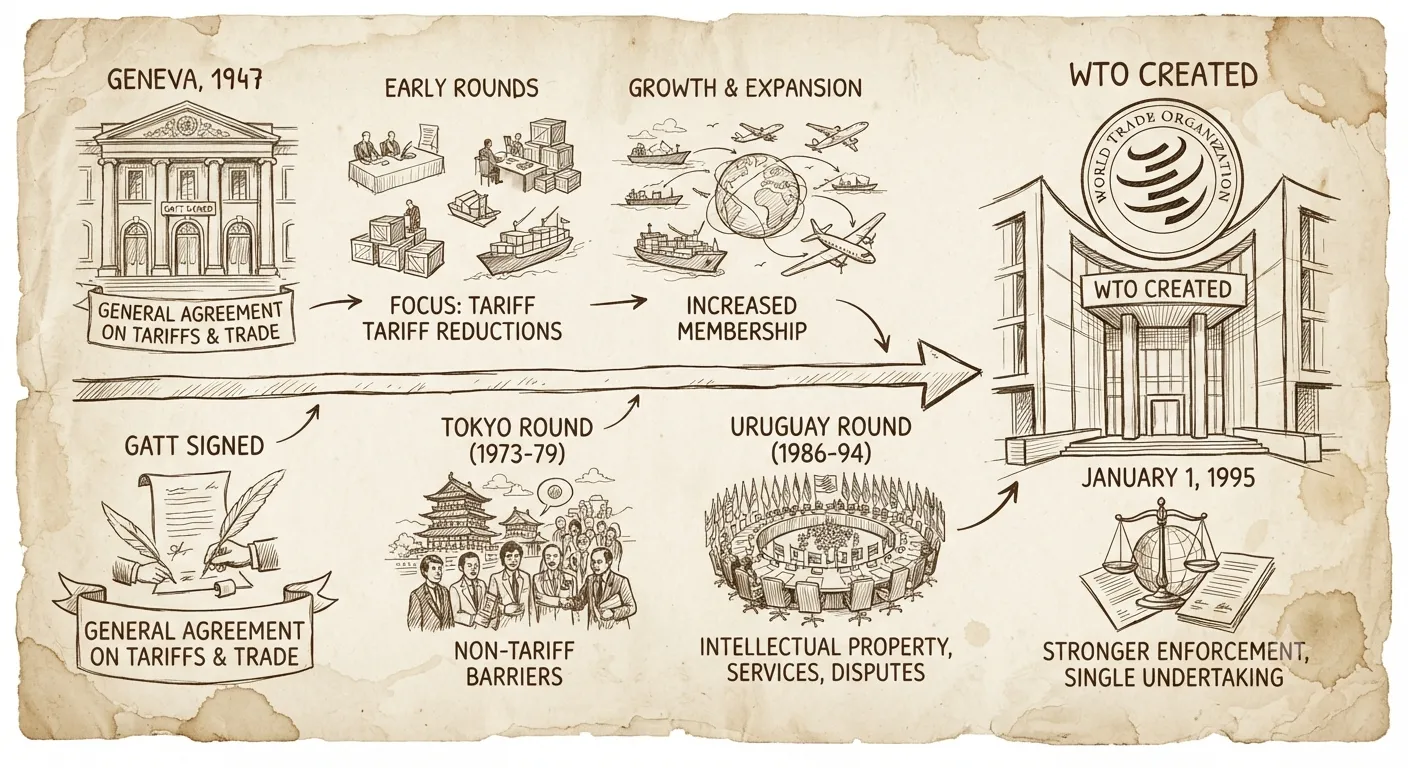
When trade rules keep shifting, industries across nations struggle to plan for long-term growth. To fix this, countries came together after the Second World War to design a shared multilateral system for global trade governance. The General Agreement on Tariffs and Trade (GATT, 1947) was the first major step, setting up the foundational rules for moving goods across borders securely.
Early International Trade Framework: GATT and Its Negotiation Rounds
Building a solid multilateral trade system didn't happen overnight. It started with intense, highly detailed negotiations aimed at lowering trade barriers under GATT. These discussions were broken down into distinct stages called rounds, with each one stepping up to tackle tariffs and complex trade regulations head-on.
Multilateral Trade Negotiation (MTN) Rounds
The MTN rounds under GATT gave countries a reliable platform to negotiate lower tariffs and establish better trade rules. These historical milestones systematically shaped the global commerce landscape we rely on today:
Negotiation Round Year / Period Primary Focus & Key Outcome Geneva 1947 The official kickoff of multilateral trade discussions. Annecy 1948 Early, necessary updates to tariffs and trade norms. Torquay 1950 Deeper cuts and adjustments to import and export protocols. Geneva 1956 A massive push to consolidate and reinforce trade rules. Dillon 1960–1961 Tackled new trade hurdles following global independence movements. Kennedy 1964–1967 Achieved major breakthroughs in reducing tariffs worldwide. Tokyo 1973–1979 Completed a comprehensive overhaul of non-tariff trade restrictions. Uruguay 1986–1994 The final, transformative round that led straight to forming the WTO. Data Accuracy Note: While the original text notes Annecy as 1948, Torquay as 1950, and Dillon as 1960–1961, standard historical timelines often mark the formal conclusion or implementation of these rounds slightly differently (Annecy 1949, Torquay 1951, Dillon 1961–1962). The source text values are strictly maintained here for architectural authenticity.
Doha Work Programme
Launched in Doha, 2001, the Doha Work Programme carries forward the torch of the original MTNs. It manages massive, highly intricate trade issues without needing a formal "MTN" label, keeping discussions active in our modern trade environment.
- (a) Directs focus toward further trade liberalization and solving emerging trade challenges.
- (b) Guarantees a continuous path for multilateral trade discussions after the Uruguay Round.
- (c) Actively helps developing countries build capacity and integrate into the global trade framework.
WTO Formation and Expanded Trade Framework
The launch of the WTO in 1995 completely transformed the old GATT framework. Instead of just focusing on physical goods, the WTO brought services and intellectual property into the mix, creating an all-inclusive, modern rulebook for international trade regulation.
WTO Structure and Agreements
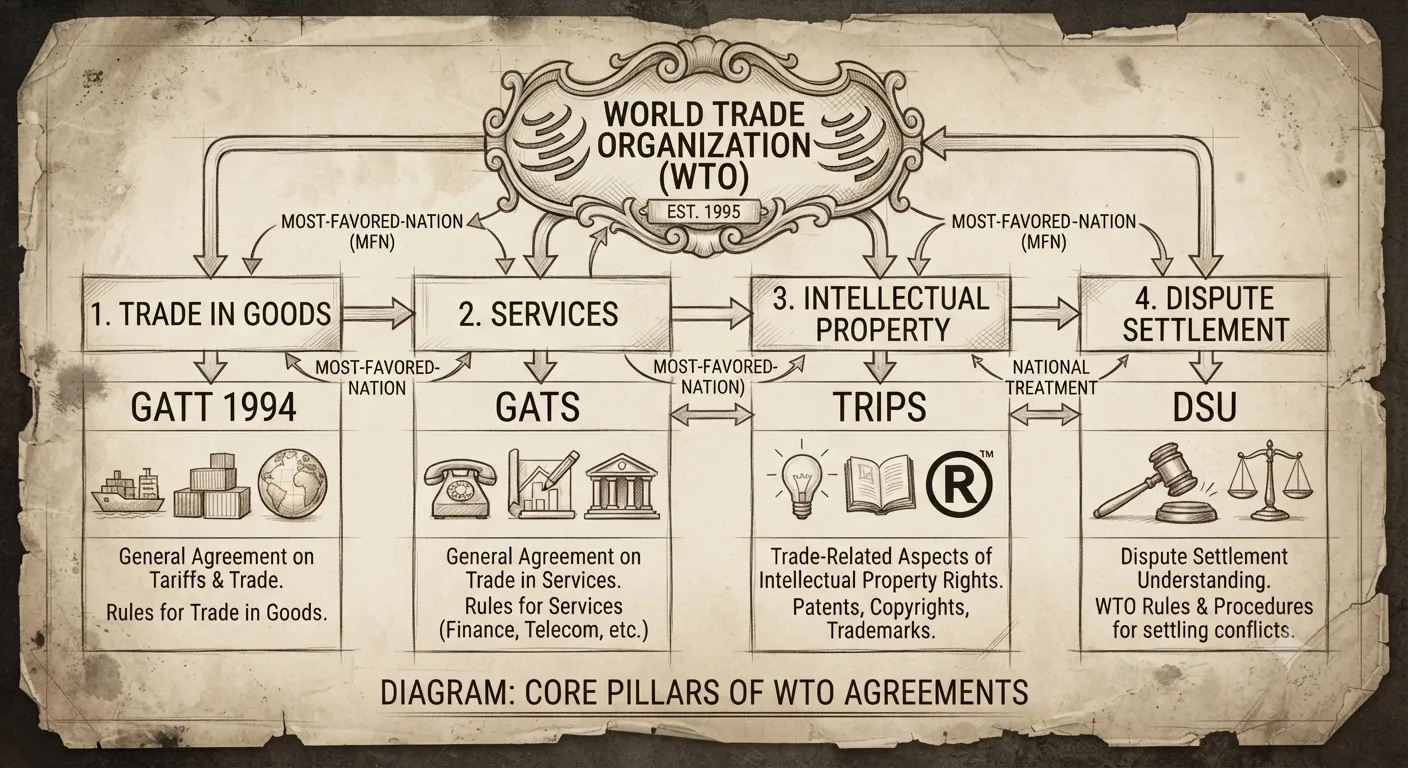
The WTO fully absorbs GATT while adding crucial new pillars to govern the modern global economy safely:
- (i) GATT 1994: Contains the updated original rules, amendments, and legal decisions for goods.
- (ii) GATS: A dedicated framework governing international trade in services (like banking, IT, and tourism).
- (iii) TRIPS: Sets the standard rules for intellectual property rights when they intersect with global trade.
- (iv) DSU: The Dispute Settlement Understanding—the vital enforcement tool that holds countries accountable to their promises.
Implementation and Compliance Mechanism
The member governments are the ones who actually run the WTO and put these agreements to work. If a country breaks a rule, private companies cannot file a case; only a member government can launch a complaint to trigger the official dispute settlement process.
- (a) Offers clear accountability and a structured path to settle complex trade fights.
- (b) Keeps trade rules uniform, fair, and predictable across the entire globe.
- (c) Drives economic stability by preventing sudden, rogue trade walls from going up.
Summary
The WTO framework remains indispensable for keeping global trade balanced and stable across goods, services, and intellectual property. Mapping its journey from GATT 1947 up to the birth of the WTO in 1995 is highly valuable for students preparing for exams in economics, commerce, or international relations.
Quick Revision Points for Students
Review these core historical and structural facts to ensure sharp retention for your upcoming exams.
- (i) The multilateral system was born post-WWII to replace market instability with a reliable set of rules.
- (ii) GATT 1947 was polished and updated across eight distinct negotiation rounds over several decades.
- (iii) The historic Uruguay Round (1986–1994) directly facilitated the transition from GATT to the official creation of the WTO in 1995.
- (iv) The modern WTO structure is built on four core pillars: GATT 1994, GATS (services), TRIPS (intellectual property), and the DSU (dispute settlement).
- (v) Private corporations cannot sue at the WTO; only member governments hold the legal right to file trade disputes.
Frequently Asked Questions (FAQ)
Q1: What major shift occurred when global trade moved from GATT to the WTO?
A1: While GATT focused purely on trade in physical goods, the creation of the WTO in 1995 expanded the framework immensely to cover international trade in services (GATS) and intellectual property rights (TRIPS) within a unified organization.Q2: Which negotiation round led directly to the formation of the WTO?
A2: The Uruguay Round, which spanned from 1986 to 1994, was the eighth and final GATT round that successfully established the WTO framework.Q3: Can a private international firm file a trade violation complaint directly with the WTO?
A3: No. The compliance and dispute settlement mechanisms are strictly state-to-state. Only the member governments have the authority to bring formal complaints forward against other nations.