Understanding the Most Favoured Nation (MFN) Treatment and National Treatment principles under WTO rules is crucial for students preparing for exams in international trade law and global commerce studies. These trade principles ensure free and fair competition among countries, regulate import and export policies, and provide a clear framework for member nations to follow non-discriminatory practices.
WTO Principles: Most Favoured Nation and National Treatment for Free Trade (1994)
The WTO establishes two core pillars to maintain complete fairness and balance in international trade. These foundation rules work closely together to ensure that no single country can manipulate market access or hand out exclusive favors at the expense of other trading partners.
- The Dynamic Duo of Non-Discrimination
The entire WTO framework relies on keeping global commerce open and balanced. By binding member nations to these rules, the system prevents sudden policy shifts that could disrupt cross-border investments or hurt international trade relationships.
- (i) MFN Treatment explicitly prohibits a country from giving preferential trade advantages to one nation over another.
- (ii) National Treatment ensures that foreign goods receive equal treatment compared to domestic products once they clear customs.
- (iii) Both principles work hand-in-hand to promote transparency, fairness, and open competition in the global market.
Understanding the Most Favoured Nation (MFN) Principle
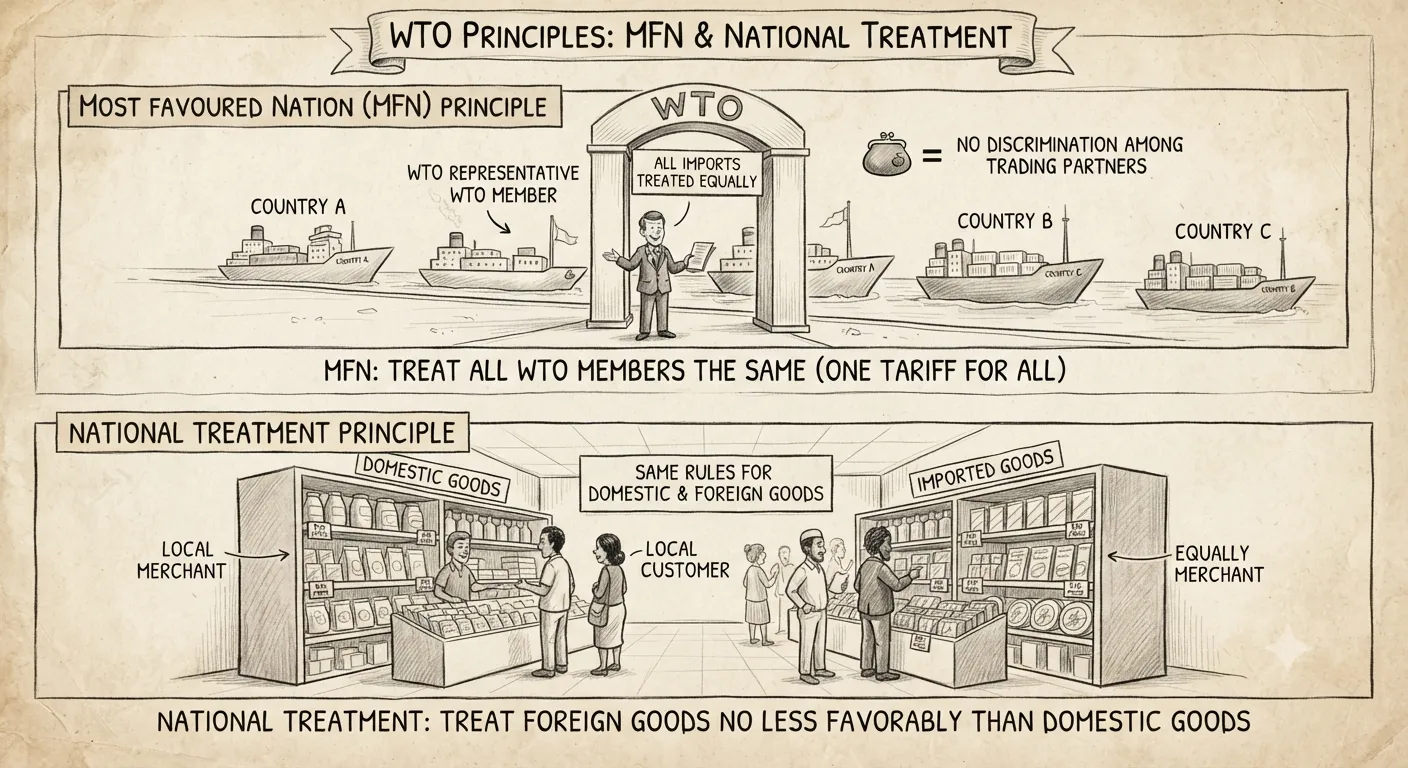
The MFN principle established under Article I of GATT 1994 serves as the first line of defense against market discrimination. It forces countries to treat all their global trading partners with the exact same level of commercial respect.
Definition and Importance of MFN
MFN treatment mandates that if a member country grants a special trade benefit or a lower tariff rate to any nation, it must extend that exact same privilege immediately and unconditionally to every other WTO member. This simple rule creates a level playing field across global markets.
- (i) Giving special rewards like lower import tariffs to a single country based on exclusive political agreements or investments is strictly prohibited.
- (ii) Singling out a country due to diplomatic arguments and blocking their imports while allowing others through is a clear violation.
- (iii) Customs duties, tariffs, and cross-border import regulations must remain completely non-discriminatory for all members.
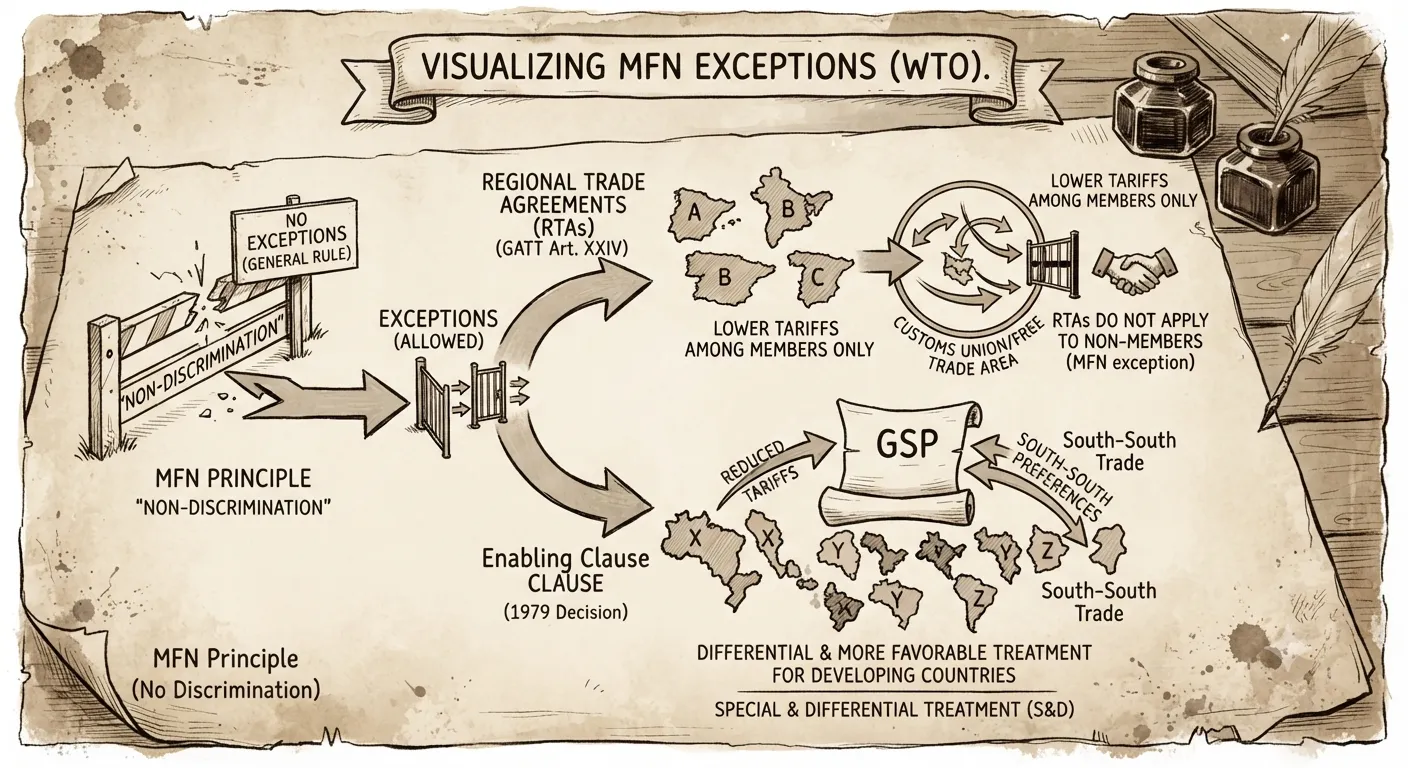
Exceptions and Conditional Benefits under MFN
While the MFN rule aims for absolute equality, the WTO builds in specific safety valves to accommodate regional partnerships and developing economies without undermining the broader rulebook.
- (a) Nations forming regional trade agreements or free trade zones can lower tariffs among themselves without sharing those specific rates with outsiders (under Article XXIV of GATT 1994).
- (b) Developing and under-developed nations can receive special trade preferences or conditional access options under a dedicated "enabling clause".
- (c) Officially known as Differential and More Favourable Treatment, Reciprocity and Fuller Participation of Developing Countries, these clauses ensure global trade remains inclusive.
The National Treatment Principle under WTO
While MFN stops discrimination at the border, National Treatment ensures that foreign products aren't secretly targeted or disadvantaged once they actually cross the border and enter the domestic marketplace.
Definition and Application
According to WTO rules, imported goods cannot be treated differently from domestic products when it comes to internal taxation, local regulations, or general market policies. This maintains fair competition between local and foreign businesses.
- (i) A government cannot levy higher domestic taxes or luxury charges on imported products than on identical home-grown items.
- (ii) Foreign goods must follow the exact same safety standards, quality testing, and licensing procedures as local goods.
- (iii) This protection makes sure the tariff benefits promised under the MFN principle aren't secretly canceled out by unfair internal laws.
Summary
The MFN and National Treatment principles under WTO guidelines form a comprehensive shield against commercial bias. MFN treatment stops favoritism at the border, while National Treatment prevents domestic laws from choking off foreign competition inside the country. Together, they create a balanced, transparent environment that is essential for students of international trade to master.
Quick Revision Points for Students
Reviewing these foundational trade rules will help you retain the vital concepts for your exams.
- (i) The MFN rule falls under Article I of GATT 1994 and guarantees equal border treatment to all WTO members.
- (ii) The National Treatment rule protects foreign goods from internal discrimination after they pass customs clearance.
- (iii) Article XXIV of GATT 1994 allows exceptions for regional trade alliances and free trade agreements.
- (iv) The "enabling clause" provides flexible, more favorable pathways specifically for developing nations.
Frequently Asked Questions (FAQ)
Q1: What is the main structural difference between MFN and National Treatment?
A1: MFN looks outward to make sure a country treats all foreign trading partners equally at the border. National Treatment looks inward to make sure foreign goods get the same treatment as domestic goods once inside the local market.Q2: Can a country ever lower its tariffs for a neighbor without violating MFN?
A2: Yes, under Article XXIV of GATT 1994, countries can form regional trade blocks or free trade pacts to lower tariffs among themselves without being forced to offer those same rates globally.Q3: What role does the "enabling clause" play in WTO trade policies?
A3: It allows developed nations to offer preferential, non-reciprocal trade benefits to developing countries, helping them compete better in international markets without violating MFN rules.
To learn more about the official implementation of these rules, check out the World Trade Organization website. Click here to visit page