Explore the critical journey of the Demographic Transition Model and the strategic Window of Demographic Opportunity. This detailed guide analyzes how population dynamics and economic development intersect, offering essential insights for students and exam preparation focusing on Population Policy and Human Capital.
🎯 In this chapter, you will understand:
- The three distinct stages of global population evolution in the Demographic Transition Model.
- How the mechanics of the working-age population shift create a demographic dividend.
- The core economic drivers, including household savings and female workforce participation.
- Policy conditions needed to prevent a shift from a dividend into a demographic challenge.
💡 Why this topic matters: Understanding how changing population age structures affect economic growth helps nations plan better policies for education, healthcare, and employment.
🧠 Core Idea: A temporary rise in the proportion of working-age citizens can accelerate national economic growth, provided the country invests properly in human capital and job creation.
The Evolution of Global Populations: The Three-Stage Model
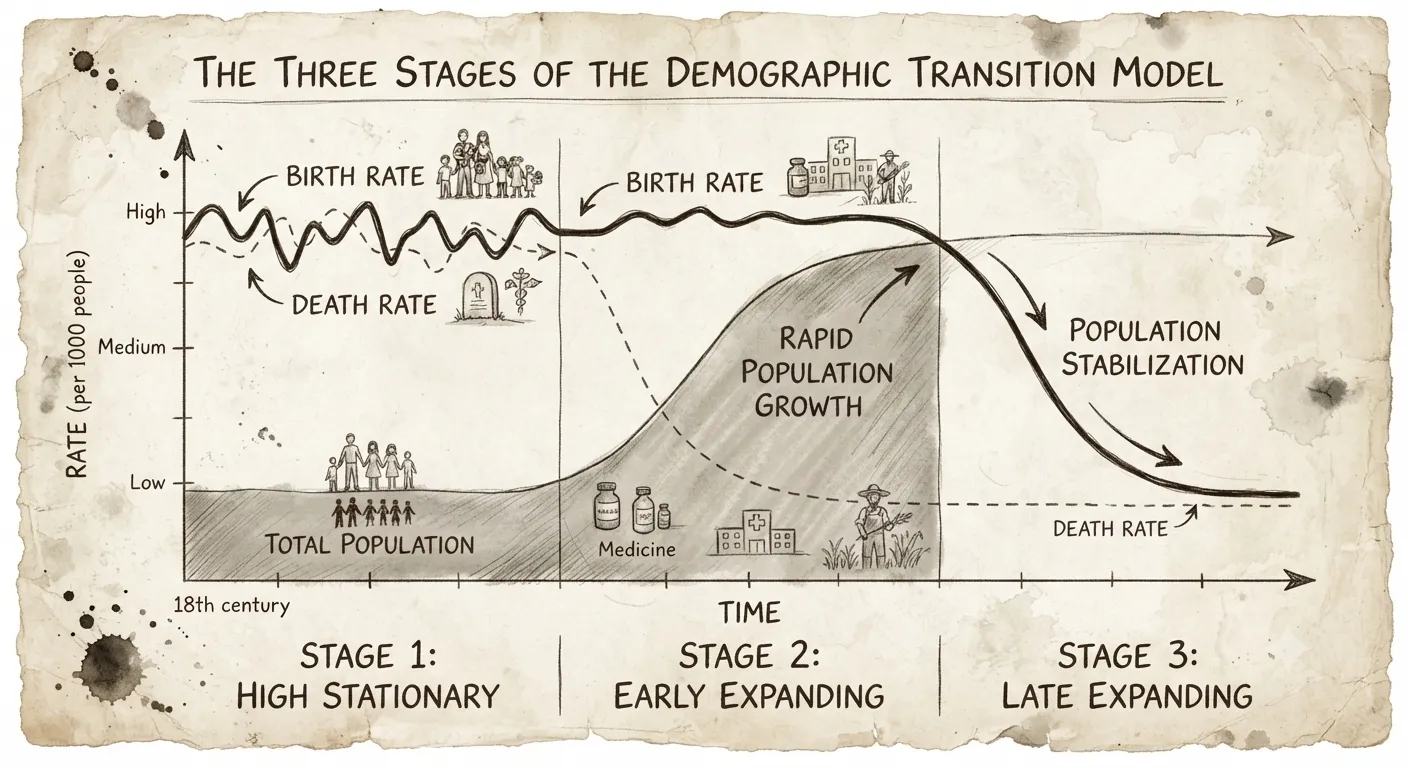
The evolution of global populations is narrated through the theory of demographic transition, a framework explaining the shift in birth and death rates as a nation climbs the ladder of economic development. This historical and economic narrative suggests that every developing society moves through a three-stage model of growth, dictated by science, medicine, and social change.
- Stage 1: Pre-Industrial Framework
Characterized by a high birth rate and a high death rate, this era is defined by poor diets, primitive sanitation, a lack of medical aid, and widespread illiteracy, keeping population growth minimal.
- Stage 2: Transitional Growth Spike
As economic development begins, death rates plummet due to better health infrastructure, yet birth rates remain high, triggering a massive population surge.
- Stage 3: Industrial and Post-Industrial Maturity
Maturity brings lower birth rates fueled by urbanisation, family planning awareness, and changed social attitudes, finally stabilising the population.
Understanding the Window of Demographic Opportunity and the Dividend
This phase represents a unique, temporary historical opening where the age structure of a nation shifts in favor of economic productivity. It marks a critical turning point where structural demographic updates can yield profound macroeconomic returns if supported by institutional scaffolding.
The Nature and Mechanics of the Demographic Window
The Window of Demographic Opportunity occurs when the working-age population () grows significantly faster than the dependent groups (those under and over ).
- (i) In the early stages of transition, young dependents dominate the landscape, straining resources.
- (ii) As the transition progresses, the working-age population peaks, creating a highly favourable age structure for the economy.
- (iii) Currently, many UDCs (Underdeveloped Countries) are entering this stage due to rapid fertility declines.
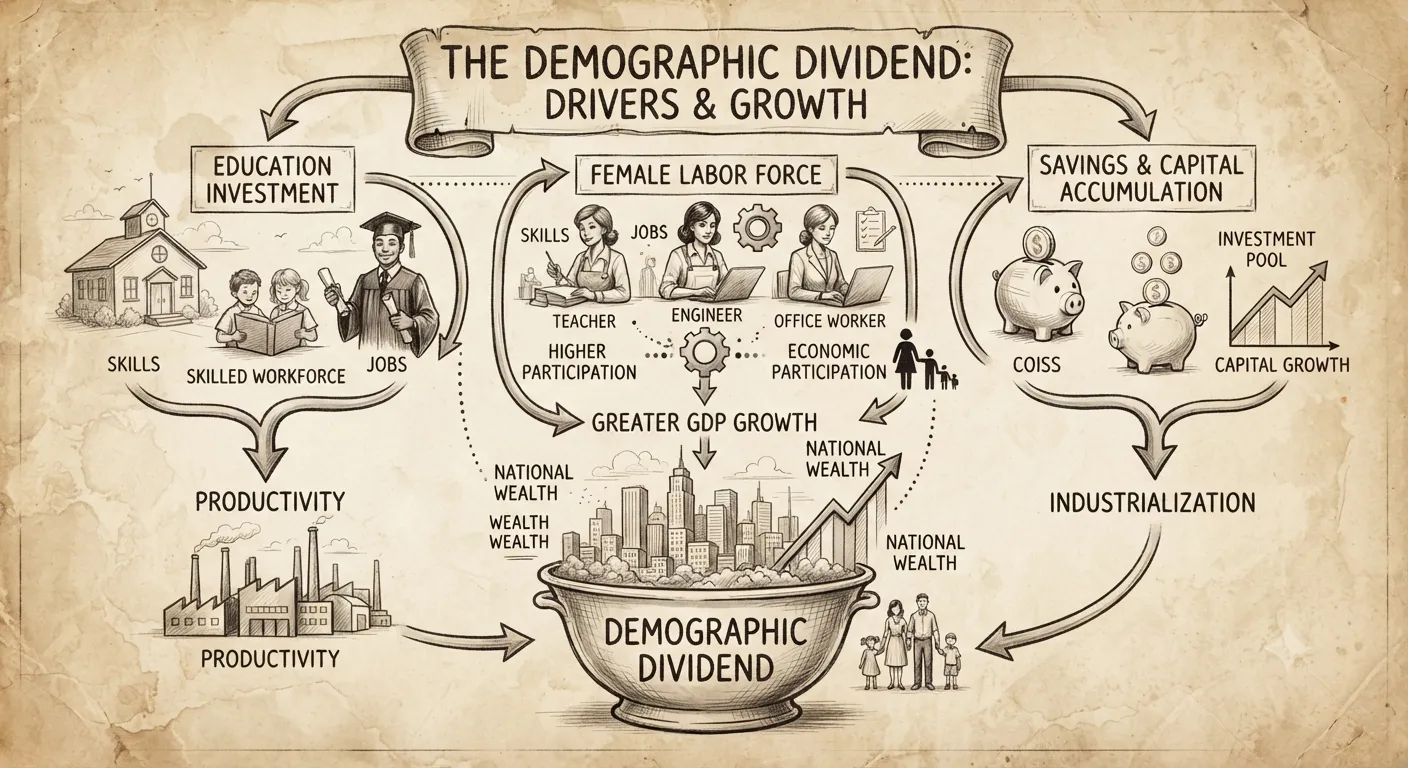
- (iv) This phenomenon is widely known as the "demographic dividend", a golden era where economic growth is accelerated by low dependency ratios.
Primary Drivers of Economic Growth during the Dividend
The surge in economic prosperity during this period is not accidental but driven by specific shifts in household and national behaviors.
Savings and Labor Force Dynamics
Household asset accumulation and demographic realities shift fundamentally to fuel market productivity:
- (i) Increased savings occur naturally as families have fewer dependents to support and a higher life expectancy to plan for.
- (ii) There is a notable higher female workforce participation as declining fertility rates free women from continuous childcare.
Investment in Human Capital and Infrastructure
Fiscal structures change direction to build future capacity rather than maintaining basic survival systems:
- (i) Families begin greater investment in health and education per child, which drastically improves the productivity of the future workforce.
- (ii) Government spending shifts away from basic survival services toward productive long-term investments due to the reduction in youth dependency.
The Fragility of the Dividend: Limitations and Future Reversals
While the potential is vast, the demographic dividend is not automatic and carries significant risks if mismanaged. It functions as a time-sensitive resource that requires precise macro-level support to prevent systemic waste.
Essential Policy Frameworks and Risks
To capture the benefits of this demographic transition, a nation must proactively build a stable and inclusive socio-economic environment.
- (i) Countries must aggressively implement policies focusing on education, health, gender equality, and employment.
- (ii) The establishment of efficient institutions and market systems is mandatory to absorb the growing labor force.
- (iii) Failure to provide jobs leads to unemployment-led social unrest, which can tragically turn the dividend into a demographic disaster.
The Closing Window: Duration and Global Reversal
The window is a fleeting moment in a nation's history, usually closing within a single generation as the population continues to age.
- (i) Eventually, the once-large working-age group grows old, leading to increased old-age dependency.
- (ii) The dependency ratio rises again as there are fewer young workers to replace the retiring generation, a trend already seen in Europe and Japan.
- (iii) Global ageing introduces new challenges for Cognitive Productivity; however, the WHO’s SAGE initiative notes that seniors with stronger cognitive performance remain productive.
- (iv) This suggests that supported by education and healthcare, an older population can still remain an economic asset.
⚡ Quick Revision Capsule: Demographic Opportunity & Dividend Key Highlights
A structured breakdown of core concepts, operational mechanics, and structural risks within demographic modeling:
| Demographic Stage / Concept | Core Demographic Characteristic | Economic & Structural Impact |
|---|---|---|
| Stage 1 (Pre-Industrial) | High birth rates and high death rates | Minimal population growth due to limited healthcare and sanitation. |
| Stage 2 (Transitional) | Plummeting death rates with persistently high birth rates | Rapid population expansion requiring expanded basic survival resources. |
| Stage 3 (Maturity) | Lower birth rates matching low death rates | Stabilized population growth supported by urbanisation and family planning. |
| Demographic Dividend | Peak working-age cohort () vs dependent groups | Accelerated economic growth driven by higher savings and labor participation. |
| Aging Reversal Phase | Growing proportion of elderly citizens | Rising dependency ratios requiring healthcare support and research insights like the WHO’s SAGE initiative. |
📝 Summary
In conclusion, the demographic window is a rare and temporary opportunity that demands urgent action. For students studying Population Policy, understanding the move from Stage 1 to Stage 3 over is vital. Success depends on the ability to invest in human capital and maximize the benefits before the window closes. Countries like India must act strategically to ensure this transition fuels long-term growth rather than instability.
🚀 Quick Revision Points
Essential facts to review before examinations:
- (i) The Three-Stage Model traces a country's shift from high birth/death rates to lower, stabilized rates as development advances.
- (ii) The Window of Opportunity opens exclusively when the working-age cohort () outpaces youth and elder dependents.
- (iii) Economic acceleration is catalyzed by increased household savings, higher female labor participation, and a transition from basic survival spending to long-term human asset creation.
- (iv) Capitalizing on the shift is not automatic; inadequate educational pipelines and poor job creation can trigger a demographic disaster.
- (v) The dividend window opens once and closes within a generation, converting the demographic bulge into an older population whose asset value depends on health and sustained baseline metrics supported by studies like WHO’s SAGE initiative.
- 💡 Exam Tip: Remember that the demographic dividend is time-bound (usually lasting 20-30 years). In exams, emphasize that demographic dividend requires active policy support—such as job creation, education, and health investments—or it risks becoming a demographic disaster.
❓ Frequently Asked Questions (FAQ)
Q1: What triggers the transition from Stage 1 to Stage 2 in the demographic model?
A1: The move to Stage 2 is driven by initial economic development, which improves health infrastructure, sanitization, and food security. This causes death rates to plummet while birth rates remain stubbornly high, causing a major population expansion.Q2: Why does the demographic dividend fail to manifest automatically in underdeveloped countries?
A2: A large working-age cohort requires matching structural infrastructure. Without targeted policies in education, healthcare, market systems, and job growth, the labor supply remains unabsorbed, risking systemic unemployment and social instability.Q3: How can an aging society remain economically productive according to global metrics?
A3: Data from the WHO’s SAGE initiative shows that senior populations can remain vital economic assets if supported by high health standards and education, which protects and prolongs their cognitive productivity.