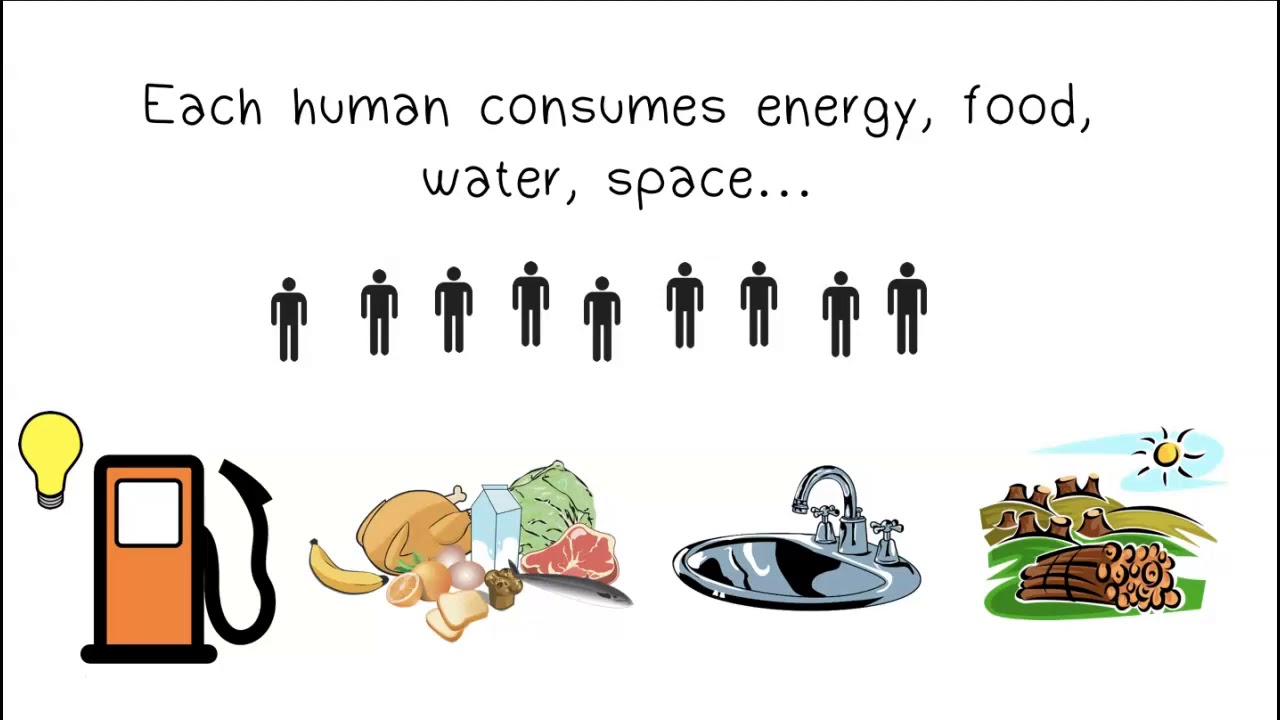
This comprehensive guide explores the dynamic role of human resources in driving global prosperity, specifically focusing on the Economic Development Act of 2026 principles and the Heckscher-Ohlin model. Understanding the quality of population is essential for students preparing for competitive exams in economics and social sciences, as it bridges the gap between labour abundance and technological innovation.
🎯 In this chapter, you will understand:
- The dual function of human resources as factor service providers and consumer units.
- How population density helps build essential public infrastructure efficiently.
- The effect of demographic transitions on national income and savings pools.
- The role of labour abundance in global trade specialisation and innovation.
💡 Why this topic matters: Human resources drive both economic production and market demand, making them the most vital element of long-term national growth.
🧠 Core Idea: A country's economic progress depends on balancing population utility as factor inputs and managing consumer demand effectively.
Human Resources and Economic Development: Roles, Impact, and Population Quality in
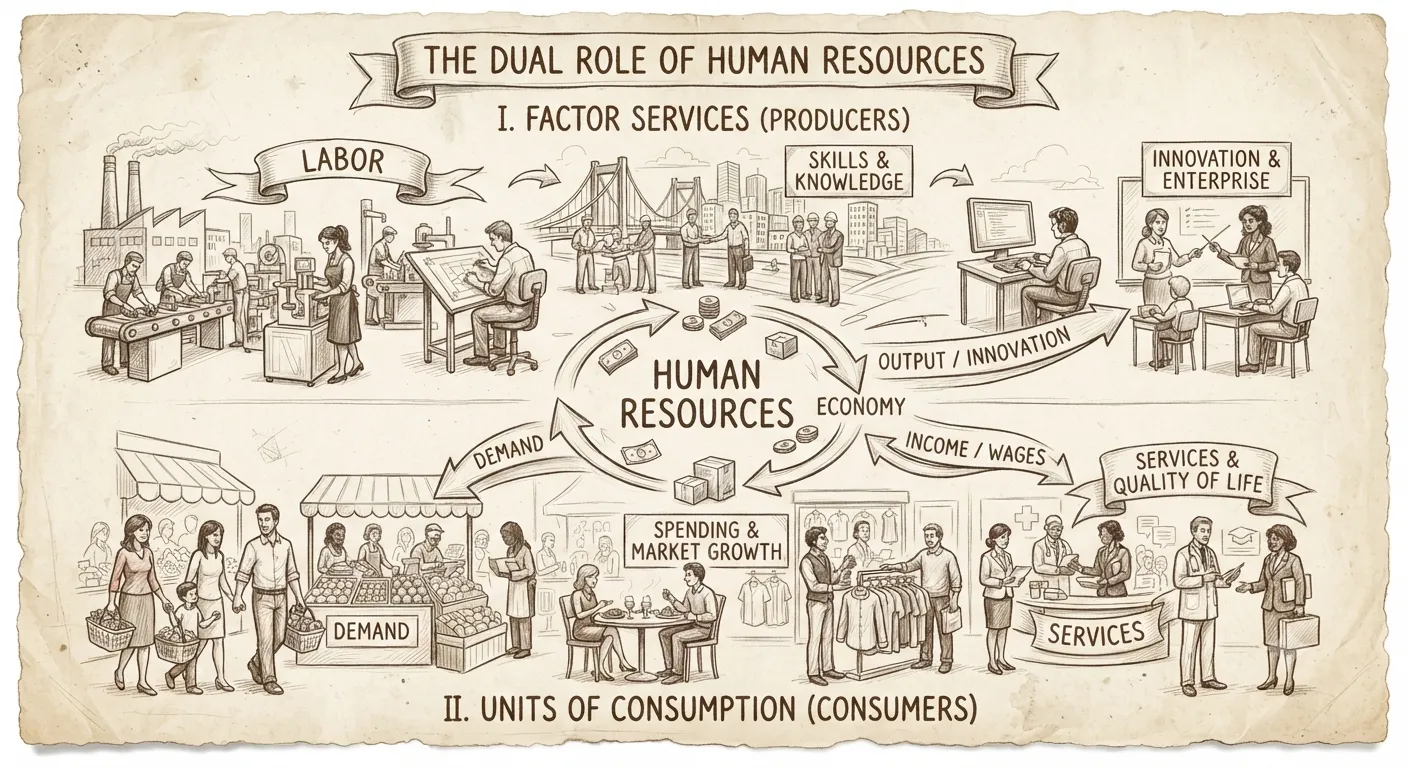
The story of economic progress is fundamentally about people, who act as the main engine for growth and sustainability. In global economics, human resources do not just exist; they perform a dual role that shapes the overall wealth of nations. By examining the Factor Services people provide alongside their role as Units of Consumption, we can see how population dynamics influence everything from national savings to daily infrastructure.
- The Core Dynamics of Population Utility
People work as both creators and users of wealth within an economy. This dual role creates a balance that directs a country's financial future.
- (i) Human resources serve as the main Factor Services, where individual entrepreneurship and labour transform raw materials into useful goods.
- (ii) At the same time, people act as Units of Consumption, where their daily needs determine demand patterns and the ability to build capital formation.
- (iii) The balance between these two roles determines whether a growing population becomes a demographic dividend or a dependency burden.
The Evolution of Human Resources as Vital Factor Services
When we look at people as providers of labour and entrepreneurship, we see energy flowing directly into a nation's production cycle. This model guides everything from small local farms to large global trade networks.
i) Minimum Scales and the Architecture of Infrastructure Efficiency
In national development, large projects like dams, ports, and irrigation systems require a minimum scale to be useful. Economies of scale work best when population density is high enough to justify the cost of roads and public utilities. A larger population supports a deeper division of labour, helping industries grow through specialized innovation and strong internal market demand.
- (a) Higher population density lowers the per-person cost of essential infrastructure.
- (b) Market size expansion supports industrial diversification and technological scaling.
ii) Navigating the Demographic Transition and National Savings Rate
For many Underdeveloped Countries (UDCs), early growth is limited by a high child dependency ratio, where basic consumption uses up potential investment capital. However, as a nation goes through the demographic transition, the working-age population grows. This opens a productive era marked by higher income and increased saving activity.
- (i) Initial stages usually show low savings because of high dependency.
- (ii) Transition periods create a surplus of workers relative to dependents.
- (iii) This demographic shift acts as the catalyst for long-term capital accumulation.
iii) The Family Farm and Capital Formation in Agriculture
In agrarian economies, capital formation happens directly on the family farm. Farm families act as primary savers and investors. During agricultural off-seasons, the abundant labour force builds fences, irrigation channels, barns, and rural roads. This work turns man-hours into agricultural capital stock without requiring outside money.
The Mechanism of Informal Investment
Simple farm-level activities turn seasonal free time into permanent physical assets.
- (a) Using off-season labour for local infrastructure building.
- (b) Direct asset creation like irrigation channels and access roads.
iv) Shifting Labour Force Participation and Dependency Dynamics
As population growth patterns change, workforce habits adapt too. Higher dependency ratios often lead to changes in working hours and shifting entry or retirement ages. In recent years, a key trend is the increase in the employment of women outside the home, which adjusts the labour supply curve.
- (i) Adjustments in retirement to balance high dependency costs.
- (ii) Gender-inclusive growth to meet growing economic demand.
- (iii) The overall effect of demographic pressure on standard working hours.
v) Global Trade Specialisation and the Power of Labour Abundance
The Heckscher-Ohlin model shows that nations with an abundance of labour naturally succeed in making labour-intensive goods. This focus creates a strong competitive advantage in international markets, helping labour-rich nations trade effectively and raise national productivity through specialization.
vi) Expanding the Talent Pool to Accelerate Technological Change
A larger population brings more than extra hands; it offers more active minds. Expanding the pool of talent raises the chance of scientific discovery and practical innovation. A large population provides the innovators needed to advance technological progress and drive economic modernization.
- (i) Higher probability of innovation within a larger population base.
- (ii) Stronger intellectual resources to support scientific progress.
⚡ Quick Revision Capsule: Regional Hourly Labour Cost Comparisons
The table below highlights comparative global hourly labour costs that showcase regional labour abundance and international trade positioning:
| Region / Country | Comparative Global Hourly Labour Cost | Economic Market Impact |
|---|---|---|
| Europe | $20 | Capital-intensive production advantage |
| USA | $19 | High technological innovation focus |
| Japan | $18 | Advanced manufacturing and automation focus |
| Asia (Average) | ~$1.65 | Strong labour-intensive goods trade edge |
📝 Summary
In summary, the quality of population—built on education, skills, and health—is the core key to economic development. For students, understanding factor services and demographic transitions helps explain how labour-intensive trade and technological change shape the world economy in as described in the Economic Development Act of 2026. Human capital remains the ultimate engine of long-term wealth creation.
🚀 Quick Revision Points
Essential facts to review before examinations:
- (i) Population works as a dual engine, providing necessary factor inputs while creating consumer demand patterns.
- (ii) Large infrastructure projects require a critical mass of population density to achieve true economies of scale.
- (iii) The demographic transition increases saving capacity when the working-age group becomes larger than young dependents.
- (iv) Agricultural communities convert off-season free time into useful capital assets right on the family farm.
- (v) The Heckscher-Ohlin model explains why low hourly labor cost regions holding an average of ~$1.65 lead in labor-heavy trade.
- 💡 Exam Tip: When writing exam answers on population dynamics, always contrast the role of human resources as factor service providers against their role as consumer units to show a complete economic picture.
❓ Frequently Asked Questions (FAQ)
Q1: How do human resources fulfill a dual role in economic frameworks?
A1: Human resources offer Factor Services through labour and entrepreneurship to create goods, while acting as Units of Consumption whose everyday needs shape market demand.Q2: What occurs to savings rates during the demographic transition phase?
A2: As birth rates drop, the child dependency ratio decreases. This expands the working-age group, which helps raise national income and savings.Q3: How does the family farm generate capital without regular cash financing?
A3: Farm families use their abundant off-season labour directly to construct key physical assets like irrigation channels, fences, and local roads.