The Arctic tundra biome represents one of the harshest yet ecologically significant cold-climate ecosystems, covering regions of northern Alaska, Canada, and Siberia. Characterized by long, freezing winters and short, cool summers, this biome features unique flora and fauna adaptations crucial for students studying environment geography and exam preparation. Understanding its permafrost, limited precipitation, and extreme sunlight conditions offers insights into biodiversity resilience in polar regions.
🎯 In this chapter, you will understand:
- The physical characteristics and extreme climatic conditions of the Arctic tundra.
- Key flora species and their survival mechanisms in frozen soils.
- Resident and migratory fauna adaptations for enduring polar winters.
- The overall ecological importance and global climate role of this biome.
💡 Why this topic matters: The tundra plays a vital role in global climate regulation and carbon storage, making it essential for environmental geography studies.
🧠 Core Idea: Polar ecosystems depend on specialized adaptations to survive extreme cold, shallow soils, and short growing seasons.
Arctic Tundra Biome: Characteristics, Flora, Fauna, and Climatic Conditions
The Arctic tundra is a treeless region around the North Pole marked by permanently frozen ground and extreme weather patterns.
Overview of the Arctic Tundra Biome and Its Extreme Environmental Conditions
The Arctic tundra is a treeless, polar biome primarily located across northern Alaska, Canada, and Siberia. Its defining feature is the permafrost, a permanently frozen subsoil layer that restricts plant growth and water absorption. Despite receiving minimal sunlight, the tundra hosts specialized ecosystems that support both plants and animals uniquely adapted to cold environments.
- (i) Average annual precipitation is approximately , making the tundra extremely dry, similar to desert conditions.
- (ii) Dry winds and frozen ground limit water infiltration, creating surface pools during summer due to permafrost barriers.
- (iii) The Sun remains near the horizon even during summer’s 24-hour daylight, providing only low-intensity sunlight.
- (iv) These conditions collectively create a challenging environment for both flora and fauna, highlighting the resilience of tundra ecosystems.
Flora of the Arctic Tundra
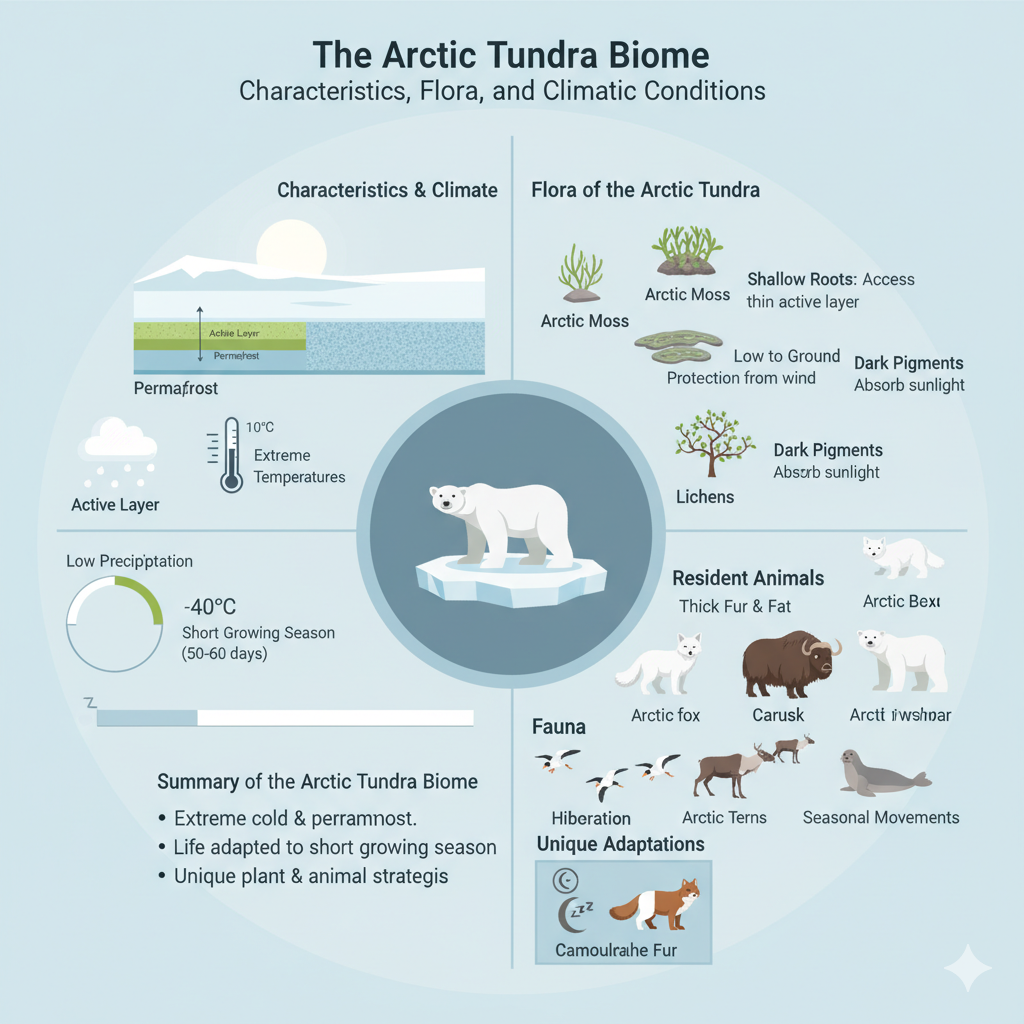
The Arctic tundra flora has evolved to survive a short growing season of and extreme cold. Shallow rooting systems and small leaf sizes are key adaptations to conserve moisture and withstand frozen soil conditions.
Plant Species and Adaptations
Approximately 1,700 plant species thrive in the tundra, including mosses, lichens, grasses, and low-lying shrubs. Adaptations include:
- (i) Small leaf surfaces to minimize water loss.
- (ii) Growth in mats or clusters to retain heat and resist strong winds.
- (iii) Shallow roots due to the impermeable permafrost, limiting vertical growth but enabling survival in nutrient-poor soil.
Seasonal Growth and Biodiversity
During the brief summer, tundra plants quickly complete their life cycle:
- (a) Rapid flowering and seed production to maximize reproductive success.
- (b) Photosynthesis peaks during the continuous daylight period.
- (c) Interaction with pollinators and migratory birds ensures ecosystem connectivity.
Fauna of the Arctic Tundra
The Arctic tundra fauna includes species adapted to extreme cold through migration, hibernation, and physical adaptations like thick fur or fat storage. These adaptations are vital for students studying animal ecology in polar biomes.
Resident Animals and Adaptations
Year-round inhabitants such as musk-ox, Arctic wolf, and brown bear have evolved physical traits to endure harsh winters:
- (i) Thick fur and fat layers provide insulation against freezing temperatures.
- (ii) Large hooves and claws help access food beneath ice and snow.
- (iii) Behavioral adaptations, such as huddling and denning, conserve heat.
Migratory Animals and Survival Strategies
Many species, including caribou, arctic hares, and migratory birds, move seasonally to avoid extreme cold. Key points include:
- (a) Birds such as ravens, snow buntings, loons, and terns travel to warmer regions during winter.
- (b) Hibernation in mammals like bears allows energy conservation during scarce food availability.
- (c) Fat storage in summer is critical for surviving months without feeding in winter.
Unique Tundra Adaptations
Special adaptations of tundra fauna ensure survival in extreme polar climates:
- Hibernation: Enables bears and other mammals to survive long winters using stored energy.
- Insulation: Musk-ox and Arctic foxes have thick fur and fat layers to withstand freezing winds.
- Behavioral: Hooves breaking ice to access water and clustered sleeping arrangements for warmth.
⚡ Quick Revision Capsule: Arctic Tundra Ecosystem
A structured breakdown of core components, adaptations, and climate features of the Arctic tundra.
| Aspect | Key Features & Attributes | Ecological Significance |
|---|---|---|
| Climate | Precipitation around /year, extreme cold, weak sunlight | Creates desert-like conditions in a cold environment |
| Soil | Impermeable permafrost layer underground | Prevents deep root growth and restricts water drainage |
| Flora | ~1,700 species including mosses, lichens, low shrubs | Adapted with shallow roots and heat-retaining mat shapes |
| Resident Fauna | Musk-ox, Arctic wolf, brown bear | Utilize thick fur, fat insulation, and specialized hooves |
| Migratory Fauna | Caribou, snow buntings, terns, ravens | Travel seasonally to avoid harsh, food-scarce winter months |
📝 Summary
The Arctic tundra biome is a unique ecosystem with permafrost, extreme cold, and a short growing season lasting , supporting specialized flora and fauna. Its adaptations offer important lessons in resilience, biodiversity, and ecological survival strategies. For students and exam preparation, understanding this biome is crucial for environmental studies, providing insights into climate adaptation, polar ecology, and ecosystem functioning.
🚀 Quick Revision Points
Essential facts to review before examinations:
- (i) Permafrost is permanently frozen ground that blocks deep root expansion.
- (ii) Tundra receives desert-level rainfall (~ annually).
- (iii) Plant growth forms low mats to withstand strong, freezing winds.
- (iv) Animals rely on hibernation, thick fur layers, or seasonal migration to survive.
- 💡 Exam Tip: Focus on how permafrost influences both vegetation (shallow roots) and surface hydrology (summer pooling) for exam questions.
❓ Frequently Asked Questions (FAQ)
Q1: What is permafrost and why is it important in the tundra?
A1: Permafrost is a layer of permanently frozen soil beneath the surface that prevents tree roots from growing deep and holds vast amounts of stored carbon.Q2: How do tundra plants adapt to the extreme cold?
A2: Tundra plants grow in low, tight clusters to trap warmth, possess shallow root networks, and complete their lifecycle rapidly during short summer months.Q3: Why is the tundra described as a polar desert?
A3: It receives very low annual precipitation (around ), which matches the moisture levels of typical dry desert regions.