Embark on a fascinating journey through space and time with the Big Bang Theory, our main scientific explanation for how the universe began and changed over . Along with earlier ideas like the Nebular Hypothesis and the Giant Impact Hypothesis for the Moon, these concepts explain how stars, planets, and Earth's solid layers came to be. This guide makes these big ideas simple and clear for students preparing for UPSC, Geography, and Physical Science exams.
🎯 In this chapter, you will understand:
- How early thinkers and modern scientists explained the birth of the cosmos.
- How the Big Bang created space, simple atoms, stars, and galaxies.
- Why inner planets are rocky while outer planets are made of gas.
- How Earth developed its layers, oceans, atmosphere, and early living organisms.
💡 Why this topic matters: Knowing how our universe and planet formed helps us understand where life comes from and how natural systems on Earth work together today.
🧠 Core Idea: Everything in the universe started from an tiny, super-hot point . As space grew and cooled, gravity pulled gas together to make stars, planets, and eventually our home Earth.
1. Early Ideas About Our Earth and Solar System
Human beings have always looked up at the night sky and wondered how Earth and the Sun came to exist. Early thinkers created simple stories, but over time, scientists developed rules based on physics and gravity.
Early Hypotheses of Planetary Origins
At first, scientists focused only on how the planets formed around our Sun before trying to explain the entire universe.
- (i) Early thoughts about Earth's origin were proposed by thinkers who moved step-by-step from simple philosophical ideas to mathematical models of gravity.
- (ii) A major early effort was the Nebular Hypothesis. It was first suggested by philosopher Immanuel Kant and later revised by mathematician Pierre-Simon Laplace in . They suggested that the Sun and planets grew out of a giant, spinning cloud of gas and dust.
- (iii) Later, in , Chamberlin and Moulton proposed the Star Interaction Hypothesis. They believed a rogue star passed close to our Sun, pulling out a long trail of solar gas that cooled down and clumped into planets.
2. Modern Cosmological Theories: From Singularity to Star Dust
Modern science looks at the biggest picture of all: how space and time started. Today, the most widely accepted explanation is the Big Bang Theory, supported by proof that galaxies are moving away from each other.

The Big Bang: The Expanding Universe Hypothesis
In , astronomer Edwin Hubble showed that galaxies are moving farther apart, proving our universe is constantly growing bigger.
- (i) The theory states that before the expansion, all matter was packed into an impossibly small point called a singularity (a tiny ball with infinite heat and density).
- (ii) The sudden expansion—the Big Bang—happened about , spreading energy and space outward in a fraction of a second.
- (iii) As space stretched and cooled down, basic parts of matter formed. Within just , the very first simple atoms appeared.
- (iv) After roughly , the temperature dropped to about 4,500 Kelvin. This allowed light to travel freely, turning the foggy universe clear and transparent.
- (v) It is important to know that galaxies are not rushing out into empty space; rather, the space between the galaxies itself is stretching.
- (vi) An older idea called the Steady State Concept, introduced by Fred Hoyle, claimed the universe always looks the same at all times, but very few scientists support this today.
Star Formation and Cosmic Distances
After the Big Bang cooled, tiny uneven patches in gas density allowed gravity to pull hydrogen gas together to form stars and galaxies.
- (a) Small differences in matter density created gravitational pockets that gathered giant clouds of hydrogen gas.
- (b) These massive spinning clouds of gas and dust are called nebulae (singular: nebula), which act as cosmic nurseries for newborn stars.
- (c) The earliest stars in our cosmic neighborhood began shining between .
- (d) Because space is so vast, scientists measure cosmic distances using a unit called a Light Year. Despite its name, a light year measures distance, not time! It is the distance light travels in one Earth year. Since light moves at 300,000 kilometers per second, one light year equals roughly 9.461 × 10¹² km. Sunlight takes about to reach Earth.
The Accretion Model: How Planets Form
Planets formed in steps inside the flat spinning disc of gas and dust surrounding young stars through a build-up process called accretion.
- (i) Core and Disc Formation: Gravity pulls gas together inside a nebula to form a dense star core, surrounded by a rotating flat ring of dust and gas.
- (ii) Planetesimal Development: Gas clumps into tiny solid grains. These grains stick together and bump into each other, growing into small objects a few kilometers wide called planetesimals.
- (iii) Planetary Accretion: Gravity draws thousands of planetesimals together. They collide, combine, and sweep up surrounding debris to form a few large bodies: the planets.
3. Our Solar System: Structure, Planets, and the Giant Impact Hypothesis
Our Solar System is our local neighborhood in space, made up of one star (the Sun), eight major planets, dozens of moons, and millions of asteroids and comets.
Composition and Timeline of the Solar System
Our solar nebula began collapsing under gravity around , and the planets finished forming around .
- (a) Inner Planets: Mercury, Venus, Earth, and Mars sit close to the Sun, inside the main asteroid belt.
- (b) Outer Planets: Jupiter, Saturn, Uranus, and Neptune sit far from the Sun, outside the asteroid belt.
- (c) Terrestrial vs. Jovian: The inner four are called Terrestrial Planets (Earth-like) because they are made of solid rock and heavy metals. The outer four are called Jovian Planets (Jupiter-like) or Gas Giants because they are huge and made mostly of light gases like hydrogen and helium.
- (d) Pluto's Status: In , the International Astronomical Union (IAU) reclassified Pluto as a dwarf planet because it has not cleared its orbital path of other debris.
Why Inner Planets Are Rocky and Outer Planets Are Gaseous
Why are the inner worlds made of stone while the outer worlds are giant gas balls? Three simple reasons explain this:
- (i) Temperature Differences: The inner planets formed near the hot Sun, where it was too warm for gases to freeze into solids. The outer planets formed far away where it was cold enough for ice and gas to stay together.
- (ii) Solar Wind Blowout: Powerful streams of particles from the young Sun pushed light gases and dust away from the inner planets. Farther out, the solar winds were too weak to blow gas away.
- (iii) Gravity Constraints: The smaller inner planets had weaker gravity and could not hold onto light gases like hydrogen, while the massive Jovian planets had strong gravity that kept their thick gas layers trapped.
The Moon: The Giant Impact Hypothesis (The Big Splat)
The Moon is Earth's only natural satellite. Scientists once thought it split off from Earth's Pacific Ocean bed, but today we know it formed through a giant collision event.
- (a) Early Ideas: In , Sir George Darwin suggested Earth and the Moon were once a single spinning, dumbbell-shaped body that snapped in two.
- (b) Modern Consensus (The Big Splat): Shortly after Earth formed about , a protoplanet roughly 1 to 3 times the size of Mars smashed into Earth at a glancing angle.
- (c) Moon Assembly: This colossal impact blasted massive amounts of Earth's outer rocky layers into space. The orbiting rock debris collected together under gravity to form our Moon.
4. Key Planetary Data: Understanding Solar System Metrics
Comparing planetary measurements helps us see clear differences between the small, dense inner worlds and the massive, lightweight outer giants.

⚡ Quick Revision Capsule: Solar System Data Comparison
This reference chart lists key scientific measurements for all eight planets in order from the Sun outward:
| Planet Name | Distance from Sun (AU) | Density (g/cm3) | Known Moons / Satellites |
|---|---|---|---|
| Mercury | 0.387 AU | 5.44 g/cm3 | 0 |
| Venus | 0.723 AU | 5.245 g/cm3 | 0 |
| Earth | 1.000 AU | 5.517 g/cm3 (Highest) | 1 |
| Mars | 1.524 AU | 3.945 g/cm3 | 2 |
| Jupiter | 5.203 AU | 1.33 g/cm3 | About 53 (known) |
| Saturn | 9.539 AU | 0.70 g/cm3 (Lowest) | About 53 (known) |
| Uranus | 19.182 AU | 1.17 g/cm3 | About 27 (known) |
| Neptune | 30.058 AU | 1.66 g/cm3 | About 13 (known) |
5. Evolution of Earth: Layered Structure, Atmosphere, and the Dawn of Life
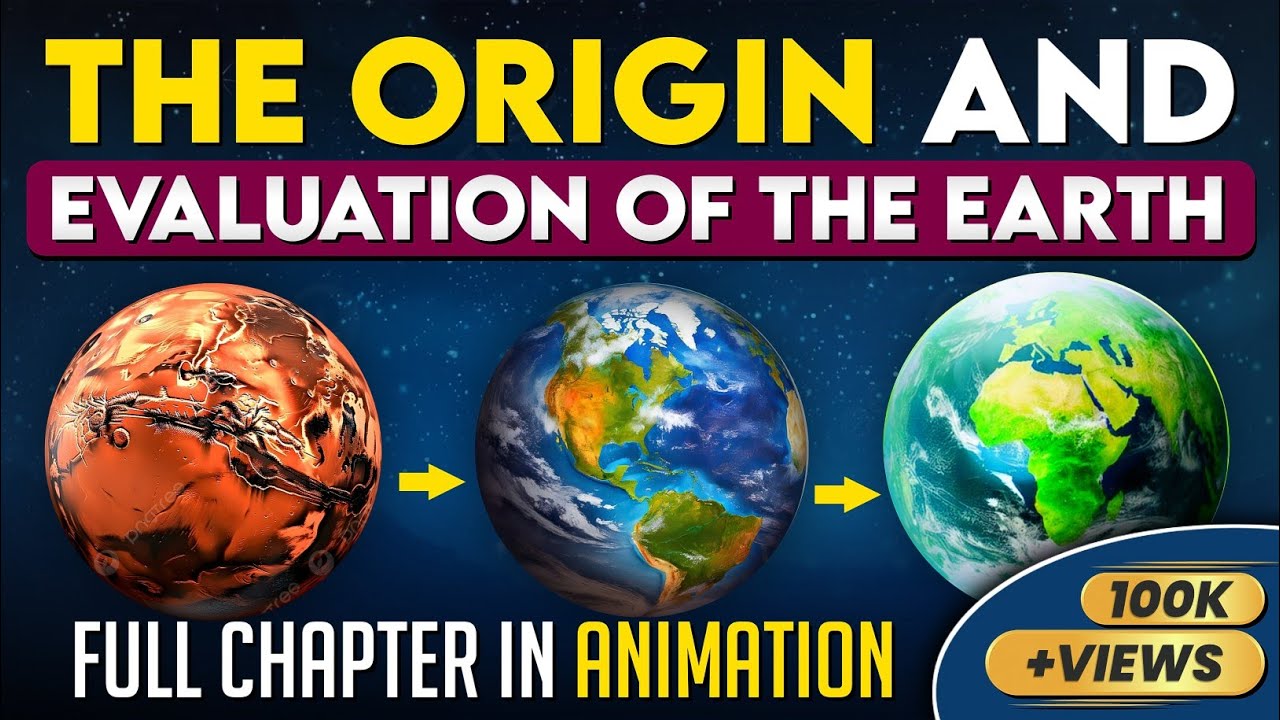
Early Earth was a hot, barren ball of rock and liquid metal. Over hundreds of millions of years, it cooled down, separated into distinct interior layers, grew oceans, and birthed life.
Development of Earth's Layered Structure
Earth formed its onion-like inner structure—the crust, mantle, outer core, and inner core—through a process called differentiation.
- (i) Density Separation: As Earth grew hot from radioactive decay and asteroid impacts, heavy materials sank to the center while light materials floated up.
- (ii) Core Formation: Heavy elements, especially iron and nickel, sank to the very center to build Earth's dense metal core.
- (iii) Crust Solidification: Lighter rocky materials floated to the surface, cooling over time to create Earth's solid outer crust.
Evolution of the Atmosphere and Hydrosphere
Earth's breathable air evolved over three major stages:
- Stage 1: Loss of Primordial Atmosphere: Earth's original thin atmosphere made of light gases like hydrogen and helium was stripped away by fierce solar winds.
- Stage 2: Volcanic Degassing: As Earth's interior cooled, volcanoes spewed out water vapor, carbon dioxide, nitrogen, methane, and ammonia. This release of trapped gases is called degassing.
- Stage 3: Modification by Photosynthesis: Water vapor condensed into rain, filling deep land basins to build the hydrosphere (oceans) within of cooling. Living cyanobacteria evolved photosynthesis between , soaking up carbon dioxide and releasing oxygen into the oceans and atmosphere.
The Geological Time Scale: A Timeline of Earth's History and Life
The Geological Time Scale maps out Earth's entire story, dividing cosmic time into Eras, Periods, and Epochs.

The geological timescale diagram, mapping the chronological history of Earth and the evolution of life. - (i) Hadean Era (): Early Earth cooling, atmosphere full of carbon dioxide, and ocean basins forming.
- (ii) Archean Era (): First microscopic life appears, including blue-green algae and single-celled bacteria.
- (iii) Proterozoic Era (): Simple soft-bodied sea creatures and complex cells develop.
- (iv) Palaeozoic Era (): Explosive growth of sea life, fish, early land plants, and amphibians.
- (v) Mesozoic Era (): The Age of Reptiles and Dinosaurs; first mammals and birds appear.
- (vi) Cenozoic Era (): Rise of mammals, early human ancestors, and eventually Modern Man (Homo sapiens).
- (vii) Origin of Life: Chemical reactions created self-copying organic molecules around , marking the official start of living matter on Earth.
📝 Summary
The epic journey from the Big Bang singularity to our living home Earth shows how physics and chemistry shaped the cosmos. Space expansion created hydrogen gas clouds; gravity compressed gas into stars and nebulae; dust particles built planetesimals; and planetary collisions created Earth and its Moon. Through internal differentiation, volcanic degassing, and biological photosynthesis, Earth transformed its barren rock into a vibrant world with continents, deep oceans, an oxygen air layer, and thriving life systems.
🚀 Quick Revision Points
Essential facts to review before examinations:
- (i) Big Bang Origin: Proposed by Edwin Hubble in , showing the universe started expanding .
- (ii) Light Year Unit: Measures space distance (9.461 × 10¹² km), not time duration.
- (iii) Planetary Categories: Inner 4 planets are rocky (Terrestrial); outer 4 are gaseous (Jovian).
- (iv) Moon Formation: Formed by the Giant Impact Hypothesis (The Big Splat).
- (v) Oxygenation of Air: Photosynthesis by cyanobacteria began adding oxygen to air around .
- 💡 Exam Tip: Questions frequently ask why inner planets are rocky while outer ones are gaseous. Always highlight three main factors: high solar heat near the Sun, strong early solar winds blowing gas away, and lower gravity on small terrestrial planets!
❓ Frequently Asked Questions (FAQ)
Q1: What is a light year, and does it measure time or distance?
A1: A light year measures physical distance across space, not time. It is the total distance light travels in one Earth year (about 9.461 trillion kilometers).Q2: What is volcanic degassing, and why was it important for Earth?
A2: Degassing is the release of trapped internal gases and water vapor through volcanic eruptions as young Earth cooled. This process formed Earth's secondary atmosphere and supplied the water that filled ocean basins.Q3: Why was Pluto reclassified as a dwarf planet in 2006?
A3: In , the International Astronomical Union ruled that a full planet must clear its orbital neighborhood of competing objects. Pluto shares its path with many other icy bodies in the Kuiper Belt, so it was reclassified as a dwarf planet.