Explore the enduring legacy of the Gurjara-Pratihara Empire, a pivotal power that shaped Northern India's history from the . This comprehensive overview details the dynasty's prominent rulers such as Bhoja I, their formidable military strength as attested by the Arab traveler Al-Masudi, their patronage of celebrated Sanskrit scholars like Rajashekhara, and their lasting contributions to North Indian temple architecture. Serving as a crucial bulwark against early foreign invasions, the Pratiharas unified vast territories and fostered a major cultural revival across the subcontinent.
In this chapter, you will understand:
- The origin, territorial expansion, and administrative setup of the Gurjara-Pratihara dynasty.
- First-hand historical insights from foreign traveler Al-Masudi on Pratihara military power.
- Cultural advancements in Sanskrit literature, Prakrit plays, and Nagara temple architecture.
- Key imperial rulers from Nagabhata I to Mihir Bhoja and the eventual decline of the empire.
Why this topic matters: Essential for understanding early medieval Indian political geography, regional architecture, and resistance against early external invasions.
Core Idea: The Gurjara-Pratiharas established a powerful imperial state centered at Kannauj, maintaining North Indian stability, promoting Brahminical traditions, and patronizing major architectural and literary developments from the 6th through 11th centuries.
The Gurjara-Pratihara Empire: Rise, Cultural Contributions, and Foreign Accounts (9th–11th Centuries)
The Gurjara-Pratihara Empire stood as a dominant power in the post-Gupta era, establishing a vast realm across Aryavarta and ruling much of Northern India for several centuries. During the , their monarchs adopted the title Maharajadhiraja of Aryavarta to signify supreme imperial authority over the region.
Imperial Strength and Heritage
The name of the dynasty reflects its historical role and administrative function within the medieval political framework of Northern India.
- (i) The term Pratihara translates to protector or door-keeper, highlighting the dynasty's vital role in defending central territories from external incursions.
- (ii) Their capital city, Kannauj, functioned as the administrative and cultural core of the empire and remained the central prize during the prolonged Tripartite Struggle.
- (iii) Dynasty origins date to around when Harichandra established a small kingdom in Bhinmal following the collapse of the Gupta Empire.
Foreign Accounts: Al-Masudi's Testimony on Pratihara Military Power
The vast economic wealth and defensive capabilities of the Pratihara state were documented by foreign observers who visited India during its height of stability.

- The Arab geographer Al-Masudi provided detailed historical records concerning the administrative layout and army strength of the ruling empire.
The Visit of Al-Masudi and Royal Titles
A native of Baghdad, Al-Masudi traveled to Gujarat between and , documenting the political reach of the sovereign authority.
- (i) In his writings, he referred to the kingdom as al-Juzr, designating its identity in historical Arabic trade logs.
- (ii) He recorded the ruler's title as Baura, which modern scholars identify as a transcription of Adivaraha, an official title used by King Bhoja I.
- (iii) Records noted that the realm encompassed approximately 1,80,000 villages, cities, and rural settlements within a territory spanning roughly 2,000 kilometers in length and breadth.
- (iv) The imperial standing army was partitioned into four standing corps, each maintaining between 7,00,000 and 9,00,000 soldiers to safeguard internal boundaries.
Patronage of Art, Literature, and Architecture
In addition to maintaining military preparedness, the Pratihara court sponsored critical artistic works and scholar guilds.
- (a) The eminent court poet and dramatist Rajashekhara served under the royal patronage of the dynasty.
- (b) His critical literary text, Kavyamimamsa, composed between and , laid down procedural guidelines for Classical Sanskrit poetic composition.
- (c) He authored the celebrated drama Karpuramanjari in Sauraseni Prakrit, dedicating the work to his wife, Avantisundari.
Pratihara Temple Architecture and Religious Traditions
Religious developments during this era saw equal support for multiple Brahminical sects alongside distinct stone temple construction models.
Map of Northern India highlighting the core territory controlled by the Gurjara-Pratihara Empire. - The Teli-ka-Mandir inside Gwalior Fort stands as a key architectural benchmark, featuring a rectangular mulaprasada and an oblong double shikhara dedicated to Shakti worship.
- Complex temple stone carvings in Osian, Abhaneri, and Kotah depict traditional Hindu iconography, including Vishnu and the marriage of Shiva and Parvati.
- Monarchs such as Vatsaraja, Mahendrapala, and Trilochanapala publicly declared their devotion to Shiva while offering patronage to Vaishnava, Shaiva, Sakta, and Surya traditions.
Key Rulers and the Political Trajectory of the Dynasty
The internal political history of the Gurjara-Pratiharas was shaped by dynamic kings who expanded regional frontiers before encountering later political challenges.
- Dynastic succession progressed through defined administrative phases that marked their expansion across central regions.
The Founder Harichandra and Nagabhata I
Initial state formation began in Western India before shifting toward central strategic strongholds.
Early Expansion Phase
The early groundwork established strategic political dominance across critical trade pathways.
- Harichandra established the family lineage in Bhinmal around .
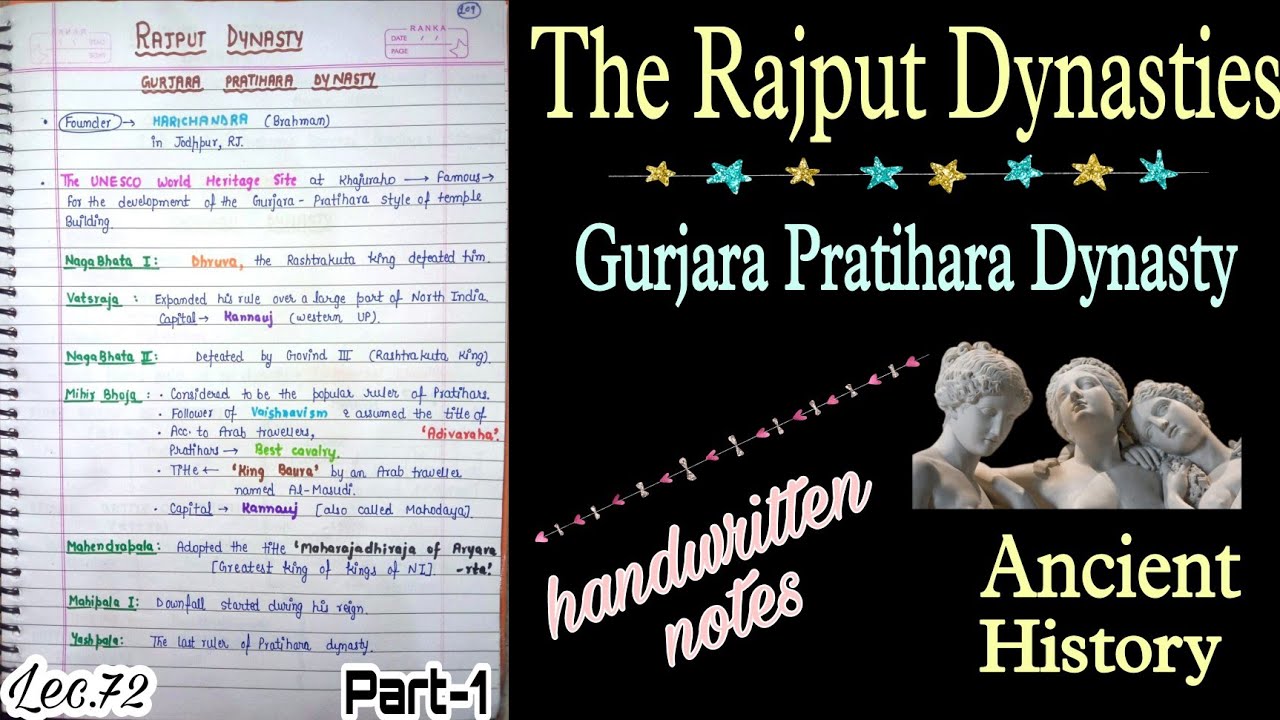
- Nagabhata I expanded from Mandor to conquer Malwa, Gwalior, and the port of Bharuch in Gujarat.
- He established his capital at Avanti and successfully repelled early Arab incursions into Sind.
Vatsraja and the Tripartite Struggle
Ascending the throne in , Vatsraja directed state resources toward taking administrative control of Kannauj.
- His expansion initiated the prolonged Tripartite Struggle against the Pala dynasty of Bengal and the Rashtrakutas of the Deccan.
- He secured an initial victory over the Pala king Dharmapala and Rashtrakuta leader Dantidurga to gain brief control of Kannauj.
The Golden Age Under Bhoja I (Mihir Bhoja)
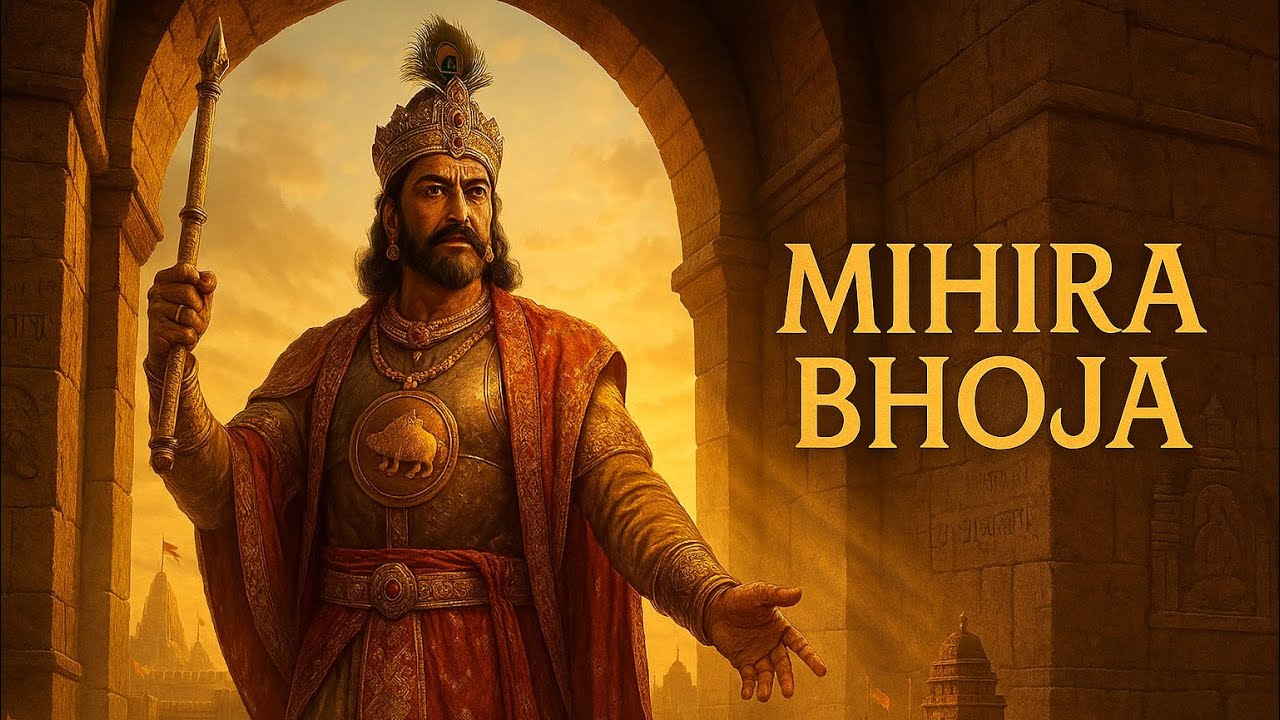
The empire reached its peak strength under Bhoja I, also known as Mihir Bhoja, who consolidated the state into a centralized power.
- Territorial borders stretched to Sind in the west, Bengal in the east, and the Narmada River to the south.
- His reign established long-term administrative stability while advancing patronage for local scholars and craftsmen.
Decline of the Dynasty
Following the reign of Bhoja I, internal succession disputes and external regional pressure weakened central authority.
- Rulers including Mahendrapala I, Bhoja II, Mahipala I, Rajapala, and Trilochanapala faced continuous territory loss.
- The death of king Jasapala in marked the final collapse of Pratihara rule in Kannauj.
Quick Revision Capsule
A structured overview of major rulers, administrative achievements, and historical contributions of the Gurjara-Pratihara Empire:
| Ruler / Entity | Period / Date | Key Contribution / Event |
|---|---|---|
| Harichandra | Founded the initial dynasty lineage at Bhinmal. | |
| Nagabhata I | Captured Malwa, Gwalior, and Bharuch; repelled early Arab incursions. | |
| Vatsraja | Initiated the Tripartite Struggle for control over Kannauj. | |
| Bhoja I (Mihir Bhoja) | Consolidated the empire's peak territorial expansion from Sind to Bengal. | |
| Al-Masudi | Documented Pratihara military divisions and administration in al-Juzr. |
Summary
The Gurjara-Pratihara Empire served as one of the most powerful imperial states in early medieval Indian history. From their base at Kannauj, they maintained regional political unity across Northern India for centuries. Through strong standing armies, they successfully defended the interior from early western invasions. Their legacy endures through significant advances in Sanskrit scholarship, Prakrit literature, and pioneering Nagara style temple architecture across Central and Northern India.
Quick Revision Points
Essential facts to review before examinations:
- (i) The term Pratihara translates as protector, reflecting their core defensive military role.
- (ii) Capital city Kannauj was the primary focus of the historic Tripartite Struggle.
- (iii) Arab writer Al-Masudi documented their standing military force divided into four massive units.
- (iv) Court poet Rajashekhara authored Kavyamimamsa and Karpuramanjari during this golden era.
- Exam Tip: Focus on the cause of the Tripartite Struggle over Kannauj, the literary contributions of Rajashekhara, and foreign accounts by Al-Masudi when answering questions on early medieval North Indian polities.
Frequently Asked Questions (FAQ)
Q1: Who was the founder of the Gurjara-Pratihara dynasty?
A1: The dynasty was founded by Harichandra near Bhinmal around , though Nagabhata I later established its imperial stance.Q2: What was the capital of the Gurjara-Pratihara Empire?
A2: The strategic city of Kannauj served as the imperial capital and central nerve of administrative power.Q3: Which famous Sanskrit scholar was patronized by the Pratihara court?
A3: The renowned poet and playwright Rajashekhara was patronized by the court, writing key works like Kavyamimamsa and Karpuramanjari.