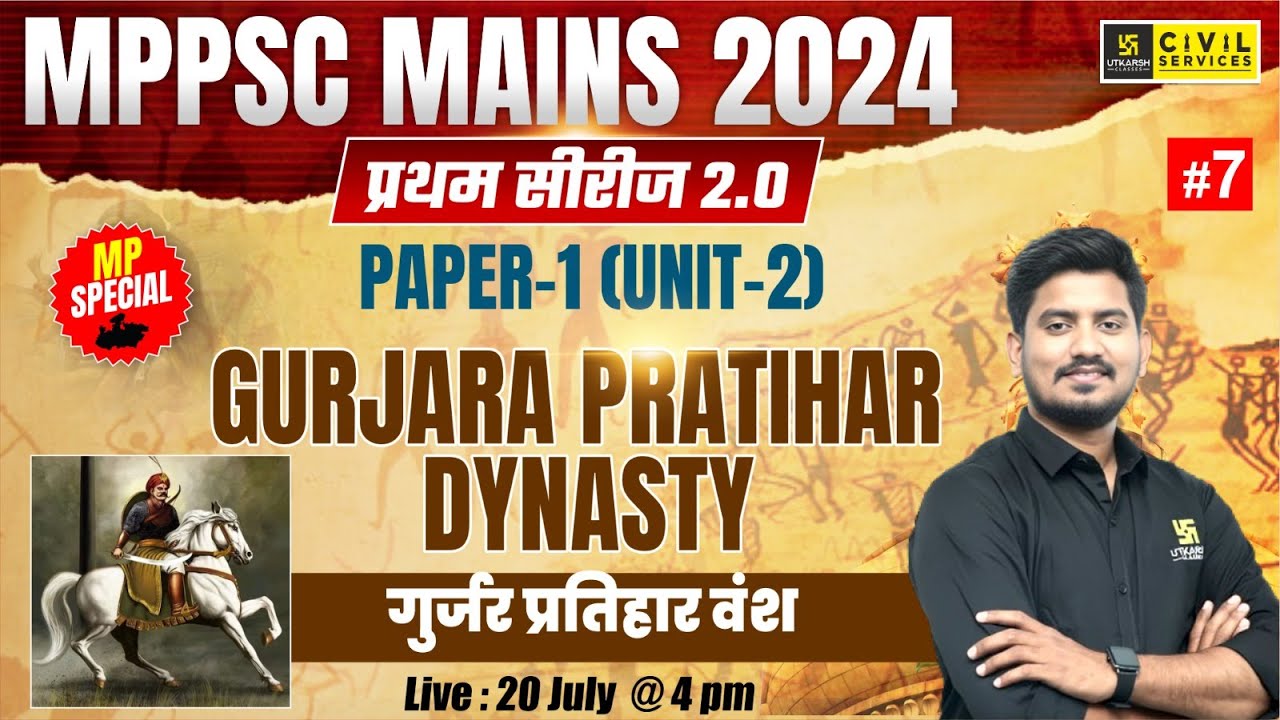
The reign of Mihirabhoja I () represents a defining period in early medieval Indian history, marked by the rapid revival and expansion of the Gurjara-Pratihara Dynasty. Operating from his imperial base at Kannauj, Mihirabhoja launched strategic military campaigns across Rajputana, the Gangetic plains, and northern borderlands. His victories over two powerful rival empires—the Rashtrakutas of the Deccan and the Palas of Bengal—re-established Pratihara dominance across Northern India. Understanding this era is crucial for students analyzing early medieval political structures, administrative systems, and territorial rivalries.
In this chapter, you will understand:
- The military expansion of Mihirabhoja I across Rajputana, Punjab, and Gangetic India.
- The dynamics of the Tripartite Struggle involving the Pratiharas, Rashtrakutas, and Palas.
- Administrative mechanisms, currency standards, and contemporary foreign observations.
- The zenith of the empire under Mahendrapala I and the causes of its subsequent decline.
Why this topic matters: Mihirabhoja's rule highlights how centralized imperial authority was rebuilt in Northern India through strategic alliances, military reassertion, and ideological patronage, forming a core topic for history examinations.
Core Idea: Mihirabhoja I transformed a fractured regional state into Northern India's dominant empire by consolidating central authority in Kannauj and holding off rivals on multiple fronts. Although internal succession struggles eventually weakened the dynasty, his administrative, military, and cultural contributions set the standard for the 9th-century political landscape.
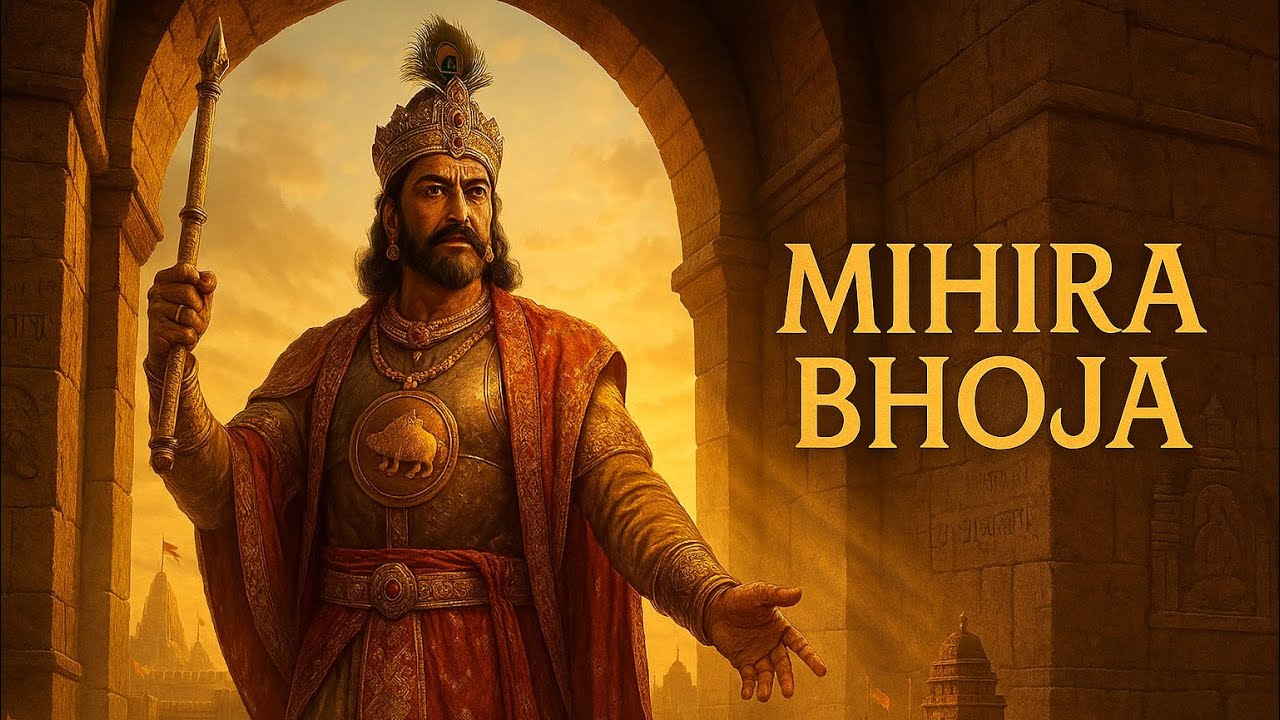
Mihirabhoja, The Great Pratihara Emperor: Reign and Strategic Conquests (circa 836–885 CE)
Mihirabhoja I, who adopted the famous title Varaha, embarked on a resolute mission to consolidate and expand the Pratihara dominion. He integrated multiple autonomous provinces under the imperial authority of Kannauj.
Expansion of Pratihara Dominion: Annexation of Rajputana and Regional Reassertion
The consolidation of Rajputana was a structured process that required re-establishing central control over feudatory chiefs who had asserted independence during earlier succession disputes.
Reassertion of Control over Pratihara Subordinates in Mandsor
A notable challenge came from a branch of the Pratiharas in Mandsor. Its ruler, King Kakkata, had previously served under Nagabhata but later sought autonomy, prompting Mihirabhoja to step in and restore order.
- (i) Inscriptions record that Kakkata was an active commander who fought against the Gaudas at Mudoggiri.
- (ii) Kakkata's son, Bahuka, showed remarkable tactical skill by defeating local chiefs named Nandabala and Mayra while gaining influence over nine administrative districts or Mandals.
- (iii) When Bahuka attempted to rule independently, Mihirabhoja moved quickly to enforce imperial supremacy, reducing Bahuka back to feudatory status.
Southern Rajputana Dominance and Tributes from Guhilas
Imperial control extended deep into Southern Rajputana, as verified by contemporary epigraphic records.
- (a) The Pratapgarh and Chatasu inscriptions explicitly confirm Mihirabhoja's overarching authority across Southern Rajputana.
- (b) Local rulers such as Harsha Guhila formally acknowledged Pratihara sovereignty through regular submission and tribute.
- (c) Historical notes state that Harsha Guhila presented high-grade cavalry horses to Mihirabhoja as a symbol of allegiance and military support.
Geographical Reach: Control Over Eastern Punjab and Kashmir Interactions
Under Mihirabhoja, the empire expanded northward into the fertile plains of Eastern Punjab, establishing a presence near the borders of Kashmir.

Strategic Control of Karnal Region (Pahewa Inscription)
Holding the Karnal district in Eastern Punjab was essential for securing trade networks and defending against northern threats.
- (i) Both the literary chronicle Rajatarangini by Kalhana and the local Pahewa inscription document Mihirabhoja's administrative control over Karnal.
- (ii) When Pratihara forces concentrated on eastern campaigns, King Sankarvarman of Kashmir made a brief push into the border regions of Karnal.
- (iii) Despite this temporary pressure, major portions of the territory remained under the administrative supervision of the Pratihara state.
The Tripartite Struggle: Conflict with Rashtrakutas and Pala Dynasty
Mihirabhoja's reign was largely shaped by the Tripartite Struggle—a three-way contest between the Pratiharas, the Rashtrakutas of the Deccan, and the Palas of Bengal for permanent control of Kannauj.
Struggle with Rashtrakutas and the Capture of Kannauj
The Deccan-based Rashtrakutas presented a constant challenge along the southern frontier, leading to alternating periods of conflict and territorial adjustment.
- (i) Early in Mihirabhoja's reign, the Rashtrakuta monarchs Amoghavarsa and Krishna II pressed northward and briefly held influence over Kannauj.
- (ii) Taking advantage of internal shifts within the Rashtrakuta court, Mihirabhoja recaptured Kannauj and pushed his empire's boundary southward toward the Narmada River.
- (iii) Although the feudatory ruler Dhruva II of Gujarat checked a further advance in a local engagement, the fertile region of Avanti (Malwa) remained a prime point of contest.
Intense Rivalry with the Pala Dynasty of Bengal
On the eastern front, the Pala kingdom under Devapala actively resisted Pratihara expansion.
- (a) Devapala maintained a strong military presence and claimed tributory authority across major portions of Northern India.
- (b) Early encounters favored the Palas, but the military balance shifted after the passing of Devapala.
- (c) The Gwalior prasasti records that Mihirabhoja eventually secured a decisive victory over the Pala forces, asserting dominance over key eastern routes.
Military Achievements, Administration, and Foreign Accounts of Mihirabhoja
Mihirabhoja created one of the largest early medieval Indian states, attracting commentary from contemporary international travelers.
Widespread Military Campaigns and Imperial Extent
Systematic campaigns connected diverse geographic zones, extending from the Himalayan foothills to the coastal regions of Western India.
- (i) Successful expeditions covered Karnal in the northwest, Saurashtra on the western coast, and central regions such as Bundelkhand and Kausambi.
- (ii) At its peak under Mihirabhoja, the Pratihara state encompassed central, northern, and western India under a single administrative framework.
Administrative Strength and Economic Strain
Observations by external visitors provide valuable context regarding the empire's internal standing and financial condition.
A silver coin of Mihirabhoja I displaying the Varaha emblem. - (a) The Arab traveler Suleman praised the Pratihara state, writing favorably about its large, well-equipped army and efficient law enforcement.
- (b) Continuous military engagements placed pressure on the royal treasury, which led to the issuance of alloyed silver coinage to stretch precious metal reserves.
Religious Devotion and Cultural Patronage of Mihirabhoja
Mihirabhoja was a key patron of religious institutions and court literature, helping make Kannauj a celebrated center of art and learning.
- (i) He maintained personal devotion to Vishnu (adopting the title Adivaraha) while encouraging worship of Shiva and other traditional deities.
- (ii) His court fostered renowned literary figures, most notably the poet Rajasekhara, whose writings enriched Sanskrit literature during this period.
Quick Revision Capsule
Key highlights of the Gurjara-Pratihara reign under Mihirabhoja I and his successors:
| Historical Aspect | Key Event / Primary Evidence | Historical Significance |
|---|---|---|
| Rajputana Consolidation | Daulatpur & Kahala Inscriptions | Re-established central control over local chiefs in Mandsor and Southern Rajputana. |
| Northern Frontier | Pahewa Inscription & Rajatarangini | Confirmed Pratihara authority over the Karnal trade corridor in Eastern Punjab. |
| Tripartite Conflict | Capture of Kannauj; victory recorded in Gwalior prasasti | Secured Northern India's imperial capital against Rashtrakuta and Pala claims. |
| Foreign Account | Travelogues of Arab traveler Suleman | Attested to the strength of the Pratihara cavalry and effective internal administration. |
| Imperial Peak & Decline | Reign of Mahendrapala I & succession war between Bhoja II and Mahipala | Reached maximum geographical extent before internal rivalries allowed feudatories to break away. |
Summary
The reign of Mihirabhoja I marks the high point of Gurjara-Pratihara power in early medieval India. Through decisive military actions, he secured the capital city of Kannauj, subdued rebellious feudatories across Rajputana, and defended imperial borders against both the Rashtrakutas and the Palas. His successor, Mahendrapala I, expanded these boundaries into Magadha and Northern Bengal. However, subsequent succession disputes between Bhoja II and Mahipala destabilized central governance, enabling regional feudatories—including the Paramaras, Chandelas, and Kalachuris—to establish independent kingdoms.
Quick Revision Points
Essential facts to review before examinations:
- (i) Mihirabhoja I ruled from and adopted the imperial title Adivaraha.
- (ii) Primary sources include the Gwalior prasasti, Daulatpur plate, Pahewa inscription, and Rajatarangini.
- (iii) The Arab visitor Suleman described the Pratihara empire as possessor of a formidable military force.
- (iv) Dynastic fragmentation was accelerated by the succession conflict between Bhoja II and Mahipala.
- Exam Tip: Pay close attention to the specific inscriptions associated with Mihirabhoja (Gwalior, Pahewa, Daulatpur) and remember that Rajasekhara was the key court poet associated with the later Pratihara court.
Frequently Asked Questions (FAQ)
Q1: What title was adopted by Mihirabhoja I, and what does it signify?
A1: Mihirabhoja I adopted the title Adivaraha (or Varaha), which signifies his devotion to the Varaha incarnation of Vishnu and symbolizes his role as a protector restoring order to his realm.Q2: Which primary sources document Mihirabhoja's military achievements?
A2: Major sources include the Gwalior prasasti, the Pahewa inscription from Punjab, the Daulatpur copper plate, and contemporary travel notes by the Arab writer Suleman.Q3: What caused the decline of the Gurjara-Pratihara Empire after Mahendrapala I?
A3: Decline was triggered by a bitter war of succession between Bhoja II and Mahipala, alongside invasions by Rashtrakuta King Indra III. This internal weakness encouraged feudatories like the Chandelas, Paramaras, and Kalachuris to declare independence.