The Gurjara-Pratihara Dynasty stood as one of the most powerful imperial lineages in medieval Indian history. Emerging prominently around the , this dynasty grew from regional roots in western India to become the primary defensive shield of North India. Rising in the political void left after the fall of earlier empires, the Pratiharas established their authority across present-day Rajasthan and Gujarat before capturing the coveted city of Kanauj. Their reign shifted the power center of the subcontinent and initiated more than a century of intense military competition known as the Tripartite Struggle. For students preparing for competitive examinations, understanding the rise, political strategy, and military achievements of the Pratiharas provides vital context regarding medieval Indian geopolitics and defense against early foreign invasions.
In this chapter, you will understand:
- The debate surrounding the origins of the Gurjara-Pratiharas.
- The founding and Arab resistance led by Nagabhatta I.
- The 150-year Tripartite Struggle for control over Kanauj.
- The golden era under Mihirbhoj and key imperial successors.
Why this topic matters: This era highlights how North Indian rulers successfully contained foreign invasions and built strong regional networks that shaped medieval administration and temple architecture.
Core Idea: Founded in the by Nagabhatta I, the Gurjara-Pratihara dynasty defended North India from Arab forces and secured dominance over Kanauj. Despite intense rivalries with the Palas and Rashtrakutas, rulers like Mihirbhoj led the empire into a golden age of stability and cultural patronage.
Rise and Origins of the Gurjara-Pratihara Dynasty: Political Consolidation Over Kanauj (8th Century C.E.)
The origin story of the Pratiharas combines tribal migrations, indigenous growth, and traditional royal genealogies. Historically linked with the Gurjaras, these leaders established small kingdoms across western India before merging into a unified imperial power based at Kanauj.
Early records show that these rulers drew strength from local agrarian and pastoral communities, transforming skilled fighters into ruling elites who commanded powerful cavalry units.
- (i) Many historical scholars point out that the Pratiharas were closely connected with the Gurjaras, a community of pastoralists and skilled warriors similar to groups like the Jats.
- (ii) These early leaders established small independent principalities across central and eastern Rajasthan, creating a strong foundation for future expansion.
- (iii) In royal court inscriptions, the dynasty claimed descent from Lakshamana, the heroic brother of Lord Rama, linking their lineage to the traditional solar clan described in the sacred epic Ramayana.
The Mysterious Origins of the Gurjara-Pratiharas: Central Asiatic or Indigenous Roots
Historians continue to discuss whether the Pratihara ruling class originated from foreign nomadic groups that settled in India or grew out of native Indian communities.
Historical References and Early Mentions
Several crucial literary and epigraphic sources confirm the presence and influence of the dynasty long before they established their capital at Kanauj.
- (i) Important historical documents, including the famous Aihole Inscription of Pulakesin II, travel journals of the Chinese monk Hieun Tsang, and Bana's classic text Harshacharita, explicitly mention the early Pratihara rulers.
- (ii) These texts prove that the Pratiharas held significant political influence in western India well before becoming a pan-Northern power.
The Gurjara Stock Debate: Nomadic vs. Indian Indigenous Theories
While most historians agree that the Pratiharas belonged to the broader Gurjara stock, two distinct viewpoints explain their geographic origins.
- (a) Foreign Origin Theory: Some scholars suggest they belonged to Central Asiatic nomadic tribes who migrated into the Indian subcontinent alongside groups like the Hunas.
- (b) Indigenous Origin Theory: Other leading historians argue that they were local Indian clans who originated directly in Rajasthan and gradually rose to royal status.
Establishment and Initial Consolidation under Nagabhatta I
The true political transformation of the dynasty took place during the , when ambitious leaders capitalized on regional instability to form a powerful centralized state.
Pratihara Rise and Founding by Nagabhatta I
As the central authority of the Gupta Empire crumbled after the , regional leaders stepped in to build independent kingdoms across Northern India.
- (i) The dynamic ruler Nagabhatta I laid the firm imperial foundation of the empire in Malwa during the early half of the
- (ii) Belonging to a respected Rajput clan, Nagabhatta I made Bhinmal his primary seat of power, ruling successfully from approximately to
Resistance to Arab Expansion and Military Successes
The most famous achievement of Nagabhatta I was his decisive defense of western India against foreign invaders advancing from the west.
- (a) His strong military organization halted the eastward expansion of Arab armies from Sindh, protecting Gujarat, Rajasthan, and Punjab from foreign subjugation.
- (b) Joining forces with other regional powers, including the Chalukyas of Gujarat, Nagabhatta I secured a major victory over Arab forces in
The Tripartite Struggle for Dominance Over Kanauj
Control over the city of Kanauj represented ultimate political authority over the fertile Gangetic plains. This led to a prolonged war between three massive regional empires.

The conflict lasted for over 150 years as three major dynasties constantly competed for economic resources, trade routes, and supreme status across northern India.
- (i) The main contenders were the Pratiharas of the west, the Palas of eastern India (Bengal), and the Rashtrakutas coming from the southern Deccan region.
- (ii) The main objective for all three kingdoms was capturing Kanauj, which had been the imperial center of Northern India since the time of Harsha.
- (iii) According to prominent historian Satish Chandra, the direct intervention of the Rashtrakuta king Dhruva triggered this extended conflict, which dragged on for nearly a century and a half.
- (iv) Despite suffering occasional losses and temporary retreats, the Gurjara-Pratiharas showed great resilience, ultimately securing long-term control over Kanauj until their eventual decline.
Prominent Gurjara-Pratihara Kings and Their Imperial Contributions
The growth of the Gurjara-Pratihara empire was shaped by several capable rulers who rebuilt imperial military strength and sponsored art, learning, and religious monuments.
Vatsaraja: The Pioneer of Kanauj Dominance and Early Setbacks
As successor to the early leaders, Vatsaraja turned the dynasty into a major aggressive force in northern politics.
Vatsaraja: Expansion and Clash with Palas
Ruling from to , Vatsaraja expanded Pratihara control deep into central North India.
- (i) He officially moved the imperial capital to Kanauj, asserting his position as the top political authority in the north.
- (ii) He defeated the Pala monarch Dharmapala in the strategically crucial Ganges-Yamuna Doab region.
- (iii) His early triumphs were cut short when the Rashtrakuta ruler Dhruva marched north, defeated him in battle, and temporarily occupied Kanauj.
Nagabhata II: Imperial Revival and Religious Reconstruction
Following a short period of uncertainty, Nagabhata II reorganized the army, recovered lost lands, and restored the prestige of his dynasty.
Nagabhata II: Territorial Expansion and Rashtrakuta Conflict
Nagabhata II proved to be an energetic and practical leader dedicated to regaining his family's imperial standing.

Architectural grandeur of temples built and restored during the Gurjara-Pratihara era. - (a) His successful military campaigns extended Pratihara influence into regions such as Sindh, Andhra, Vidarbha, and Kalinga.
- (b) Although he suffered an early defeat against the Rashtrakuta king Govinda III, he recovered quickly, reclaimed Malwa, and rebuilt imperial administrative control.
- (c) He earned great respect by rebuilding the sacred Somnath Temple in Gujarat, which had been previously destroyed during foreign raids from Sindh.
Rambhadra and Mihirbhoj: The Period of Loss and the Golden Era
A brief period of military decline under Rambhadra was quickly followed by the longest and most prosperous reign in the empire's history under Mihirbhoj.
Rambhadra: The Brief Reign and Territorial Losses
The short reign of Rambhadra, son of Nagabhata II, brought sudden political instability and loss of territory.
- (i) Facing pressure from the aggressive Pala king Devapala, Rambhadra lost control over key border territories and faced internal rebellions.
Mihirbhoj: The Architect of the Golden Age
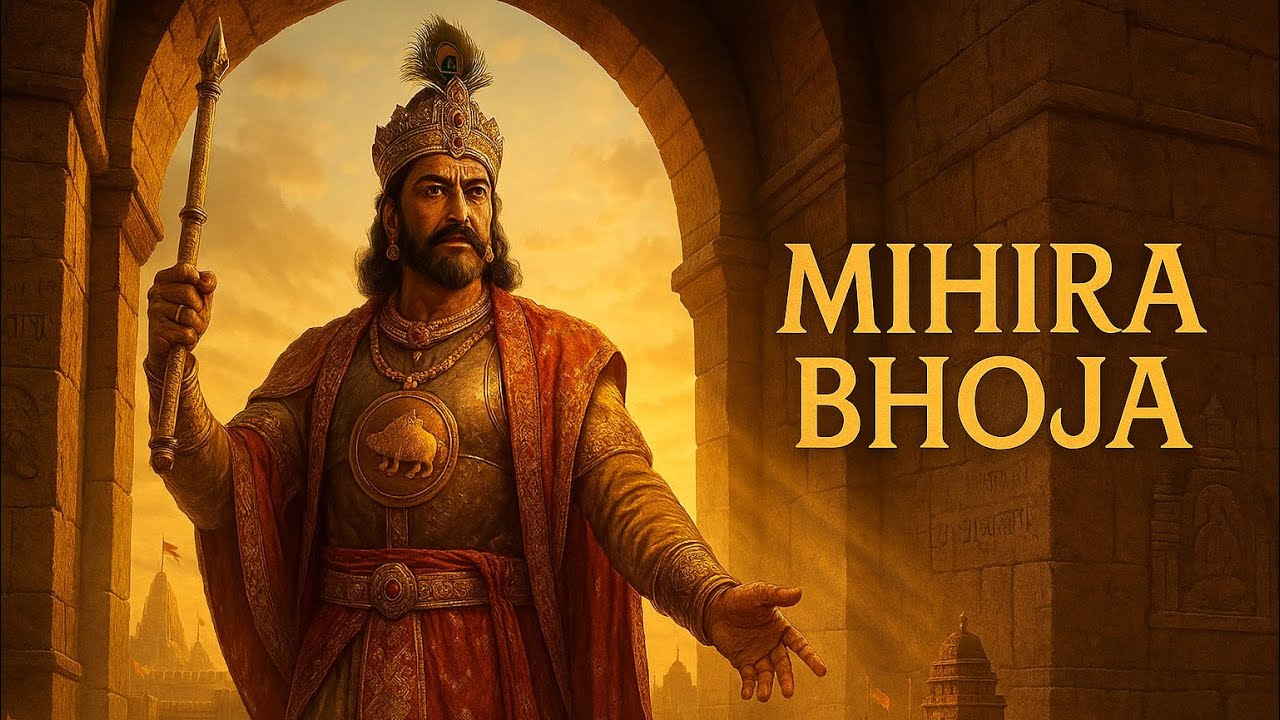
Taking the throne after Rambhadra, Mihirbhoj became the most celebrated and powerful sovereign of the Pratihara dynasty.
- (a) Beginning his rule in , Mihirbhoj re-established order, reorganized the military, and expanded the borders of the empire.
- (b) Historians recognize his long reign as the golden era of Pratihara rule, marked by widespread economic prosperity, military dominance, and administrative stability.
Quick Revision Capsule: Key Rulers and Achievements
The following summary table outlines the prominent monarchs of the Gurjara-Pratihara Dynasty, their operational timelines, and their major historical contributions:
| Ruler Name | Reign Period | Key Contributions & Achievements |
|---|---|---|
| Nagabhatta I | Founded the imperial dynasty in Malwa; successfully defeated Arab invasion forces in | |
| Vatsaraja | Shifted the capital to Kanauj; defeated Pala king Dharmapala; initiated the Tripartite Struggle. | |
| Nagabhata II | Recovered lost territories; extended control over Malwa; rebuilt the historic Somnath Temple. | |
| Rambhadra | Short reign marked by temporary territorial losses to the Pala king Devapala. | |
| Mihirbhoj | Created the Golden Era of Pratihara rule; restored total political stability and economic prosperity across North India. |
Summary
The Gurjara-Pratihara Dynasty played an important role in medieval Indian history by organizing a strong centralized state across North India during a turbulent era. From their origins in western India to their crucial role in halting foreign invasions, they provided vital stability for over two centuries. Their control over Kanauj and ultimate success in the long Tripartite Struggle protected North India's cultural and political foundations, making their history essential for understanding medieval Indian governance.
Quick Revision Points for Students
Focus on these high-yield facts for history and civil service examinations:
- (i) The empire was founded by Nagabhatta I in with an early capital at Bhinmal.
- (ii) Nagabhatta I successfully led a regional alliance that defeated invading Arab armies in
- (iii) The Tripartite Struggle involved three major regional powers: the Pratiharas, Palas, and Rashtrakutas.
- (iv) Mihirbhoj () guided the empire into its golden age, expanding territorial boundaries and supporting cultural growth.
- Exam Tip: Remember that the primary cause of the Tripartite Struggle was gaining direct political and economic control over the Gangetic plains through the strategic city of Kanauj. Questions often test the chronological order of rulers and key achievements, such as Nagabhata II rebuilding the Somnath Temple.
Frequently Asked Questions (FAQ)
Q1: Who was the founder of the Gurjara-Pratihara Dynasty?
A1: The imperial foundation of the dynasty was established by Nagabhatta I around in the Malwa region.Q2: What was the primary cause of the Tripartite Struggle?
A2: The Tripartite Struggle was fought to secure complete control over Kanauj, the strategic and economic center of Northern India.Q3: Which ruler presided over the golden era of the Gurjara-Pratihara Empire?
A3: Mihirbhoj, who took the throne in , led the dynasty during its golden era of maximum territorial growth, political stability, and prosperity.