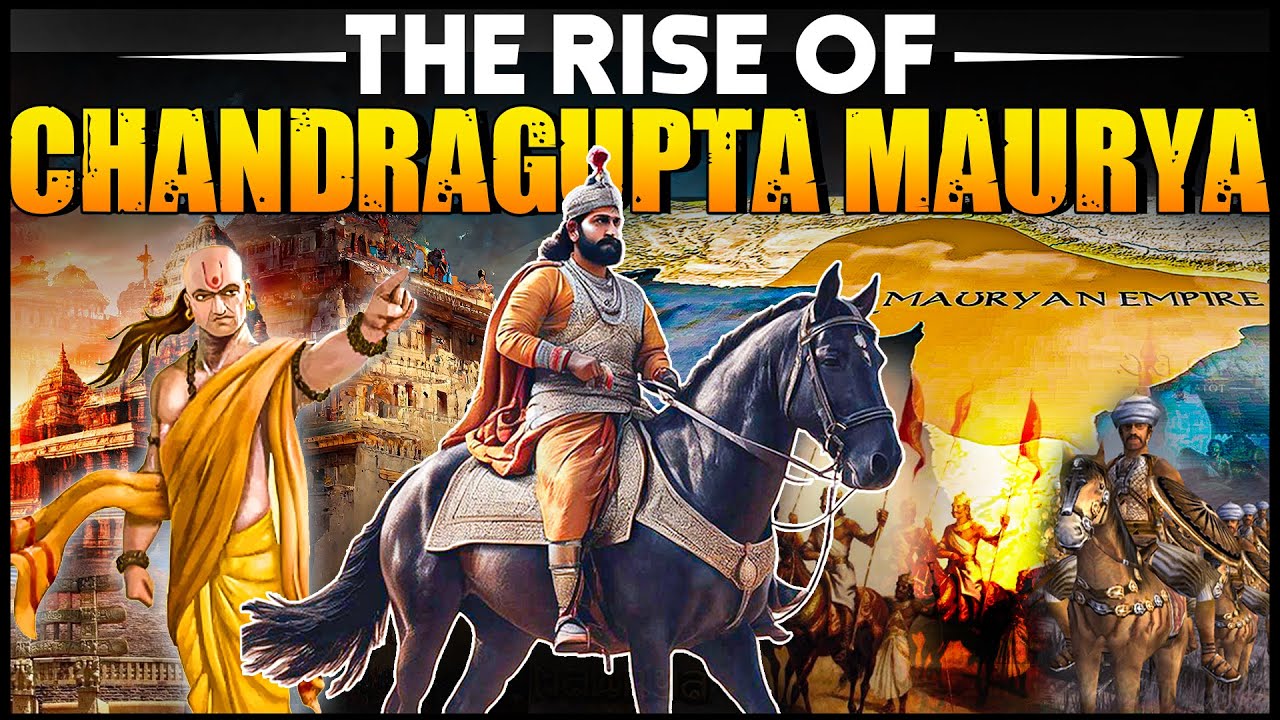
The story of Chandragupta Maurya, the visionary architect of one of ancient India’s largest domains, remains crucial for students preparing for history and competitive examinations. His life—marked by the establishment of the vast Mauryan Empire (c. 322 BCE–185 BCE) alongside the strategic genius of Chanakya (Kautilya)—lays the ultimate foundation for understanding imperial organization, centralized governance, and administrative statecraft in ancient India. From taking down the mighty Nanda dynasty to defending northern borders against foreign expansion, his reign restructured the political and economic landscape of the Indian subcontinent forever.
In this chapter, you will understand:
- The mysterious origins of Chandragupta Maurya and his rise to power.
- Military victories over the Nandas and the diplomatic treaty with Seleucus I Nicator.
- The administrative machinery, municipal committees, and key officers (Adhyakshas).
- The distinction between regional kingdoms and unified imperial systems.
Why this topic matters: This period marks the transition of India from scattered regional kingdoms into a unified imperial power. Understanding Mauryan administration, revenue collection, and foreign diplomacy is a core element of ancient Indian history exams.
Core Idea: Guided by Chanakya, Chandragupta Maurya established India's first pan-subcontinental empire around 322 BCE. By combining sharp military expansion, foreign diplomacy, and a highly structured bureaucracy, the Mauryas built a centralized administrative model centered in Pataliputra that managed economics, trade, agriculture, and defense on an unprecedented scale.
Chandragupta Maurya: The Rise of the First Great Indian Empire (c. 322 BCE)
The foundation of the mighty Mauryan Empire was laid by Chandragupta Maurya, who transitioned from an obscure background to become a formidable emperor. Historical accounts of his birth and early life vary across texts, adding a layer of compelling mystery to his political ascendancy.
Historical Traditions on Chandragupta's Lineage
Ancient records present distinct views regarding the social and caste background of Chandragupta:
- (i) The Brahmanical tradition suggests a humble background, claiming he was the son of Mura, a Sudra woman who served in the court of the Nandas, hinting at an extraordinary rise from low social standing.
- (ii) Conversely, Buddhist sources elevate his lineage, asserting that he belonged to the Kshatriya clan known as the Mauryas, who ruled in the region around Gorakhpur.
Overthrowing the Nandas and Securing North-West India
Before expanding into a multi-regional power, Chandragupta focused his energy on dismantling the ruler of Magadha and taking advantage of the shifting power dynamics along India's western borderlands.
Strategic Campaigns and Territorial Consolidation
The campaign to overthrow the rulers of Magadha required calculated patience, strategic intellect, and diplomatic negotiation.
The Strategic Downfall of the Nanda Dynasty
The overthrow of the Nandas was orchestrated by Chandragupta and his mentor, the astute Chanakya (also known as Kautilya). Upon seizing the capital of Magadha, he established the core stronghold of the Mauryan state.
- (i) Early military moves involved harassing the outer peripheries of the Nanda kingdom before striking the central power structure in Magadha.
- (ii) After securing the fertile Ganges Plain, Chandragupta capitalized on the political vacuum left in the northwest following the retreat of Alexander the Great’s army.
Conflict and Diplomatic Alliance with Seleucus I Nicator
A major foreign challenge emerged from Seleucus I Nicator, the Greek ruler controlling regions west of the Indus River. Chandragupta’s victory resulted in a historic peace treaty.
- (a) Chandragupta successfully liberated north-western India from Seleucus, establishing firm Mauryan rule over former Greek satrapies.
- (b) The peace treaty of 303 BCE was a diplomatic landmark: Seleucus ceded vast territories—including eastern Afghanistan, Baluchistan, and the region west of the Indus River—in exchange for 500 trained war elephants.
- (c) The treaty included a matrimonial agreement (epigammia), and Seleucus dispatched an ambassador named Megasthenes, who documented his detailed observations of India in his book Indica.
The Vast Territorial Expansion of the Mauryan Empire
Under Chandragupta’s leadership, the Mauryan state grew into a massive domain spanning across almost the entire Indian subcontinent.

Geographical Scope of Imperial Dominance
The territorial boundaries of the empire reflected unprecedented administrative reach and military coordination.
Geographical Reach and Regional Control
The empire was continental in scale, stretching across diverse geography and terrain across India:
- (i) The empire extended across Bihar, Orissa, and Bengal in the east, stretched through western and north-western India, and reached deep into the Deccan plateau in the south.
- (ii) At its peak, the Mauryas ruled over nearly the entire Indian subcontinent—a geographical area larger than the later British Raj, excluding only extreme southern regions like Kerala, Tamil Nadu, and parts of north-eastern India.
Imperial Organization: Mauryan Governance and Strength
Managing an empire of this magnitude required a tightly centralized administrative machinery operating from the imperial capital of Pataliputra.
Structure of Central and Municipal Administration
Power flowed directly from the emperor down through provincial governors and municipal boards.
The Meticulous Administrative Structure
The realm was partitioned into manageable political units to balance central control with local governance.
- (i) The empire was divided into large provinces, each governed by a royal prince called a Kumara to maintain crown authority.
- (ii) Major urban centers such as Pataliputra, Kausambi, Ujjain, and Taxila served as administrative, commercial, and judicial centers.
Pataliputra City Administration
The municipal system of the capital city was organized into specialized administrative boards as recorded by foreign observers.
- (a) Municipal governance in Pataliputra was managed by six specialized committees, each composed of five members (totaling 30 city commissioners).
- (b) These boards supervised civic life, including sanitation, registration of births and deaths, foreign visitors, trade regulations, standardizing weights and measures, and quality control of manufactured goods.
Central Bureaucracy and Standing Army
The state directly managed key economic sectors and maintained a massive military apparatus.
- (i) Central departments closely regulated social and economic affairs to optimize state revenues and maintain social order.
- (ii) Chandragupta commanded a vast permanent standing army (infantry, cavalry, war elephants, and chariots), organized and overseen by six dedicated military boards.
Key Officials and Their Crucial Roles in Mauryan Administration
The day-to-day operations of the Mauryan empire depended on a detailed hierarchy of specialized department heads called Adhyakshas.
Superintendents and Royal Officers
Every major sector of trade, agriculture, justice, and defense had a designated official handling its operations.
Economic and Agricultural Superintendents (Adhyakshas)
These officials managed economic production and tax collection across the empire:
- Sitadhyaksha: The Superintendent of Agriculture, tasked with overseeing crown lands and state farming operations.
- Pautavadhyaksha: The Superintendent of Weights and Measures, responsible for maintaining standardized commercial metrics.
- Panyadhyaksha: The official in charge of Trade and Commerce, controlling market supply, demand, and prices.
- Lohadhyaksha & Sauvarnika: Officers who supervised industrial workshops and state-manufactured goods, including metals and gold.
- Sulkaadhyaksha: The Collector of Tolls, who gathered duties on imported and exported commodities.
- Karmantika: The Head of Industries and Factories, managing manufacturing units owned by the state.
- Akaradhyaksha: The Mining Officer, in charge of prospecting, extracting, and processing mineral reserves.
- Kupyadhyaksha: The Superintendent of Forest Produce, managing timber, reserves, and forest resources.
Judicial, Defense, and Security Officials
Law enforcement and internal defense were delegated to specialized officers:
- Dandapala: The Head of Police, responsible for maintaining public security and peace.
- Bandhanagaradhyaksha: The officer who supervised jails and correctional facilities.
- Nayaka: The Chief of City Security, handling urban defense and municipal law enforcement.
- Vyabharika: The Chief Judge, presiding over civil and criminal judicial proceedings.
- Koshadhyaksha: The Treasury Officer, managing imperial revenue reserves.
- Durgapal: The Governor of Royal Forts, in charge of border and internal fortifications.
- Nava Adhyaksha: The Superintendent of Ships, regulating river transit, maritime trade, and waterways.
- Ayudhagaradhyaksha: The officer who managed armories and weapon manufacturing.
Quick Revision Capsule: Mauryan Administrative Hierarchy
A quick summary of key Mauryan officials, their responsibilities, and core functional domain:
| Official Designation | Administrative Role | Core Domain & Responsibility |
|---|---|---|
| Sitadhyaksha | Agricultural Superintendent | Management of state crown lands, farming, and agrarian output. |
| Pautavadhyaksha | Inspector of Weights & Measures | Standardization of commercial scales, units, and trade measurements. |
| Akaradhyaksha | Chief Mining Officer | Exploration, resource extraction, and management of state mines. |
| Sulkaadhyaksha | Toll Collector | Collection of customs, duties, and entry tolls on trade goods. |
| Nava Adhyaksha | Naval Superintendent | Regulation of river transport, ferry fees, and maritime traffic. |
Summary
Chandragupta Maurya completely transformed the ancient Indian political landscape by replacing decentralized kingdoms with a organized, unified Mauryan Empire starting around 322 BCE. With the guidance of Chanakya, he dismantled Nanda rule in Magadha, secured India's northwestern frontier by defeating Seleucus I Nicator in 303 BCE, and established a structured administrative system run by designated superintendents (Adhyakshas) and municipal boards. His reign set the standard for centralized administration, military organization, and economic governance throughout ancient Indian history.
Quick Revision Points for Students
Key facts to remember for examinations:
- (i) 322 BCE: Foundation of the Mauryan Dynasty by Chandragupta Maurya after defeating Dhana Nanda.
- (ii) 303 BCE: Peace treaty signed with Seleucus I Nicator; 500 elephants exchanged for territories in modern-day Afghanistan and Baluchistan.
- (iii) Municipal Setup: Pataliputra city was governed by 6 committees of 5 members each.
- (iv) Ascetic Retirement: Jaina traditions record that Chandragupta abdicated in favor of his son Bindusara (c. 297 BCE) and performed Sallekhana at Shravana Belgola with monk Bhadrabahu.
- Exam Tip: Questions frequently focus on the specific duties of the Adhyakshas (e.g., Sitadhyaksha vs. Akaradhyaksha) and the terms of the 303 BCE treaty with Seleucus Nicator. Make sure to memorize the functional titles of municipal and economic superintendents.
Frequently Asked Questions (FAQ)
Q1: What were the key terms of the 303 BCE treaty between Chandragupta Maurya and Seleucus I Nicator?
A1: Seleucus ceded vast eastern territories including eastern Afghanistan, Baluchistan, and areas west of the Indus River. In return, Chandragupta gave Seleucus 500 war elephants. The treaty also involved a marriage alliance (epigammia) and the dispatch of Greek ambassador Megasthenes to Pataliputra.Q2: How was the administration of the capital city Pataliputra organized?
A2: According to Megasthenes' Indica, Pataliputra was governed by a municipal board consisting of 30 members divided into 6 specialized committees of 5 members each, overseeing sanitation, trade, foreign affairs, birth/death records, weights and measures, and manufactured goods.Q3: According to Jaina tradition, how did Chandragupta Maurya end his reign?
A3: Jaina texts state that Chandragupta abdicated his throne around 297 BCE in favor of his son Bindusara, converted to Jainism, and traveled to Shravana Belgola in Karnataka with the saint Bhadrabahu, where he performed Sallekhana (religious fasting unto death).