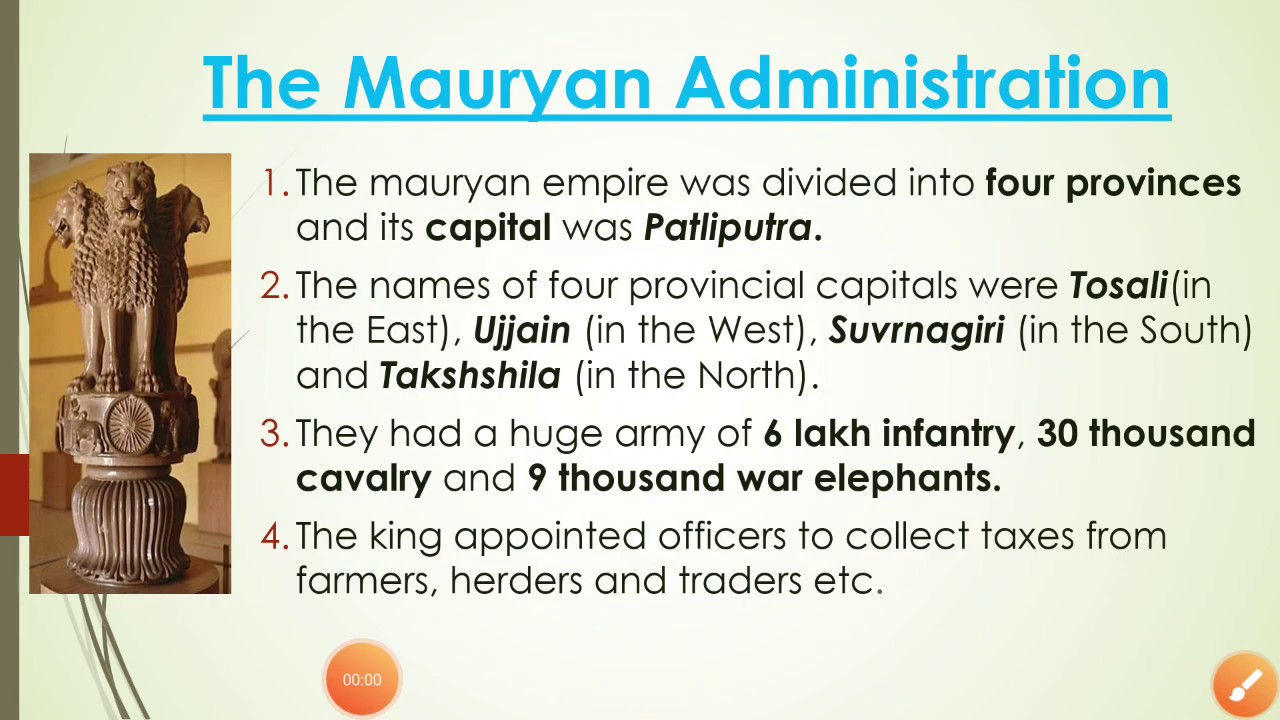
The Mauryan Empire, flourishing during the period of 322 BCE to 185 BCE, represents a foundational chapter in ancient Indian history, marked by an advanced economy, a well-structured society, and a profound cultural and political legacy. This meticulously organized content offers a deep dive into the complex Mauryan administration, its robust trade networks, and the decline of the dynasty after Emperor Ashoka, providing essential, high-yield material for students preparing for competitive exams.
In this chapter, you will understand:
- The centralized economic system, state monopolies, and regulatory bureaucracy of the Mauryan state.
- Major trade routes like the Uttarapatha and Dakshinavarti Marga alongside key maritime ports.
- Social stratification as described by Megasthenes and the moral governance of Ashoka's Dhamma.
- Revenue collection mechanisms (Bhaga, Udaka-Bhaga) and the multi-faceted causes of the empire's downfall.
Why this topic matters: Understanding the Mauryan Empire is essential for mastering ancient Indian history. It provides vital insights into how early Indian statecraft, centralized revenue collection, trade infrastructure, and social pluralism were systematically established and sustained across the subcontinent.
Core Idea: The Mauryan dynasty built a highly centralized empire anchored by state-monopolized industries, vast overland and maritime trade networks, and an extensive revenue system. Despite social restrictions, progressive policies around public welfare, emergency relief, and religious tolerance flourished under figures like Emperor Ashoka. However, internal corruption, economic strain, and administrative overreach eventually caused the imperial structure to dissolve around 180 BCE.
Mauryan Economy, Society, and Enduring Cultural Legacy (322 BCE–185 BCE)
A highly centralized state mechanism drove unprecedented economic growth and regulated almost every aspect of trade and production within the vast Mauryan dominion. The Mauryan political structure, centered around the capital city of Pataliputra, established a template for state-controlled enterprise unparalleled in its time. The Mauryan king was not just a political sovereign but also the chief economic manager, with the government actively participating in trade and manufacturing to consolidate the royal treasury through taxes and war spoils.
- (i) The Mauryan government exerted direct control over vital industries, maintaining strategic monopolies over coinage, mining, salt production, and the crucial construction of massive warships for maritime control.
- (ii) The monarch possessed extensive state-owned properties, including lucrative forests, designated hunting reserves, and specialized manufacturing hubs, with surplus materials being strategically sold to ensure a constant inflow of imperial wealth.
- (iii) This era was defined by meticulous planning, where the entire economic framework, including the movement of valuable goods like indigo, medicinal herbs, cotton, and silk, fell under the vigilant supervision of the state.
The Robust Mauryan Trade Network and Official Economic Supervision
The remarkable prosperity of the Mauryan period was built upon a foundation of extensive trade routes and a specialized bureaucracy dedicated solely to managing commerce and enforcing economic standards.

The Great Royal Highways and Central Trade Hubs of Ancient India
The strategic genius of the Mauryan administration was reflected in its infrastructure. Mauryan roads were engineered to facilitate trade across immense distances, creating a dense, robust network that connected distant parts of the subcontinent and fostered a golden age of commerce.
Specialized Mauryan Economic Officials and Regulatory Roles
To ensure this complex economy functioned without friction, the Mauryans created a highly specialized class of officials, each tasked with regulating a specific domain, ensuring fair practice, and maximizing state revenue.
- (a) Panyadhyaksha: This official held the critical responsibility of overseeing commerce and managing trade activities throughout the empire.
- (b) Samsthadhyaksha: The regulator of markets, ensuring orderly market transactions and preventing exploitative practices among traders.
- (c) Pautavadbyaksa: The authority ensuring standard weights and measures were uniformly used across all transactions, guaranteeing fair trade practices.
- (d) Navadhyaksha: The key official in charge of controlling and regulating all river transport and navigation activities.
- (e) Sulkadhyaksa: The officer responsible for the collection of tolls and duties (Sulkas) levied on goods entering or leaving the major city gates.
Infrastructural Investments for Trade Efficiency
The Mauryan state understood that efficient infrastructure was critical for sustained economic dominance, leading to massive public works focused on transportation and storage.
- Warehouses and Logistics: The government maintained extensive warehouses for storing state produce and trade goods, alongside well-organized transport hubs, optimizing logistics for both domestic and foreign trade.
- Road Maintenance: The Department of Highways ensured the great roads were maintained, featuring a design wide enough for cattle, chariots, and pedestrians, with trees planted to offer vital shade to travelers.
- Travel Amenities: To make arduous long-distance travel manageable, the state established inns for weary travelers along the highways and ensured fresh drinking water was available at regular, marked intervals.
Roads, Highways, and Ports: A Mauryan Transport Masterpiece
While later periods saw refinements, it was the Mauryans who truly pioneered the concept of a vast, interconnected, and state-maintained transportation network that spanned the entire subcontinent, creating a "golden era" of connectivity.
- (i) The Royal Route: This vital political and economic corridor successfully connected the capital city of Patliputra to the strategic northern region of Nepal, passing through significant settlements like Vaishali and Champaran.
- (ii) The Himalayan Foothill Route: A crucial pathway for northern trade, linking Vaishali to major cities such as Kasi, Kapilvastu, and eventually extending all the way to Peshawar.
Maritime Trade and Key Indian Ports (Broach/Barygaza and Tamralipti)
Understanding the importance of sea-borne trade, the Mauryans secured crucial ports that connected the thriving Indian economy to distant lands in the West and Southeast Asia.
Major maritime gateways: Broach (Barygaza) in the west and Tamralipti in the east enabled global sea commerce. - (a) Western Gateway (Broach): The port of Broach (also known as Barygaza) on the western coast served as the primary trade hub, connecting the Mauryan Empire to the Roman world and other Western civilizations.
- (b) Eastern Gateway (Tamralipti): The port of Tamralipti on the eastern coast was the essential outlet for trade with Southeast Asia and islands, securing India's role in trans-oceanic commerce.
Mauryan Society and Religion: Pluralism and Social Structure
The social landscape of the Mauryan Empire was a complex tapestry of professional classes and diverse religious practices, offering unique insights into ancient Indian life, notably through the accounts of Megasthenes.
Megasthenes' Description of Seven Distinct Social Groups
Megasthenes, the Greek ambassador to the Mauryan court, meticulously documented Indian society, observing a rigid, professional stratification where social mobility was severely restricted, defining society into seven occupational divisions.
- (i) Philosophers: Highly revered intellectuals and religious guides, categorized separately from the general populace.
- (ii) Cultivators: The largest group, forming the core agricultural backbone of the empire.
- (iii) Hunters and Herders: Nomadic or semi-settled groups primarily concerned with livestock and forest resources.
- (iv) Artisans and Traders: The skilled craftspeople and merchants responsible for production and commerce.
- (v) Overseers (Spies): The king's agents who monitored public affairs and reported directly to the central administration.
- (vi) The King’s Counsellors: The elite political class responsible for advising the monarch and administering justice.
- (vii) Soldiers: The military class responsible for the defense and expansion of the empire.
Status of Women and Religious Tolerance (Ashoka's Dhamma)
Despite the rigid social structure, the Mauryan era displayed certain progressive traits, particularly regarding women's rights and an official state policy of profound religious pluralism championed by Ashoka.
- (a) Women in Public Roles: Women were not solely confined to the domestic sphere; some notably served as the king’s bodyguards, demonstrating an exception to traditional roles.
- (b) Divorce and Remarriage: Women in Mauryan society enjoyed important rights, including the ability to pursue divorce and remarriage, suggesting a relatively progressive social framework.
- (c) Religious Pluralism: Religion remained a personal choice and was never imposed by the state. Chandragupta Maurya embraced Jainism; Bindusara patronized the Ajivikas; and Ashoka adopted Buddhism.
- (d) Ashoka's Dhamma:Ashoka famously promoted tolerance and moral governance through his policy of Dhamma, spreading messages of peace and welfare without coercing conversion, cementing a legacy of benevolent rule.
The Agricultural Backbone, Revenue System, and Famine Relief
Agriculture was the economic anchor of the Mauryan Empire, thriving under favorable geographical conditions and managed by a stringent, yet welfare-oriented, state revenue system.
State Revenue Collection: Bhaga, Kara, Bali, and Udaka-Bhaga
The empire relied heavily on agricultural output, necessitating a well-defined system of land and water taxation, which was overseen by specialized revenue officers.
- (i) Samaharta's Role: The Samaharta, the chief revenue collector, was responsible for securing the king's primary share of the produce, known as Bhaga, which typically ranged from 1/4th to 1/6th of the total yield.
- (ii) Additional Taxes: The state imposed several other significant levies, including Kara, Bali, and the crucial Udaka-Bhaga (water tax), with overall taxation levels ranging from 1/5th to 1/3rd of the total yield.
- (iii) Irrigation Costs: The sophisticated, state-managed irrigation system—vital for maximizing agricultural output—came with a mandatory cost, as farmers were required to pay specific water taxes (Udaka-Bhaga).
Welfare Governance and Mauryan Famine Relief Measures
Despite the high levels of taxation, the Mauryan government demonstrated a commitment to public welfare, particularly during crises like famines, highlighting a key aspect of their governance philosophy.
- (a) The Mauryan state showed a notable degree of concern for its populace, recognizing the inherent risk of agrarian economies dependent on monsoons.
- (b) Epigraphic evidence from Sohgaura (Uttar Pradesh) and Mahasthana (Bangladesh) confirms that official famine relief measures were instituted, showcasing the Mauryans' proactive commitment to crisis management and good governance.
The Inevitable Decline and Dissolution of the Mauryan Empire
The colossal Mauryan Empire, despite its robust foundations, eventually succumbed to internal weaknesses and external pressures, beginning to falter soon after the death of Ashoka in 232 BCE, leading to its collapse by 180 BCE.
Political Causes for the Mauryan Decline
The primary catalysts for the empire's political unravelling were weak central leadership, the overreach of bureaucracy, and the corruption of key state institutions.
- (i) Incapable Successors: The immediate successors of Ashoka proved to be politically weak and militarily incapable of managing the vast, complex, and highly decentralized administrative structure of the empire.
- (ii) Oppressive Bureaucracy: The once-reformatory Dhamma-mahamattas, originally tasked with moral governance, evolved into an overpowering and oppressive bureaucratic force, eroding local support.
- (iii) Corrupt Spy System: The once-powerful espionage network, critical for intelligence and control, became corrupted and dysfunctional, significantly contributing to overall administrative inefficiency and decay.
Economic and Environmental Factors in the Mauryan Collapse
Simultaneous economic pressures and poor environmental management further destabilized the empire, severely weakening its military and agrarian core.
- (a) Loss of Metal Monopoly: The state gradually lost its vital monopoly over metal resources, especially iron, which was crucial for both agriculture and the military, ultimately weakening its strategic power.
- (b) Ecological Crisis: Extensive deforestation, undertaken to expand agriculture, led to severe ecological imbalances, resulting in devastating floods and cyclical famines that disrupted the agrarian economy.
- (c) Fiscal Strain: In a desperate bid to shore up failing revenues, the government resorted to increasingly punitive fiscal measures, even taxing marginal economic groups such as entertainers and prostitutes.
Enduring Legacy Shaping Future Indian Governance and Culture
Despite the eventual fall of the last Mauryan ruler, the dynasty’s principles and innovations left an indelible mark on the subcontinent, shaping the political and cultural trajectory of subsequent dynasties.
- The Mauryan legacy decisively shaped Indian governance, established formal, structured trade practices, and laid the foundations for a syncretic culture that influenced successor states for centuries to come.
Mauryan Key Administrative Officials & Revenue Matrix
A quick-reference study capsule summarizing key Mauryan officials, administrative roles, and fiscal mechanisms:
| Official / Term | Administrative Role / Mechanism | Core Function & Target Impact |
|---|---|---|
| Panyadhyaksha | Commerce & Market Regulator | Supervised general trade activities and merchant operations across the state. |
| Samsthadhyaksha | Market Standards Inspector | Regulated market transactions to prevent fraud and merchant exploitation. |
| Pautavadbyaksa | Weights and Measures Official | Enforced uniform standards for scales, weights, and measures in all markets. |
| Navadhyaksha | Superintendent of Water Transport | Controlled river navigation, ferry routes, and maritime shipping activities. |
| Samaharta & Bhaga | Chief Revenue Collector & Land Tax | Collected state tax (1/4th to 1/6th of yield) alongside water tax (Udaka-Bhaga). |
Summary
The Mauryan Empire stands as a paramount era in ancient India, characterized by administrative mastery, widespread economic prosperity, and significant cultural and moral growth under figures like Ashoka. From Chandragupta Maurya's foundational conquests to the enlightened principles of Dhamma, the Mauryans left an indelible mark. While the empire crumbled by 180 BCE, its robust foundations in governance, organized trade infrastructure, and centralized administration became the essential stepping stones for all future major Indian civilizations, making the study of the Mauryan legacy critical for students aiming to understand the roots of modern Indian statecraft.
Quick Revision Points
Essential takeaways for rapid exam preparation:
- (i) Centralized rule was based in Pataliputra, exercising monopolies over mining, coinage, and shipbuilding.
- (ii) The trade network was anchored by the Uttarapatha (northwest to south) and Dakshinavarti Marga (southward corridor).
- (iii) Key ports included Broach (Barygaza) in the west and Tamralipti in the east.
- (iv) Agricultural taxation was collected by the Samaharta, with official famine relief recorded at Sohgaura and Mahasthana.
- Exam Tip: Pay special attention to Mauryan official designations (like Panyadhyaksha and Samaharta) and tax terminology (such as Bhaga and Udaka-Bhaga). Questions frequently target the contrast between overland routes (Uttarapatha) and external trade ports (Tamralipti, Broach).
Frequently Asked Questions (FAQ)
Q1: What were the primary trade routes under the Mauryan Empire?
A1: The primary routes were the Uttarapatha, stretching from Taxila in the northwest to Kanyakumari, and the Dakshinavarti Marga running southward. Key trade hubs included Ujjain, with ports at Broach and Tamralipti.Q2: How was land revenue structured in Mauryan times?
A2: The chief revenue officer was the Samaharta. The main land tax was Bhaga (ranging from 1/4th to 1/6th of the yield). Additional levies included Kara, Bali, and Udaka-Bhaga (water tax for irrigation).Q3: What factors led to the decline of the Mauryan Empire around 180 BCE?
A3: The collapse was driven by weak successors after Ashoka, oppressive administrative overreach by Dhamma-mahamattas, loss of iron resource monopolies, severe fiscal strain, and ecological damage due to widespread deforestation.