The Decline of the Maurya Empire and the subsequent emergence of Post-Mauryan Society mark a critical transition in ancient Indian history, with profound implications for governance, religion, and culture. The once-mighty empire, founded by Chandragupta Maurya around 322 BCE and reaching its zenith under Emperor Ashoka, dissolved by 185 BCE. This era of fragmentation, initiated by the assassination of the last ruler Brihadratha by Pushyamitra Shunga, is particularly important for students preparing for exams as it elucidates the complex dynamics of imperial collapse and the rise of new religious and literary traditions, notably the growth of Mahayana Buddhism and the codification of the Dharmashastras.
In this chapter, you will understand:
- Structural causes behind the collapse of the central Mauryan state by 185 BCE
- Impact of the Shunga Coup and the rise of regional successor kingdoms
- Evolution of Mahayana Buddhism and Bhakti traditions in Post-Mauryan times
- Codification of social laws via Manusmriti and advances in art and science
Why this topic matters: It explains how the fall of India's first pan-Indian empire created a decentralized political structure that fostered deep artistic, religious, and literary innovations across the subcontinent.
Core Idea: Political fragmentation after 185 BCE did not cause cultural decay. Instead, the loss of central control allowed regional dynasties, foreign contacts, and new religious movements like Mahayana Buddhism and Vaishnavism to flourish alongside landmark legal codifications.
Analyzing the Reasons for the Decline of the Maurya Empire (322 BCE – 185 BCE) and Post-Mauryan Developments
The Maurya Empire, the first pan-Indian polity, crumbled rapidly after the reign of Emperor Ashoka due to a confluence of structural weaknesses, political instability, and military betrayal. The monumental Mauryan administration, while efficient at its peak, proved unsustainable under less capable leadership, leading to its eventual and definitive fall which heralded a new political landscape.

Reasons for the Decline of the Mauryan Empire - (i) The empire's foundation by Chandragupta Maurya in 321 BCE and subsequent expansion under his grandson Ashoka created a vast but geographically challenging domain, whose unity depended heavily on a powerful central figure.
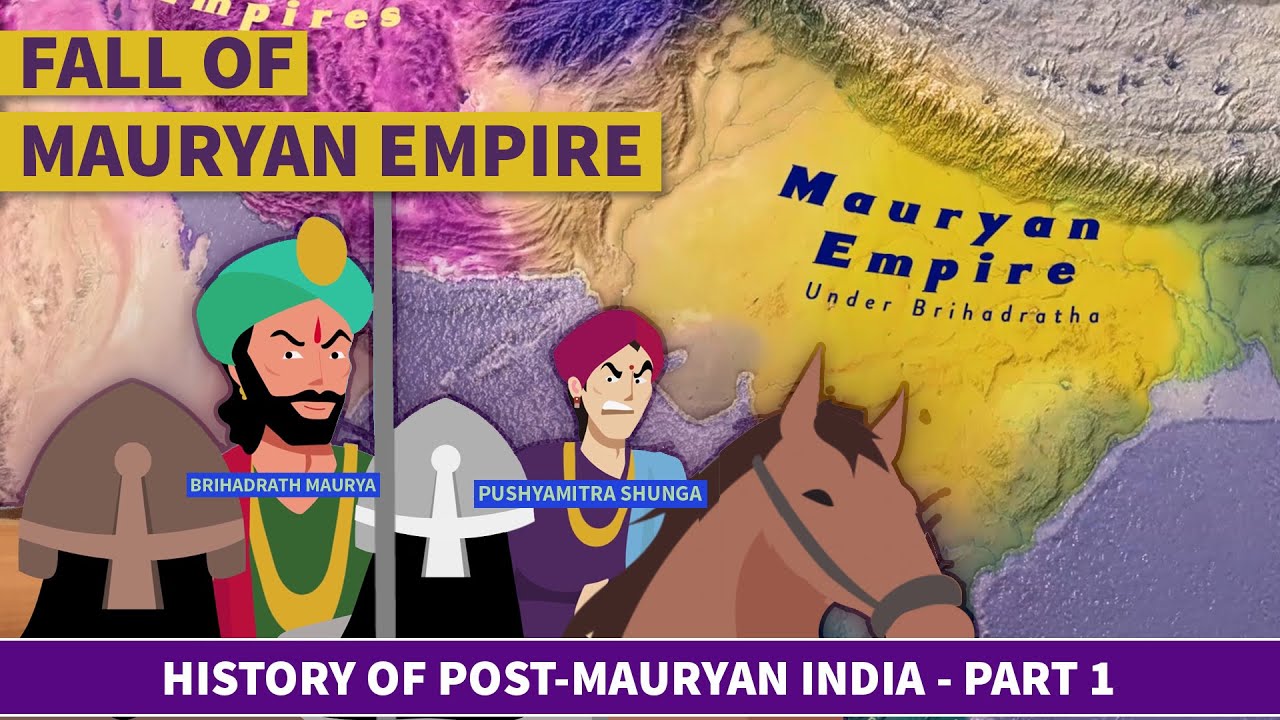
- (ii) The final act of collapse occurred in 185 BCE when the last Mauryan ruler, Brihadratha, was dramatically overthrown and assassinated by his own commander-in-chief, Pushyamitra Shunga, who immediately established the Shunga Dynasty.
- (iii) The underlying causes for the disintegration include lack of strong central leadership post-Ashoka, crippling economic difficulties, festering internal conflicts, and devastating foreign invasions, all of which led to the fragmentation into smaller regional powers.
The Inevitable Downfall of the Mauryan Imperial Authority
The vast Mauryan dominion began to show fissures immediately after Ashoka’s death, as his successors struggled to replicate his administrative prowess and maintain the delicate balance of power across the sprawling territory, allowing external and internal pressures to mount.
Stages and Factors Leading to the Mauryan Collapse: A Historical Narrative
The narrative of the decline is one of gradual decay, where political fragility, economic overextension, and military vulnerability created a perfect storm that the weak successors of Ashoka could not weather, culminating in the empire’s dissolution.
- (i) Weak Successors: A primary catalyst was the succession of Mauryan rulers who were ineffective and lacked administrative vision after the death of Ashoka, leading to a profound erosion of central authority and a surge in internal unrest and rebellion across the provinces.
- (ii) Internal Conflicts and Decentralization: The empire was plagued by power struggles within the royal family and growing dissatisfaction among the local governors. As the central command weakened, provincial rulers increasingly sought greater autonomy, effectively leading to political fragmentation well before the final coup.
- (iii) Economic Difficulties and Financial Strain: The cost of managing such a vast, centralized empire, coupled with excessive taxation and rising military expenses, placed an unsustainable burden on the economy. This financial strain, exacerbated by declining trade and agricultural productivity, led to profound economic instability.
- (iv) External Invasions and Military Weakness: The weakening imperial borders became a magnet for foreign aggressors. The attacks by Greeks and Greco-Bactrians on Mauryan territories further diminished the empire’s power, proving that internal instability combined with external aggression inevitably precipitates collapse.
- (v) The Final Coup d'État: The ultimate demise of the Maurya Empire was swiftly brought about in 185 BCE when the last ruler, Brihadratha, was assassinated by his Commander-in-Chief, Pushyamitra Shunga, marking the definitive end of the centralized Mauryan rule and the immediate beginning of the Shunga Dynasty.

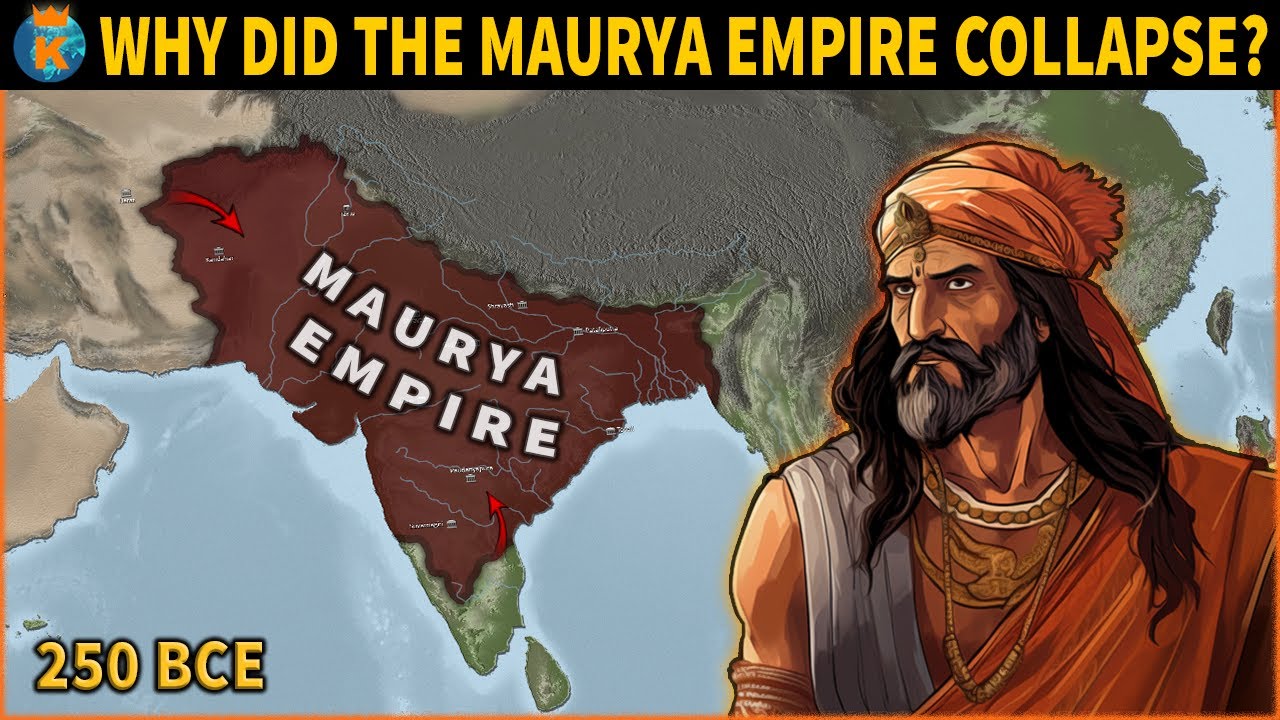
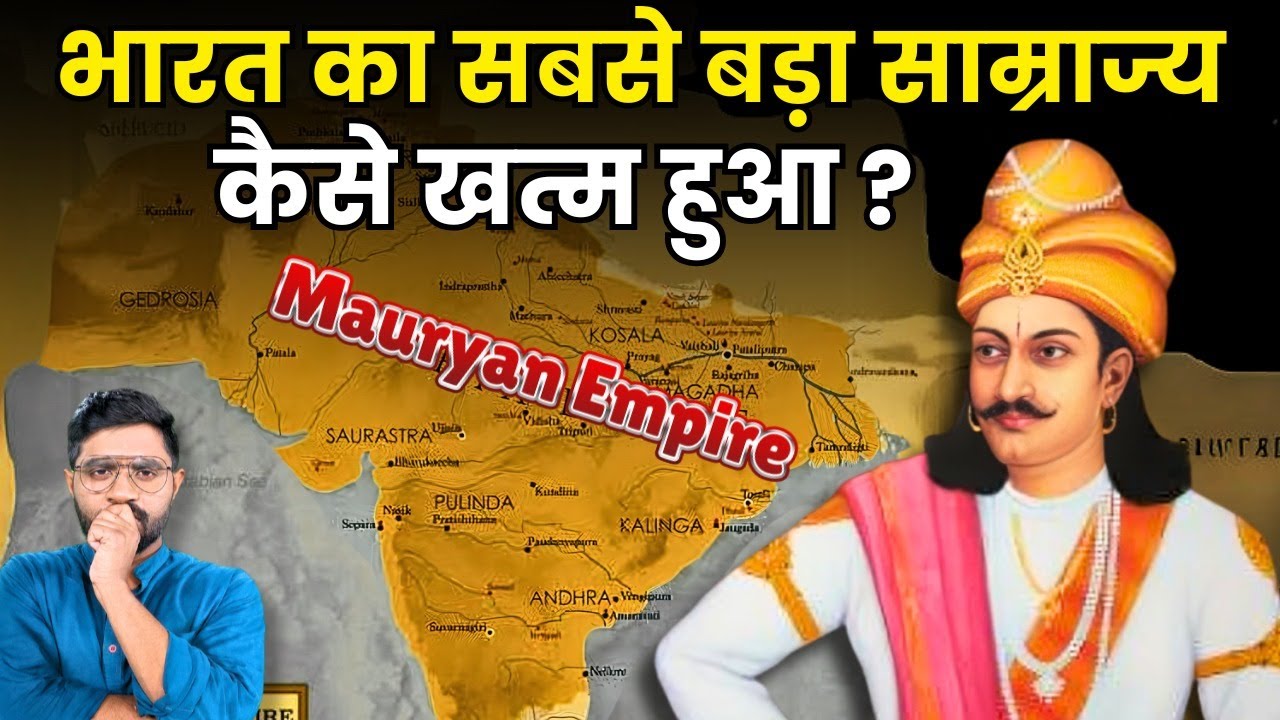
Geographical Extent of the Mauryan Empire at Its Peak
Societal and Cultural Flourishing in the Post-Mauryan Era: Religion, Literature, and Arts
Following the political fragmentation of the Maurya Empire, the subcontinent experienced a period of intense cultural and religious transformation, where Buddhism evolved significantly and Vedic Brahmanism reasserted itself, shaping the future of Indian philosophical thought and social structure.
Religious Transformation: Rise of Mahayana and Bhakti Cults
The post-Mauryan age was defined by dynamic religious shifts, witnessing the popularization of theistic traditions that offered salvation through intense personal devotion (Bhakti) and the pivotal split within Buddhism.
Origin and Growth of Mahayana Buddhism
Buddhism underwent a major metamorphosis, especially under the patronage of Central Asian rulers, leading to the emergence of Mahayana Buddhism (The Great Vehicle). This form contrasted sharply with Hinayana Buddhism (The Lesser Vehicle), emphasizing the divinization of the Buddha and the ideal of the Bodhisattva.
New Buddhist Literary Contributions
The period saw the creation of significant texts like the Milindapanha, a profound dialogue between the Indo-Greek king Menander and the philosopher Nagasena, which reinforced Buddha's divine status. Similarly, the Buddhacharita by Asvaghosha provided a biographical narrative that cemented the divine image of the Gautama Buddha.
The Emergence of Vaishnava and Shaiva Traditions
This era saw the solidifying of popular Hinduism out of Vedic Brahmanism, primarily centered around two powerful theistic streams: Vaishnavism (worship of Vishnu, Vasudeva, Krishna) and Shaivism (worship of Shiva and Shakti). Both traditions embraced the concept of salvation through a supreme deity’s grace and Bhakti, while gradually moving away from animal sacrifices.
Royal Patronage for New Faiths
The influence of new rulers, such as the Kushan rulers, is visible, as illustrated by Vima Kadphises who notably depicted the deity Shiva on his coins, signifying the growing royal support for these emerging Hindu sects.
The Codification of Social Law: The Dharmashastra of Manu
In response to the shifting religious landscape and the need for social order in a fragmented political environment, Brahmanic scholars reinforced Vedic orthodoxy through the composition of authoritative legal and social texts.
- (a) The Manusmriti: Composed between 200 BCE and 200 CE, the Manusmriti (or The Dharmashastra of Manu) emerged as the authoritative text for Brahmanical law, belonging to the Smriti corpus, providing detailed codes for moral and legal principles.
- (b) Key Social and Political Themes: These texts aimed to legitimize the divine right of kings, meticulously rationalize the complex caste system (Varna) and the stages of life (Ashramas), and enforce strict views on women’s roles, thereby structuring society under a formalized, Brahmanical framework.
Secular Literature and Unprecedented Scientific Advances
Despite political upheaval, the Post-Mauryan era was a golden age of cultural cross-pollination, leading to significant advances in literature, science, and the arts, incorporating influences from Persia, Greece, and China.

Successor States After the Decline of the Mauryan Empire - (i) Flourishing Literature: While Prakrit languages gained popularity, Sanskrit remained the language of the elite, used in inscriptions by foreign rulers like Rudradaman. Monumental works such as the Mahabhashya by Patanjali and the early documentation of South Indian history in the Sangam literature (200 BCE – 200 CE) were crucial literary outputs.
- (ii) Groundbreaking Scientific Developments: Indian scholars made precise advancements in Astronomy (detailed planetary calculations), Mathematics (introduction of trigonometry and indeterminate equations), and Medicine. The refinement of Ayurveda by luminaries like Charaka and Susruta established foundational medical practices that influenced global thought.
- (iii) Innovative Art and Architecture: The stupa, with the Sanchi Stupa as the most refined example, became a primary architectural symbol. Three major schools of sculpture emerged, showcasing regional and international fusion:
- (a) Gandhara School: Distinctly influenced by Greek and Roman art (Hellenistic style), famed for its depictions of the Buddha.
- (b) Mathura School: Characterized by an indigenous Indian artistic style and vigour.
- (c) Amaravati School: Known for its highly intricate carvings and narrative Buddhist themes.
Quick Revision Capsule
A quick comparative reference of the Post-Mauryan developments across politics, religion, literature, and art:
| Domain | Key Transformation / Mechanism | Core Outcome / Significance |
|---|---|---|
| Political Structure | Transition from central rule to regional dynasties (Shungas, Kushans, Satavahanas) | Assassination of Brihadratha in 185 BCE ended central empire |
| Buddhist Religion | Division into Hinayana and Mahayana schools | Deification of Buddha and introduction of the Bodhisattva ideal |
| Brahmanical Law | Codification of social laws via Manusmriti (200 BCE–200 CE) | Formalized social hierarchies, Varna, and Ashrama systems |
| Language & Literature | Rise of Sanskrit patronage and early Sangam Literature | Works like Patanjali's Mahabhashya and Asvaghosha's Buddhacharita |
| Visual Arts | Emergence of Gandhara, Mathura, and Amaravati schools | Hellenistic fusion combined with native sculptural traditions |
Summary
The fall of the Maurya Empire was not a mere political failure but a historical process driven by the compounding effects of weak leadership, fiscal mismanagement, and political unrest, culminating in the 185 BCE assassination of Brihadratha. However, the subsequent Post-Mauryan period was marked by intense cultural and intellectual development, including the evolution of Mahayana Buddhism, the rise of Vaishnava and Shaiva traditions, and breakthroughs in science and literature. Understanding this transition is crucial for students, as it highlights how the collapse of a centralized state can paradoxically open the door to profound and lasting societal, religious, and artistic advancements in ancient Indian history.
Quick Revision Points
Essential checkpoints for last-minute exam revision:
- (i) The Mauryan Empire ended in 185 BCE when Pushyamitra Shunga killed Brihadratha and founded the Shunga Dynasty.
- (ii) Mahayana Buddhism introduced idol worship of Buddha and the Bodhisattva concept, supported by Kushan patronage.
- (iii) The Manusmriti was composed between 200 BCE and 200 CE to reinforce Brahmanical socio-legal structures.
- (iv) Three distinct art styles developed: Gandhara (Greco-Roman influence), Mathura (indigenous style), and Amaravati (narrative relief panels).
- Exam Tip: Pay special attention to the causes of Mauryan decline (economic strain vs. weak leadership) and be prepared to compare the key features of Gandhara and Mathura sculpture styles in descriptive questions.
Frequently Asked Questions (FAQ)
Q1: Who was the last ruler of the Maurya Empire, and how did it end?
A1: The last Mauryan ruler was Brihadratha. He was assassinated in 185 BCE by his military commander, Pushyamitra Shunga, who then established the Shunga Dynasty.Q2: What is the main difference between Hinayana and Mahayana Buddhism?
A2: Hinayana focuses on the original teachings and individual self-discipline without idolizing Buddha. Mahayana treats Buddha as a divine deity, emphasizes devotional worship, and centers on the concept of Bodhisattvas.Q3: What role did the Manusmriti play in the Post-Mauryan period?
A3: Composed between 200 BCE and 200 CE, the Manusmriti served as a legal and moral code that reaffirmed Vedic orthodoxy, strict Varna caste duties, and social order following imperial disintegration.