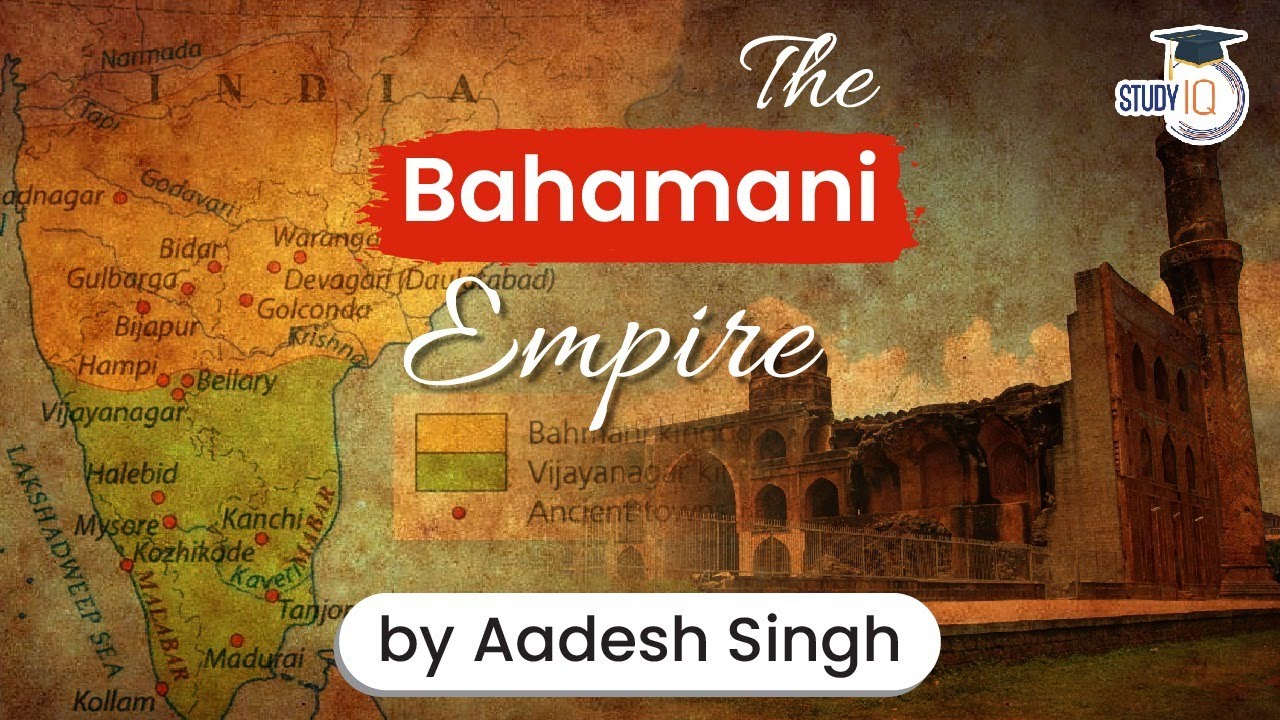
The creation of the Bahmani Kingdom (–) was a major turning point in medieval Indian history. It was the first powerful Muslim state to rise in the Deccan region. Founded by Alauddin Hasan Bahman Shah (originally called Hasan Gangu) in , this grand South Indian empire played a central role in regional politics while shaping art, architecture, literature, and administrative systems. Learning about the Bahmani Sultanate's rulers, governance, and culture is very important for students preparing for competitive history exams.
🎯 In this chapter, you will understand:
- How the Bahmani Kingdom was founded in 1347 and expanded across the Deccan.
- The administrative reforms, tax structures, and military organization of the empire.
- The architectural, literary, and cultural achievements under key monarchs and ministers.
- The causes behind the empire's decline and its split into five successor sultanates.
💡 Why this topic matters: It marks the establishment of the first major Islamic state in South India, laying the ground for regional administration and Indo-Persian culture.
🧠 Core Idea: The Bahmani Sultanate balanced heavy military defense against neighboring empires like Vijayanagar with rich administrative and artistic development.
📌 Bahmani Kingdom: The Rise, Administration, and Enduring Cultural Legacy in the Deccan (1347-1526)
The Bahmani Kingdom, set up by Alauddin Hasan Bahman Shah in , grew into a mighty Muslim empire across the strategic Deccan plateau. It stood as a strong power that frequently fought with the nearby Vijayanagar Kingdom, before eventually breaking up into five famous successor states known as the Deccan Sultanates.
- (i) The kingdom began after a successful revolt led by Zafar Khan against Muhammad Bin Tughlaq of the Delhi Sultanate, backed by local Sufi saints.
- (ii) For almost two centuries, from to around , the Bahmani state served as a dominant political and cultural force in South India.
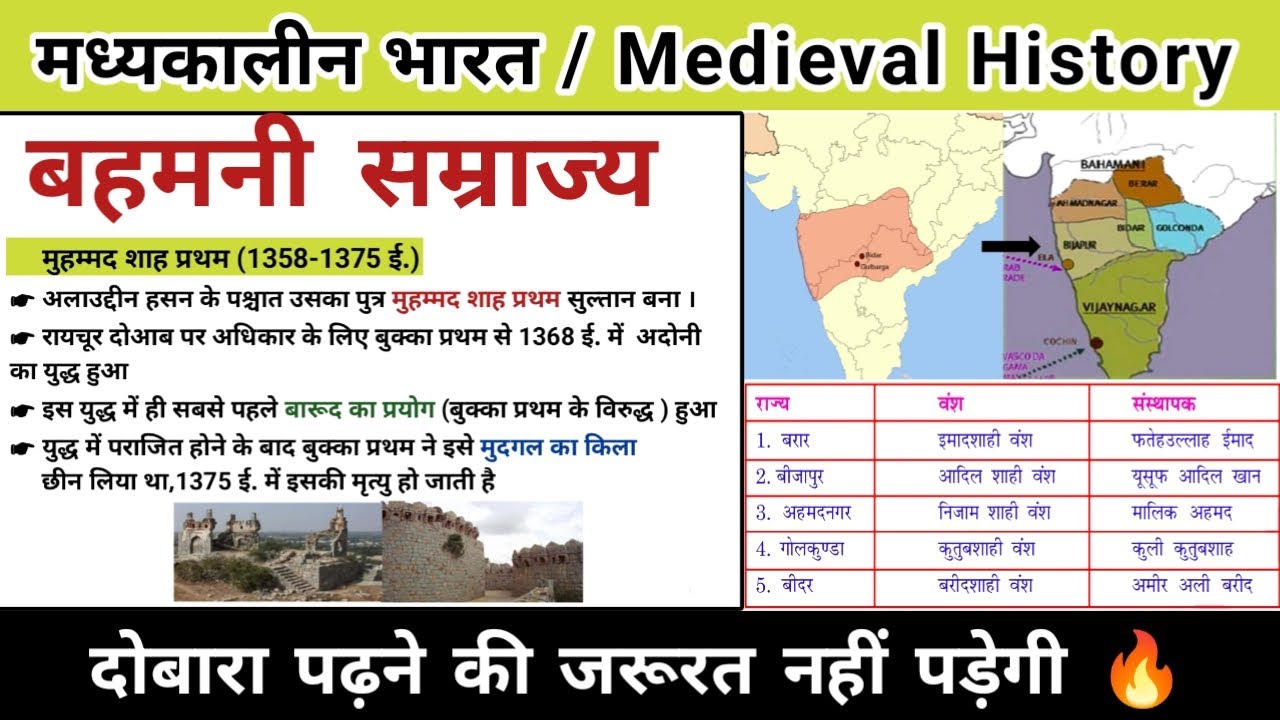
- (iii) The empire reached its highest efficiency under the leadership of its Prime Minister, Mahmud Gawan, but later split into five separate Deccan Sultanates: Bijapur, Ahmednagar, Berar, Golconda, and Bidar.
👑 Origin, Visionary Rulers, and Territorial Expansion of the Bahmani Sultanate
Starting from a swift military revolt, the kingdom was organized and expanded by capable kings who focused on both growing their borders and supporting culture.

Alauddin Hasan Bahman Shah (1347-1357): The Foundation of Deccan Sovereignty
Alauddin Hasan Bahman Shah, the founder, built up his power and made Gulbarga his first capital city.
- (i) As the main leader of the Bahmani Kingdom, he secured key regions and set up Gulbarga as the center of government.
- (ii) He expanded the new empire across key parts of the Deccan.
- (iii) He built the early foundation for the state's administration and military organization.
Muhammad Shah I (1358-1377): Asserting Military Dominance
Muhammad Shah I strengthened the military power of the kingdom through key victories over nearby rivals.
- (i) His rule saw major battles, including successful campaigns against the Vijayanagar Kingdom and taking over land from the Warangal Kingdom.
Feroz Shah Bahmani (1397-1422): Patronage and Cultural Integration
Feroz Shah Bahmani encouraged learning, culture, and overseas business during his reign.
- (i) He supported arts, science, and foreign trade, bringing global attention to the Deccan.
- (ii) He appointed qualified Hindus to high positions in his administration to use local talent.
Ahmed Shah I (1422-1435): The Strategic Shift to Bidar
Ahmed Shah I moved the capital city to help protect and grow the kingdom.
- (i) He moved the royal capital from Gulbarga to Bidar and finished taking over the remaining Warangal territories.
Mahmud Gawan (1463-1481): Zenith of Administrative Excellence
The time of Mahmud Gawan, a talented Persian statesman, was the peak period of Bahmani strength.
- (i) Serving as Prime Minister under Muhammad Shah III, Gawan reformed the administration, updated the land revenue setup, and expanded sea trade networks to bring wealth to the empire.
🏛️ Bahmani Governance: Feudal Administration, Military Might, and Revenue Structures
The Bahmani Kingdom used a feudal administrative structure backed by a centrally managed revenue and military system.
Administrative Structure and Hierarchy
The government was organized like a pyramid, with the King at the top and governors handling the provinces.
- (i) The Sultan was the supreme head of state, holding absolute power over laws, courts, and government decisions.
- (ii) The empire was divided into four large provinces (Tarafs), each run by a governor called a Tarafdar.
- (iii) Local village administration was managed by traditional officers like the Patel (tax collector and local police) and the Kulkarni (village accountant).
Military Organization and Command Structure
The army was vital to safeguard borders against rival states.
- (i) The kingdom kept a regular standing army made of four groups: infantry, cavalry, war elephants, and early artillery.
- (ii) The Sultan was the main commander-in-chief, assisted by senior officials like the Amir-ul-Umra (military minister) and Kiledars (fort commanders).
Revenue Administration and Economic Foundation
State funds came mostly from farm produce and commercial taxes.
- (i) Land revenue was the main source of income, with the normal tax set at one-third of total agricultural produce.
- (ii) Other earnings came from house taxes, trade taxes, and specific profession taxes.
- (iii) Tax funds paid for the standing army, royal court expenses, and public works.
🎨 Culture, Intellectual Exchange, and Iconic Indo-Islamic Architecture
The Bahmani rulers supported learning, encouraged cultural exchange, and created distinct Indo-Islamic architecture.
Education, Scholarship, and Linguistic Patronage
Promoting education was central to the Bahmani state, seen through its schools and support for visiting scholars.
The historic Mahmud Gawan Madrasa located at Bidar, built as a center for higher learning. - (i) Kings built Madrasas (centers of learning), maintained libraries, and supported foreign scholars.
- (ii) Persian and Arabic were used as the primary languages for court work, writing, and government records.
- (iii) The kingdom brought together artistic and literary ideas from the Middle East, Central Asia, and India.
Architectural Achievements and the Indo-Persian Style
Bahmani buildings mixed Indian and foreign styles into grand historical monuments.
- (i) The local Indo-Islamic building style mixed with Persian influences, seen in its domes and decorative arches.
- (ii) Famous monuments include Gulbarga Fort, the covered Jama Masjid, Bidar Fort, the tall Chand Minar, and the Madrasa of Mahmud Gawan.
⚡ Quick Revision Capsule: Bahmani Kingdom (1347–1526)
Key summary details about the Bahmani Sultanate for fast revision:
| Aspect | Key Details | Historical Impact |
|---|---|---|
| Founder & Capital | Alauddin Hasan Bahman Shah (); Capital at Gulbarga (later moved to Bidar). | First independent Muslim state in the Deccan plateau. |
| Administrative Unit | Provinces called Tarafs governed by a Tarafdar. | Streamlined central and regional governance. |
| Peak Reformer | Prime Minister Mahmud Gawan under Muhammad Shah III. | Reorganized land revenue, expanded foreign trade, and built the Bidar Madrasa. |
| Land Tax Rate | Fixed at 1/3 of total agricultural produce. | Funded the professional standing army and forts. |
| Successor States | Split into 5 Deccan Sultanates: Bijapur, Ahmednagar, Berar, Golconda, Bidar. | Continued Deccan Indo-Persian culture until Mughal annexation. |
📝 Summary
The Bahmani Kingdom (–) was the first great Muslim empire of the Deccan. It built strong foundations in governance, art, architecture, and education. Leaders like Alauddin Hasan Bahman Shah, Feroz Shah Bahmani, and Ahmad Shah I expanded its lands, encouraged diverse culture, and reformed the government. Studying the Bahmani Sultanate helps students understand South Indian history and the later emergence of the Deccan Sultanates.
🚀 Quick Revision Points
Essential facts to review before examinations:
- (i) Established in by Hasan Gangu after rebelling against Muhammad Bin Tughlaq.
- (ii) Divided into four administrative provinces called Tarafs led by Tarafdars.
- (iii) Capital shifted from Gulbarga to Bidar under Ahmed Shah I in .
- (iv) Famous architectural marvels include the Jama Masjid at Gulbarga and the Madrasa of Mahmud Gawan at Bidar.
- 💡 Exam Tip: Remember that Mahmud Gawan was not a king, but the Prime Minister (Vizier) who brought the Bahmani Kingdom to its highest peak of power before its split.
❓ Frequently Asked Questions (FAQ)
Q1: Who founded the Bahmani Kingdom and when?
A1: It was founded in by Alauddin Hasan Bahman Shah (also known as Hasan Gangu).Q2: What were the provinces in the Bahmani Kingdom called?
A2: The provinces were called Tarafs, and each was ruled by a governor known as a Tarafdar.Q3: What five states emerged after the Bahmani Kingdom broke apart?
A3: It split into the five Deccan Sultanates: Bijapur, Ahmednagar, Berar, Golconda, and Bidar.
👑 Notable Rulers: Leadership, Reforms, and Enduring Cultural Impact
The reigns of leaders like Feroz Shah Bahmani and Ahmad Shah I brought territorial growth, governance reforms, and cultural developments.
Firuz Shah Bahmani (1397-1422): The Scholar-King and Patron of Learning
Feroz Shah Bahmani was known for his support of education, diverse court life, and development projects.
Leadership and Cultural Patronage: Promoting Knowledge
- (i) He supported religious studies and natural sciences to boost learning in his kingdom.
- (ii) His court welcomed scholars and artists from different regions and cultural backgrounds.
Administrative Reforms and Astronomy: Integrating Talent
- (i) He appointed Hindus into senior roles in his administration, especially in revenue management.
- (ii) Interested in astronomy, he built an observatory near Daulatabad.
Military Campaigns and Cultural Dominance: Assertion of Power
- (i) He expanded control toward Berar and fought campaigns against Vijayanagar forces in the Krishna-Godavari region.
- (ii) His policies strengthened Bahmani influence across the Deccan plateau.
Ahmad Shah I (1422-1436): Strategic Shift and Territorial Consolidation
Ahmad Shah I moved the capital city to centralize power and expand the kingdom's territory.
Succession and Military Campaigns: Spiritual Influence
- (i) He took the throne after Feroz Shah and was guided by the Sufi saint Gesu Daraz.
- (ii) He led military campaigns toward Warangal and secured important eastern coastal ports.
Capital Shift and Regional Consolidation: Centralizing Authority
- (i) He moved the royal capital from Gulbarga to Bidar for better security and central administration.
- (ii) He expanded Bahmani power into Malwa, Gondwana, and the Konkan coast.
🎓 Historical Significance and Summary of the Bahmani Kingdom for Students
Flourishing from to , the Bahmani Kingdom created a strong foundation in administration, art, architecture, and education in the Deccan. Key leaders like Alauddin Hasan Bahman Shah, Feroz Shah Bahmani, and Ahmad Shah I led territorial expansion, built trade connections, and supported cultural growth. Understanding the Bahmani Sultanate is vital for students learning about medieval South Indian history.