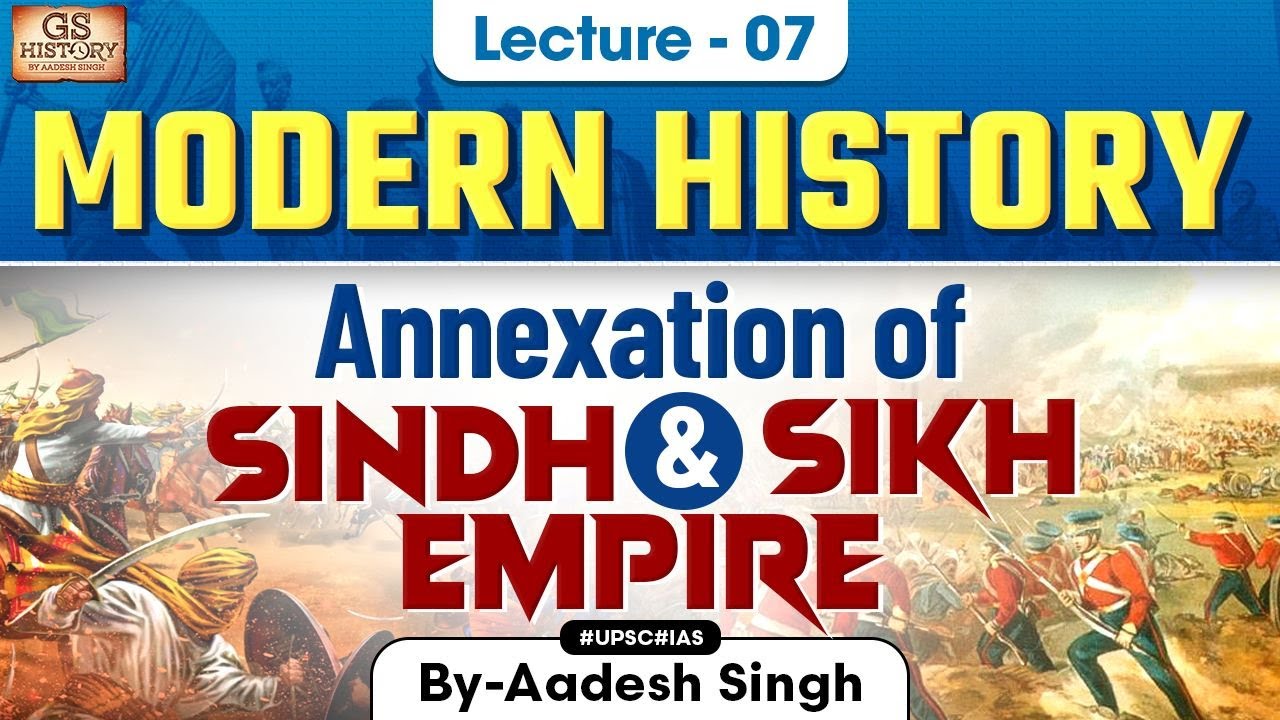
The British expansion in Sindh, spanning the late 18th and early 19th century, represents a pivotal and often aggressive chapter in Indian colonial history. Through a sequence of key treaties, calculated political maneuvers, and enforced alliances, the British East India Company systematically secured strategic control of Sindh, profoundly shaping trade, diplomacy, and military operations in the entire region, making this a crucial area of study for students preparing for modern Indian history examinations.
🎯 In this chapter, you will understand:
- Early British interests in Sindh driven by anti-French and anti-Russian diplomatic strategy.
- The economic and navigation impact of the landmark Treaty of .
- The political subjugation through the Tripartite Treaty and Subsidiary Alliance of .
- The ultimate conquest and formal annexation of Sindh under Lord Ellenborough in .
💡 Why this topic matters: It highlights how European geopolitical rivalries directly resulted in the military subjugation and territorial expansion of the British Empire in northwest India.
🧠 Core Idea: The British East India Company gradually transformed commercial access into complete political and military dominance over Sindh using defensive treaties, financial extortion, and aggressive warfare.
📌 British Expansion in Sindh: Historical Treaties and Political Strategies (1799–1843)
The British movement into Sindh combined diplomatic pacts with military pressure to build a safe frontier along northwestern India.
- Late 18th Century: Early British Interests and Fear of External Alliances
The initial British focus on Sindh was driven primarily by geopolitical fears rather than immediate economic desire. The late 18th century saw the growing dread of a powerful coalition between Napoleon Bonaparte, the French Emperor, and Tipu Sultan of Mysore, threatening a land-based invasion of India.
- (i) In , the then Governor-General, Lord Wellesley, proactively attempted to re-establish and expand commercial ties with Sindh, fundamentally aiming to create a strategic buffer and counteract the potential French–Tipu Sultan–Shah Zaman alliance.
- (ii) These strategic negotiations were opened with the local ruler, Fath Ali Khan, in the hope of securing a foothold.
- (iii) However, influenced by the strong counsel of Tipu Sultan and the vocal opposition from local mercantile groups, the Amir of Hyderabad (Sindh) decisively rejected the British overtures and expelled the British agent, Crow, in , an insult the Company chose to quietly overlook for the time being.
📌 Treaty of ‘Eternal Friendship’ and Securing the Western Frontier
A renewed and much more urgent British interest in Sindh emerged due to the menacing geopolitical landscape in Europe, specifically the threat posed by Napoleon and Russia's expansionist plans towards India.

The Specter of Franco-Russian Invasion on India
The signing of the Tilsit alliance between Alexander I of Russia and Napoleon Bonaparte was a turning point. This treaty included alarming provisions for a joint land invasion of India, which forced the British to create a robust and continuous strategic barrier across their northwestern frontier to contain Russia.
- (i) This immediate fear drove the British to consolidate alliances with states positioned between Russia and British India.
Proactive British Diplomatic Missions for Defensive Pacts
In response to the Franco-Russian threat, Lord Minto launched a series of high-level diplomatic missions across the region to secure strategic partnerships against the impending invasion.
- (a) Key envoys were dispatched: Metcalfe to Lahore (Punjab), Elphinstone to Kabul (Afghanistan), and Malcolm to Teheran (Persia).
- (b) Simultaneously, Nicholas Smith was sent to Sindh to negotiate a definitive defensive arrangement, known as the Treaty of ‘Eternal Friendship’, with the ruling Amirs.
- (c) The Amirs, after deliberation, agreed to the terms, which principally involved the complete exclusion of French influence from their territory and the mutual exchange of diplomatic agents with the British.
- (d) This treaty was formally renewed in , notably expanding its scope to exclude not only the French but also Americans, and concurrently resolving outstanding border issues near Kachch following the decisive defeat of the Maratha Empire in .
📌 The Treaty of 1832: Opening the Indus to British Commerce
The treaty marked a significant escalation of British influence, transitioning the relationship from a purely political defensive pact to one encompassing strategic economic control over the region's key waterway. William Bentinck dispatched Colonel Pottinger to Sindh to finalize this crucial agreement with the Amirs.
Key Provisions: Free Passage for Trade, Not Arms
The agreement was designed to open the lucrative trade routes of the Indus River to English traders while attempting to maintain a facade of respect for Sindh's sovereignty by restricting military presence.
The Indus River trade navigation route opened under the Treaty of 1832. - (i) The most critical provision granted free passage for English traders to navigate the entire length of the Indus; crucially, this privilege was explicitly restricted and did not extend to warships or any form of military cargo.
- (ii) To appease the Amirs, English merchants were strictly prohibited from settling permanently in Sindh, and all travelers were mandated to carry proper passports.
- (iii) The Amirs retained the sovereign right to adjust local tariff rates on goods, but they were expressly forbidden from imposing any form of military dues or tolls on the passing trade.
- (iv) The treaty stipulated mutual collaboration with the Raja of Jodhpur, specifically to suppress the threat of regional robbers operating in the vicinity of Kachch.
- (v) Finally, the agreement formally confirmed all previous treaties and included mutual clauses of non-jealousy, though this commitment would soon be compromised by the British.
📌 Lord Auckland’s Strategy: Converting Sindh into a British Protectorate
With Lord Auckland arriving as Governor-General in , the focus shifted from commercial penetration to outright political and military control, driven by the escalating situation in Afghanistan.
Consolidating Control for the Afghan Campaign
Lord Auckland's primary mandate was to further protect India from the anticipated Russian invasions and to gain decisive influence over the fiercely independent Afghans. Since Ranjit Singh of Punjab remained a formidable power resisting British influence, the relatively weaker Amirs of Sindh became the strategic target for military consolidation.
- (i) The need to secure a reliable logistical base and transit route for British military operations into Afghanistan made the consolidation of control over Sindh an unavoidable strategic step.
- (ii) Exploiting the capture of the territory of Rojhan in Sindh, Pottinger successfully negotiated and signed a crucial new treaty with the Amirs.
- (iii) This treaty promised the Amirs protection, but at the cost of agreeing to accept the stationing of permanent Company troops within their territory, with the Amirs footing the entire expense.
- (iv) By accepting the British demand for intervention in their disputes and the presence of a permanent British resident, the Amirs effectively conceded their full sovereignty, and Sindh was thus rendered a formal British protectorate.
The Tripartite Treaty of 1838: The British Afghan Strategy
To further isolate and pressure Afghanistan, the British engineered the Tripartite Treaty, using Sindh as a pawn in their larger regional game, ultimately financing their own Afghan objectives using Sindhi resources.
Using Sindhi Tribute for Afghan War Chest
The British successfully convinced Ranjit Singh to sign this treaty, which, among other things, designated the British as the mediating power in any existing or future disputes between the Sikh Empire and the Amirs. Simultaneously, the British manipulated the exiled Emperor Shah Shuja to formally renounce his historical rights over Sindh in exchange for an agreed-upon annual tribute payment.
- (i) The British swiftly took control over the assessment and collection of this tribute amount.
- (ii) This collected money was immediately diverted to fund the costly Afghan military campaigns, effectively securing both a vital transit route through Sindh and a means of funding the war effort against Afghanistan.
Forced Acceptance of British Subsidiary Alliance (1839)
The British moved quickly to formally consolidate their military hold on Sindh, coercing the Amirs into accepting the stringent terms of the Subsidiary Alliance, fundamentally overriding the non-military clauses of the treaty.
Provisions for Permanent Military Occupation and Financial Strain
The treaty signed in cemented the end of Sindh's independence and the beginning of its financial subjugation to the Company.
- (i) It dictated the compulsory stationing of British troops at key strategic points, specifically Shikarpur and Bukkar, with the Amirs being forced to pay a heavy annual subsidy of Rs 3 lakh for the maintenance of these forces.
- (ii) The Amirs were strictly prohibited from engaging in any foreign diplomatic negotiations without the explicit approval of the Company, effectively stripping them of external sovereignty.
- (iii) The treaty demanded the provision of store-rooms for the Company’s military supplies at the critical port of Karachi and formalized the abolition of all tolls on trade moving along the Indus River.
- (iv) Despite intelligence from Pottinger suggesting that Herat was indefensible, Auckland disregarded the advice and proceeded with the costly Afghan War, critically relying on Sindh as the primary transit base for all troops and supplies.
The Progressive Conquest and Formal Annexation of Sindh (1843)
Despite having secured a protectorate and a subsidiary alliance, the British rapidly moved toward the outright annexation of Sindh, justifying their final conquest through a mix of strategic, economic, and fabricated reasons.
Final Drivers for Annexation and Economic Gain
The official conquest under Lord Ellenborough was rationalized by several factors, which masked the true British desire for territorial and commercial expansion.
- (i) Economic Temptation: The perception of immense wealth concentration among the Amirs made the region an attractive financial target for the Company.
- (ii) Land and Resources: The inherent fertility of the lands of Sindh promised lucrative agricultural revenue.
- (iii) Geopolitical Security: The British sought to permanently block any possible Persian expansionist movements toward India, which they believed could be backed by French assistance.
- (iv) Containing Russia: The long-standing threat of Russian advances remained a primary strategic justification for seizing permanent control of the region.
- (v) Commercial Access: Formal control would guarantee and facilitate unhindered trade via the crucial Indus River route.
The Final Act of Annexation
The strategic and economic objectives culminated in the formal annexation of Sindh in under Lord Ellenborough’s tenure, which was achieved through a series of military engagements, ensuring the permanent control over both the region's geography and its vital commercial waterways.
Summary: Impact of British Strategic Control Over Sindh
The aggressive sequence of treaties—from the ‘Eternal Friendship’ pact to the Subsidiary Alliance of —demonstrates the British East India Company's relentless strategy of using geopolitical fears to justify commercial and military dominance, culminating in the formal annexation of Sindh in . This pivotal event secured the Indus River trade route, created a crucial buffer against potential Russian and French influence, and served as the vital launchpad for the Afghan campaigns. The study of British expansion in Sindh is essential for students, as it powerfully illustrates the coercive diplomatic and military techniques employed by the Company to systematically dismantle local sovereignty in modern Indian history.
⚡ Quick Revision Capsule: British Expansion in Sindh
A structured timeline overview detailing the progression of British policy towards Sindh from initial contact to full annexation.
| Year / Period | Treaty or Event | Key Strategic Significance |
|---|---|---|
| Early Diplomatic Missions | Lord Wellesley tried to set up commercial relations; British agent Crow was expelled by the Amir of Hyderabad. | |
| Treaty of ‘Eternal Friendship’ | Negotiated by Nicholas Smith; excluded French and American influences from Sindh territory. | |
| Indus Trade Treaty | Opened the Indus River to English merchants while explicitly banning military vessels. | |
| Subsidiary Alliance | Stationed permanent Company troops in Sindh and extracted an annual tribute of Rs 3 lakh. | |
| Formal Annexation | Carried out under Lord Ellenborough following military operations to secure total imperial control. |
📝 Summary
The takeover of Sindh between documents the step-by-step conversion of a independent regional state into a complete British colony. As outlined in standard historical texts like Modern Indian History, fear of French and Russian invasions led the British to convert defensive non-aggression treaties into heavy military impositions.
🚀 Quick Revision Points
Essential facts to review before examinations:
- (i) Treaty of Eternal Friendship () was signed to counter Napoleon's threat in India.
- (ii) The Treaty of granted passage to merchants along the Indus but barred military passage.
- (iii) The Tripartite Treaty () exploited Sindhi resources to fund the First Anglo-Afghan War.
- (iv) Sindh was fully annexed to British India in under Governor-General Lord Ellenborough.
- 💡 Exam Tip: Focus on the shift in British policy between (commercial access without military forces) and (forced military presence through the Subsidiary Alliance).
❓ Frequently Asked Questions (FAQ)
Q1: Why did the British first take an interest in Sindh during the late 18th century?
A1: The British were concerned about foreign invasion threats, specifically a potential alliance between Napoleon Bonaparte, Tipu Sultan, and Shah Zaman of Kabul.Q2: What was the main restriction in the Treaty of 1832 regarding the Indus River?
A2: While the treaty opened the Indus River to English merchant shipping, it explicitly forbade the entry of armed vessels or military troop movements.Q3: When and under whose leadership was Sindh officially annexed?
A3: Sindh was officially annexed to British India in under the administration of Governor-General Lord Ellenborough.