The Desai–Liaqat Pact stands as a pivotal yet unsuccessful effort in the to bridge the political stalemate between the Congress and the Muslim League. Initiated by Bhulabhai Desai and Liaqat Ali Khan, this attempt sought to set up a functional interim government based on equal political representation. Though unratified, its proposals and historical impact remain an important topic for students preparing for competitive examinations on India's constitutional history.
🎯 In this chapter, you will understand:
- The underlying political stalemate that led to the Desai–Liaqat negotiations in .
- The key recommendations regarding equal representation and minority reservations.
- The reasons why party leaders ultimately rejected the informal agreement.
- The lasting influence of the parity principle on subsequent British plans like the Wavell Plan.
💡 Why this topic matters: It highlights early attempt to resolve communal political disputes through power-sharing formulas prior to partition.
🧠 Core Idea: An informal agreement between central assembly leaders to form a joint interim government based on political parity.
Background, Proposals, and Political Legacy of the Desai–Liaqat Pact (1945)
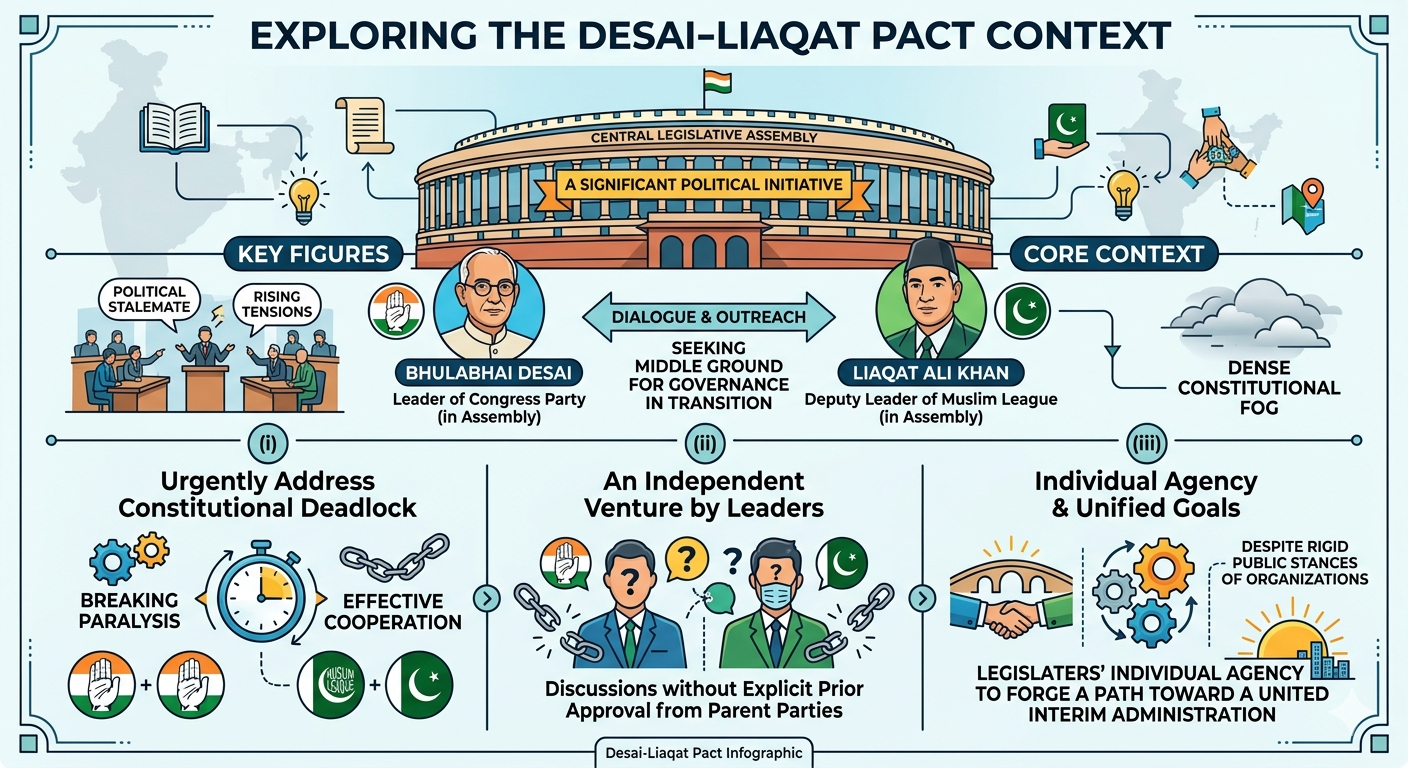
A significant political initiative emerged within the Central Legislative Assembly, led by leaders seeking to resolve the ongoing constitutional deadlock.
During a period of political stalemate, Bhulabhai Desai, leader of the Congress party in the assembly, reached out to Liaqat Ali Khan, deputy leader of the Muslim League. Their dialogue stemmed from an urgent need to find common ground to facilitate governance during a transitional phase.
- (i) The primary reason for this initiative was the urgent need to break the constitutional deadlock between the Indian National Congress and the All-India Muslim League.
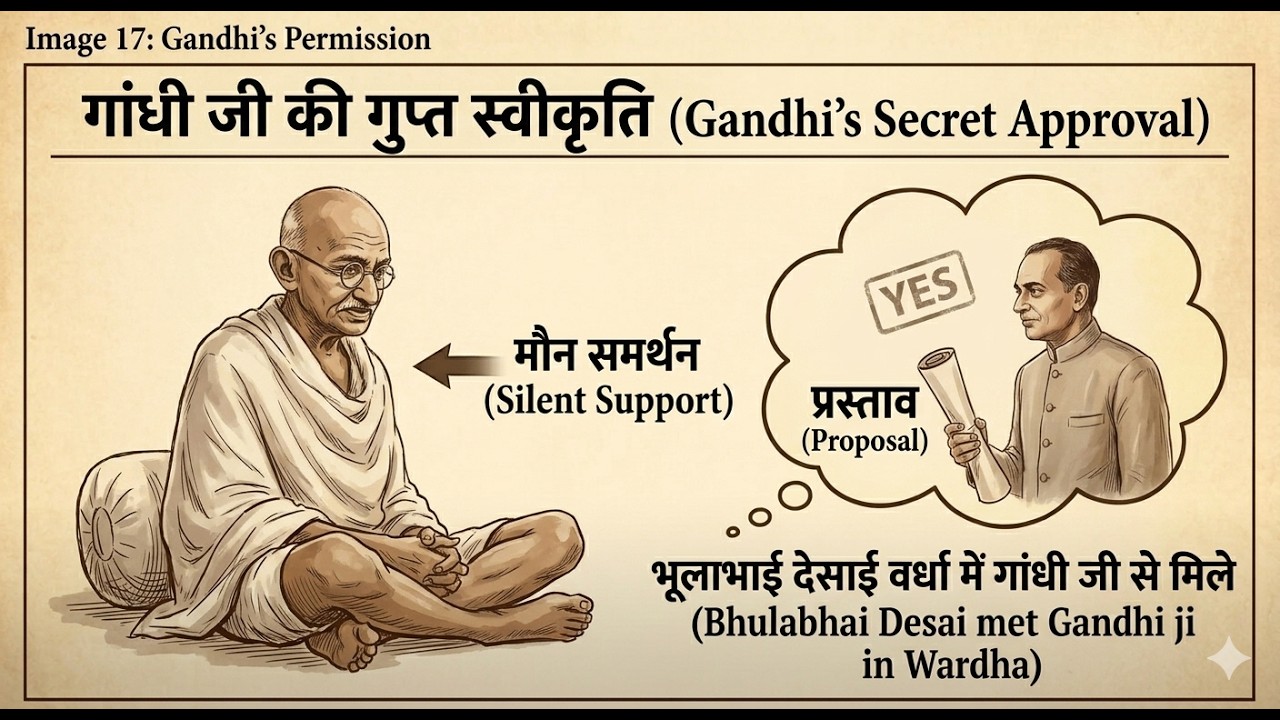
- (ii) These talks were conducted independently by both leaders without prior official approval from their respective political parties.
- (iii) This meeting shows how individual legislative leaders attempted to create a path toward a joint interim administration despite rigid party positions.
The Structural Framework and Key Proposals of the 1945 Pact
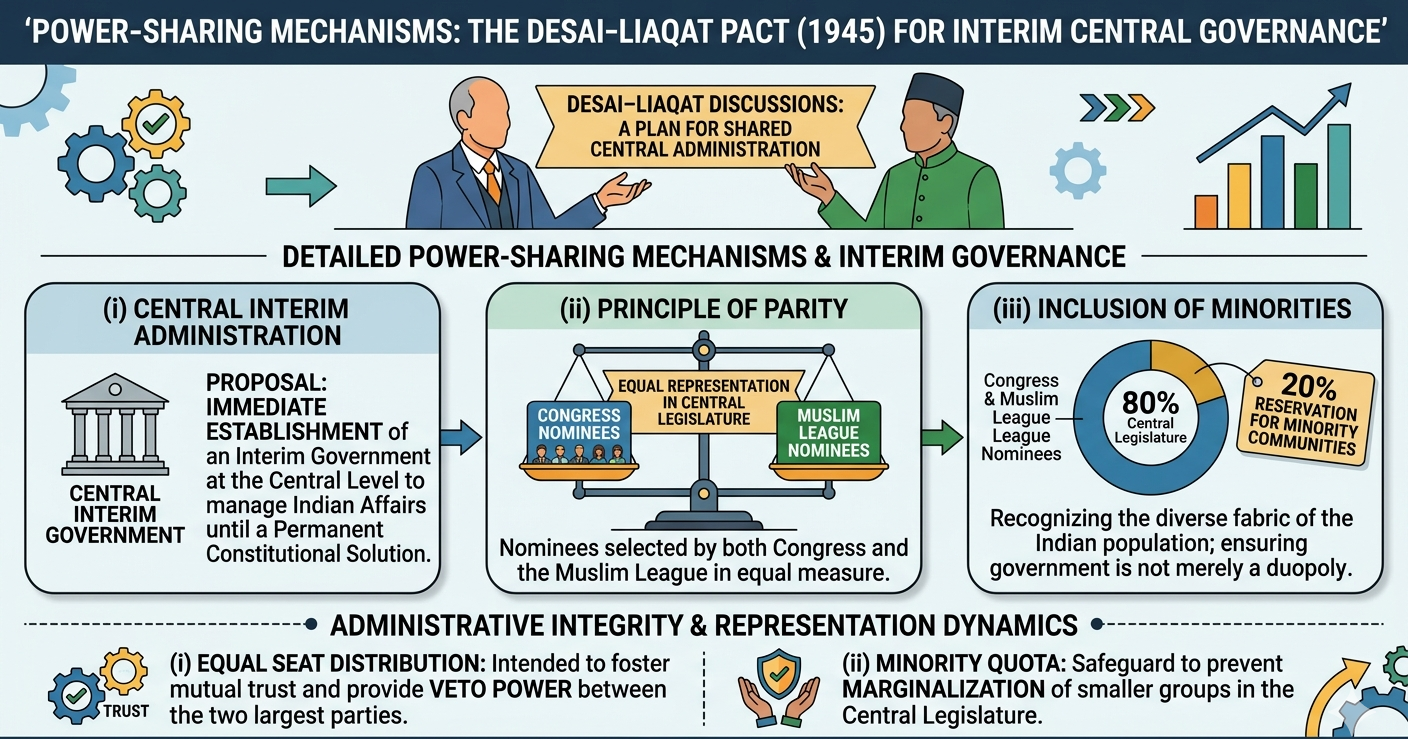
The main focus of the Desai–Liaqat discussions was a carefully designed plan for a shared central administration to balance political interests.
Detailed Power-Sharing Mechanisms and Interim Governance
The proposal planned for a transitional stage where administrative stability would be managed by a joint interim government at the center.
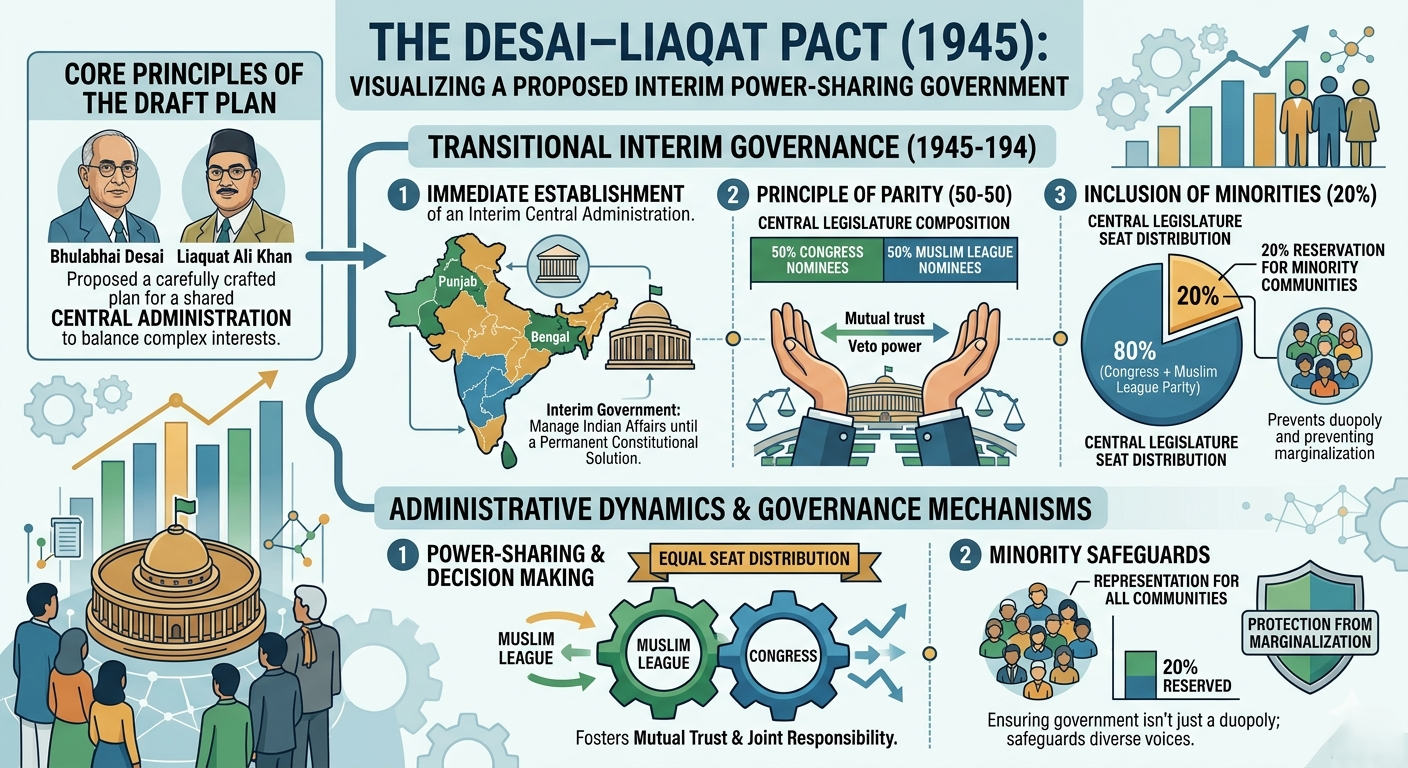
- (i) Central Interim Administration: The core proposal was to immediately set up a central interim government until a final constitutional setup was established.
- (ii) Principle of Parity: The plan suggested equal political weight, where nominees for the central legislature would be split equally between Congress and the Muslim League.
- (iii) Inclusion of Minorities: To protect diverse interests, the proposal included a 20% seat reservation specifically for minority communities.
Administrative Integrity and Representation Dynamics
The plan relied on specific representation rules to ensure cooperation between major political groups.
- (a) Equal distribution of seats was meant to build trust and offer balanced influence to both major groups.
- (b) The minority reservation acted as a safety measure to prevent smaller communities from being overlooked in the central legislature.
Political Implications and Ideological Shifts in National Discourse
Apart from administrative arrangements, the Desai–Liaqat discussions reflected a shift in handling political disputes between major parties.
- (i) The talks were an early formal recognition that structured power-sharing was required for political stability.
- (ii) Proposing parity between both organizations established a principle that appeared frequently in later constitutional talks.
The Ultimate Failure and Long-Term Impact on Indian Politics
Despite the constructive aims of the Desai–Liaqat effort, the initiative ran into major difficulties once made public to party leaders.
Rejection by Major Political Stakeholders and Unresolved Deadlock
Without official organizational support, the agreement collapsed as key leaders from both groups stepped back from the proposal.
- (i) The Congress leadership opposed equal seat representation without a clear timeline for full independence and democratic principles.
- (ii) The Muslim League leadership, under Jinnah, felt the informal deal lacked sufficient guarantees for minority protections.
- (iii) As a result, the political standstill continued, leading to official British attempts like the Wavell Plan.
⚡ Quick Revision Capsule: Key Details of the Desai–Liaqat Pact (1945)
Here is a summary table covering the essential facts and key features of the proposal:
| Feature | Details | Impact / Remark |
|---|---|---|
| Key Architects | Bhulabhai Desai (Congress) & Liaqat Ali Khan (Muslim League) | Initiated privately without formal authorization from party commands. |
| Core Proposal | Formation of a central interim government to manage transition. | Designed to solve the constitutional deadlock. |
| Representation Ratio | 50% Congress nominees, 50% Muslim League nominees | Introduced the political parity concept. |
| Minority Quota | 20% seats reserved for minority groups | Protected representation for smaller communities. |
| Final Outcome | Rejected by Congress High Command & Jinnah | Paved the way for the Wavell Plan in . |
📝 Summary
While the Desai–Liaqat Pact did not succeed in forming an interim government, its historical importance remains notable. By introducing the concept of political equality between major parties, it influenced subsequent discussions prior to the partition of India in .
🚀 Quick Revision Points
Essential facts to review before examinations:
- (i) Negotiated in early between Bhulabhai Desai and Liaqat Ali Khan.
- (ii) Advocated for an immediate central interim government.
- (iii) Applied equal numbers for Congress and League nominees alongside a minority quota.
- (iv) Failed due to lack of support from main party leaders, leading to the Wavell Plan.
- 💡 Exam Tip: Focus on the proposed seat distribution ratio (equal political seats plus 20% minority reservation) and how it influenced the Wavell Plan.
❓ Frequently Asked Questions (FAQ)
Q1: Who were the main leaders behind the Desai–Liaqat Pact?
A1: The pact was negotiated by Bhulabhai Desai of the Congress and Liaqat Ali Khan of the Muslim League.Q2: What was the main formula for seat distribution proposed in the pact?
A2: It proposed equal seats for Congress and Muslim League nominees in the central legislature, with 20% reserved for other minorities.Q3: Why did the Desai–Liaqat Pact fail?
A3: It failed because neither the Congress leadership nor Jinnah officially supported the informal agreement.