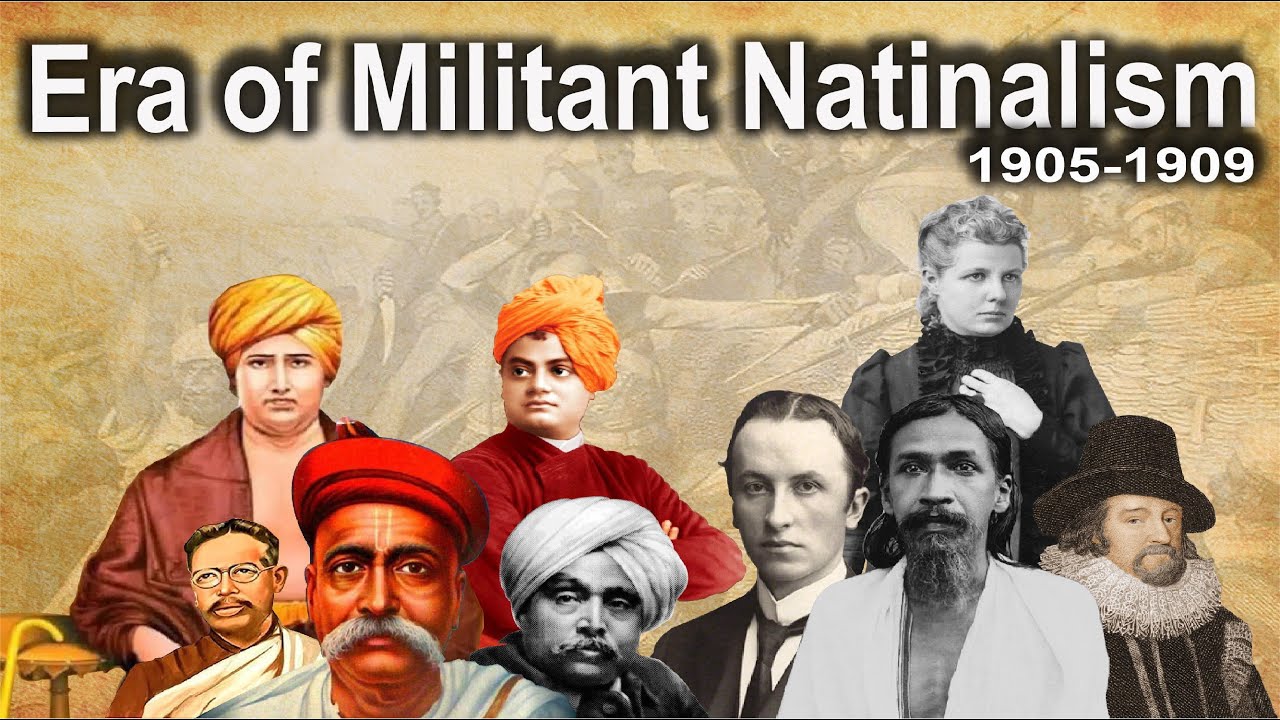
The rise of militant nationalism in India during the late and early marked a major turning point in the Indian freedom struggle. Growing anger against British rule, harsh colonial policies, deep economic distress, and the encouraging ideas of leaders like Tilak, Vivekananda, and Aurobindo created a strong, assertive phase of the national movement. Understanding this era helps students see how Indian political thinking evolved during the freedom movement.
🎯 In this chapter, you will understand:
- The key reasons behind the growth of radical nationalist ideas in India.
- How strict laws and official policies pushed young leaders toward direct action.
- The primary ideas and guiding philosophies of key Indian leaders during this time.
- How events like the 1905 Partition of Bengal turned local protests into a massive national movement.
💡 Why this topic matters: This period shifted the freedom struggle from gentle requests to strong demands for complete independence.
🧠 Core Idea: True self-rule comes through self-reliance, unity among the public, and direct peaceful resistance against unjust rule.
Militant Nationalism in India: Rise, Growth, and Leadership (1890–1905)
A major change began as people moved away from sending formal petitions toward openly demanding self-rule. This change was a direct response to the slow progress of earlier methods and the stubborn attitude of colonial administrators. The roots of this movement grew out of economic difficulty and a fresh wave of national awareness.
People across India realized that economic harm would not stop through peaceful discussions alone.
- (i) A new group of leaders questioned old methods and started asking for Purna Swaraj, or total independence.
- (ii) The social and political environment was transformed by a deep love for the nation and a willingness to make personal sacrifices.
- (iii) Public political participation expanded quickly as ordinary citizens joined the movement.
The Catalyst of Discontent: Causes for the Rise of Militant Nationalism in India
The push toward assertive politics came from a mix of financial hardships, social pressures, and harsh decisions made by administrators like Lord Curzon.

A Turning Point: Recognition of the True Nature of British Rule
By the end of the century, younger members of the Indian National Congress realized that colonial authorities were mostly focused on taking wealth out of India rather than helping its people.
- (i) Widespread severe poverty worsened as repeated crop failures and diseases hit rural areas, while official help remained very limited.
- (ii) Public trust fell further when the Indian Councils Act of 1892 failed to offer real governance responsibilities to Indian citizens.
The Era of Shackles: Repressive Legislation (1892–1904)
Instead of addressing popular concerns, authorities passed restrictive laws aimed at silencing public speech and limiting local newspapers.
Suppression in the late 1890s
Government actions in the late created widespread outrage and motivated young political workers.
- (a) In , the removal of the Natu brothers without trial and the arrest of Bal Gangadhar Tilak on charges of anti-government writing shocked the public.
- (b) In , changes to legal rules under IPC Section 124A and Section 156A made punishments for criticizing government actions much stricter.
Curzon’s Administrative Assault (1899-1904)
Administrative changes implemented between and further restricted local representation and administrative freedoms.
- (a) In , the Calcutta Corporation Act cut down the number of elected Indian members, placing decisions back in official hands.
- (b) In , the Official Secrets Act limited newspaper reporting and reduced the public flow of official information.
- (c) In , the Indian Universities Act brought higher education centers under closer government monitoring to curb student political involvement.
The Spiritual and Intellectual Revival of India
A fresh feeling of self-respect spread across the country as thinkers helped people rediscover the value of Indian heritage and reliance on local strengths.
Prominent leaders guided the public with clear ideas of self-reliance and unity. - Spiritual Pride: Thinkers like Swami Vivekananda and Bankim Chandra Chatterjee spoke deeply about cultural values, building strong confidence among the youth.
- New Leadership: Prominent leaders like Tilak, Aurobindo Ghosh, and Bipin Chandra Pal urged people to build their own strength instead of relying on government help.
- Global Events: Global events changed common beliefs when small nations stood up against larger powers, such as Japan's victory over Russia in , proving that organized national determination could succeed.
The Ultimate Provocation: The Partition of Bengal
The government plan to divide Bengal in turned widespread anger into a countrywide movement for reform and self-reliance.
- (i) The division of Bengal was seen as a step to separate people in an active center of national political activity.
- (ii) This decision started the Swadeshi Movement, which popularized the use of local goods and widespread public protests.
⚡ Quick Revision Capsule: Key Factors of Militant Nationalism
This table summarizes the main reasons, policy changes, and events that created this active political phase:
| Factor / Event | Timeframe | Impact on Freedom Movement |
|---|---|---|
| Indian Councils Act | Failed to give real powers to Indians, showing the limits of soft constitutional requests. | |
| Press & Sedition Laws | Jailed popular leaders like Tilak and restricted freedom of expression. | |
| University & Secrets Acts | Placed universities and newspaper reports under tight official control. | |
| Global Events Impact | Showed that Asian nations could defeat large empires, boosting confidence. | |
| Partition of Bengal | Triggered the Swadeshi Movement and mass boycott of foreign products. |
Philosophies of Resistance: Views and Leadership in Militant Nationalism
The active nationalist thinkers believed that freedom could be reached through self-reliance, internal strength, and direct participation by the public.
Inspirational Ideologies of the Radicals
Strong statements from this period inspired students, workers, and local communities alike:
- (i) Swami Vivekananda: Taught that physical and moral strength was essential for national progress.
- (ii) Bal Gangadhar Tilak: Explained that today's strong steps lay the ground for future standard political methods.
- (iii) Karachi Chronicle: Noted in that international examples proved focused effort could overcome strong obstacles.
The Emergence of a New Political Cadre
This period brought forward committed leaders who connected directly with ordinary people across regions.
- (i) Lal-Bal-Pal Trio: Led by Lala Lajpat Rai, Bal Gangadhar Tilak, and Bipin Chandra Pal, along with Aurobindo Ghosh.
- (ii) These key leaders gave clear direction to the Swadeshi agitation, turning political discussions into a nation-wide effort.
📝 Summary
Assertive nationalism grew out of financial suffering, rigid administrative policies, and limited results from early political requests. Under the guidance of leaders like Tilak, Aurobindo, and Lajpat Rai, people learned the value of local industries, self-confidence, and public unity. Events around set the foundation for future movements that eventually led to complete independence.
🚀 Quick Revision Points
Essential facts to review before examinations:
- (i) The movement shifted focus from sending official petitions to demanding Purna Swaraj.
- (ii) Economic distress and famines in the late created widespread public dissatisfaction.
- (iii) Strict measures like the Indian Universities Act of 1904 angered young students.
- (iv) The Partition of Bengal turned regional protests into the countrywide Swadeshi Movement.
- 💡 Exam Tip: Remember the primary leaders known as the Lal-Bal-Pal trio (Lala Lajpat Rai, Bal Gangadhar Tilak, and Bipin Chandra Pal) and their core focus on self-reliance (Swadeshi).
❓ Frequently Asked Questions (FAQ)
Q1: What was the main cause for the growth of militant nationalism?
A1: It grew due to public unhappiness with economic hardships, harsh official laws, and limited results from early political petitions.Q2: How did the Partition of Bengal impact the national movement?
A2: The partition acted as an immediate trigger that started the Swadeshi Movement and brought large numbers of citizens into active participation.Q3: Who were the main leaders of this phase?
A3: Key leaders included Bal Gangadhar Tilak, Lala Lajpat Rai, Bipin Chandra Pal, and Aurobindo Ghosh.