The Chittagong Uprising in Bengal reflected the determination of Indian revolutionaries during the freedom struggle against British rule. Despite facing government repression and internal divisions within political factions, visionary leaders like Surya Sen and his dedicated group inspired a wave of armed resistance. For students of Indian history preparing for competitive exams, this phase highlights the critical role of youth-led revolutionary movements that operated alongside mainstream Congress politics.
🎯 In this chapter, you will understand:
- The reorganization of Bengal's revolutionary groups during the .
- The life, philosophy, and leadership of Surya Sen ("Masterda").
- The planning, execution, and impact of the Chittagong Armoury Raid in .
- The long-term influence of the uprising on the Indian national movement.
💡 Why this topic matters: It highlights how localized, disciplined armed actions can disrupt colonial power and inspire national resistance.
🧠 Core Idea: Strategic discipline, local youth participation, and moral conviction can challenge state repression.
Challenges, Leadership of Surya Sen, and Impact of the Chittagong Armoury Raid in Bengal’s Revolutionary Movement
The decade of the served as a transformative period for the revolutionary landscape of Bengal, marked by both strategic reorganizations and intense internal friction. As the fervor of the freedom struggle intensified, the underground networks of Bengal sought to align themselves with broader political fronts to gain legitimacy and reach.
- (i) During the , several revolutionary groups in Bengal meticulously reorganized their underground networks while working within the Congress framework, which helped expand its grassroots base.
- (ii) A large number of revolutionaries supported C.R. Das during his Swarajist campaign, creating synergy between radical and legislative politics.
- (iii) Following the death of C.R. Das in , the Bengal Congress faced instability and split into rival factions led by J.M. Sengupta and Subhash Chandra Bose.
- (iv) This era was also marked by dramatic events, such as the assassination attempt on Police Commissioner Charles Tegart by Gopinath Saha in , which triggered severe government crackdowns and led to the arrest of prominent leaders like Subhash Bose.
Revolutionary Life and Legacy of Surya Sen: The Masterda of Bengal
Behind the Chittagong Uprising stood Surya Sen, a leader whose life combined intellectual values with militant patriotism.

Early Role in the Freedom Struggle and Grassroots Education
The journey of Surya Sen began in classrooms in Chittagong, where he balanced teaching with revolutionary ideals.
- (i) Surya Sen, initially an active leader in the Non-Cooperation Movement, worked as a teacher in a national school at Chittagong.
- (ii) His work as an educator earned him the nickname "Masterda", helping him recruit young students into the revolutionary fold.
Imprisonment, Discipline, and Strategic Political Involvement
The British Raj recognized the threat posed by Surya Sen, leading to repeated attempts to stop his work through imprisonment.
- (i) Surya Sen endured prolonged imprisonment between , using this period to refine his political strategy for Indian independence.
- (ii) After his release, he served as the secretary of the Chittagong District Congress Committee, strengthening the local movement.
Analysis of Leadership in Chittagong
Key traits of Surya Sen's leadership approach:
- (a) He connected secret organizational work with public mobilization.
- (b) He maintained strict military-style discipline within his organization.
Inspiration, Humanist Ideals, and Cultural Roots
The philosophy of Surya Sen was rooted in the cultural and humanist traditions of Bengal.
- (i) He drew strength from the poetry of Rabindranath Tagore and the verses of Qazi Nazrul Islam.
- (ii) He emphasized that "Humanism is the essence of a revolutionary," ensuring his group kept its moral compass.
Impact of the Chittagong Armoury Raid: A Blow to British Prestige
The Chittagong Armoury Raid was a key moment in the Indian freedom struggle, demonstrating that British authority could be directly challenged.
Execution of the Raid and the Provisional Government
In , Chittagong saw a coordinated action that disrupted local colonial administration.
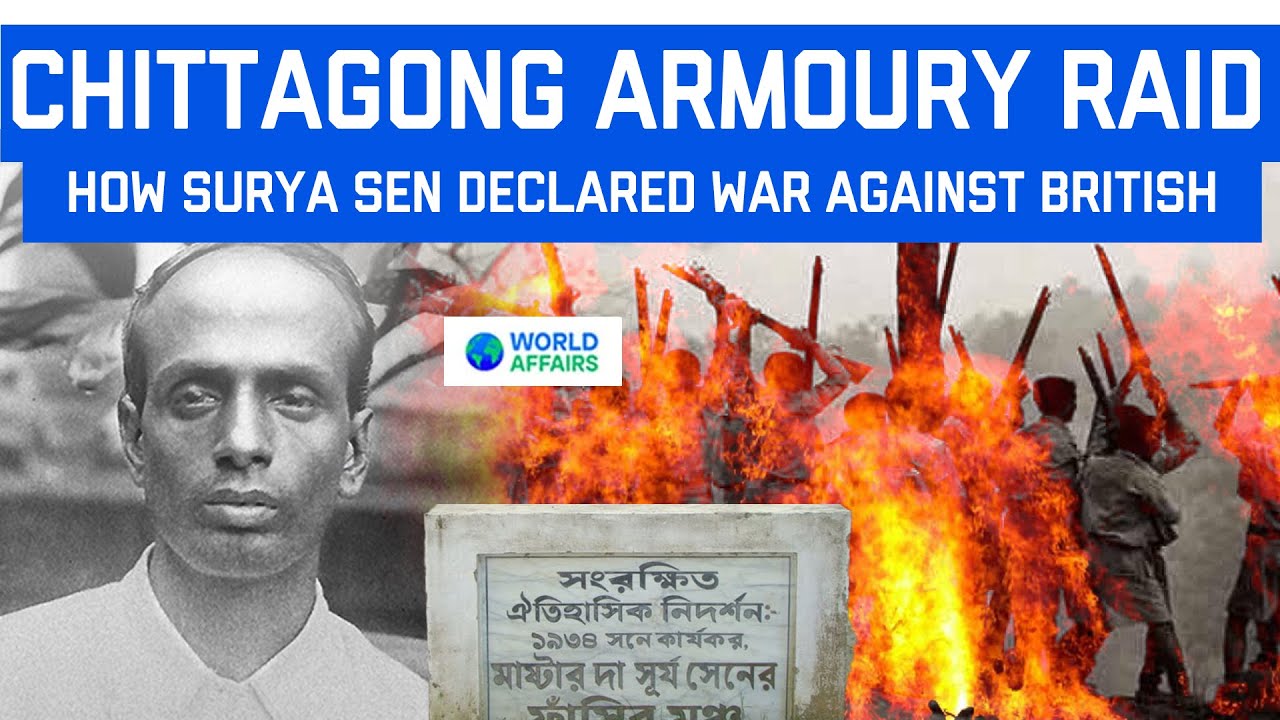
- (i) Surya Sen led an armed action with associates Anant Singh, Ganesh Ghosh, and Lokenath Baul, challenging British authority in the region.
- (ii) The plan targeted arms and ammunition in Chittagong’s main armouries and aimed to cut off communication links with the rest of Bengal.
- (iii) The operation met with initial success; a provisional revolutionary government was declared, and the Indian national flag was raised over the city.
Aftermath, Final Sacrifice, and National Inspiration
Although colonial forces regained control, the event left a lasting imprint on the Indian movement.
- (a) After years of underground resistance and guerrilla fighting, Surya Sen was arrested in following a betrayal.
- (b) His execution in inspired further youth participation across India.
- (c) The raid proved that organized actions could disrupt colonial administrative machinery.
⚡ Quick Revision Capsule: Chittagong Uprising and Surya Sen
Key highlights of the revolutionary movement in Bengal during the 1920s and 1930s:
| Aspect | Key Details | Historical Significance |
|---|---|---|
| Key Leader | Surya Sen ("Masterda") | Organized local youth and combined classroom teaching with revolutionary strategy. |
| Main Event | Chittagong Armoury Raid () | Targeted colonial armouries and cut communication channels across Bengal. |
| Associates | Anant Singh, Ganesh Ghosh, Lokenath Baul | Formed the core leadership that executed the attack and formed a provisional government. |
| Literary Influences | Works by Rabindranath Tagore and Qazi Nazrul Islam | Provided emotional and cultural grounding for the group's humanist vision. |
| Outcome & Legacy | Arrest in , Execution in | Demonstrated that planned resistance could disrupt colonial governance structures. |
📝 Summary
The Chittagong Uprising stands as an example of organized resistance during the . Led by Surya Sen, it demonstrated the impact of disciplined action and local leadership. Understanding this event helps explain the different methods used within the broader Indian independence movement.
🚀 Quick Revision Points
Essential facts to review before examinations:
- (i) Bengal revolutionaries worked within Congress platforms during the to expand their reach.
- (ii) Surya Sen was known as "Masterda" while working as a teacher in Chittagong.
- (iii) The raid temporarily cut Chittagong off from colonial administration.
- (iv) The group drew inspiration from writings by Rabindranath Tagore and Qazi Nazrul Islam.
- 💡 Exam Tip: Remember the timeline: 1920s organizational phase → Swarajist support → April 1930 Raid → 1933 Arrest → 1934 Execution.
❓ Frequently Asked Questions (FAQ)
Q1: Why was Surya Sen called "Masterda"?
A1: He was called "Masterda" because he worked as a teacher in a national school in Chittagong, where he built strong connections with local students.Q2: What was the main goal of the Chittagong Armoury Raid in 1930?
A2: The main goal was to seize arms from colonial armouries, disrupt communication systems, and declare a provisional government to challenge British rule.Q3: How did literary works influence the Chittagong revolutionaries?
A3: Leaders like Surya Sen drew inspiration from the works of Rabindranath Tagore and Qazi Nazrul Islam, combining political resistance with humanist values.