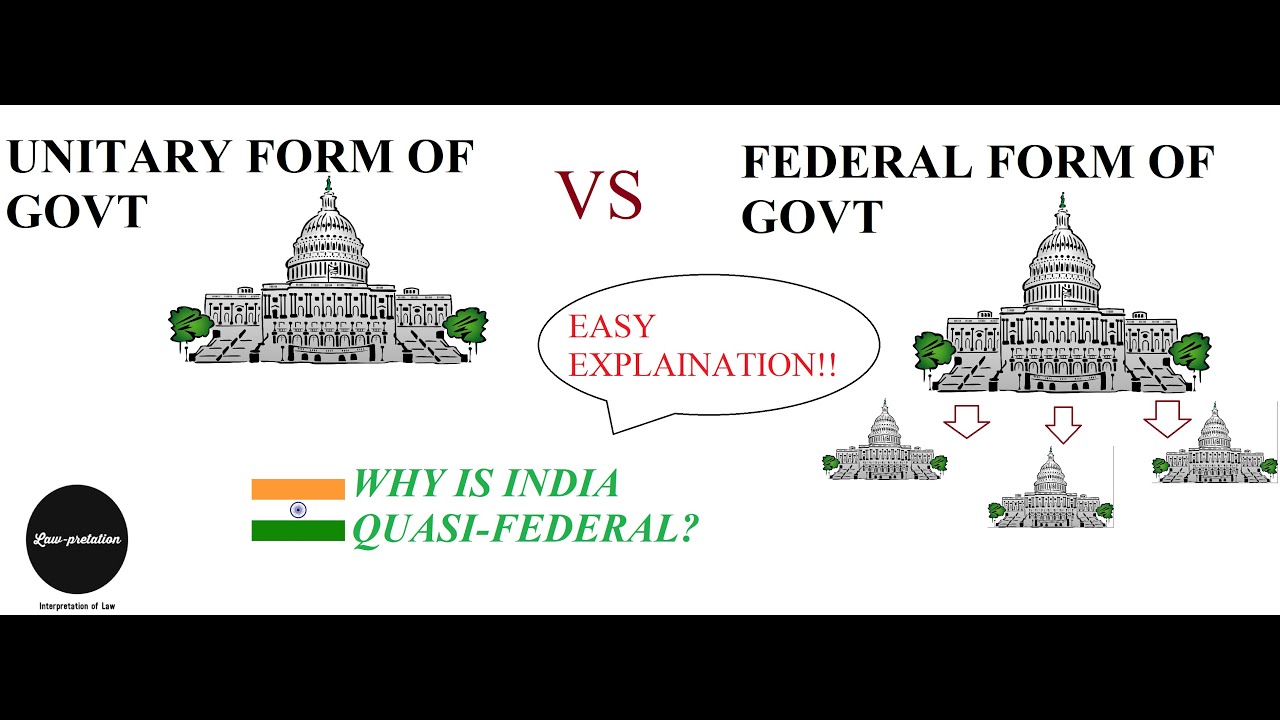
Explore the intricate Unitary Features of the Indian Constitution that define the power dynamics between the Union and States. Understanding these provisions is vital for students and UPSC/Law exam aspirants to grasp how India maintains national integrity through a centralized federal structure.
🎯 In this chapter, you will understand:
- How the Indian Constitution balances federal spirit with strong unitary tendencies.
- Why legislative and territorial authority is tilted in favour of the Centre.
- How unified institutions, services, and legal structures prevent fragmentation.
- How representation, emergency provisions, elections, and audit machinery strengthen central oversight.
💡 Why this topic matters: These provisions explain why India is often described as a Quasi-Federal state, where national unity and stability are protected through a strong Centre.
🧠 Core Idea: India follows a federal structure, but several constitutional features give the Union greater control over the states, especially during crises.
Unitary Features of the Indian Constitution and Centralized Power Dynamics
The Indian political landscape is defined by a unique constitutional arrangement where the federal spirit is balanced by strong unitary tendencies. In the story of Indian democracy, the founding fathers realized that for a diverse nation to survive, a “Strong Centre” was a prerequisite, leading to several non-federal or unitary traits within the 1950 Constitution.
- (i) The distribution of legislative powers is heavily weighted in favor of the Union.
- (ii) Unlike traditional federations, the Centre holds the keys to structural and administrative control over the provinces.
- (iii) Various mechanisms ensure that in times of crisis, the entire nation operates as a single entity.
Dominance of the Centre: Legislative and Territorial Authority
The Constitution establishes a hierarchy where the Union Government maintains superior authority over the states in matters of law-making and existence.
The Concept of a Strong Centre in Policy Making
The division of powers is not equal; the Union List contains a larger number of subjects and more significant entries than the State List, ensuring the Centre’s decisive tilt in power.
- (i) The Centre possesses overriding authority over the Concurrent List in case of conflicts.
- (ii) Residuary powers rest entirely with the Centre, a sharp departure from the USA where they belong to the states.
States Not Indestructible: The Territorial Reality
In the Indian story, states lack guaranteed territorial integrity, allowing the Parliament to redraw the map of India with ease.
- (i) Parliament can alter state boundaries, names, or areas through a simple majority.
- (ii) This creates a system known as an “indestructible Union of destructible states”, distinct from the USA model.
Institutional and Administrative Unification of the Nation
The administrative framework of India is designed to prevent fragmentation through unified institutions and legal structures.
Single Constitution and Flexible Amendments
Unlike many federations, states have no independent constitutions; a single document governs the entire landscape of India.
Flexibility of the Amending Process
- (i) The amendment process is less rigid, allowing Parliament to change much of the document unilaterally.
- (ii) Only the Centre can initiate amendments, whereas in the USA, states share this right.
- (iii) The historical exception of Jammu and Kashmir having its own constitution no longer exists.
Integrated Judicial and Administrative Services
India operates under a single, unified judicial system and shared administrative services that link the states to the central command.
- (a) Integrated Judiciary: The Supreme Court and High Courts enforce both Central and state laws uniformly.
- (b) All-India Services: Officers of the IAS, IPS, and IFS are controlled by the Centre, which reduces state autonomy in local administration.
Representation, Oversight, and Emergency Powers
The Union maintains oversight through the appointment of officials and the ability to absorb all powers during specific contingencies.
The Role of the Governor and Veto Over State Bills
The Governor acts as the agent of the Centre within the state executive, ensuring central oversight of state governance.
- (i) The President appoints the Governor, who serves at his pleasure, following the Canadian model.
- (ii) Veto Over State Bills: The Governor can reserve state bills for Presidential consideration, allowing a total veto over state legislation.
Emergency Provisions: The Ultimate Unitary Tool
The Constitution recognizes national, state, and financial emergencies that centralise all powers instantly.
- (i) No other federation has such a transformative mechanism to turn a federal system into a unitary one without formal amendment.
- (ii) This ensures the Union can safeguard the nation’s sovereignty in times of peril.
Integrated Election and Audit Machinery
Financial and democratic integrity is managed by centralized bodies to ensure uniformity across all states.
- Integrated Election Machinery: The Election Commission, appointed by the President, handles both Central and State polls.
- Integrated Audit: The Comptroller and Auditor-General (CAG) limits state financial independence by auditing accounts without state consultation.
Summary of the Unitary Features and their Significance
These Unitary Features highlight why India is often termed a ‘Quasi-Federal’ state. The decisive tilt toward the Centre through All-India Services, Emergency Provisions, and a Single Constitution ensures national stability. For students, mastering these concepts is essential to understanding the Indian Polity and the delicate balance of power that keeps the Union indestructible. This centralized framework, mirrored after the Canadian system, remains a cornerstone of the Constitution of India.
🚀 Quick Revision Points
Essential facts to review before examinations:
- (i) The Union List has more important subjects than the State List, giving the Centre greater legislative power.
- (ii) Residuary powers belong to the Centre, unlike in the USA.
- (iii) Parliament can change state boundaries, names, or areas by simple majority, making states destructible but the Union indestructible.
- (iv) The Constitution of India provides a single Constitution, integrated judiciary, All-India Services, emergency powers, and centralized election and audit machinery.
- 💡 Exam Tip: Remember the phrase “indestructible Union of destructible states” and link it with Parliament’s power to alter state boundaries, names, or areas.
❓ Frequently Asked Questions (FAQ)
Q1: Why is India called quasi-federal?
A1: India is called quasi-federal because it has a federal structure but contains strong unitary features that give the Centre greater authority.Q2: What are residuary powers?
A2: Residuary powers are powers over subjects not mentioned in any list; in India, they rest with the Centre.Q3: How do emergency provisions make India more unitary?
A3: During national, state, or financial emergencies, powers become centralised, allowing the Union to function as a unitary system without formal amendment under the Constitution of India.