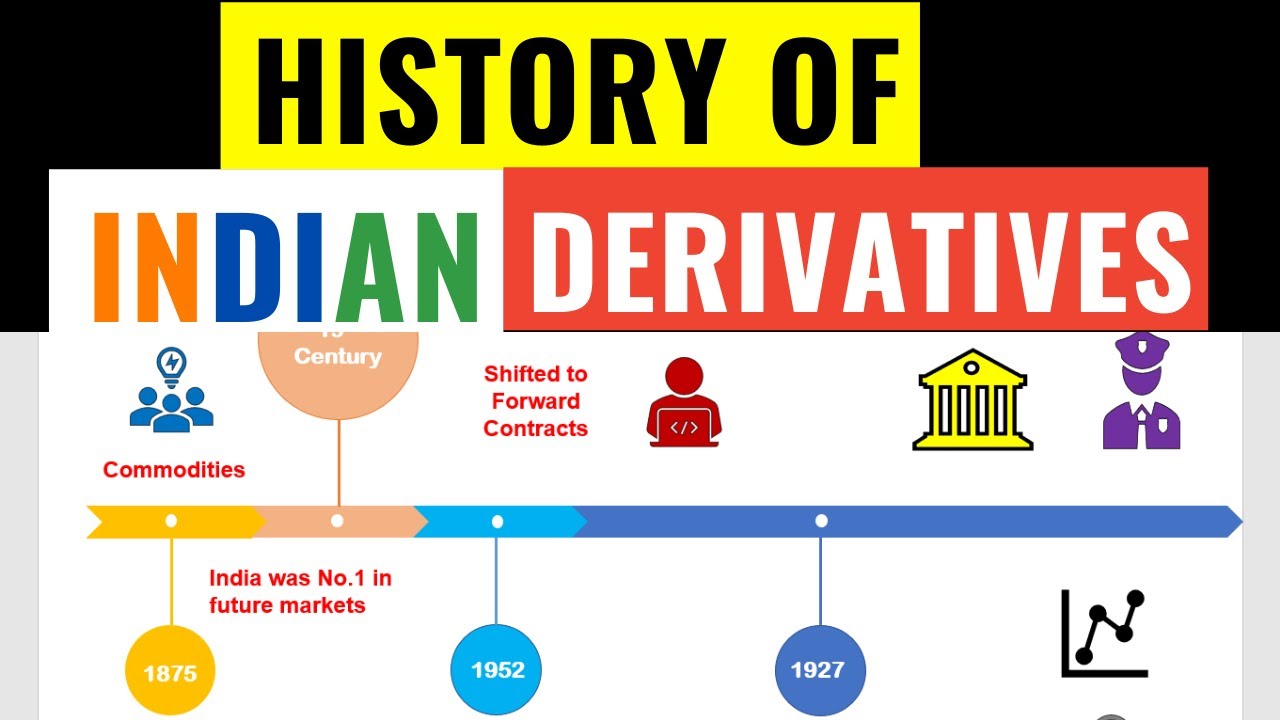
This simple guide looks at the fast-moving Derivatives Market in India. It traces the story of financial contracts like Index Futures and Options starting from the key year of . Learning how the market moved from OTC Derivatives to Exchange-Traded Derivatives is helpful for students and exam candidates who want to understand Indian financial market operations.
🎯 In this chapter, you will understand:
- How derivatives started and grew in the Indian stock market since .
- The three main reasons people trade: hedging, speculation, and arbitrage.
- The real differences between exchange-traded and over-the-counter (OTC) contracts.
- Why stock derivatives succeeded quickly while interest rate futures faced challenges.
💡 Why this topic matters: Derivatives help manage market risks and show where asset prices are headed in the Indian economy.
🧠 Core Idea: A derivative gets its value from an underlying asset, allowing traders to protect investments or earn profits from price shifts.
The Evolution and Structural Dynamics of the Derivatives Market in India (2000-2026)
The Indian financial system changed deeply when complex trading tools were introduced to control risk and improve market trading flow. The growth of derivatives in India relies on modern technology and strong regulation rules.
A New Era of Financial Engineering in the Indian Economy
The launch of the equity derivatives section helped Indian markets meet global standards. Traders used these tools to protect themselves against changes in stock prices and commodity price levels. The National Stock Exchange (NSE) played a major role in creating a safe platform for high-volume trading.

The Narrative of Meaning, Strategic Uses, and Historical Evolution
At its core, a derivative is not a standalone asset. It is a financial agreement that gets its value from an underlying market item. These contracts help spread financial risks across different traders based on their specific money goals.
Defining Derivative Securities and Their Underlying Foundations
A derivative security acts as a financial contract with a value linked directly to an underlying asset. These assets can include a specific stock price, an exchange rate, broad price indices, or interest rates. Because contracts depend on changes in interest rates or commodity prices, their value shifts side-by-side with the main base asset.
The Three Pillars of Market Participation: Hedging, Speculation, and Arbitrage
Traders enter the derivatives market for three different reasons, creating a healthy balance of risk-takers and cautious investors. A report by Fitch Ratings in pointed out that Indian laws favor hedging, but trading actions in the spot market often overlap.
Hedging: The Shield Against Volatility
Hedging protects against financial loss in the spot market by taking an opposite trade position. Most Indian traders call themselves hedgers to follow local rules and shield their investments from sudden market drops.
Speculation and Arbitrage: Driving Liquidity
Speculators try to make money by predicting future price movements, taking on the risks that hedgers pass along. At the same time, Arbitrageurs search for small price differences between the spot and derivatives markets, buying low in one place and selling high in another to boost market efficiency.
Historical Milestones: From June 2000 to the Rolling Settlement Era
The equity derivatives trading in India began in , after more than four years of detailed planning by regulatory bodies. This step was followed in by a move to a rolling settlement system in the cash stock market.
As trading grew, the NSE became a clear leader in equity derivatives turnover among developing nations. This growth helped establish fair price discovery for individual stocks, bringing clearer information to the overall Indian financial system.
The Great Divide: Exchange-Traded vs. Over-the-Counter (OTC) Instruments
The Indian financial market separates these instruments into two types based on where they are traded and how standardized they are. These structural differences change how default risks are handled.
The Bespoke World of OTC Derivatives and Credit Risk
Over-the-counter (OTC) derivatives are bilateral financial contracts such as forwards and swaps. Because two parties negotiate them directly, they are easy to customize but carry a higher credit risk. Their main features include:
- (i) High flexibility allows custom terms to fit specific corporate needs.
- (ii) The risk that the other party fails to pay remains a concern for institutional investors.
- (iii) Strictly controlled by the Reserve Bank of India (RBI); unapproved private trades or informal forward markets are illegal.
Exchange-Traded Derivatives: The Strength of Standardization
Unlike OTC options, an exchange-traded derivative (like a futures contract) follows fixed rules. It trades on open exchanges like the BSE or NSE, where the NSE handled over 99% of all trading volume during . These exchanges stay secure through set practices:
- (i) Contracts use fixed rules for deal size, asset type, and settlement dates.
- (ii) A clearinghouse backs every trade, practically removing credit risk.
- (iii) Upfront margin requirements and daily mark-to-market calculations keep trading safe.
The Growth Trajectory: Equity Segments and the Interest Rate Struggle
While equity derivatives in India grew to high global rankings, other financial areas faced contract design problems that slowed down adoption. Comparing these two paths shows why correct contract design is so important.
The Unprecedented Success of Equity Derivatives and Index Futures
The equity derivatives in India grew fast after starting with index futures in and moving to single stock futures. By , the NSE offered futures and options on 118 individual stocks, settling every trade in cash. A closer look at this period shows clear trader choices:
- (i) Single stock futures became the top choice, taking up half of all traded value by .
- (ii) Index futures held a solid 40% share of traded value, offering an easy way to trade the broader market.
- (iii) Single stock options were less popular than stock futures during those early years.
Interest Rate Derivatives: The Shift to the OTC Market
In , the NSE tried launching interest rate futures, but the effort did not work well. Weak contract setups created a gap between reference rates and real market rates, leading institutional investors to choose OTC interest rate derivatives instead. Companies adapted to this shift in key ways:
- (a) Interest rate swaps and forward rate agreements became the main choices for managing debt.
- (b) Companies used these tools to change from fixed-rate borrowings to floating-rate loans when interest rates in India dropped.
- (c) The OTC market offered the flexibility and volume that exchange-traded interest rate futures lacked at the time.
⚡ Quick Revision Capsule: Derivatives Market Structure
Here is a quick overview comparing key traits of Exchange-Traded vs. OTC Derivatives in India:
| Feature | Exchange-Traded Derivatives | OTC Derivatives |
|---|---|---|
| Contract Structure | Fully standardized contract terms | Customized bilateral agreements |
| Trading Venue | Public exchanges (NSE, BSE) | Direct private negotiations between parties |
| Default Risk | Guaranteed by a central clearinghouse | Higher counterparty and credit risk |
| Primary Regulator | SEBI (Securities and Exchange Board of India) | Reserve Bank of India (RBI) |
| Common Examples | Index futures, stock options | Interest rate swaps, forward agreements |
📝 Summary
The growth of the Derivatives Market in India is a major step toward financial growth, giving key hedging tools for market users into and beyond. By learning the roles of the NSE and RBI alongside the setup of index futures, students can see how market efficiency and fair price discovery take place. The achievements of equity derivatives since remain an encouraging example for developing markets around the world.
🚀 Quick Revision Points
Essential facts to review before examinations:
- (i) Equity derivatives trading officially started in India in , followed by rolling settlements in .
- (ii) During , the NSE dominated exchange-traded derivatives with over 99% of total trading volume.
- (iii) By , single stock futures became the most traded contract, holding half of all value, while index futures took 40% share.
- (iv) Exchange-traded derivatives use clear standard rules and a central clearinghouse to block default risk, while OTC deals are private agreements regulated by the RBI.
- 💡 Exam Tip: Remember that exchange-traded derivatives remove credit risk using a central clearinghouse, while OTC derivatives carry counterparty risk because they are private deals.
❓ Frequently Asked Questions (FAQ)
Q1: What marks the beginning of equity derivatives trading in India?
A1: Equity derivatives trading in India officially started in June 2000 after more than four years of planning by market regulators. This was followed by the launch of rolling settlements in the spot market in July 2001.Q2: Why did exchange-traded interest rate futures face challenges compared to OTC derivatives?
A2: The interest rate futures started by the NSE in June 2003 struggled because flawed contract setups created a gap between reference rates and real market rates. Because of this, institutional investors chose private OTC tools like interest rate swaps and forward agreements instead.Q3: How do exchange-traded derivatives mitigate the credit risk found in OTC contracts?
A3: Exchange-traded derivatives remove default risk by using a central clearinghouse that guarantees every trade, along with required margin deposits and daily mark-to-market settlements. In contrast, OTC derivatives are private two-party deals without a central guarantor, so they carry higher counterparty risk.