Explore the fascinating journey of the Indian exchange rate system, a critical topic for economics students and competitive exam aspirants. This detailed analysis covers the transition from the Bretton Woods era to Capital Account Convertibility, highlighting the pivotal reforms and acts that shaped the Indian Rupee's global standing.
🎯 In this chapter, you will understand:
- The journey of India's exchange rate policy from fixed ties to flexible market mechanisms.
- How the breakdown of the Bretton Woods System led to the currency basket framework in .
- The role of LERMS and MLERMS in establishing full current account convertibility.
- The path toward Capital Account Convertibility guided by the Tarapore Committee.
💡 Why this topic matters: Understanding how India managed its currency over the decades explains how the Reserve Bank of India maintains national financial stability and balances trade in a shifting global economy.
🧠 Core Idea: India transformed its exchange rate strategy from a rigid tie with foreign currencies into a dynamic, market-driven floating system to protect and grow its economy.
Evolution of Indian Exchange Rate Policy: A Historical Journey from 1947 to Modern Era
The historical narrative of India's currency management reflects a shift from rigid colonial ties to a market-driven global integration. The story begins with the Indian Rupee tethered firmly to the British Pound Sterling, navigating through the collapse of international systems and domestic economic crises to emerge as a managed floating currency.
- (i) The early years were defined by the Par Value System under the IMF guidelines.
- (ii) Systematic transitions occurred from pegged regimes to a basket of currencies approach.
- (iii) Modern policy emphasizes Real Effective Exchange Rate (REER) monitoring and forex reserve adequacy.
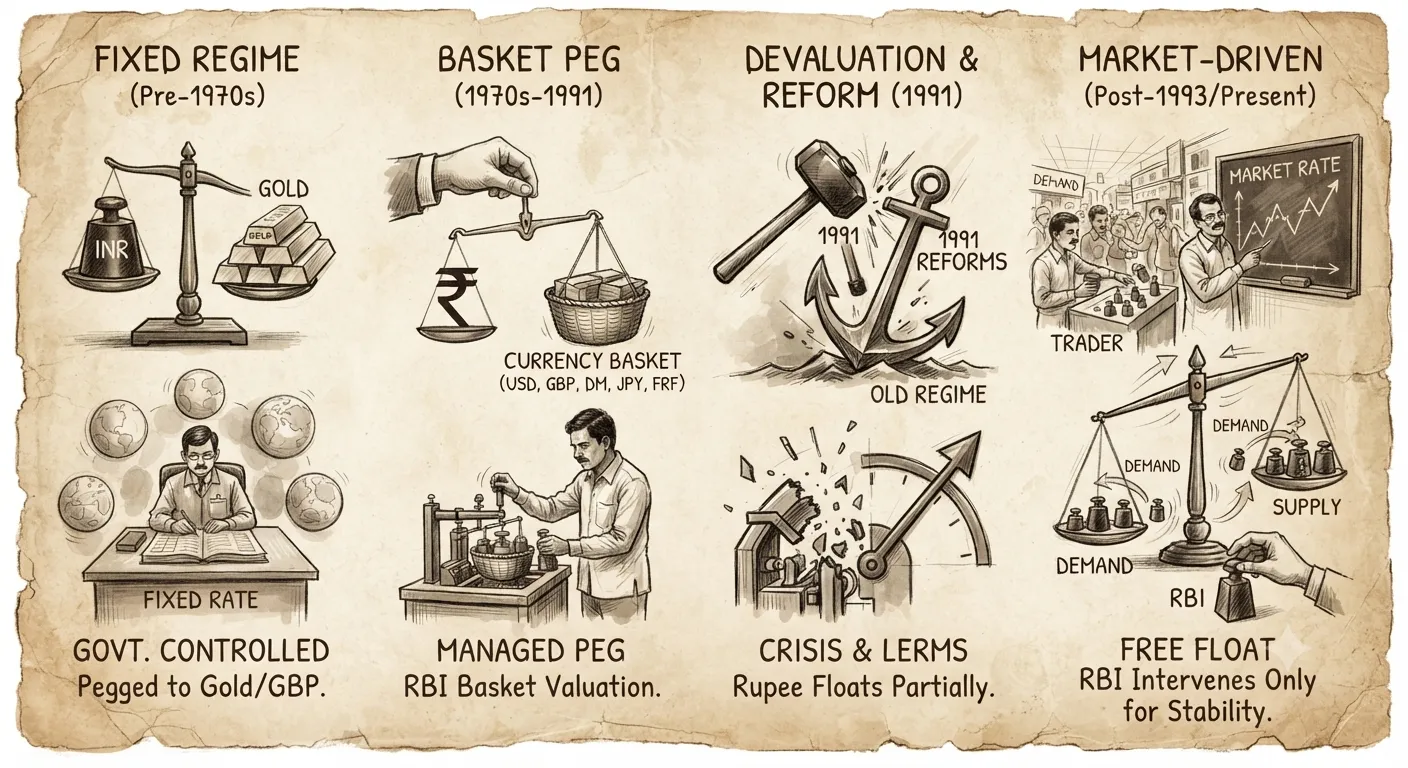
The Era of Fixed Regimes: Exchange Rate Under Bretton Woods System
Following Independence, India adhered to the global financial architecture established by the Bretton Woods Agreement, anchoring its currency landscape to international protocols.
The Sterling Connection and IMF Compliance
Historically, the Indian rupee was pegged to the pound sterling until the late 1960s, maintaining a stable but dependent relationship with the UK economy.
Gold Par Value and RBI Intervention
As a member of the International Monetary Fund (IMF), India declared a par value of the rupee in terms of gold. The Reserve Bank of India (RBI) maintained this value within a strict ±1% band, using the pound sterling as the primary intervention currency for all market operations.
The 1966 Devaluation Milestone
In June 1966, a significant shift occurred when the rupee was devalued to address economic pressures. The new par value was set at 0.118489 grams of gold per rupee, which fixed the rupee-sterling rate at GBP 1 = Rs. 18.
Navigating Uncertainty: Transition After the Collapse of Bretton Woods
The global breakdown of fixed exchange rates in forced India to seek a more flexible framework for the Indian Rupee amidst mounting international volatility.
From Dollar Pegging to the Currency Basket System
Between and , India experimented with various anchors to protect the rupee's value from international volatility.
- (i) In August 1971, the rupee was briefly pegged to the US dollar at US$1 = Rs. 7.50, though the RBI still used sterling for interventions.
- (ii) Following the Smithsonian Agreement in , the rupee was re-pegged to the pound sterling with a wider ±2.25% band.
- (iii) By , the floating of the pound caused the rupee to fluctuate uncontrollably, leading to domestic instability.
- (iv) By September 1975, Britain's weak economy led to a 20% depreciation of the pound, causing an automatic and harmful depreciation of the rupee and fueling inflation in India.
The Secret Basket of 1975
On September 25, 1975, India finally delinked from sterling and moved to a basket of currencies. The specific weights of this basket were strictly confidential to prevent market speculation, allowing the RBI the discretion to adjust weights based on India's trade patterns without external interference.
The Reform Era: Liberalised Exchange Rate Management System (LERMS)
The forex crisis of 1990–91 acted as a catalyst for sweeping economic liberalisation in the Indian financial sector, resetting structural mechanisms entirely.
Introduction of the Dual Exchange Rate System
On March 1, 1992, the RBI introduced LERMS, a transitional path toward a market-determined exchange rate.
Key Mechanisms of LERMS
It introduced Rupee convertibility for all approved external transactions based on a dual pricing mandate. Under The 60:40 Rule, exporters could sell 60% of receipts at market-determined rates, while 40% had to be surrendered to the RBI at the official exchange rate. This dual system allowed the government to subsidize essential imports while encouraging exports.
Full Current Account Convertibility: Modified LERMS (1993)
Building on the success of , India moved toward a unified exchange rate to further integrate with the global economy and strip away dual rate distortions.
The Birth of MLERMS and Market Determination
The Reserve Bank of India (RBI) made the Indian rupee fully floating on the current accounteffective March 1, 1993.
- (i) Under the Modified Liberalised Exchange Rate Management System (MLERMS), the dual rate was abolished in favor of a unified market rate.
- (ii) All transactions were routed through Authorised Dealers (ADs) at prevailing market prices.
- (iii) While trade restrictions eased, foreign exchange payments remained under the Exchange Control Regulations to ensure stability.
The Sodhani Committee Recommendations (1994–95)
To deepen the forex market, Mr. O.P. Sodhani chaired an expert group that submitted 33 recommendations in .
Banking and Corporate Empowerment
Banks were granted autonomy to set net overnight positions and gap limits. Permission was granted to invest up to 15% of Tier 1 capital overseas and set FCNR deposit rates. Corporates gained the ability to hedge genuine exposures, though margin trading via EEFCAs was restricted after the Asian Financial Crisis. Meanwhile, RBI intervention was advised to be selective and strategic rather than frequent.
The Final Frontier: Capital Account Convertibility in India
By the late , the focus shifted from simple trade balances to the free movement of capital, led by the analytical framework of the Tarapore Committee.
The Tarapore Committee and CAC Framework
On , the RBI established a committee to chart the path for Capital Account Convertibility (CAC).
Defining Convertibility and Liberalisation
CAC was defined as the freedom to convert local assets into foreign assets (and vice-versa) at market rates. The framework recommended the liberalisation of FDI and the facilitation of portfolio investments while increasing the EEFC entitlement to 50% to support Indian exporters.
Exchange Rate and Reserve Adequacy
The committee proposed a monitoring band of ±15% around the Real Effective Exchange Rate (REER). It established strict benchmarks stating that Forex reserves should cover at least six months of imports, and integrated risk management through Interest Rate Swaps (IRS) and Forward Rate Agreements (FRAs).
⚡ Quick Revision Capsule: Key Milestones of Indian Exchange Rate Policy
This table compares the major phases of India's exchange rate policy, highlighting key features and historical dates.
| Era / Policy | Timeframe | Core Mechanism & Impact |
|---|---|---|
| Bretton Woods System | – | Rupee pegged to Pound Sterling with gold par value; major devaluation in to GBP 1 = Rs. 18. |
| Currency Basket Regime | – | Rupee delinked from sterling and tied to a secret multi-currency basket to avoid global shocks. |
| LERMS | – | Dual exchange rate system using the 60:40 rule to ease transition into market rates. |
| MLERMS | onwards | Unified market rate system establishing full Current Account Convertibility. |
| Tarapore Committee (CAC) | Framed rules for Capital Account Convertibility with a ±15% REER band and 6-month import cover. |
📝 Summary
The evolution of the Indian exchange rate policy from to the era demonstrates India's resilience and adaptive economic strategy. Understanding the transition from LERMS to MLERMS and the importance of Capital Account Convertibility is essential for students of macroeconomics and finance, as it explains how the RBI maintains balance of payments stability in a volatile global market.
🚀 Quick Revision Points
Essential facts to review before examinations:
- (i) Independence Era: The Indian Rupee was initially pegged to the British Pound Sterling under the IMF's par value guidelines.
- (ii) 1966 Shift: The rupee was devalued to fix the rate at GBP 1 = Rs. 18, corresponding to 0.118489 grams of gold per rupee.
- (iii) 1975 Secret Basket: India delinked from sterling to follow a confidential basket of currencies, eliminating automatic depreciation caused by the weak UK economy.
- (iv) LERMS (1992): Introduced a dual rate system featuring a 60:40 rule (60% market rate, 40% official surrender rate).
- (v) MLERMS (1993): Abolished the dual rate system to launch a unified market-determined rate and full current account convertibility.
- (vi) Tarapore Framework (1997): Laid out structural milestones for Capital Account Convertibility (CAC), establishing a ±15% REER band and a 6-month import cover reserve benchmark.
- 💡 Exam Tip: Remember the distinction between LERMS (, dual rate with 60:40 split) and MLERMS (, single unified market rate). This distinction is a frequent topic in competitive examinations!
❓ Frequently Asked Questions (FAQ)
Q1: What was the 60:40 rule under the Liberalised Exchange Rate Management System (LERMS)?
A1: Introduced on , the 60:40 rule required exporters to surrender 40% of their foreign exchange earnings to the RBI at the official exchange rate, while allowing them to sell the remaining 60% at market-determined rates.Q2: When did the Indian Rupee shift to a unified market-determined exchange rate system?
A2: The rupee moved to a unified market rate on , under the Modified LERMS (MLERMS), which effectively operationalized full Current Account Convertibility.Q3: What benchmarks did the Tarapore Committee establish for Capital Account Convertibility (CAC)?
A3: The committee recommended a target monitoring band of ±15% around the Real Effective Exchange Rate (REER) and mandated that foreign exchange reserves should remain sufficient to cover at least 6 months of imports.