The year marked a monumental turning point for the Indian Stock Market, shifting it from an old, tightly controlled setup into a transparent, globalized financial market. Driven by the Liberalization policy of 1991, these widespread changes removed major government hurdles, automated trading operations, and placed safety for investors right at the center of the system. Understanding how these basic reforms improved safety, trading speeds, and settlement rules gives us a clear look into India's modern economy.
🎯 In this chapter, you will understand:
- How regulatory changes and SEBI replaced state control over share pricing and capital raising.
- The transition from physical floor trading to nationwide screen-based trading and demutualized stock exchanges.
- The role of dematerialization and depositories in removing physical paper risks and investor complaints.
- How risk management systems, derivatives, and compressed rolling settlements created a modern financial grid.
💡 Why this topic matters: India's modern stock market relies on the key rules and technological platforms introduced during the post-1992 era, making this essential knowledge for understanding present-day financial systems.
🧠 Core Idea: Modernizing Indian capital markets required replacing old broker-run floors with electronic trading, setting up independent regulation through SEBI, turning paper shares into digital demat entries, and enforcing strict risk controls.
📌 Principal Reform Measures Undertaken in Indian Stock Market Since 1992
The post-1992 period completely changed how money was raised, priced, and monitored across Indian financial networks, moving away from rigid state control to market-driven efficiency.
Establishment of SEBI and the Regulatory Overhaul
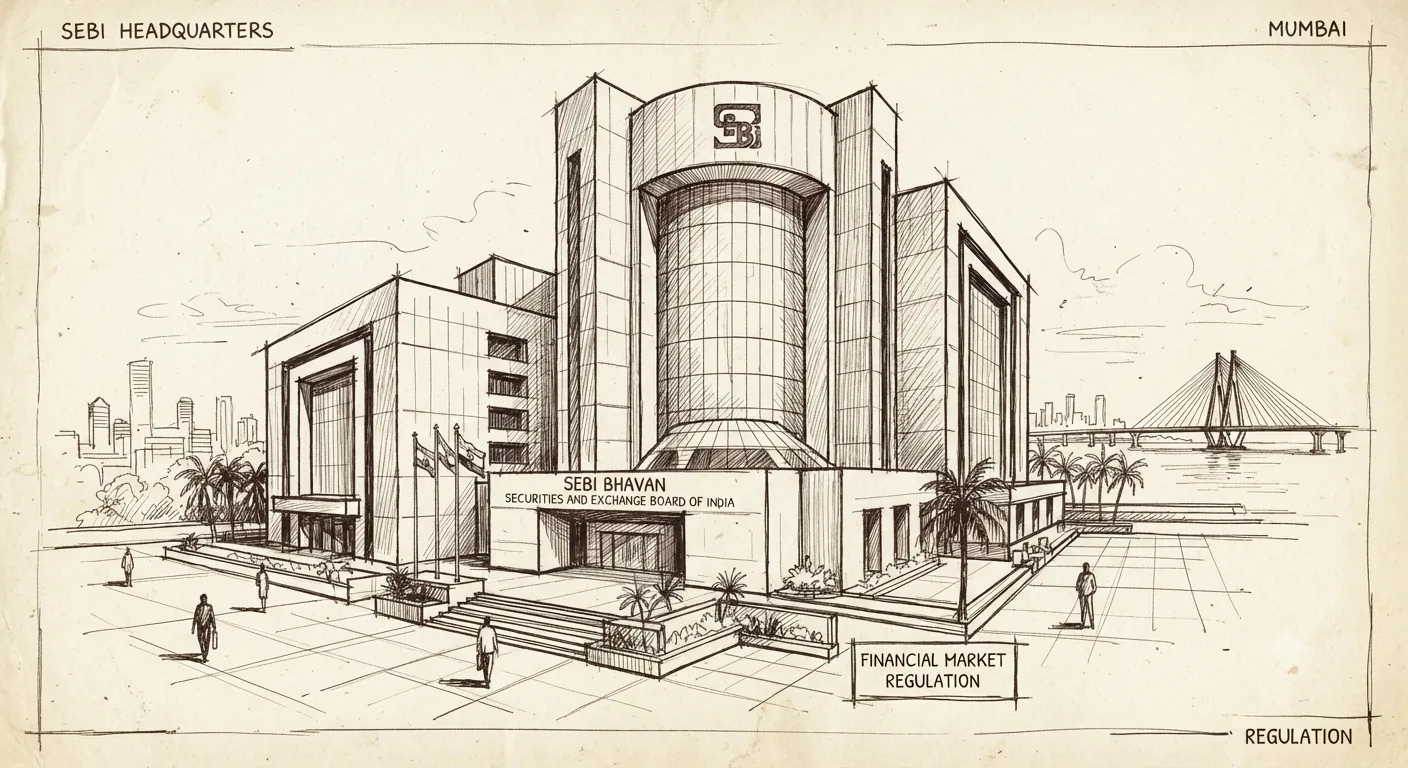
Before these historical changes took root, market operations were limited by the Capital Issues (Control) Act, 1947. Under that old rulebook, any company wanting to issue shares or bonds had to ask the Central Government for explicit approval regarding the exact amount, type, and price. In line with the main Liberalization policy of 1991, this restrictive Act was officially removed in . This opened the path to set up the Securities and Exchange Board of India (SEBI) with full legal authority. SEBI was given legal power to focus on three core goals:
- (a) Protecting the interests of investors, with a special focus on everyday small retail investors in the market.
- (b) Promoting the development of the securities market through modern infrastructure upgrades.
- (c) Regulating the securities market to prevent unfair practices by large institutions.
To help it carry out these tasks, SEBI received broad regulatory powers taken from key sections of the Companies Act and the Securities Contracts (Regulation) Act (SCRA). Today, a major portion of the main legal rules in the Companies Act that affect the stock market are actively managed directly by SEBI.
Market Determined Allocation of Resources and Investor Protection
Removing the old Capital Issues Act and creating an independent regulator ended government control over share issues, premium pricing, and interest rates on corporate bonds. From that moment on, resource allocation was handed over to natural market forces. To protect public safety in this new open setup, SEBI introduced its landmark Disclosure and Investor Protection (DIP) guidelines, which clearly outlined strict rules for both companies issuing shares and market brokers. Under this system, SEBI actively:
- (i) Outlines clear, mandatory disclosures and uniform financial accounting standards.
- (ii) Issues binding instructions to market brokers to maintain steady market growth.
- (iii) Ensures that the general public receives complete information about the share issue, the company, and the underlying assets.
This regular flow of accurate data enables everyday citizens to make clear, well-informed choices based on clean facts rather than wild rumors.
To back this up, a multi-agency safety net including the Department of Economic Affairs (DEA), the Department of Company Affairs (DCA), and SEBI created active grievance cells to handle public complaints. Additionally, individual stock exchanges are legally required to maintain dedicated safety pools, including:
- (i) Specialized investor protection funds
- (ii) Localized consumer protection funds
- (iii) Systemic trade guarantee funds
These combined funds ensure that investors can claim fair compensation if a broker defaults or fails to complete a trade. Furthermore, the DCA set up a dedicated Investor Education and Protection Fund (IEPF), focused entirely on building financial knowledge and keeping public money safe over the long term.
📌 Points to remember: The repeal of the Capital Issues (Control) Act in gave statutory powers to SEBI, moving share pricing to free-market forces backed by strict disclosure rules and investor protection funds.
📌 Demutualisation and Establishment of NSE
Breaking open the local monopolies of old broker-run clubs required a brand-new setup built on independent institutional ownership and professional management separation.
The Structural Rise of the National Stock Exchange
The plan for a modern National Stock Exchange (NSE) was carefully considered by policymakers in . At that time, the state-backed OTCEI (Over-The-Counter Exchange of India) was the country's newest automated attempt, but its low trading activity and poor performance raised major concerns. Many feared that a new exchange would struggle to compete with the huge, long-established trading volume held by the veteran BSE (Bombay Stock Exchange).
Despite those concerns, the urgent need for an independently managed exchange won out, and equity trading at the NSE officially started in . In less than twelve months, the NSE bypassed older networks to become India's most active stock market—a remarkable achievement. The BSE responded quickly to this competition by adopting similar automated technology in . This technology race completely transformed daily trading, bringing in:
- (i) Clear and complete visibility across all buy and sell orders.
- (ii) Total privacy and anonymity in executing daily trades.
- (iii) Greater competition among brokers, which lowered entry costs for traders.
- (iv) A major improvement in overall operational speed and efficiency.
To secure this new era of operational independence, regulatory authorities focused on reducing old broker control inside exchange management boards. They required a strict reorganization of governing boards, ruling that at least 50% of the seats must be held by non-broker representatives. Because early board changes did not produce deep enough results, the government stepped in during with a firm plan for full exchange corporate restructuring. This completely separated the three main parts of the business: Ownership, Management, and Trading membership. Supported by tax savings offered by the central government, multiple regional exchanges successfully completed this vital structural transformation over the following years.
📌 Transition to Nationwide Screen Based Trading
Replacing physical shouting floors with real-time computers made stock market access simple and direct for investors across all parts of India.
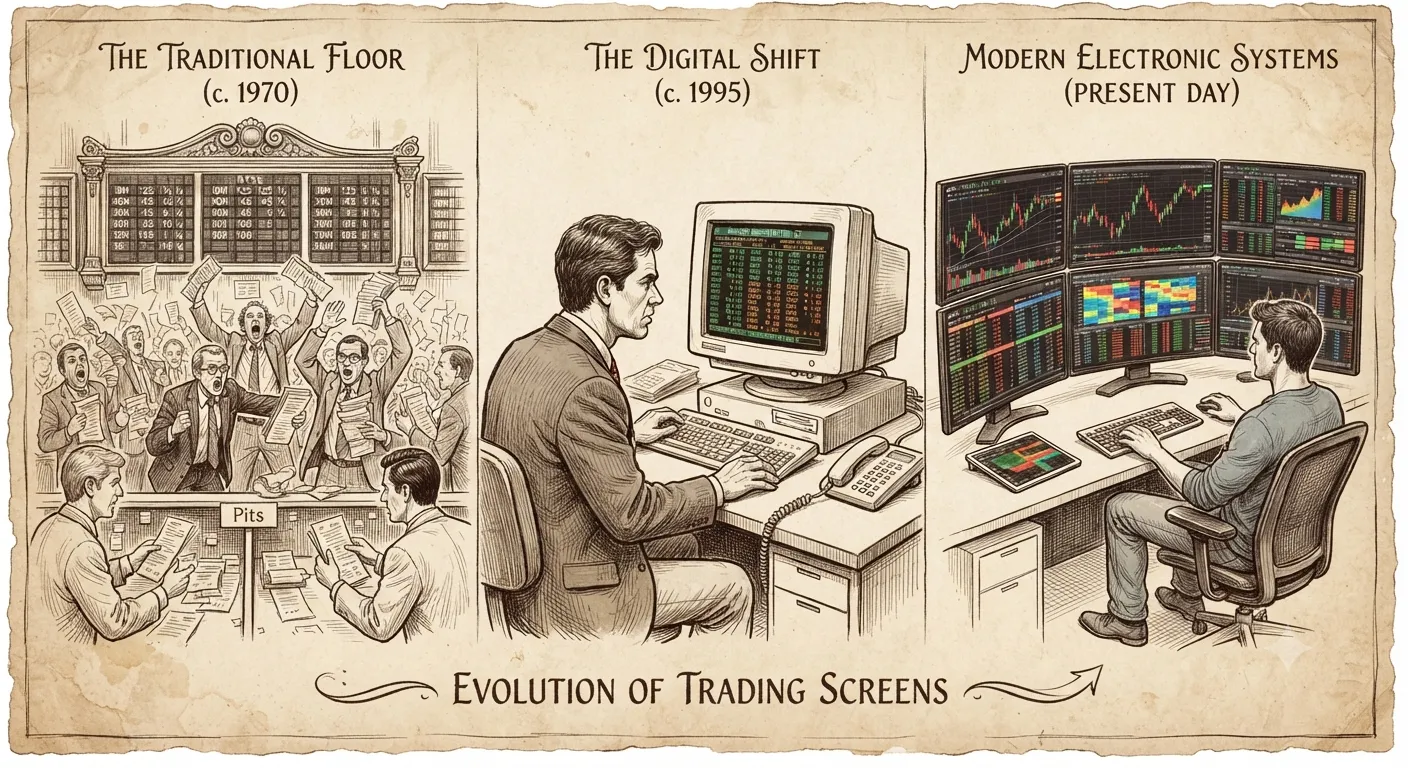
Replacing the Trading Floor with Electronic Terminals
To greatly improve trade execution speed, increase daily liquidity, and bring total clarity to prices, the NSE introduced a nationwide, fully automated Screen Based Trading System (SBTS). Under this digital setup, registered broker members simply enter their desired share quantities and prices into a computer terminal. The system's central engine then automatically matches and completes the trade the exact instant it finds a matching offer.
This clean computer setup instantly removed the heavy delays, hidden pricing practices, and weak infrastructure typical of the old physical trading floors. By the end of , all active Indian stock exchanges had successfully moved away from physical trading floors to electronic computer systems. This quick move placed India's trading systems alongside modern global financial centers.
📌 Points to remember: Automated screen-based trading replaced physical open outcry floors across India by late , bringing instant computer order matching and complete transparency.
📌 Risk Containment at the Clearing Corporation
By stepping directly between buyers and sellers, central clearing institutions removed individual broker defaults from the trading system.
Institutionalizing Trade Guarantees and Novation
As trading volumes grew rapidly across the country, managing default risks and ensuring smooth trade completions became vital. To solve this, the NSE introduced the legal process of novation—where a central clearing house acts as the buyer to every seller and the seller to every buyer. It set up the National Securities Clearing Corporation Ltd. (NSCCL), which began working in . This central clearing hub introduced:
- (i) A carefully calculated mathematical risk management system.
- (ii) Continuous online trade tracking paired with automatic shutoff of broker terminals if risk limits are crossed.
- (iii) A well-funded settlement guarantee fund built to absorb sudden market losses.
To help traditional brokers move smoothly into this corporate structure, the government provided a full capital gains tax waiver when individuals converted their personal exchange memberships into corporate trading firms.
📌 Comprehensive Risk Management in Capital Markets
A multi-layered defense network keeps watch over overall market exposure, ensuring a single default does not cause broader system failures.
The Safety Architecture Defending the Market Grid
To prevent local market defaults and protect daily investors, regulatory bodies and domestic stock exchanges built a comprehensive risk management system. This defensive network is regularly updated by both stock exchanges and regulators to handle changing price swings. The daily protocol relies on:
- (i) Strict minimum cash and capital requirements for all active broker members.
- (ii) Firm, audited minimum net-worth criteria.
- (iii) Multi-tiered margin requirements, including upfront margins, daily mark-to-market (MTM) margins, and variation margins.
- (iv) Direct institutional limits placed on overall trade volumes and market exposure.
- (v) Mandatory corporate indemnity insurance protection.
- (vi) Real-time computer monitoring backed by immediate automatic cutoff of trading access the moment a broker crosses safe risk limits.
At the same time, stock exchanges run advanced market monitoring systems to spot unusual trading activity, track excessive price swings, and stop intentional price manipulation before it spreads. These systems are supported by dedicated trade guarantee funds, which stand ready to cover cash shortages if a member fails to fulfill their financial obligations on settlement day.
📌 Dematerialisation and Electronic Depositories
Replacing fragile paper share certificates with secure digital entries brought unprecedented speed and safety to stock ownership.
Dismantling Bad Deliveries through Digital Ledgers
The introduction of the major Depositories Act, 1996 completely transformed share ownership by shifting from paper certificates to electronic account entries managed by central depositories like NSDL (National Securities Depository Limited) and CDSL (Central Depository Services Limited). This modern system delivered:
- (i) Smooth transfer of shares with unmatched speed, accuracy, and safety.
- (ii) Complete conversion of physical paper shares into secure digital accounts via dematerialization.
- (iii) Clear, electronic record-keeping of all past share ownership.
To speed up this change, the government removed all stamp duty charges on the transfer of electronic shares. This quickly led to all actively traded shares being held, traded, and settled purely in digital demat form. Today, over 99.9% of total market trading is completed through digital dematerialized channels.
Historical Context: Before this digital system was introduced, SEBI received over 50,000 retail complaints every year—adding up to 2.7 million complaints over ten years—mainly caused by delayed share transfers, fake certificates, and lost mail. Widespread dematerialization completely removed these operational risks.
To lock in these benefits permanently, mandatory digital trading was strictly enforced for all new company public share offers (IPOs), rights issues, and large public sales valued at Rs. 10 crore or higher. This strict rule keeps the primary market clean and prevents physical paper certificates from returning to active use.
📌 Points to remember: The Depositories Act, 1996 created NSDL and CDSL, replacing paper shares with digital demat accounts and removing bad deliveries, fake shares, and transfer delays.
📌 Introduction of Derivatives Trading in India
Modern risk-management tools allowed both large financial institutions and individual retail investors to handle market risks using structured financial products.
The Birth of Structured Risk Management Instruments
The historical Securities Contracts (Regulation) Act, 1956 was officially updated by Parliament in to lift a three-decade-old ban on forward trading. This legal change paved the way for modern derivatives trading on Indian stock exchanges. Following the safety plans prepared by the expert L. C. Gupta Committee, official derivatives trading launched in across both the NSE and BSE. Today, this active market segment offers:
- (i) Active index futures and index options based on main market benchmark indices.
- (ii) Broadly traded stock options and stock futures tied to major individual company shares.
- (iii) Specialized interest rate futures available on exchange platforms to manage interest rate risks.
📌 Globalisation of Indian Capital Market Architecture
Opening cross-border financial routes allowed international funds to flow into India while enabling domestic firms to raise capital globally.
Connecting Domestic Enterprise with Global Liquidity Pools
As part of India's global integration, domestic companies received permission to raise large-scale capital directly from foreign investors using several international routes:
- (i) American Depository Receipts (ADRs) for US markets.
- (ii) Global Depository Receipts (GDRs) for European and global trading centers.
- (iii) Foreign Currency Convertible Bonds (FCCBs).
- (iv) Structured External Commercial Borrowings (ECBs).
Because ADRs and GDRs offer full two-way conversion, Indian companies can list their shares on major foreign stock exchanges by offering ADR/GDR programs backed by domestic shareholdings. At the same time, incoming investment channels were opened, allowing Non-Resident Indians (NRIs) and specialized Overseas Corporate Bodies (OCBs) to invest capital directly into Indian companies.
In a related step, registered Foreign Institutional Investors (FIIs) were granted direct approval to invest in a wide range of local securities, including Indian government bonds. Their incoming and outgoing financial transactions enjoy full, unrestricted capital account currency conversion. Under the standard portfolio investment route, FIIs can hold up to 24% of the total share capital of a local company. This limit can be raised up to the highest sector limit, provided it receives formal approval from the company's board of directors and its shareholders. Today, Indian stock exchanges can set up remote trading terminals overseas, making their trading platforms globally accessible over the internet, while domestic mutual funds manage specialized foreign funds to purchase international shares and global ADRs/GDRs.
📌 Rolling Settlement and Ban on Deferral Products
Shortening transaction times and removing old speculative delay systems brought structural stability and safety to daily market clearings.
The Evolution from Badla to T+1 Settlements
Before these clearing changes were introduced, India's traditional account-period settlement cycle took anywhere from 14 to 30 days. This long delay exposed the market to high default risks, speculative price bubbles, and clearing failures. This unstable environment was fueled by the old Badla system—a practice that allowed traders to carry over leveraged positions and repeatedly delay final trade payments.
To remove this major weakness, regulators completely banned carry-forward mechanisms in and moved the entire market to a continuous rolling settlement framework. Initial rolling tests on a T+5 schedule had started in for a small group of stocks to shrink the clearing timeframe. To keep the market stable, the regulator first applied a standard weekly cycle across all stock exchanges for shares not yet in the rolling group.
By , every listed share was shifted into the official rolling settlement system. In , improved computer technology allowed T+3 settlements to replace T+5, and over time, the market smoothly transitioned into fast T+1 settlements for selected share categories. These compressed clearing times significantly improved market efficiency, reduced clearing house risks, and built strong investor confidence. While regulators made these updates step-by-step in response to past market issues, the overall modernization of stock market rules remains an active, ongoing process.
📌 Points to remember: Replacing the old Badla system in with rolling settlements reduced market risks, gradually speeding up settlements from T+5 down to T+3 and eventually T+1.
⚡ Quick Revision Capsule: Key Milestones in Indian Stock Market Reforms
This quick summary table highlights the primary legislative, structural, and technological milestones that transformed the Indian capital market after 1992.
| Year | Key Reform Measure | Primary Impact on Capital Markets |
|---|---|---|
| Repeal of Capital Issues (Control) Act & Statutory powers to SEBI | Ended government control on share pricing and established an independent regulator. | |
| Launch of NSE & nationwide Screen Based Trading (SBTS) | Replaced physical open outcry trading floors with transparent, automated computer order matching. | |
| Passing of Depositories Act and setup of NSDL / CDSL | Introduced paperless dematerialization of shares, eliminating physical certificate risks and delays. | |
| Introduction of Derivatives Trading (Index & Stock Options/Futures) | Provided structured hedging tools for institutional and retail risk management. | |
| Ban on Badla system & Transition to continuous Rolling Settlement | Eliminated speculative settlement delays, moving trade clearing from T+5 to T+3 and ultimately T+1. |
📝 Summary
The modernization of India's capital markets represents a successful transition from localized, broker-dominated clubs into an automated, strictly regulated financial system. Guided by SEBI and powered by digital infrastructure like the NSE, NSDL, and CDSL, India eliminated paper-based settlement risks, introduced strong risk management controls, and compressed settlement cycles down to modern global standards, ensuring a clear and safe market environment for domestic retail investors and international institutions alike.
🚀 Quick Revision Points for Students
Essential facts to review before examinations:
- (i) The Capital Issues (Control) Act, 1947 was repealed in , ending arbitrary state control over share pricing and giving statutory authority to SEBI.
- (ii) The National Stock Exchange (NSE) started equity operations in , pioneering automated screen-based trading (SBTS) and independent exchange management.
- (iii) The Depositories Act, 1996 enabled paperless share management through NSDL and CDSL, removing old certificate forgery and transfer delay risks.
- (iv) Speculative carry-forward systems like the Badla system were banned in , replaced by uniform rolling settlements that shortened clearing times from weeks down to T+3, T+5, and eventually T+1.
- (v) International integration unlocked two-way conversion using ADRs and GDRs, allowing foreign institutional investors (FIIs) to deploy funds under full capital account currency conversion rules.
- 💡 Exam Tip: When answering questions about stock market reforms, highlight the shift from state pricing control to free-market price discovery under SEBI, and emphasize how dematerialization via NSDL/CDSL eliminated bad deliveries.
❓ Frequently Asked Questions (FAQ)
Q1: What exactly was the 'Badla' system and why did regulators ban it?
A1: The Badla system was an old carry-forward practice in Indian stock trading that allowed investors to delay trade settlements for weeks while holding leveraged speculative positions. Regulators banned it in because its long 14-to-30-day clearing windows created extreme settlement risks, frequent defaults, and market instability.Q2: How did the Depositories Act of 1996 impact retail investors in India?
A2: The Depositories Act, 1996 introduced digital share holding (demat), converting physical paper certificates into digital accounts managed by NSDL and CDSL. This eliminated over 50,000 annual complaints regarding stolen, forged, or delayed share certificates, providing retail investors with faster transactions, better accuracy, and safe asset storage.Q3: What role does 'novation' play within the NSCCL framework?
A3: Through the legal process of novation, the National Securities Clearing Corporation Ltd. (NSCCL) steps into every transaction as the central counterparty—acting as the buyer to every seller and the seller to every buyer. This removes individual broker default risk by guaranteeing trade settlement even if a broker fails to pay.