The story of Imperial Kannauj marks a pivotal turning point in early . Following the decline of the mighty Gupta Empire, the political heartland of northern India moved west from Pataliputra to the fertile Gangetic plains centered around Kannauj. Controlling this strategic city meant controlling the trade networks, agricultural wealth, and political dominance over Aryavarta. Between and , successive regional forces fought relentlessly to establish their sovereignty here. The rise of the Maukhari dynasty, the golden reign of Harshavardhana, and the century-long Tripartite Struggle involving the Pratiharas, Palas, and Rashtrakutas between and shaped the political structure of the subcontinent, creating a legacy that influenced Indian statecraft for generations.
In this chapter, you will understand:
- How the decline of the Guptas established Kannauj as North India's premier political center.
- The Maukhari kingdom's emergence and their fatal conflict with the alliance of Gauda and Later Guptas.
- Harshavardhana's rise, empire consolidation, and key historical documentation sources.
- The 100-year Tripartite Struggle among Pratiharas, Palas, and Rashtrakutas, ending in Pratihara supremacy.
Why this topic matters: Understanding the rise and fall of Imperial Kannauj explains how political power fragmented after the Guptas and re-aligned into strong regional kingdoms across Northern, Eastern, and Southern India—a core topic for history examinations.
Core Idea: Kannauj replaced Pataliputra as the symbol of imperial sovereignty in North India. Controlling the city conferred the prestigious status of supreme ruler over Aryavarta, driving fierce rivalries among regional dynasties for over three centuries.
The Geopolitical Shift: The Decline of Guptas and Rise of Kannauj as a Power Centre
The unraveling of the Gupta Empire created a major power vacuum in northern India. As central authority crumbled, local governors and feudatories declared independence, shifting the center of gravity away from traditional strongholds toward strategically positioned cities in the Gangetic basin.
Factors Driving the Collapse of Central Imperial Authority
Multiple pressures undermined the territorial integrity of the Gupta state during the late fifth and early sixth centuries.
- Continuous raids by external aggressive groups, such as the Pushyamitras and the formidable Hunas, severely disrupted regional administration in Central India.
Fragmentation of Peripheral Provinces
Loss of economic hubs crippled the state's financial core and shattered administrative unity.
- Peripheral territories like Saurashtra and Western Malwa slipped out of central control.
- In the early , former feudatories asserted sovereignty across regional pockets.
- The Maitrakas established an independent kingdom at Valabhi.
- The Maukharis chose Kannauj as their central seat of government, building a powerful regional kingdom.
The Emergence of the Maukharis and Their Control Over Kannauj
Starting as regional vassals, the Maukharis quickly expanded their territorial holdings to transform Kannauj into a fortified imperial capital capable of commanding the upper and central Gangetic plains.

- The Maukhari state grew systematically across northern regions, creating strong defense networks and royal alliances.
Maukhari Territorial Expansion and Key Rulers
From eastern centers to western trade routes, Maukhari authority covered a vast landmass across modern North India.
- Their realm extended from Nalanda in the east all the way to Ahicchatra and Thaneshwar in the west.
- To the north, their influence reached into the dense Tarai region, while southern expansion halted near the borders of modern-day Uttar Pradesh.
- Harivarman laid the founding roots of the Maukhari line at Kannauj.
- The dynasty reached its political high point under Grahavarman, whose marriage to princess Rajyashri of Thaneshwar created a vital strategic alliance with the rising Vardhana dynasty.
The Fatal Conflict with the Later Guptas and Sasanka of Gauda
Rapid Maukhari expansion provoked intense hostility from rival royal lines seeking control over the fertile plains.
- The Later Guptas joined forces with Sasanka, the powerful ruler of Gauda (Bengal), forming an aggressive military coalition against Kannauj.
- In the resulting invasion, Maukhari King Grahavarman was killed on the battlefield, and his queen Rajyashri was taken prisoner.
- This military defeat dissolved active Maukhari rule and prompted direct intervention from the Vardhana dynasty of Thaneshwar.
The Rise of Harshavardhana and the Consolidation of Power in Kannauj
Following the crisis in Kannauj, young prince Harshavardhana inherited the throne of Thaneshwar. Through quick diplomatic moves and decisive military campaigns, he merged the two crowns to establish an expansive empire across northern India.
- Harsha moved his capital permanently from Thaneshwar to Kannauj, turning the city into a celebrated center for learning, culture, and governance.
Documentation of Harsha's Reign: Primary Historical Sources
Harsha's rule is among the most thoroughly documented epochs in early Indian history, backed by literary works and foreign travel logs.
Primary accounts including Banabhatta's Harshacharita and Huien Tsang's Si-yu-ki - The Chinese Buddhist monk Huien Tsang visited India during this era, recording detailed observations on administrative practices, society, and religious assemblies in his travelogue Si-yu-ki.
- Court poet Banabhatta composed the famous royal biography Harshacharita, offering detailed narratives of Harsha's early life, military marches, and political victories.
Avenging the Family and Securing the Kingdoms
Harsha faced immediate military and diplomatic tasks upon ascending the throne during a time of total political instability.
- He launched immediate military campaigns to avenge his brother Rajyavardhana and brother-in-law Grahavarman, successfully rescuing his sister Rajyashri from captivity.
- He merged the governance of Thaneshwar and Kannauj, forging a unified, powerful northern empire that checked regional aggression for over four decades.
Post-Harsha Period: Yasovarman, the Arab Threat, and Kashmir's Intervention
Harsha's death in triggered renewed political instability across northern India. However, Kannauj retained its imperial prestige, drawing ambitious rulers who sought to revive its grand political status.
Yasovarman's Rule and Foreign Relations
In the early eighth century, Yasovarman re-established Kannauj as a dominant regional power through strong foreign policy and military expansion.
- In , Yasovarman dispatched an official diplomatic mission to China to form strategic international alliances.
- This period coincided with aggressive advances by Arab forces pushing into western borders of the Indian subcontinent.
The Attack by Lalitaditya of Kashmir
Rivalries with northern kingdom lines eventually disrupted Yasovarman's political ambitions.
- Between and , King Lalitaditya-Muktapida of Kashmir led a major invasion into the central plains.
- Lalitaditya defeated Yasovarman in battle, forcing a peace treaty that temporarily curbed Kannauj's military momentum.

The Tripartite Struggle for Dominance: The Battle for Imperial Kannauj
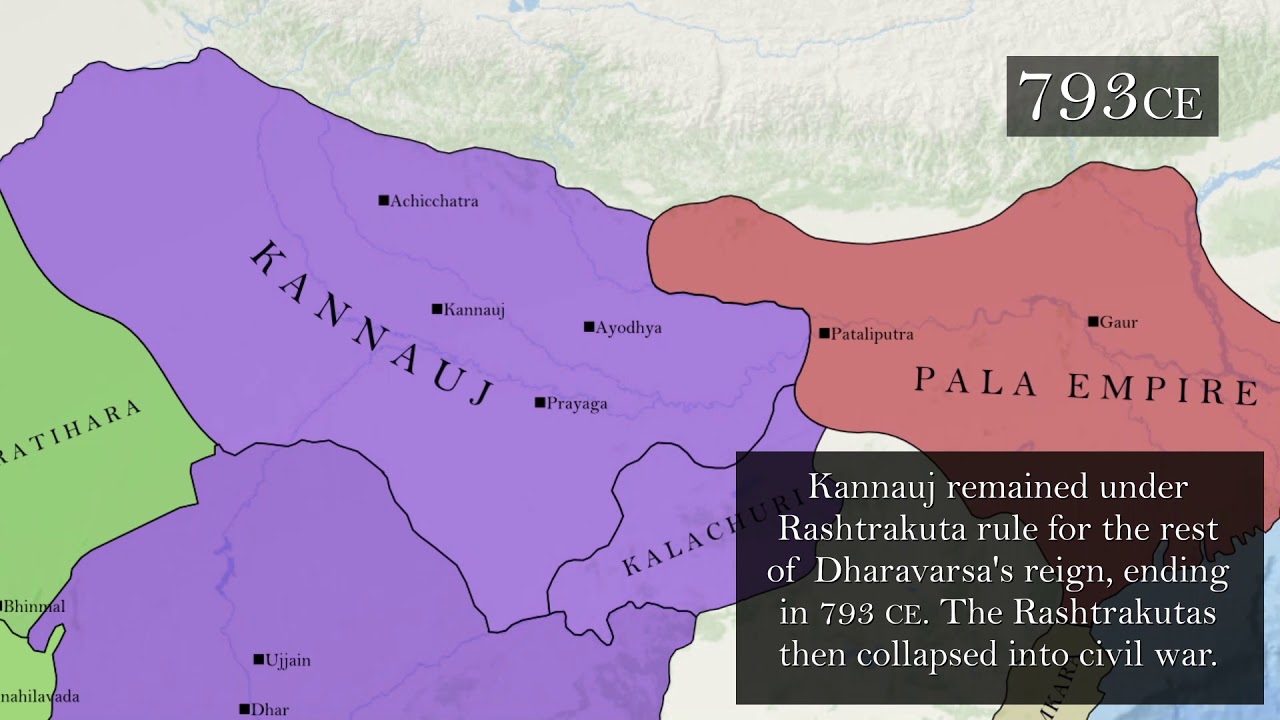
The historical phase known as the Age of Imperial Kannauj was defined by a century-long, multi-directional conflict for control of North India's chief political prize. Three major ruling houses—the Pratiharas, the Palas, and the Rashtrakutas—deployed massive armies to claim ultimate sovereignty over Aryavarta.
The Three Contenders: Pratiharas, Palas, and Rashtrakutas
Each dynasty brought immense military forces and economic backing from their home territories into the Gangetic heartland.
- The Pratiharas of western India, led initially by Nagabhatta I, gained immense prestige by successfully defending western frontiers against early Arab incursions.
- The Rashtrakutas, operating from their southern capital at Manyakheta in the Deccan, expanded northward under Dantidurga to project pan-Indian military power beyond the Vindhyas.
- The Palas of Bengal, guided by Dharmapala, marched westward to secure Kannauj and cement their leadership across northern kingdoms.
The Tripartite Struggle (785–816 CE): A Battle for Supremacy
This prolonged contest pitted the Pratiharas of Gurjaradesa, the Palas of Bengal, and the Rashtrakutas of Manyakheta against one another in alternating waves of conquest and retreat.
The Escalation of Conflict
Declining internal administration in post-Harsha Kannauj created a power vacuum that invited foreign intervention.
- By the late , internal instability made Kannauj vulnerable to external campaign forces.
- Both the Pratiharas and Palas viewed controlling the city as necessary to claim imperial status.
- The Rashtrakutas used periodic northern marches to prevent either northern power from consolidating total control.
The First Phase (785–790 CE)
Initial Pratihara advances were quickly checked by surprise southern campaigns led by the Rashtrakuta military.
- Pratihara ruler Vatsaraja invaded Kannauj, ousted its local ruler Indrayudha, defeated Pala King Dharmapala, and captured the royal treasury.
- Rashtrakuta King Dhruva marched north, defeating both Vatsaraja and Dharmapala in quick succession.
- Following his victories, Dhruva withdrew back to the Deccan, leaving northern politics unsettled.
Dharmapala’s Ascendancy (791 CE)
Capitalizing on the Rashtrakuta retreat, Dharmapala moved swiftly to establish Pala authority over the Gangetic plain.
- With southern armies gone, Dharmapala seized Kannauj and installed his nominee, Chakrayudha, on the throne as a vassal king.
- He organized a grand imperial durbar at Kannauj, attended by various regional rulers, signaling temporary Pala supremacy in North India.
Govinda III’s Northern Campaign (798–800 CE)
The southern Rashtrakuta kingdom launched another strategic campaign to reset the balance of power in the north.
- Rising power among northern kingdoms prompted Govinda III of the Rashtrakutas to lead a massive northern expedition.
- Govinda III defeated Pratihara King Nagabhata II and compelled both Chakrayudha and Dharmapala to acknowledge his superiority.
- Following precedent, Govinda III returned south shortly after, allowing northern contenders to regroup.
The Final War and Pratihara Victory (816 CE)
The decisive final phase established long-term Pratihara control over Kannauj.
- Following Govinda III's death, Nagabhata II invaded Kannauj, deposed Chakrayudha, and crowned himself King of Kannauj.
- Dharmapala assembled an allied coalition for one final effort to reclaim the imperial capital.
- In the decisive Battle of Monghyr, Dharmapala’s forces were completely defeated, securing Nagabhata II's triumph and ending Pala ambitions in the central region.
This hard-won victory cemented Pratihara supremacy over Kannauj. Following his decisive victory, Nagabhata II assumed the high imperial title of Paramabhattaraka, opening a long period of unified Pratihara rule across northern India.

Timeline of the Tri-Partite Struggle for Kannauj - Power Struggle Among Pratiharas, Palas, and Rashtrakutas The Pratihara Empire After the Struggle Under Mihirbhoja
The Pratihara state reached its greatest territorial extent under Mihirbhoja, whose long reign brought prosperity and military stability against western invaders.
Mihirbhoja: The Great Pratihara King
Mihirbhoja stands among the most celebrated imperial rulers in medieval Indian history.
- Contemporary Arab chroniclers recorded his name as Bhauura, a reference derived from his royal titles Varaha or AdiVaraha.
- He was widely known in trade records as the King of Jurz, an Arab designation for the rulers of the Gurjara-Pratihara line.
Mihirbhoja’s Expansion and Arab Battles
His armies secured vast frontier zones, stopping external advances into the Gangetic heartland.
- In , northern territories bordering Nepal were integrated into the imperial state administration.
- His realm extended north to Sarvasta-mandala within the Nepal Terai and adjoining Himalayan regions.
- Mihirbhoja fought numerous strategic battles against advancing Arab forces, containing their territorial footprint in western regions.
Arab Accounts of Mihirbhoja’s Empire
Foreign trade documents and travel logs recorded the economic wealth and powerful armies of the Pratihara state.
- The Arab merchant Sulaiman, visiting in , wrote detailed praise of the kingdom's stable government and powerful cavalry.
- Later in , traveler Abu Zaid documented Kannauj as the magnificent capital of the great Empire of Jurz.
The Peak of Imperial Prominence
Under Pratihara guidance, the capital city attained unmatched cultural and economic stature.
- By the time of Mihirbhoja’s death in , Kannauj had achieved an unparalleled level of prominence in Madhyadesa, serving as the undisputed center of northern power.
The long-standing Tripartite Struggle, which had impacted northern India for decades, concluded with the Pratihara victory, reshaping the political landscape of early Medieval India.
Quick Revision Capsule: Imperial Dynasties of Kannauj
A structured overview comparing key dynasties, leaders, mechanisms, and political outcomes during the era of Imperial Kannauj:
| Dynasty / Phase | Key Rulers & Figures | Primary Strategic Accomplishment |
|---|---|---|
| Maukharis | Harivarman, Grahavarman | Transformed Kannauj from a regional post into an imperial capital; forged alliances with Thaneshwar. |
| Vardhana Dynasty | Harshavardhana, Rajyavardhana | Unified Thaneshwar and Kannauj into an empire; patronized scholars like Banabhatta and Huien Tsang. |
| Gurjara-Pratiharas | Vatsaraja, Nagabhata II, Mihirbhoja | Emerged victorious in the Tripartite Struggle; blocked Arab incursions into northern India. |
| Palas of Bengal | Dharmapala, Devapala | Projected eastern power westward; temporarily installed Chakrayudha as a vassal king in Kannauj. |
| Rashtrakutas | Dhruva, Govinda III, Dantidurga | Demonstrated southern power by repeatedly defeating northern contenders before returning to the Deccan. |
Summary
The political history of Imperial Kannauj reflects the transition from centralized imperial rule under the early Guptas to a dynamic regional power structure. Situated at the core of the Gangetic plain, Kannauj emerged as the new political prize of Aryavarta. The Maukharis established its initial prominence, which was later expanded into a unified empire under Harshavardhana. Following Harsha's death, the city's strategic importance sparked the century-long Tripartite Struggle among the Gurjara-Pratiharas, the Palas, and the Rashtrakutas. Ultimately, the Pratiharas secured long-term victory under rulers like Nagabhata II and Mihirbhoja, holding the city until foreign invasions in the eleventh and twelfth centuries led to its political decline.
Quick Revision Notes
Essential facts to review before examinations:
- (i) The Maukharis were the first dynasty to establish Kannauj as a major imperial capital in North India.
- (ii) King Harshavardhana merged the crowns of Thaneshwar and Kannauj after the murder of Grahavarman.
- (iii) The Tripartite Struggle involved three dynasties: Pratiharas (West), Palas (East), and Rashtrakutas (South).
- (iv) Nagabhata II won the final victory at the Battle of Monghyr (816 CE), securing Pratihara control over Kannauj.
- Exam Tip: Pay special attention to primary literary sources like Banabhatta's Harshacharita and Huien Tsang's Si-yu-ki, as well as foreign chronicler accounts by Sulaiman and Abu Zaid. Questions frequently focus on the causes, key battles, and ultimate outcome of the Tripartite Struggle.
Frequently Asked Questions (FAQ)
Q1: Why did Kannauj replace Pataliputra as the power center of North India?
A1: Kannauj occupied an elevated, easily defendable location in the fertile central Gangetic plain, making it ideal for controlling trade routes, agricultural revenue, and military movements across Aryavarta after the decline of the Guptas.Q2: Which three dynasties fought in the Tripartite Struggle and who won?
A2: The struggle involved the Gurjara-Pratiharas of western India, the Palas of Bengal, and the Rashtrakutas of the Deccan. The Gurjara-Pratiharas secured long-term control after Nagabhata II's victory in 816 CE.Q3: What role did foreign accounts play in documenting the history of Imperial Kannauj?
A3: Records from the Chinese monk Huien Tsang provide direct observations of Harsha's administration, while Arab travel logs from Sulaiman and Abu Zaid detail the military power and economic prosperity of the Pratihara Empire under Mihirbhoja.