The historical trajectory of imperial Kannauj represents a decisive turning point in ancient Indian statecraft, signaling a dramatic power shift away from the declining Gupta Empire toward competitive regional kingdoms. Positioned in the fertile heartlands of Aryavarta, the city grew into the supreme symbol of political sovereignty across North India. This narrative tracks the rise of the local Maukhari dynasty, the subsequent unification of northern territories under Harshavardhana, and the century-long contest known as the Tripartite Struggle among the Pratiharas, Palas, and Rashtrakutas between and . Understanding these shifts clarifies how political fragmentation led to new strategic alliances across early medieval India.
In this chapter, you will understand:
- How the decline of the Guptas enabled Kannauj to replace Pataliputra as the imperial seat.
- The strategic role of the Maukharis and Harshavardhana in establishing northern unity.
- The multi-stage dynamics of the Tripartite Struggle involving three major regional powers.
- The ultimate consolidation under Mihirbhoja and the factors causing the city's eventual decline.
Why this topic matters: This period forms a crucial part of history curricula and competitive examinations, illustrating the transition from centralized ancient empires to regional political networks in early medieval North India.
Core Idea: After the fall of the Gupta Empire, control over Kannauj became the ultimate mark of imperial authority in northern India. Over three centuries, regional powers fought to secure the city, culminating in Pratihara dominance before foreign invasions brought the era to an end.
The Geopolitical Shift: The Decline of Guptas and Rise of Kannauj as a Power Centre
The gradual weakening of the Gupta dynasty created a power vacuum across northern India, turning Kannauj into the central prize for regional supremacy in Aryavarta. External invasions and internal rebellions fractured central authority, allowing former administrative centers to transform into ambitious sovereign states.
Factors Behind Northern Political Vacuum
Multiple pressures broke the structural integrity of the Gupta state during the and .
- (i) The Gupta monarchs faced heavy military pressure from external groups, particularly the Pushyamitras and the Hunas, whose incursions disrupted trade routes and internal stability across Central India.
- (ii) These invasions stripped the empire of vital tax-producing frontier regions, including Saurashtra and Western Malwa, accelerating central financial distress.
- (iii)
Emergence of Autonomous Feudatories
Local governors and feudatories broke away from imperial control to form self-governing lines.
- (a) The Maitrakas established a long-lasting regional capital at Valabhi.
- (b) The Maukharis fortified Kannauj, turning it into a fortress city along the strategic trade arteries of the Gangetic Plain.
The Emergence of the Maukharis and Their Control Over Kannauj
Starting as provincial administrators, the Maukharis built an independent kingdom around Kannauj. Their strategic location along key river routes enabled them to control regional commerce and project military influence across neighboring districts.

Maukhari Territorial Expansion and Key Rulers
The dynasty established administrative control over major portions of northern India, creating the base for the city's future imperial prominence.
- (i) Maukhari authority stretched from Nalanda in eastern regions toward Ahicchatra and Thaneshwar in the west.
- (ii)
Founders and Matrimonial Alliances
Dynastic marriages played a crucial role in securing their borders against rivals.
- Harivarman initiated the Maukhari lineage at Kannauj as its original founder.
- Grahavarman elevated the kingdom's prestige by marrying Rajyashri, daughter of the Vardhana ruler of Thaneshwar, cementing an alliance between two rising powers.
The Fatal Conflict with the Later Guptas and Sasanka of Gauda
The rising influence of Kannauj provoked aggressive countermeasures from eastern kingdoms looking to stop Maukhari expansion.
- (i) The Later Guptas formed a hostile coalition with Sasanka, the powerful ruler of Gauda in Bengal.
- (ii)
The Siege and Overthrow of Maukhari Rule
The allied invasion brought quick devastation to the royal court at Kannauj.
- (a) Joint forces launched a sudden assault on the city, killing Grahavarman during the fighting.
- (b) Queen Rajyashri was captured and imprisoned, triggering direct military intervention from her native house of Thaneshwar.
The Rise of Harshavardhana and the Consolidation of Power in Kannauj
The crisis following Grahavarman's death brought young Harshavardhana to authority. By combining the crowns of Thaneshwar and Kannauj, Harsha created a unified northern empire that restored cultural and economic vitality to the region during the early .
Primary Historical Sources on Harsha's Administration
Contemporary chronicles and foreign travelogues provide clear accounts of Harsha's military campaigns and state governance.
- (i) The Chinese Buddhist monk Huien Tsang traveled extensively across the realm, recording detailed observations on social life, administration, and religious assemblies in his work Si-yu-ki.
- (ii)
Biographical Texts by Banabhatta
Court literature gives direct details regarding political moves and lineage history.
- Court poet Banabhatta composed the Harshacharita, detailing Harsha's early struggles, military campaigns, and political consolidation.
Avenging the Family and Securing the Kingdoms
After his elder brother Rajyavardhana was assassinated, Harsha took immediate action to secure his family's lineage and restore order.
- (i) He tracked down and rescued his sister Rajyashri from captivity in the Vindhyan forests.
- (ii)
Merging Thaneshwar and Kannauj
With no direct heir on the Maukhari throne, Harsha combined administration across both realms.
- (a) He shifted his primary court from Thaneshwar directly to Kannauj, making it the supreme imperial capital of northern India.
- (b) He expanded his control across Punjab, Bengal, and Odisha, maintaining stability until his death in .
Post-Harsha Era: Yasovarman, Foreign Threats, and Kashmir's Intervention
Following Harsha's death in , northern India fractured once again into competing territories. However, Kannauj retained its status as a vital strategic hub, attracting ambitious monarchs and inviting external military conflicts throughout the .
Yasovarman's Rule and Diplomatic Initiatives
During the early , Yasovarman re-established local sovereignty, engaging in active foreign diplomacy to defend his kingdom against external threats.
- (i) He dispatched an official diplomatic mission to China in to form alliances against regional rivals and advancing western forces.
- (ii)
Facing Umayyad Military Advances
Rising pressure along western frontiers forced local rulers into joint defense actions.
- (a) Arab forces pushed inward toward Sindh and western borders, threatening Gangetic trade connections.
- (b) Yasovarman coordinated regional defensive actions to secure core agricultural and economic zones.
Northern Invasion by Lalitaditya of Kashmir
Rivalries among northern kingdoms led to sudden invasions that upset the regional balance of power.
- (i) Between and , King Lalitaditya-Muktapida of Kashmir launched a full-scale expedition southward.
- (ii)
Outcome of the Kashmiri Expedition
The conflict ended Yasovarman's expansion, shifting control over northern routes.
- (a) Yasovarman suffered a decisive defeat, forcing him to accept peace terms dictated by Kashmir.
- (b) The defeat left Kannauj structurally weakened, paving the way for a three-way battle among rising distant dynasties.
The Tripartite Struggle for Dominance: The Battle for Imperial Kannauj
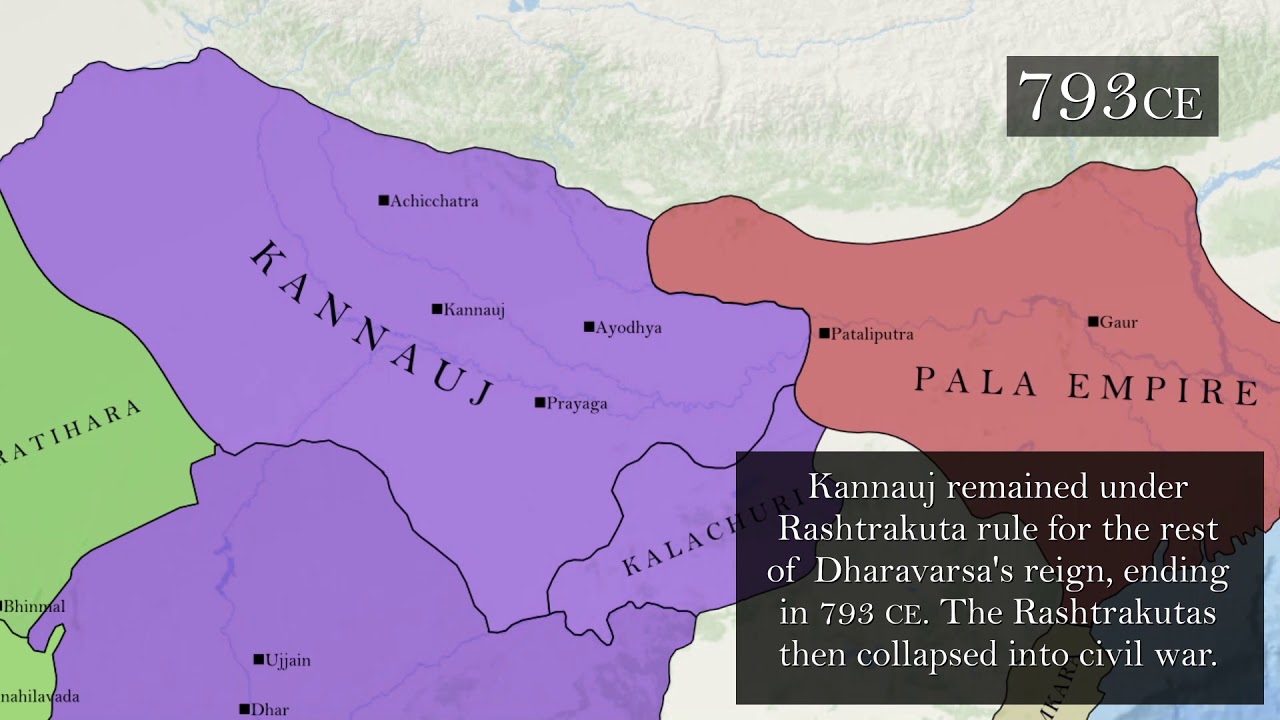
The era of Imperial Kannauj was defined by a century-long, multi-generational conflict for control over North India's primary political center. Three major dynasties—the Pratiharas of the west, the Palas of the east, and the Rashtrakutas of the south—fought continuously to hold the city and claim supreme sovereign rights across Aryavarta.

The Three Contenders and Their Regional Bases
Each dynasty brought vast resource bases and powerful military forces to the struggle for northern hegemony.
- (i) The Gurjara-Pratiharas, led initially by Nagabhatta I, expanded from western Rajasthan and Malwa after stopping early Arab invasions.
- (ii) The Palas of Bengal, organized under Dharmapala, pushed westward along the Gangetic corridor to claim supreme authority over northern commercial centers.
- (iii) The Rashtrakutas of Manyakheta in the Deccan, founded by Dantidurga, repeatedly marched north over the Vindhya mountains to demonstrate their military dominance over Gangetic rulers.
Phases of the Tripartite Conflict (785–816 CE)
This long contest moved through distinct military campaigns, with momentum shifting repeatedly among the three royal houses.
- (i)
The First Phase of Conflict (785–790 CE)
Initial clashes pitted western forces against eastern rulers before southern armies intervened.
- (a) Pratihara ruler Vatsaraja invaded Kannauj, ousted its puppet ruler Indrayudha, and defeated Pala King Dharmapala in battle.
- (b) Rashtrakuta King Dhruva marched north, defeating both Vatsaraja and Dharmapala in quick succession before returning south due to internal succession issues.
- (ii)
Pala Ascendancy and Imperial Court (791 CE)
The sudden withdrawal of southern armies allowed eastern forces to temporarily take control of the city.
- (a) Dharmapala occupied Kannauj and installed his ally Chakrayudha onto the throne as a vassal ruler.
- (b) He organized a grand royal durbar attended by regional rulers from Punjab, Rajputana, and Malwa to confirm his imperial standing.
- (iii)
Rashtrakuta Intervention Under Govinda III (798–800 CE)
Renewed southern campaigns disrupted eastern control over the Gangetic Plain.
- (a) Govinda III of the Rashtrakutas launched a second northern campaign, defeating Pratihara successor Nagabhata II.
- (b) Both Chakrayudha and Dharmapala submitted to Govinda III, but southern forces once again withdrew to the Deccan without establishing a permanent northern administration.
- (iv)
Final Pratihara Victory at Monghyr (816 CE)
A decisive military campaign permanently settled control over the disputed capital.
- (a) Nagabhata II captured Kannauj directly, removing Chakrayudha and declaring himself king.
- (b) In the decisive Battle of Monghyr, Nagabhata II completely defeated Dharmapala's combined forces, ending major Pala claims to the city.
- (i)

Chronological overview of campaign phases in the Tripartite Struggle The Pratihara Empire Under Mihirbhoja
Following the final victory, the Pratihara dynasty turned Kannauj into the stable administrative capital of a vast empire, reaching its peak under King Mihirbhoja ().
- (i)
Reign and Titles of Mihirbhoja
Foreign accounts confirm the political authority and economic strength of his realm.
- Arab chroniclers referred to him as Bhauura, a title linked to his official coin designations Varaha and AdiVaraha.
- He was widely known in frontier records as the King of Jurz, referring to his Gurjara-Pratihara lineage.
- (ii)
Expansion and Frontier Defense
Mihirbhoja defended imperial borders against foreign incursions while bringing adjacent regions under central authority.
- (a) He extended sovereign authority northward into the Nepal Terai and the Sarvasta-mandala around .
- (b) He fought crucial border battles against advancing Arab forces, stopping their eastward movement beyond Sindh.
- (c) Travelers such as Sulaiman () and Abu Zaid () praised the security, wealth, and powerful cavalry forces protecting the capital city.
- (i)
Quick Revision Capsule: Imperial Dynasties of Kannauj
A structured overview of the major dynasties that ruled or fought for control over Kannauj:
| Dynasty | Key Rulers | Primary Role & Impact on Kannauj |
|---|---|---|
| Maukharis | Harivarman, Grahavarman | Shifted power from Pataliputra; built early defenses and established Kannauj as a regional capital. |
| Vardhanas | Harshavardhana | Unified Thaneshwar with Kannauj; hosted major cultural assemblies and created a powerful northern empire. |
| Palas | Dharmapala | Contested western expansion; temporarily held Kannauj and installed vassal king Chakrayudha. |
| Rashtrakutas | Dhruva, Govinda III | Launched repeated northern campaigns from the Deccan, defeating rival armies before withdrawing south. |
| Gurjara-Pratiharas | Nagabhata II, Mihirbhoja | Won the Tripartite Struggle; secured long-term control over Kannauj and held off western invasions. |
The Eventual Fall of Kannauj: From Imperial Capital to Ruins
The long era of imperial prominence built by the Maukharis, Harsha, and the Pratiharas came to an end due to internal weakness and repeated foreign invasions during the late medieval period.
The city's decline began when Mahmud of Ghazni attacked Kannauj in , plundering its wealth and destroying its historic monuments. The final blow occurred in when Shihab-ud-din (Ghori) captured and dismantled the urban fortifications. This brought an end to centuries of political dominance, leaving behind historical ruins that mark the former capital of early medieval North India.
Summary
The story of Kannauj tracks the shift from ancient imperial rule to regional state systems in early medieval India. Following the collapse of the Gupta Empire, the city rose under the Maukharis and reached its first peak under Harshavardhana. Its central location made it the focus of the century-long Tripartite Struggle among the Pratiharas, Palas, and Rashtrakutas. The eventual victory of the Pratiharas under Nagabhata II and Mihirbhoja provided temporary stability before 11th and 12th-century invasions brought an end to its imperial era.
Quick Revision Points
Essential historical takeaways for revision:
- (i) The weakening of Gupta authority due to Huna invasions allowed Kannauj to replace older centers like Pataliputra.
- (ii) Harshavardhana merged Thaneshwar with Kannauj, turning the city into the premier political seat of northern India.
- (iii) The Tripartite Struggle () was fought among the Pratiharas, Palas, and Rashtrakutas.
- (iv) Nagabhata II won final control over the city at the Battle of Monghyr, opening the way for Mihirbhoja's reign.
- Exam Tip: Remember the three dynasties in the Tripartite Struggle and their locations: Pratiharas (West/Malwa), Palas (East/Bengal), and Rashtrakutas (South/Deccan). Also note key primary sources: Huien Tsang's Si-yu-ki and Banabhatta's Harshacharita.
Frequently Asked Questions (FAQ)
Q1: Why did Kannauj replace Pataliputra as the primary power center of North India?
A1: Kannauj was located on higher ground in the central Gangetic plain, making it easier to defend while offering direct control over trade routes along both the Ganges and Yamuna rivers.Q2: Who were the main participants in the Tripartite Struggle and what were they fighting for?
A2: The struggle involved the Gurjara-Pratiharas, the Palas, and the Rashtrakutas. They fought for control of Kannauj because holding the city symbolized supreme sovereign authority over Aryavarta.Q3: What primary sources provide information about Harshavardhana's reign at Kannauj?
A3: Key sources include the travel memoir Si-yu-ki by Chinese pilgrim Huien Tsang and the court biography Harshacharita written by Banabhatta.