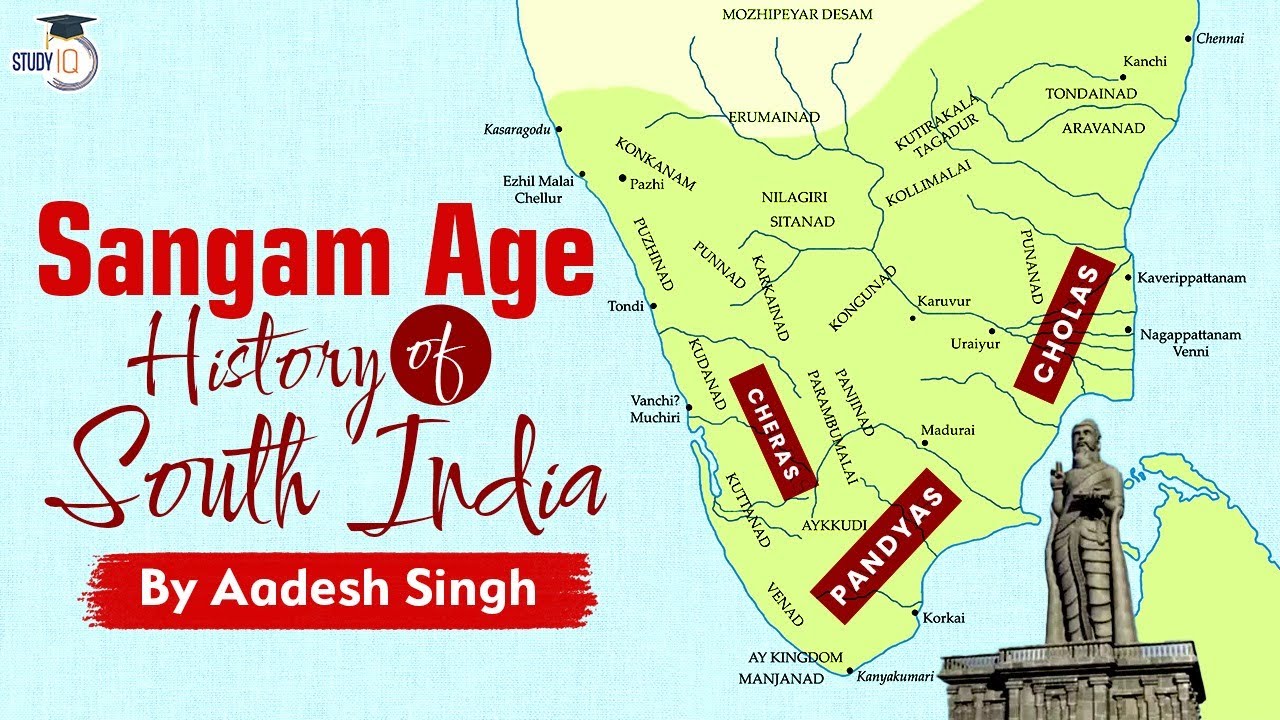
Exploring ancient South India starts with studying Sangam Literature, a foundational collection of early Tamil literary works that gives us an extraordinary look into the social, political, and cultural life of the region. Produced under the generous patronage of the early Pandya rulers, these poems capture the thoughts, values, and daily experiences of ancient Tamil society. The classical corpus is traditionally divided into two core emotional realms: Akam, which deals with inner feelings and personal love, and Puram, which focuses on public life, heroism, and warfare. The narrative of the Three Sangams—or literary academies—was first systematically documented in an commentary on Iraiyanar Akaporul by Nakkiranar. Understanding this literary heritage is essential for students, history scholars, and competitive exam aspirants aiming to master early South Indian history.
In this chapter, you will understand:
- The tradition and chronological narrative of the Three Literary Assemblies (Sangams).
- The division of classical poems into Akam (inner love) and Puram (outer world) genres.
- The five poetic landscapes (Tinai) and their associated emotional states and warfare stages.
- How Sangam works function as direct and indirect historical records for ancient Tamil society.
Why this topic matters: It forms the cornerstone of South Indian historiography, providing primary evidence for early Tamil state formation, maritime trade, social hierarchies, and literary evolution.
Core Idea: Sangam literature is the earliest surviving body of Tamil literature, compiled through legendary assemblies under Pandya patronage. Organised into Akam (love) and Puram (heroism/warfare) genres, these poems reflect both the poetic imagination and real-world historical memory of ancient Tamilakam.
Delving into the History and Structure of the Three Literary Academies (Sangams) of the Tamil Tradition
The term Sangam refers to an academy or gathering of scholars, poets, and critics who met under royal sponsorship to evaluate, compile, and preserve literary creations. While the word itself appeared in medieval texts, the institutional tradition it represents goes back much further into antiquity.
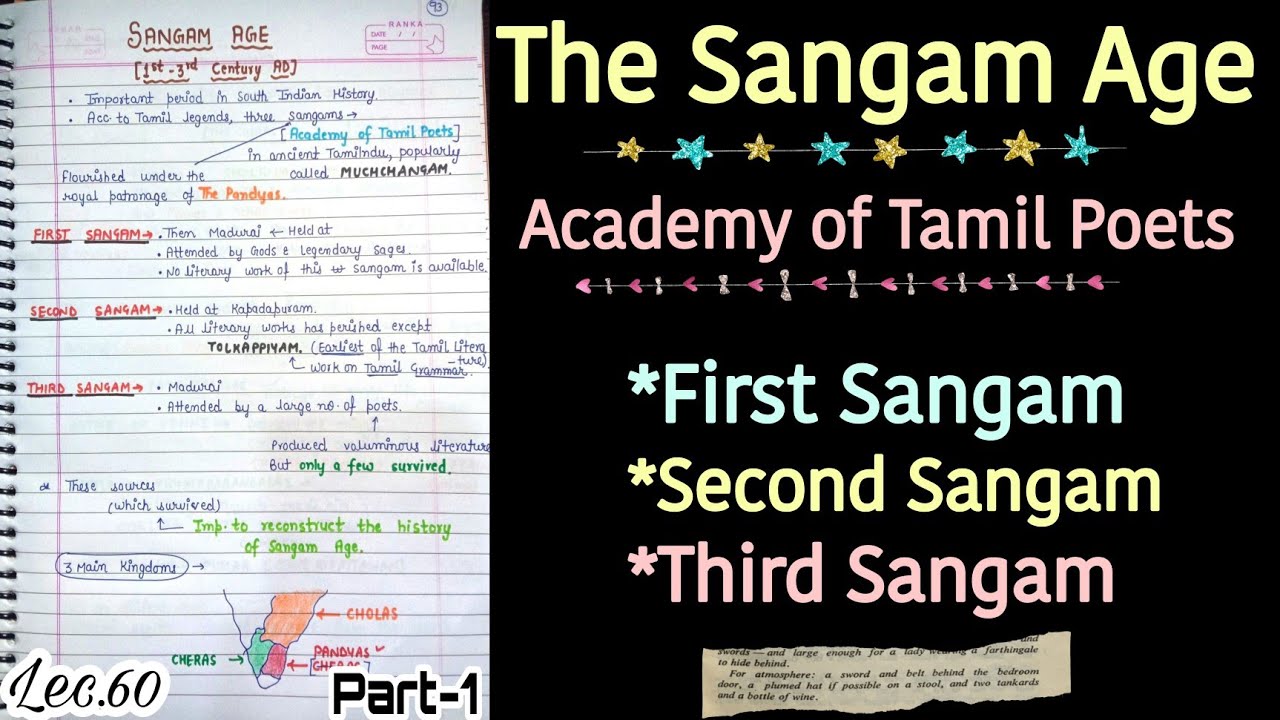
According to traditional Tamil accounts, notably recorded by Nakkiranar in his commentary on Iraiyanar Akaporul, three distinct assemblies took place sequentially over thousands of years under the patronage of Pandya kings.
- (i) These academies converted what was originally a dynamic oral tradition into codified written literature.
- (ii) The long timeline attributed to these assemblies highlights the ancient status of Tamil as one of the world's primary classical languages.
- (iii) The surviving poetry preserves the authentic historical collective memory of early Tamils.
The Three Legendary Tamil Sangams: A Chronological Account of Literary Assemblies
Tamil tradition divides the literary academies into three distinct historical periods, each centered in a different capital city of the Pandya kingdom.

The First Sangam: The Grand Assembly at Ten Madurai (South Madurai)
The First Assembly, or Mudal Sangam, is said to have taken place at ancient Ten Madurai (South Madurai). Tradition claims it lasted for and involved 4449 poets.
- (i) Legendary members included divine figures like Lord Shiva, Lord Muruga, and Lord Kubera, along with the revered sage Agasthya.
- (ii) No written works survive from this first era, as the city of Ten Madurai was eventually engulfed by the sea.
The Second Sangam: The Literary Hub at Kapatapuram
Following the submersion of the first capital, the Second Assembly (Iday Sangam) was established at Kapatapuram. It reportedly lasted for with the participation of 3700 poets.
- (a) Like its predecessor, Kapatapuram was also submerged by the sea, destroying almost the entire literary output of the period.
- (b) The sole surviving text attributed to this era is the masterwork of grammar, Tolkappiyam.
The Third Sangam: The Source of Surviving Classical Tamil Literature
The Third Assembly (Kadai Sangam) was held at the modern city of Madurai. It lasted for under the patronship of 49 Pandya kings, and its compositions form the entire body of classical Sangam literature available today.
- Surviving Works: Comprises the earliest known Tamil texts, offering valuable historical information about South India.
- Tolkappiyam: Authored by Tolkappiyar, this is the oldest surviving Tamil grammatical work, detailing language rules, poetics, and social conventions.
- Ettu Tokai (Eight Anthologies): A compilation of eight distinct poetic collections: Natrinai, Kuruntokai, Iinkurunuru, Patitruppathu, Paripadal, Kalittokai, Akananuru, and Purananuru.
- Pattu Pattu (Ten Idylls): A collection of ten longer narrative poems, including Tirumurugaatruppadai, Porunaratruppadai, Sirupaanaatruppadai, Perumppaanaatruppadai, Mullaipattu, Maduraikanchi, Nedunalvaadai, Kurinjipaatu, Pattinapalai, and Malaipadukadam.
Classifying the Core Genres: Themes and Poetic Landscapes (Tinai) of Sangam Literature
Classical Sangam literature uses a structured framework that connects human emotions and actions to specific physical landscapes, divided into two primary genres.
Akam Poems: The Poetry of Inner Life, Love, and Emotions
The Akam genre focuses on personal relationships, courtship, love, and family life. These poems never mention real personal names of kings or individuals. Instead, emotional experiences are mapped onto five eco-zones called tinai:
- (i) Kurinji (Mountainous): Represents the union of lovers and secret midnight meetings in the hills.
- (ii) Mullai (Pastoral/Forest): Symbolises patient waiting by the heroine for her lover's return from a journey or war.
- (iii) Marutam (Riverine/Agricultural): Associated with domestic friction, infidelity, and reconciliation in fertile valleys.
- (iv) Neytal (Coastal/Seashore): Expresses grief, anxiety, and painful separation along the beach.
- (v) Palai (Arid/Wasteland): Depicts dangerous journeys, hardship, and elopement across dry terrain.
Puram Poems: The Poetry of External Life, Warfare, and Societal Values
The Puram genre deals with public affairs, statecraft, battle, ethics, and royal generosity. Unlike Akam, these poems explicitly name real chieftains, kings, bards, and historical locations. Battles are also classified into specific tinai stages, marked by wearing different flowers:
- (a) Vetchi Tinai: The cattle raid that initiates conflict with an enemy kingdom.
- (b) Vanchi Tinai: The military mobilization and preparation for war.
- (c) Uzhinai Tinai: The strategy and execution of fortress siege warfare.
- (d) Tumpai Tinai: The direct, open field pitch battle between armies.
- (e) Vakai Tinai: The celebration of victory and distribution of rewards.
Historical Elements and the Legacy of Tamil Collective Memory in Sangam Works
Although these poems were orally composed between and , they were compiled into formal anthologies by around the . They serve as a vast historical archive of early South Indian life.
Literary Heritage, Precursors, and Historical Consciousness
The sophistication of Sangam poetry indicates that a long poetic tradition existed before these texts were written down. The grammatical text Tolkappiyam cites earlier unwritten traditions over 240 times.
- (i) Historical awareness in the texts operates on both ancient recollections and immediate observations.
- (ii) Descriptions of the Past: References to royal genealogies, ancient wars, Vedic rituals, and ancestral lineages.
- (iii) Contemporary Historical Narratives: First-hand accounts by court poets and traveling bards detailing economic conditions, foreign trade, and political developments of their day.
Puram and Akam: Direct and Indirect Historical Records
Both poetic genres contribute unique historical information to modern researchers.
- Puram Songs: Offer direct historical evidence by identifying Chera, Chola, and Pandya kings, specific battlegrounds, and political alliances.
- Akam Songs: Offer indirect historical context by using real-world events, landmarks, or famous battles as background metaphors for romantic situations.
Quick Revision Capsule
Summary breakdown of the Three Sangam Academies for rapid exam revision:
| Academy | Location & Timeline | Key Features & Works |
|---|---|---|
| First Sangam (Mudal) | Ten Madurai () | Patronised by Pandya kings; attended by Agasthya; all works lost to sea. |
| Second Sangam (Iday) | Kapatapuram () | Submerged by ocean; sole surviving text is the grammar manual Tolkappiyam. |
| Third Sangam (Kadai) | Madurai () | Supported by 49 Pandya kings; source of Ettu Tokai and Pattu Pattu. |
| Akam Genre | Inner life / Love themes | 5 Landscaping zones (Kurinji, Mullai, Marutam, Neytal, Palai). |
| Puram Genre | Outer life / War & Ethics | 5 War stages (Vetchi, Vanchi, Uzhinai, Tumpai, Vakai); names real kings. |
Summary
Sangam Literature is the bedrock of classical Tamil culture, offering a detailed picture of ancient South Indian society between and . Through its unique organization into Akam (love) and Puram (war fare and social life) genres, it captures both personal human emotions and large-scale political realities under the Pandya rulers. Studying these works helps us understand early state formation, trade, and social systems in ancient Tamilakam.
Quick Revision Notes
Essential facts to remember for examinations:
- (i) The commentary on Iraiyanar Akaporul by Nakkiranar () is the primary source for the three Sangams narrative.
- (ii) Tolkappiyam is the oldest surviving Tamil grammar text, originating from the Second Sangam.
- (iii) The major Third Sangam compilations are Ettu Tokai (Eight Anthologies) and Pattu Pattu (Ten Idylls).
- (iv) Akam poems deal with anonymous inner love, while Puram poems document historical kings, war, and public deeds.
- Exam Tip: Remember that Akam poems never mention the personal names of kings or places directly in the main romantic plot, whereas Puram poems explicitly name kings, chieftains, and battles. Questions frequently test this key distinction.
Frequently Asked Questions (FAQ)
Q1: What are the main differences between Akam and Puram genres in Sangam literature?
A1: Akam poetry focuses on inner emotions, love, and family life using stylized natural landscapes without naming real historical figures. Puram poetry focuses on the outer world, including warfare, governance, ethics, and heroism, directly naming real kings, bards, and battlefields.Q2: Which works belong to the Third Sangam assembly?
A2: The surviving classical works of the Third Sangam include Tolkappiyam (grammar treatise), Ettu Tokai (Eight Anthologies), and Pattu Pattu (Ten Idylls).Q3: Who provided patronage to the Sangam assemblies?
A3: According to historical tradition, the Sangam academies flourished under the direct royal patronage of the Pandya kings in southern Tamilakam.