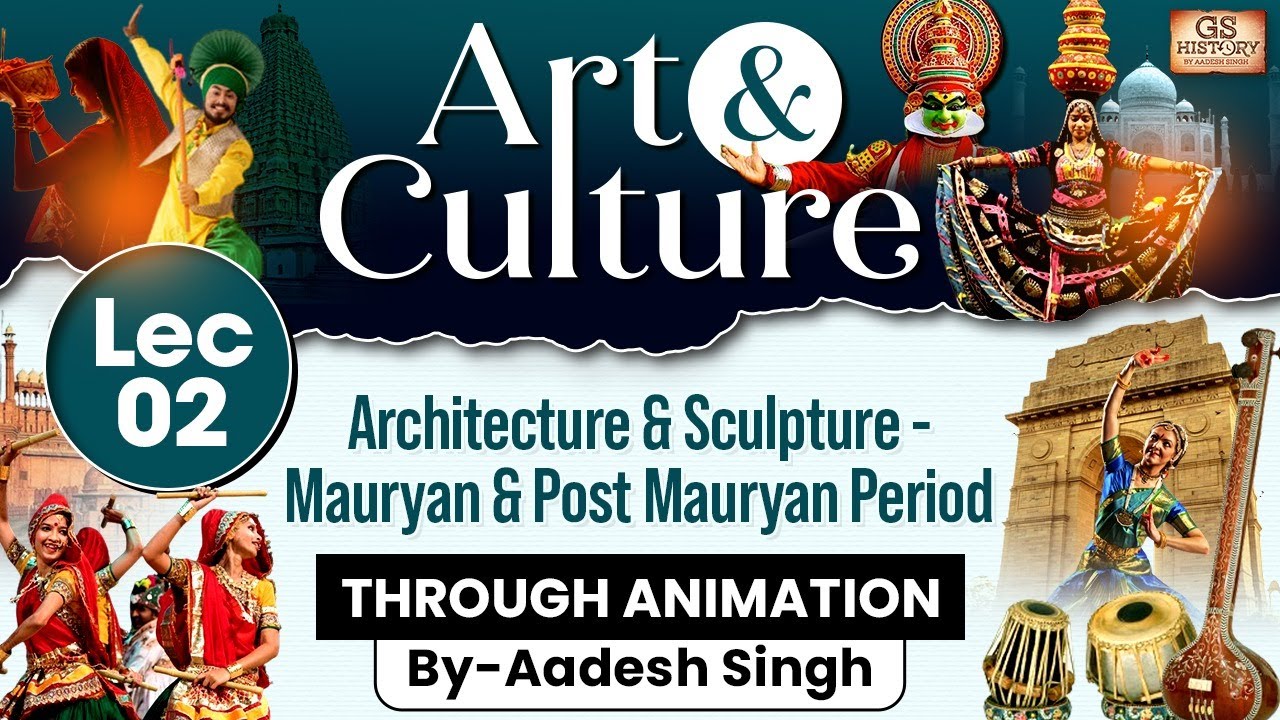
The Lion Capital of Sarnath and the Didargunj Yakshini stand as paramount, iconic examples of Mauryan art and sculpture (), showcasing the technical brilliance and rich cultural and artistic traditions of ancient India. These monumental works highlight profound Buddhist symbolism, the extensive Ashoka’s patronage, and the sophisticated evolution of early sculptural and architectural design. They are thus highly important for students preparing for history, culture, and art competitive exams, offering indispensable insights into symbolism, master craftsmanship, and historical continuity in the Indian subcontinent.
🎯 In this chapter, you will understand:
- The structural components and profound Buddhist symbolism of the Sarnath Lion Capital.
- The aesthetic elegance, Mauryan polish, and human-form mastery of the Didargunj Yakshini.
- The evolution of Stupa architecture, Aniconism, and visual narrative styles in early Buddhist art.
- Exam-focused questions and revision points regarding Mauryan patronage and artistic legacy.
💡 Why this topic matters: It forms the backbone of ancient Indian art history and provides essential concepts frequently tested in competitive exams.
🧠 Core Idea: Mauryan stone carving introduced monumental scale, high-gloss polish, and sophisticated symbolic storytelling to Indian art.
🏛️ Lion Capital of Sarnath and Didargunj Yakshini – Mauryan Art and Sculptural Masterpieces (3rd Century BCE) Detailed Analysis
The Lion Capital of Sarnath is a celebrated, internationally recognized symbol of India’s national heritage and the pinnacle of early Buddhist art and imperial power.
This magnificent monolithic capital, a testament to the might and spiritual vision of the Mauryan Empire, was discovered at the sacred site of Sarnath near Varanasi. It was specifically commissioned by the great Emperor Ashoka to commemorate the momentous occasion of the Buddha’s first delivery of the sermon—an event profoundly known as Dhammachakrapravartana (Turning the Wheel of Law).
- (i) It is universally recognized as representing one of the technically finest and most aesthetically powerful sculptures ever produced during the entire span of the Mauryan period, demonstrating an unprecedented level of finish and form.
- (ii) The Capital holds a deeply symbolic and emotional status as the official national emblem of India, embodying the nation's profound cultural and historical significance and commitment to peace (Dharma).
- (iii) The precious and invaluable remains of this ancient artifact, carefully retrieved from the site, are meticulously preserved and housed in the Archaeological Museum at Sarnath for posterity and future study.
🏗️ Components and Structure of the Lion Capital of Sarnath: An Architectural Marvel
The magnificent Lion Capital originally comprised five distinct, interconnected parts, which together symbolize both the high level of artistic mastery achieved by Mauryan artisans and the core Buddhist teachings and cosmic order it was intended to represent.
The Monolithic Pillar Structure and Decorated Abacus: A Story of Artistic Perfection
The capital structure showcases an extraordinary and seamless blend of naturalism, technical perfection, and a highly distinctive, mirror-like polish, rising majestically from a foundational base to the spiritual crowning element.
- (i) The foundational Shaft, which was originally a single piece of stone supporting the entire capital, is now regrettably fragmented into several pieces, marking the ravages of time and history.
- (ii) A distinctive inverted Lotus bell base formed the supporting platform for the entire sculpted design, symbolizing the blossoming of purity and enlightenment from the muddy depths.
- (iii) The circular Drum (or Abacus) is beautifully decorated with four dynamically moving animals—the elephant, bull, horse, and lion—each depicted in high-relief and seemingly running in a clockwise direction, representing the ceaseless march of the universe.
- (iv) Resting majestically atop the abacus are the four addorsed lions, seated back-to-back, carved with incredible muscular tension and a regal bearing, symbolizing the universal roar of the Buddha's teachings.
- (v) The structure was originally crowned by a large Dharamchakra (Wheel of Law), which is now broken and carefully kept within the site museum, symbolizing the ultimate truth and the Dharma’s universal reach.
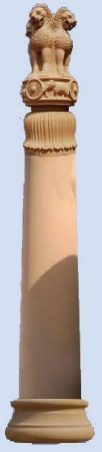
Pillar Capital Abacus of Lion Capital Sarnath - A detailed view of the Abacus and Lions, showcasing intricate Mauryan artistry and the distinctive mirror-like polish. Full View of the Lion Capital Masterpiece: India's National Symbol
This single image encapsulates the historical and artistic power of the monument, illustrating why it was chosen to represent modern India—its strength, truth, and spiritual legacy being unparalleled.
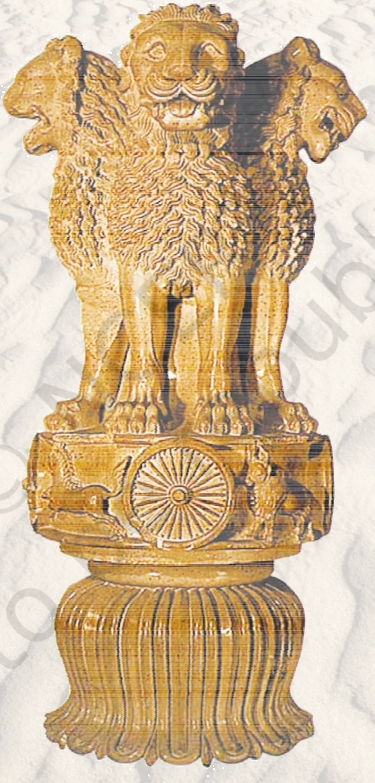
Sarnath Lion Capital - The complete reconstructed Symbol of India’s heritage and national emblem, a testament to Mauryan sculptural skill.
🎨 Symbolism and Design: Mauryan Craftsmanship and Buddhist Philosophy Intertwined
The design of the Lion Capital masterfully intertwines complex Buddhist symbolism with an extraordinary level of Mauryan craftsmanship, reflecting precision in form and deep philosophical meaning that speaks of imperial and spiritual authority.
Lion Design Features: Monumental Strength and Naturalistic Expression
The four lions are carved with a monumental strength and a realistic anatomical accuracy that sets them apart from earlier art forms, demonstrating a decisive shift toward technical realism and sophisticated sculpting.
- (i) The powerful, four lions are seated back-to-back (addorsed), giving the capital a truly monumental and commanding presence from all directions, signifying the spread of Dharma in all cardinal directions.
- (ii) The animals display strong, realistic musculature and remarkably naturalistic expressions, capturing the animal's inherent power and the majesty of the Mauryan state.
- (iii) There is meticulous attention to detail in the carving of the lips, the voluminous mane, and the overall powerful volume of the animal forms, achieving a rare blend of realism and idealism.
The Abacus and its Symbolism: The March of Dharma Across the Directions
The circular abacus is not merely decorative but deeply symbolic, representing the ceaseless spread of the Dharma (Buddhist law) through the cardinal directions, interspersed with animal figures symbolizing different aspects of the Buddha's life and the cosmic order.
- (a) The drum is adorned with a Chakra (wheel) featuring 24 spokes, repeated in all four directions, symbolizing the 24 principles of Dharma and the perpetual motion of the universe (Samsara).
- (b) Between the chakras are high-relief depictions of the bull, horse, elephant, and lion, which are generally believed to be the four guardian animals of the four directions or symbolic representations linked to the Buddha's life events.
- (c) The entire upper structure is supported by an inverted lotus bell, whose petals are sculpted with precision, symbolically representing purity and the blossoming of enlightenment from the material world.
Architectural Design and Circular Viewing: A 360-Degree Sculpture
Unlike reliefs designed for a fixed frontal view, the Sarnath Capital was deliberately conceived as a piece of sculpture in the round, emphasizing its universal appeal and comprehensive presence as a symbol of authority.
- (i) The sculpture was cleverly designed for a full 360° viewing, ensuring no single fixed perspective, thus symbolizing the universality and all-encompassing nature of the Dharma.
- (ii) The extraordinary detail and perfect symmetry reflect a mastery of both form and the depiction of subtle movement and controlled power within a unified monolithic structure.
Other Lion Capitals from the Mauryan Period: A Widespread Imperial Motif
While Sarnath is undoubtedly the most famous, the Lion Capital motif was not unique, demonstrating its widespread status as an important imperial and religious symbol across the vast Mauryan empire.
- (i) Another significant, though now dilapidated, lion capital was discovered at Sanchi, confirming the widespread use of this motif as a standard feature of the imperial outreach.
- (ii) The majestic lion motif, popularized by the Mauryans as a symbol of royal and spiritual authority, continued to be an influential and enduring theme in later periods of Indian art and sculpture.
💃 Didargunj Yakshini – The Epitome of Mauryan Sculptural Art in Human Form
The Didargunj Yakshini is a life-size standing sculpture that has become globally famous for its astonishing elegance, full female form, and the characteristic, highly reflective Mauryan polish, representing the mastery of early stone carving and the depiction of vital, sacred femininity.
Introduction to the Yakshini: Discovery and Preservation in Patna Museum
Discovered in Didargunj near Patna, this stunning sculpture is regarded as one of India's finest art treasures and is now the centerpiece of the Patna Museum collection, symbolizing fertility, abundance, and the Yakshini cult.
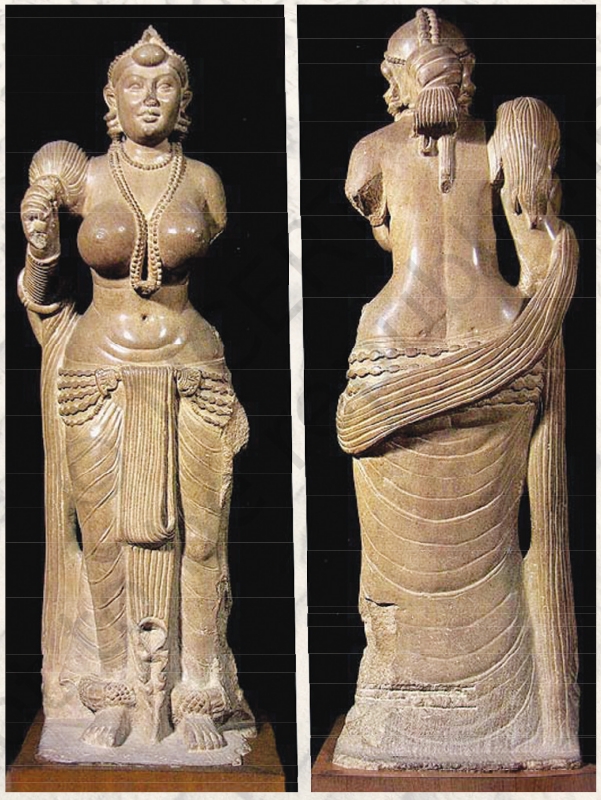
Didargunj Yakshini – A masterful Mauryan Period sculpture, symbolizing fertility and abundance, renowned for its high polish. - (i) The figure is prominently depicted holding a chauri (flywhisk) in her right hand, an attribute often associated with a retainer or attendant, although her left hand is now sadly broken and missing.
- (ii) It is a massive, free-standing sculpture carved entirely in the round from sandstone, and is highly recognizable for its characteristic, superb Mauryan polish that makes the stone appear almost metallic and luminous.
Design and Features: Anatomical Detail and Realistic Naturalism
The sculpture’s details showcase an exceptional command over stone carving, depicting the human form with a full, voluptuous naturalism that powerfully emphasizes vitality, life-force, and physical beauty (Prakriti).
- (i) The face features round, soft cheeks, sharp, defined eyes, nose, and lips, along with subtle detailing of the muscles, conveying an impressive, lifelike realism and serenity.
- (ii) The jewelry, particularly the meticulously carved necklace beads, are impressively rendered in full round, lending a palpable sense of weight as they fall gently over the belly, enhancing the figure's volume.
- (iii) The prominent and full breasts distinctively highlight the heaviness and volume of the torso, emphasizing the figure’s naturalistic, idealized, and life-affirming form.
Garments and Ornamentation: The Illusion of Transparent Drapery
The depiction of clothing is a technical marvel, with the fabric carved so thin and close to the body that it creates a compelling illusion of sheer transparency—a sculptural feature that became a defining characteristic of later Indian art.
- (a) The garment tied around the belly is tight, creating a realistic bulging effect that highlights the fullness and softness of the form beneath the fabric.
- (b) The delicate, transparent folds of the lower garment appear to cling tightly to the legs, revealing the form underneath—a hallmark of early sculptural sophistication and technical excellence in stone carving.
- (c) The feet are adorned with distinctive, thick bell ornaments, adding to the overall detailed and rich ornamentation that contrasts with the sheer fabric, indicating the figure’s status and divinity.
Back and Hair: Sculptural Completeness and Detail
The attention to the back and the intricate hair styling confirms that the Yakshini figure was designed to be fully appreciated from all angles, not just the frontal view, showcasing the artist's holistic approach.
- (i) The hair is intricately tied in a neat back knot, and the powerful bare back is sculpted with equal attention to detail and anatomical accuracy, ensuring completeness.
- (ii) The drapery folds elegantly over the legs, and the meticulous lines of the flywhisk (chauri) are rendered with superb precision, emphasizing the object's function and the figure’s grace.
Collective Nature of Mauryan Art Patronage: Beyond Royal Commission
The Mauryan artistic endeavor, particularly for religious structures like Stupas, was often a community project, supported by a broad base of donors, reflecting the social reach and acceptance of the new religious movements.
- (i) Monumental projects, such as the Stupas, were rarely the work of a single royal patron but involved extensive collective patronage from various social groups.
- (ii) Even powerful traders (merchants) and their influential guilds significantly contributed to these art and architectural initiatives, with their donations often meticulously recorded in accompanying inscriptions for public recognition.
Stupa Architecture and Post-Mauryan Sculptural Decoration: An Evolution
Though initiated in the Mauryan period as simple earthen mounds, the Stupa form evolved significantly with elaborate decorative additions and architectural elements in the subsequent centuries, especially the Shunga period.
- (i) Stupas were architecturally developed through the addition of elaborate stone railings (Vedikas) and rich sculptural elaborations, particularly in the Shunga and later periods, turning them into vast art galleries.
- (ii) The basic, sacred structure consisted of the cylindrical drum, the hemispherical anda (dome representing the cosmic egg), the square railing on top (harmika), and the crowning triple umbrella (chhatra).
- (iii) Ornate, meticulously sculpted gateways (Toranas) were added, which served as vast canvases for detailed sculptural narratives and episodic storytelling of the Buddha’s life and past lives.
Depiction of Buddha in Early Buddhism: The Concept of Aniconism
In the earliest phases of Buddhist art, including the Mauryan period, the Buddha was profoundly respected but was not represented in human form—a practice known as Aniconism—but rather through significant, evocative symbols.
- (i) The Buddha was consistently shown symbolically (aniconism) through key representations like his footprints, the stupas, the lotus, or the Dharma Chakra (Wheel of Law), emphasizing his transcendent nature.
- (ii) This symbolic art gradually gave way to narrative art that visually depicted the Jataka stories and the key events of the Buddha’s life, making the moral teachings accessible to the masses.
Types of Narratives in Buddhist Art: Visual Storytelling Techniques
To communicate the complex stories of the Buddha’s life and past lives to a lay audience, various visual narrative techniques were expertly employed on the Stupa railings and Toranas, facilitating a rich, engaging form of religious instruction.
- (a) Synoptic narrative: This powerful technique presents multiple scenes of a single story within one frame, showing events before and after the central moment, condensing time and space.
- (b) Continuous narrative: This popular style shows a sequence of events unfolding repeatedly within a continuous pictorial space, guiding the viewer through the entire story without breaks.
- (c) Episodic narrative: This efficient method, which shows only the most climactic or important moments of a story, was frequently used to depict the major events in the Buddha’s life, relying on the audience's knowledge.
Jataka Stories in Buddhist Art: Moral and Ethical Precepts for the Layperson
The Jataka tales, which recount the previous births of the Buddha as the Bodhisattva, were a foundational and recurring subject in early Buddhist art, serving as accessible moral parables demonstrating virtues.
- (i) The tale of the Chhadanta Jataka (the story of the six-tusked elephant) was a popular and frequently sculpted artistic subject, illustrating self-sacrifice.
- (ii) The story of Vidurpundita Jataka illustrated wisdom and ethical conduct as paramount virtues for spiritual attainment.
- (iii) Other widely depicted and ethically significant stories included the Ruru Jataka, Sibi Jataka, Vessantara Jataka, and Shama Jataka, all designed to teach the core Buddhist virtues of compassion, generosity, and self-control.
⚡ Quick Revision Capsule: Mauryan Art Comparison
A fast visual summary comparing the two primary sculptural masterpieces of the Mauryan Era.
| Feature | Lion Capital of Sarnath | Didargunj Yakshini |
|---|---|---|
| Primary Subject | Royal lions, abacus animals, and Dharmachakra | Life-size female figure holding a chauri (flywhisk) |
| Material & Polish | Chunar sandstone with mirror-like Mauryan polish | Polished buff sandstone with glass-like sheen |
| Symbolic Context | Spreading of Buddha's teachings & Ashokan imperial vision | Fertility, abundance, and local worship traditions |
| Viewing Angle | 360-degree sculpture carved in the round | Fully sculpted free-standing figure in the round |
| Current Location | Sarnath Archaeological Museum | Patna Museum, Bihar |
📝 Summary
The Lion Capital of Sarnath and the Didargunj Yakshini collectively represent the zenith of Mauryan sculptural excellence, encapsulating a period of intense Buddhist symbolism, imperial vision, and the foundational development of early stupa architecture. These immortal masterpieces vividly reveal the period's unparalleled artistic refinement, profound religious importance, and enduring historical legacy, particularly through the use of the distinctive Mauryan polish. For students of history and culture, they provide essential and unparalleled insights into ancient Indian history, art, and the foundational cultural expressions of the subcontinent, making them vital for comprehensive competitive exam preparation on Indian Art and Culture.
🚀 Quick Revision Points
Essential facts to review before examinations:
- (i) Sarnath Capital commemorates Buddha's first sermon, Dhammachakrapravartana.
- (ii) Didargunj Yakshini showcases mastery in carving transparent drapery and human forms.
- (iii) Early Buddhist art followed Aniconism, representing Buddha only via symbols.
- (iv) Narrative techniques included synoptic, continuous, and episodic styles depicting Jataka tales.
- 💡 Exam Tip: Remember the four animals on the abacus: Elephant, Horse, Bull, and Lion moving in a clockwise direction around the 24-spoke wheel.
❓ Important Questions & Answers on Mauryan Art (FAQ)
Q1: Did sculpture in India originate during the Mauryan period?
A1: While the Mauryan period marked a monumental advance in scale and technique, it did not originate sculpture in India. Earlier forms, such as terracotta and bronze figures, existed during the Indus Valley Civilization. The Mauryans introduced stone refinement, monumental scale, and the famous high polish.Q2: What is the significance and architectural development of the Stupa?
A2: The Stupa served as a relic monument and site for veneration. Structurally, it developed from earthen mounds into complex structures with a drum, anda (dome), harmika (square railing), chhatra (umbrella), and intricately carved Toranas (gateways).Q3: How are the four major events of Buddha's life represented in early Buddhist art?
A3: Early art used symbolic (aniconic) forms: Birth is shown by a Lotus/Elephant; Renunciation by a riderless Horse; Enlightenment by the Bodhi Tree; and Mahaparinibbana by the Stupa or Footprints.Q4: What are Jatakas and their connection to Buddhism?
A4: Jatakas are stories recounting the previous lives of the Bodhisattva. They were carved on Stupa railings and gateways to teach moral lessons like compassion (Karuna) and self-sacrifice to the public.