The Mauryan art and architecture, commencing around the , signifies a monumental and transformative era in Indian cultural history, characterized by the debut of large-scale, polished stone structures. These iconic works—including the famous pillars, stupas, rock-cut caves, and sculptures—were infused with profound religious and political symbolism. Under the strategic imperial patronage of Emperor Ashoka and his predecessors, the flourishing Buddhist and Jain religious traditions, alongside indigenous folk beliefs like Yaksha worship, established the foundational aesthetic of this period. This detailed exploration is profoundly important for students and competitive exam preparation as it comprehensively illustrates the convergence of major religious movements, centralized political patronage, administrative inscriptions, and unparalleled monumental works that laid the groundwork for ancient Indian civilizational art.
🎯 In this chapter, you will understand:
- The rise of non-Vedic religious traditions and centralized political patronage under the Mauryan empire.
- The syncretic integration of Shraman traditions (Buddhism and Jainism) and indigenous folk cults (Yaksha worship).
- The technical excellence of monolithic Ashokan pillars, rock-cut caves, and monumental Stupas.
- Collaborative patronage involving royal decrees, lay devotees, and professional artisan guilds.
💡 Why this topic matters: Understanding Mauryan art reveals the intersection of centralized imperial authority, religious evolution, and monumental craftsmanship that defined early Indian civilization.
🧠 Core Idea: Monumental stone architecture, pillar edicts, and syncretic sculpture fused political power with spiritual devotion.
Religious and Social Movements: A Crucible Shaping Artistic Origins in the
The served as a pivotal intellectual and social forge, where the emergence of powerful new philosophical doctrines and a burgeoning social dissent against the rigid varna-jati social structure fundamentally dictated the themes, symbolism, and nature of early Mauryan religious art.
-
The Mauryan period, firmly entrenched in the , dramatically inaugurated an age of profound religious, political, and artistic transformation, permanently altering the course of Indian architecture and sculptural traditions.
This remarkable artistic surge was directly correlated with the rise of non-Vedic religious traditions, skillfully harnessed and funded by the extensive, centralized political dominance of the Mauryan empire, culminating in an artistic zenith under the committed patronage of Emperor Ashoka, particularly for Buddhist and powerful Yaksha artistic representations.
- (i) The philosophical growth and institutionalization of Buddhism and Jainism, rooted in the ascetic Shraman tradition, provided the necessary new ideological and aesthetic direction for artistic output.
- (ii) The strategic consolidation of the mighty Magadha Kingdom organically evolved into the sprawling Mauryan empire, uniquely affording the extensive centralized resources required for unprecedented monumental construction projects across the subcontinent.
- (iii) Emperor Ashoka's personal dedication played a crucial, transformational role, as he systematically utilized his vast imperial authority and treasury to vigorously promote and patronize the construction of numerous enduring Buddhist monuments and pillar edicts throughout his realm.
Shraman Tradition: The Ideological Foundation for Early Buddhist and Jain Artistic Patronage
The core tenets of the Shraman tradition offered a powerful ideological alternative, forming the philosophical basis for the two major non-Vedic religious movements—Buddhism and Jainism—whose egalitarian principles were readily adopted and visibly showcased in Mauryan artistic endeavors, signaling a distinct shift away from exclusive Brahmanical ritualism.
- (i) The pivotal was a landmark period that witnessed the significant, simultaneous emergence and subsequent flourishing of both Buddhism and Jainism within the culturally rich and expansive Gangetic valley region.
- (ii) Both of these nascent traditions shared a common, radical root in the ascetic Shraman tradition and actively propagated teachings that challenged the established, birth-based social stratification dictated by the prevailing varna and jati systems.
- (iii) This progressive ideological stance attracted widespread patronage from various and diverse social strata, which profoundly influenced the core themes, the geographical spread, and the social inclusiveness that defined early Mauryan artistic patronage.
Yaksha and Folk Worship Traditions: Seamless Integration into Mauryan Religious Art
Religious expression during the Mauryan period was remarkably syncretic and highly inclusive, encompassing a vibrant tapestry of ancient, indigenous spiritual practices, notably the worship of Yaksha, powerful nature spirits, and the mother-goddess. These practices were smoothly integrated and visually represented alongside the emerging shraman traditions, reflecting a composite cultural environment.
- (a) The widespread religious landscape was exceptionally diverse, integrating ancient, deeply rooted folk cults that included the spiritual veneration of Yaksha (male nature spirits) and the widespread practice of mother-goddess worship.
- (b) Multiple, varied forms of worship coexisted effectively and peacefully, actively contributing to the rich cultural and artistic landscape alongside the imperial patronage directed towards Buddhism and Jainism.
- (c) Significantly, the popular Yaksha worship, frequently symbolizing fertility, abundance, and earth-bound power, was often smoothly integrated into the developing iconography of both Buddhist and Jain traditions, securing its place as a staple subject of powerful early Mauryan sculpture.
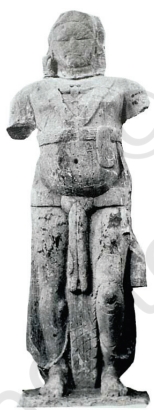
Statue of Yaksha Parkham - A monumental, technically impressive, free-standing sculpture of a Yaksha, powerfully symbolizing the early and robust nature of Mauryan religious art.
Mauryan Pillars, Monumental Sculptures, and Rock-Cut Architecture: Defining the Artistic Legacy
The most tangible and enduring artistic legacy of the Mauryan period is magnificently preserved in the towering Ashokan monolithic pillars, the massive free-standing Yaksha sculptures, the symbolic Stupas, and the pioneering, finely crafted rock-cut caves, collectively demonstrating an unprecedented level of both artistic and technical excellence under the Mauryan political stability.
Ashokan Pillars: Indigenous Monoliths Showcasing Superior Craftsmanship over Achaemenian Influences
While the architectural idea of erecting monumental pillars may have derived some conceptual inspiration from the Achaemenian (Persian) traditions, the Ashokan pillars were undoubtedly a distinct and technically superior Indian innovation, uniquely characterized by their monolithic (single-stone) construction and famous, highly-glossy surface polish.
- (i) The general architectural concept of monumental pillar erection was likely inspired by contemporary Achaemenian traditions of Persia, but the Mauryan pillars achieved technical superiority by being carved from a single, massive piece of stone, making them inherently monolithic structures.
- (ii) These imposing Ashokan pillars functioned as critical instruments of imperial communication and moral governance, bearing the famed Dharmalipis (edicts and inscriptions) containing the Emperor's moral and ethical directives strategically placed across northern India.
- (iii) The elaborate capital figures, majestically crowning the pillar shaft, featured potent animals like lions, elephants, and bulls, all carved with a remarkable sense of vigorous movement and naturalistic style, and finished with the famous mirror-like Mauryan polish.
Notable Pillars and Inscriptions: The Timeless Icon of the Sarnath Lion Capital
The geographically dispersed Ashokan Pillars served both as religious markers and ethical signposts meticulously placed throughout the vast empire. Among them, the majestic Lion Capital at Sarnath is universally recognized as the undisputed artistic and symbolic masterpiece of the Mauryan era, rich in Buddhist allegorical meaning.
- (a) Significant and well-preserved Mauryan pillars have been discovered at historically and religiously important locations such as Basarah-Bakhira, Lauriya-Nandangarh, Rampurva, Sankisa, and most famously, the site of Sarnath.
- (b) The magnificent and artistically powerful Lion Capital at Sarnath, representing the ultimate expression of Mauryan finesse, has been rightfully adopted as the National Emblem of India, symbolizing sovereignty, truth, and imperial power.
- (c) This capital specifically commemorates the pivotal event of the Dhammachakrapravartana (the turning of the Wheel of Law), marking the sacred location where the Buddha delivered his first foundational sermon to his disciples.
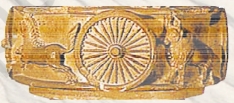
Abacus of Sarnath Lion Capital - A detailed close-up view of the drum section, expertly exemplifying the precise Mauryan symbolism, the high-gloss polish, and intricate artistry with its depiction of processional animals and the symbolic Dharma Chakra.
Yaksha and Yakshini Sculptures: The Power of Monumental Free-Standing Folk Art
In addition to the grand imperial pillars, the Mauryan period was also instrumental in the production of impressive, life-sized, free-standing sculptures of popular deities, specifically the Yakshas and Yakshinis, which formally incorporated indigenous folk deities into the structured, imperial art of the empire.
- (i) Large, monumental and imposing Yaksha-Yakshini statues were notably discovered in regions including Patna, Vidisha, and Mathura, suggesting a widespread, deeply-rooted popular devotion to these essential nature spirits across the Mauryan domain.
- (ii) These monumental figures were artistically characterized by their substantial volumetric representation, detailed physiognomy, and the renowned mirror-like polished surfaces that became the definitive hallmark of skilled Mauryan craftsmanship.
- (iii) The world-famous Didarganj Yakshi sculpture discovered near Patna remains one of the most exquisite, technically perfect, and gracefully carved examples, celebrated for its fluid form and detailed drapery, embodying Mauryan sculptural ideals.
Terracotta Figurines and Rock-Cut Architecture: Pioneering the Tradition of Early Cave Temples
The rich canvas of Mauryan art was not restricted to just grand, polished stone works but also included simpler, popular expressions via terracotta art, while simultaneously pioneering the tradition of structural, monolithic rock-cut architecture primarily to house ascetic sects.
- (a) In stark contrast to the imposing, technically demanding stone sculptures, the more prevalent terracotta figurines exhibited a relatively simpler, more popular style, often with less detailed anatomical delineation, indicating mass appeal.
- (b) The impressive and dynamic Rock-cut elephant at Dhauli, carved directly out of the living rock of the cliff face, powerfully illustrates the early Mauryan artistic focus on capturing natural form with a dynamic, fluid linear rhythm.
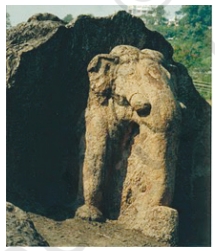
Dhauli Elephanta - An early, significant Mauryan rock-cut monument at Dhauli, demonstrating the artisans' mastery over the medium and its blend of powerful symbolism and naturalistic form. - (c) The renowned Lomus Rishi cave located deep within the Barabar Hills is a prime and undisputed example of the earliest known rock-cut architecture, having been officially dedicated by Emperor Ashoka himself to the reclusive Ajivikas ascetic sect.
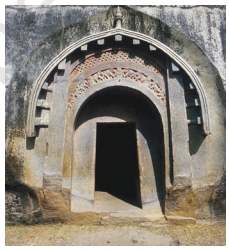
Lomus Rishi Caves Entrance - The facade showcases the distinctive early rock-cut cave entrance with its characteristic simulated wooden chaitya arch motif and detailed elephant frieze, representing the transition from wooden to stone architecture.
Stupas and Viharas: Centers of Relic Worship and Monastic Life
Driven by Ashoka's zealous, empire-wide patronage, the Stupa transitioned to become the quintessential, most recognizable religious monument of the era, deliberately designed to enshrine the sacred relics of the Buddha and serve as the central focus for veneration, meditation, and monastic community life.
- (i) The original foundational Stupas were meticulously constructed over the primary relics of the Buddha at eight major sites, including Rajagraha, Vaishali, Kushinagar, Kapilavastu, and Pava, signifying their profound, irreplaceable religious importance.
- (ii) The excavated architectural remains of the Bairat stupa in Rajasthan provide specific, tangible evidence of a significant structural monument dating precisely to the , firmly placing it within the Mauryan period.
- (iii) The architectural and symbolic grandeur of the Great Stupa at Sanchi, although extensively expanded and elaborately decorated in later centuries, was fundamentally commissioned and originally patronized by Ashoka, marking the crucial beginning of monumental Stupa architecture.
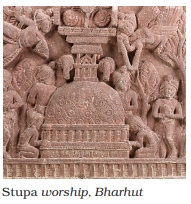
Stupa Worship Depiction - An illustrative frieze, often found on later railings like those at Barhut, highlighting the practice of ancient Buddhist veneration and the enduring cultural significance of Mauryan-era artistic concepts.
Patronage and Inscriptions: The Essential Role of Donors and Artisan Guilds
The successful, large-scale creation of these massive architectural and sculptural projects was not solely the result of unilateral royal decree but necessitated a broader, collective funding and labor effort, involving essential contributions from lay devotees, influential traders, and highly organized professional artisan guilds.
- (a) Extensive epigraphic evidence, meticulously recorded in inscriptions dating as early as the , explicitly names and records the identities and professions of the donors, illustrating widespread community and democratic participation in these artistic projects.
- (b) Financial and material support for these colossal building projects came from diverse and stratified sources, including contributions from lay devotees, politically powerful kings, and influential guilds (Srenis), collectively demonstrating a pattern of sophisticated communal patronage.
- (c) Specific artisan inscriptions found at various sites cite the names of highly skilled individuals, such as the sculptor Kanha at Pitalkhora and Balaka at Kondane, formally confirming the vital and acknowledged role of professional sculptors and stone workers in the creation of these iconic masterpieces.
⚡ Quick Revision Capsule: Mauryan Art & Architecture Highlights
A quick reference breakdown of core Mauryan architectural styles, features, and key historical examples.
| Art / Monument Type | Key Features & Symbolism | Notable Examples |
|---|---|---|
| Ashokan Pillars | Monolithic sandstone shafts with high-gloss polish and animal capitals | Sarnath, Rampurva, Lauriya-Nandangarh |
| Rock-Cut Caves | Early rock-cut architecture for ascetic sects | Lomus Rishi Cave (Barabar Hills) |
| Yaksha/Yakshini Sculptures | Free-standing volumetric folk art with mirror polish | Parkham Yaksha, Didarganj Yakshi |
| Stupa Architecture | Hemispherical solid domes housing sacred relics | Great Stupa at Sanchi, Bairat Stupa |
| Terracotta Figurines | Popular, smaller-scale devotional items with simpler form | Various Gangetic valley sites |
📝 Summary
The enduring Mauryan period art and architecture () fundamentally embodies a sophisticated and technically advanced synthesis of transformative religious innovation and centralized imperial power. This synthesis found its grand expression in monuments like the symbolic Buddhist stupas, the technologically advanced monolithic Ashokan pillars with their glossy finish, the powerful monumental Yaksha sculptures, the pioneering early rock-cut caves, and the lively terracotta figures. The combined patronage by the commanding Emperor Ashoka and affluent commercial guilds fostered the creation of unparalleled, timeless masterpieces such as the Sarnath Lion Capital and the foundational structure of the Great Sanchi Stupa. For students and aspirants preparing for competitive exams, this era provides essential, deeply insightful material on the critical fusion of robust political authority, consequential religious reform (particularly Buddhism), and unparalleled artistic and technical excellence that irrevocably shaped the historical course of ancient Indian civilization and cultural aesthetics.
🚀 Quick Revision Points
Essential facts to review before examinations:
- (i) Emergence of monolithic stone pillars with mirror-like finish during the .
- (ii) Integration of popular folk deities like Yaksha and Yakshini into official imperial art.
- (iii) Dedication of the Lomus Rishi Cave in the Barabar Hills to the ascetic Ajivikas sect by Emperor Ashoka.
- (iv) Adoption of the Sarnath Lion Capital as the National Emblem of India.
- 💡 Exam Tip: Focus on distinguishing between Achaemenian foreign influences and indigenous Mauryan innovations—especially the single-stone monolithic nature of the pillars and the high-gloss polish.
❓ Frequently Asked Questions (FAQ)
Q1: What is the significance of Ashokan pillar edicts?
A1: They served as instruments of moral governance and imperial communication across the Mauryan empire.Q2: What material and technique defined Mauryan stone sculptures?
A2: They were carved from single blocks of stone and finished with a distinctive mirror-like polish.Q3: Who were the Lomus Rishi Caves dedicated to?
A3: They were dedicated by Emperor Ashoka to the reclusive Ajivikas ascetic community.