The extensive archaeological retrieval of pottery, beads, and diverse ornaments offers an unparalleled window into the daily life, artistic flair, and metallurgical prowess of the Harappan people, making this subject critical for students preparing for history and culture examinations on the Indus Valley Civilization.
🎯 In this chapter, you will understand:
- The standardized ceramic production and wheel-made pottery techniques of the Harappans.
- The variety of decorative styles, including Black Painted Ware and specialized perforated vessels.
- The advanced bead-making factories and personal ornament hoards found at key sites like Lothal and Chanhudaro.
- Everyday material aspects including cotton and wool spinning, grooming, and monumental stone carving at Dholavira.
💡 Why this topic matters: Artifacts like ceramics, beads, and jewellery reveal the technological prowess, economic depth, and social structures of the Indus Valley Civilization without relying on deciphered texts.
🧠 Core Idea: Harappan material culture combines utility with refined artistry, demonstrating high standardization, trade connectivity, and specialized craft industries across urban centers.
Material Culture of the Harappan Civilization: Decoding Pottery, Beads, and Adornment ()
A rich assortment of excavated artifacts paints a vivid picture of the sophisticated material life and specialized craftsmanship that defined the great urban centers of the Indus Valley.
The Harappan material culture demonstrates a remarkable balance between utilitarian necessity and aesthetic value, utilizing locally sourced materials and advanced techniques in ceramics, gemology, and metalwork.
- (i) The abundance of finds across major sites confirms a highly standardized and technologically advanced production system for goods used in domestic routines and personal adornment.
- (ii) These artifacts are key historical sources, revealing social stratification and trade networks through the widespread use of semi-precious materials and standardized forms.
- (iii) The technological consistency suggests a strong central influence or shared craft traditions across the vast geographical expanse of the Indus Valley Civilization.
Harappan Pottery: Advanced Techniques, Distinct Decorations, and Everyday Utility
The ceramic industry was fundamental to Harappan daily life, producing a wide range of vessels distinguished by their expert craftsmanship and stylistic uniformity across the civilization.
Expert Wheel-Thrown and Ubiquitous Plain Wares
The Harappan ceramic tradition was largely characterized by efficiency and precision, utilizing the potter's wheel for the majority of their production, a testament to their skilled mass manufacturing capabilities.
- (i) Wheel-Made Mastery: The vast majority of pottery was expertly thrown on a fast potter's wheel using a fine red clay, although more basic or less common forms were still occasionally produced by hand.
- (ii) The Dominance of Plain Pottery: More frequently discovered than the painted varieties, this type typically featured a smooth, single-colored coating—a fine red or sometimes grey slip—and was utilized for the essential tasks of everyday storage, cooking, and consumption.
Black-Painted and Specialized Decorative Ceramics
While utilitarian needs were primary, a significant portion of the pottery demonstrated the Harappan artisan's decorative flair through distinctive painting styles and unique, specialized forms for specific functions.
- (a) Black Painted Ware: This is the most famous and visually striking style, involving the precise application of a glossy black pigment, often featuring geometric patterns, and stylized motifs of leaves, trees, and occasional animal figures, over the initial red clay base.
- (b) Polychrome Pottery Rarity: This style was relatively scarce and highly valued, seen primarily on small decorative vases where multiple colors—including red, black, green, and white—were employed to create intricate designs.
- (c) Incised Pottery: Decoration by scratching patterns, or incising, directly into the wet clay was a less common technique, typically confined to the utilitarian bases of pans and standing vessels.
- (d) Perforated Pottery: A distinctly specialized vessel type, this pottery is easily recognizable by the numerous small holes dotting its entire surface, strongly suggesting its functional purpose as a strainer or sieve, likely for filtering liquids or beverages.
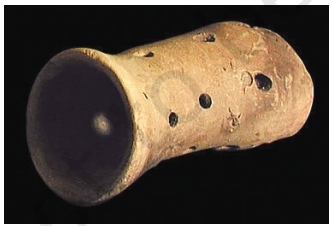
Perforated Pot - An example of specialized Harappan pottery, likely used for straining liquids or beverages, illustrating unique design for utility. - (e) Miniature Pottery: The discovery of extremely small vessels, with some measuring under half an inch in size, points toward their use in specialized ritualistic, votive, or purely decorative capacities, rather than everyday functions.
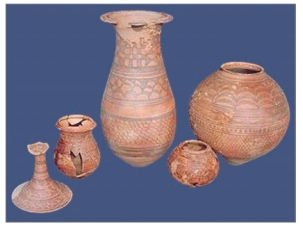
Indus Valley Pottery - Showcasing the diverse forms, utility, and decorative traditions of the Harappan ceramic industry, from practical jars to finely painted wares.
Beads and Ornaments: The Sophisticated Adornment Culture of the Harappans
The Harappan Civilization showcased an advanced material culture through its sophisticated jewellery industry, which combined artistry with expert knowledge of gemology and metallurgy, creating luxurious personal ornaments.
Jewellery Materials and Key Excavation Sites
The discovery of large caches of jewellery confirms that the Harappan elite possessed great wealth and appreciated fine craftsmanship, utilizing a variety of materials from precious metals to simple baked clay for personal adornment.
- (i) Diverse Ornaments: Their extensive repertoire of personal items included intricate necklaces, earrings, anklets, and bracelets, fabricated using prized materials such as gold, silver, and valuable semi-precious stones, sometimes alongside more affordable baked clay.
- (ii) Significant Hoards: Demonstrating the depth of this wealth and aesthetic preference, substantial hoards of jewellery have been recovered from major urban centers, notably the capital city of Mohenjodaro and the vital international trade hub of Lothal.
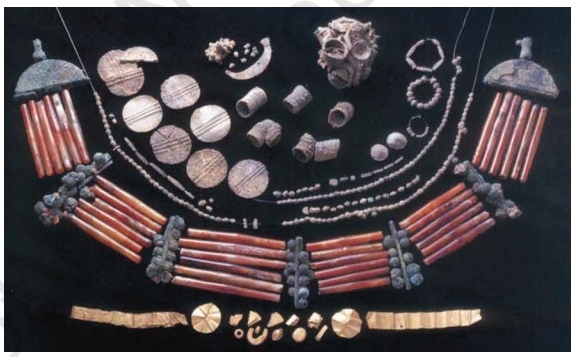
Beads & Jewelry - Evidence of the advanced adornment culture and sophisticated bead-making industry of the Indus Valley Civilization, highlighting their mastery over precious stones.
Advanced Bead-Making Industry, Shapes, and Decoration
The meticulousness involved in bead production points to a specialized craft industry, with workshops dedicated solely to transforming raw stones into finely finished adornments.
- (a) Specialized Bead Factories: Dedicated factories and workshops, particularly prominent at sites like Chanhudaro and Lothal, expertly utilized a wide array of semi-precious stones, including carnelian, jasper, quartz, and lapis lazuli, sourced through extensive trade networks.
- (b) Complex Shapes: The artisans created beads in a surprising diversity of intricate and complex shapes, encompassing popular forms such as disc, cylindrical, spherical, barrel, and segmented varieties.
- (c) Elaborate Embellishment: Many of these beads underwent further artistic enhancement through techniques like delicate incising, etching, or the luxurious process of coating them with thin sheets of gold foil.
- (d) Unique Animal Models: A unique decorative innovation involved small, artfully crafted models of animals, such as monkeys and squirrels, which were ingeniously employed as decorative pin-heads or utilized as individual beads within a necklace.
Textiles, Fashion, and Stone Craftsmanship: Completing the Material Picture
Beyond the famous ceramics and jewellery, the Harappans also demonstrated considerable skill in textile production and architectural stone-work, revealing a comprehensive and developed material culture.
Textile Production, Clothing, and Cosmetics
The proficiency in producing fabrics was essential for their daily clothing needs, supported by archaeological evidence of tools used for spinning and weaving.
- (i) Spinning Expertise: The people were highly proficient in the demanding process of spinning raw cotton and wool fibers, a skill reliably evidenced by the numerous finds of spindle whorls at excavation sites.
- (ii) Standard Clothing: Depictions and figurines suggest a prevalent clothing style for men included a dhoti-like garment worn on the lower body, paired with a distinct shawl-like wrap elegantly draped over the upper torso.
- (iii) Prevailing Fashion: Sculptures and small figurines illustrate that the populace favored distinctive hairstyles and well-groomed beards, reflecting a conscious attention to personal aesthetics.
- (iv) Early Cosmetics: Basic cosmetic substances were in use, including cinnabar, a red pigment possibly serving as an early form of lipstick, and a type of powder used as an eyeliner or eye-paint.
Advanced Stone Architecture at Dholavira
While often noted for their brickwork, their mastery of stone carving is indisputably demonstrated by the monumental structures discovered at key sites.
- (i) Stone Craftsmanship Evidence: The complex and precisely cut stone architecture, notably found at the large settlement of Dholavira, clearly showcases a significant skill in working with heavy stone, perfectly complementing their widely recognized expertise in metal casting, sophisticated pottery painting, and detailed terracotta modelling.
⚡ Quick Revision Capsule: Harappan Material Culture
A quick comparison of key artifacts, raw materials, primary locations, and archaeological importance across the Indus Valley region.
| Artifact Category | Materials & Techniques Used | Key Excavation Sites |
|---|---|---|
| Pottery Wares | Fast wheel, fine red clay, red slip, black pigment (Black Painted Ware) | Widespread across all major IVC sites |
| Perforated & Miniature Pottery | Hand-punched perforated holes, precise miniature moulding | Mohenjodaro, Harappa |
| Beadwork & Jewellery | Carnelian, lapis lazuli, gold, silver, steatite, etching & foil coating | Lothal, Chanhudaro, Mohenjodaro |
| Textiles & Cosmetics | Spinning cotton and wool via spindle whorls; cinnabar for pigments | Harappa, Mohenjodaro |
| Stone Masonry | Finely cut and polished stone masonry blocks | Dholavira |
📝 Summary
The study of Harappan pottery, beads, and ornaments is crucial as it details the technological sophistication, artistic sensibility, and trade relationships of the Indus Valley Civilization during . The standardized Black Painted Ware, the intricate bead production at Lothal and Chanhudaro, and the use of metals like gold and silver reveal a highly advanced society. For students preparing for competitive exams, these artifacts provide the most tangible evidence of Harappan daily life, social structure, and unique craft production techniques.
🚀 Quick Revision Points
Essential facts to review before examinations:
- (i) Fast wheel-thrown ceramics with red slip formed the backbone of daily utilitarian storage and cooking.
- (ii) Black Painted Ware featured geometric and natural motifs like leaves, trees, and animals over red clay.
- (iii) Major bead production centers existed at Chanhudaro and Lothal, utilizing carnelian and lapis lazuli.
- (iv) Finds of spindle whorls confirm widespread production of cotton and wool garments.
- 💡 Exam Tip: Focus on linking specific sites with craft specializations—for example, Chanhudaro and Lothal for bead manufacturing, and Dholavira for stone masonry work.
❓ Frequently Asked Questions (FAQ)
Q1: What was the primary technique used for making Harappan pottery?
A1: Most Harappan ceramics were mass-produced on a fast potter's wheel using fine red clay, often finished with a red slip.Q2: Which sites were famous for Harappan bead manufacturing?
A2: Dedicated bead factories were located at Chanhudaro and Lothal, processing stones like carnelian, jasper, and lapis lazuli.Q3: What function did perforated pottery serve in the Indus Valley Civilization?
A3: Perforated pots with small holes across their surface were specialized vessels likely used as strainers or sieves for liquids.