Explore the extraordinary contributions of the Pahari artists, especially Pandit Seu and his sons, Manaku and Nainsukh, who catalyzed the pivotal shift from the bold Basohli painting style to the lyrical Kangra school of painting. This transition, which defined Indian miniature art, is a crucial topic for art history students and essential for UPSC and competitive exam preparation, showcasing masterpieces like the Gita Govinda series and insightful portraiture.
🎯 In this chapter, you will understand:
- The transition of Pahari miniature painting from the bold Basohli style to the delicate Kangra school.
- The artistic achievements of Manaku through his celebrated Gita Govinda series.
- The intimate portraiture and groundbreaking self-depiction by Nainsukh under Raja Balwant Singh's patronage.
- The naturalistic realism depicted in narrative scenes like the migration to Vrindavan from the Bhagvata Purana.
💡 Why this topic matters: The family of Pandit Seu redefined the aesthetics of Pahari miniature art during the , making it a core focus for art history and competitive exam syllabi.
🧠 Core Idea: A gradual shift from intense colors and bold lines (Basohli) toward graceful naturalism, soft palette, and emotional sensitivity (Kangra).
The Artistic Legacy: Pandit Seu, Manaku, and Nainsukh's Role in Shifting Pahari Painting Styles (18th Century)
The foundational work of Pandit Seu's family was indispensable in transitioning the dynamic Pahari miniature painting tradition across the Western Himalayas, moving from the intensity of Basohli to the grace of Kangra.
- (i) The patriarch, Pandit Seu, trained his two immensely talented sons, Manak (or Manaku) and Nainsukh, who became the central figures in this artistic evolution.
- (ii) Their collective artistic output served as the crucial bridge, laying the elaborate and refined foundation for what is now celebrated as the glorious Kangra period of painting.
- (iii) This period marked a profound transformation in aesthetic sensibilities, emphasizing delicate line work, naturalism, and a subtle emotional depth that contrasted sharply with the earlier, bolder styles.
Manaku's Defining Work: The Sensuous and Spiritual Narrative of the Gita Govinda Series
Manaku's acclaimed series based on the Gita Govinda is a literary and visual feast, capturing the timeless and deeply philosophical love story of Radha and Krishna as penned by the poet Jayadeva.
Thematic Depth and Narrative Structure in Manaku's Gita Govinda
This masterly set of paintings intricately follows Jayadeva's poetic composition, narrating the complex, emotional, and divine relationship between Radha and Krishna, typically set amidst the idyllic, lush banks of the River Yamuna.
- (i) Key artistic themes explored include Krishna’s spirited, playful interaction with the gopis (milkmaids), Radha’s profound heartbreak and anguish due to separation, and the ultimate, mystical reunion of the divine couple.
- (ii) Philosophically, Radha is symbolically represented as the individual soul (Jivatma), desperately seeking communion, while Krishna embodies the ultimate cosmic power (Paramatma) or the divine reality.
- (iii) One particularly evocative painting captures the moment of Radha approaching Krishna, a depiction rich in subtle emotional cues, showcasing her innate shyness yet powerful, underlying eagerness, often inscribed with text expressing her deepest inner sentiments and longings.
Nainsukh's Genius: Intimate Portraiture and Rare Self-Depiction with Prince Balwant Singh
Nainsukh excelled in highly individualized portraiture, moving beyond simple flattery to capture the subject's personality, as brilliantly showcased in his depictions of his patron, Raja Balwant Singh of Jasrota.
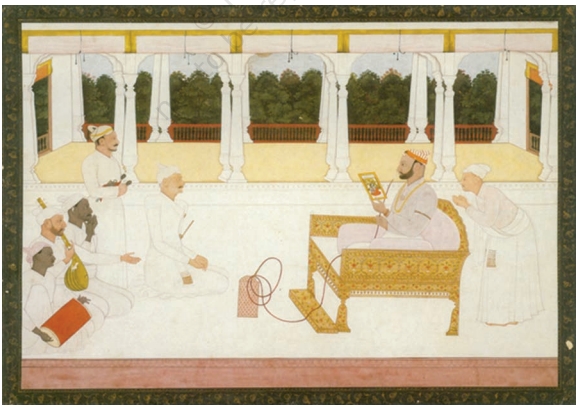
Balwant Singh by Nainsukh - A majestic painting of Raja Balwant Singh by Nainsukh, showcasing his royal demeanor and profound patronage of Pahari art, a key piece for art history students. Depicting Royalty and Artistic Collaboration: Balwant Singh and Nainsukh
A remarkably insightful painting immortalizes Prince Balwant Singh of Jasrota, who is shown in a moment of quiet contemplation, closely and intently observing a piece of artwork, likely created by Nainsukh himself.
- (a) The composition is notable for featuring Nainsukh within the scene—the artist is subtly yet respectfully positioned standing behind the royal patron, creating a profound and rare self-representation within the history of Indian miniature painting.
- (b) The serene and deliberately quiet composition meticulously highlights the calm, contemplative temperament of Balwant Singh, with accompanying court musicians subtly and harmoniously positioned to complement the scene's tranquility.
- (c) The particular captured moment often shows Balwant Singh smoking a hukka, entirely immersed in observing a depiction of Krishna, underscoring the patronage of religious themes alongside portraiture.
Naturalistic Narratives: Nanda and Yashoda's Migration to Vrindavan from the Bhagvata Purana
Another compelling example of the Kangra style's naturalism is the painting illustrating the poignant scene from the Bhagvata Purana, detailing the journey of Nanda's family as they relocate to Vrindavan seeking sanctuary from the demonic threats prevalent in Mathura.
Realism and Detail in the Depiction of the Sacred Journey
This painting is a testament to the acute observation and realistic representational style favored by the Kangra school, particularly in depicting human emotion and the surrounding environment during the sacred journey.

Nanda, Yashoda, and Krishna - A heartwarming painting of Krishna with his foster parents Nanda and Yashoda, capturing the essence of divine love and familial bond, vital for understanding Kangra miniature themes. - (i) The narrative structure shows Nanda diligently leading the entire group on one sturdy bullock cart, followed by a second cart carrying the central figures: the divine child Krishna, his brother Balaram, his foster mother Yashoda, and Rohini.
- (ii) The attention to detail is remarkable, capturing the naturalistic expressions of the travelers, including signs of fatigue, subtle conversations taking place amongst the family, and the visual struggle of carrying heavy belongings.
- (iii) The realistic treatment of the landscape and environment, combined with the composition's close, immersive framing, gives the artwork a unique quality, often described as a flush-cut composition resembling an early photograph.
⚡ Quick Revision Capsule: Key Pahari Artists & Masterpieces
A quick comparative reference detailing the master artists, their primary patrons, style characteristics, and notable works.
| Artist | Key Masterpiece / Theme | Primary Stylistic Innovation |
|---|---|---|
| Pandit Seu | Patriarch & Master Instructor | Initiated the gradual shift from Basohli bold expressionism to refined naturalism. |
| Manaku | Gita Govinda Series | Spiritual narrative composition, lyrical symbolism of Jivatma and Paramatma. |
| Nainsukh | Portraits of Raja Balwant Singh of Jasrota | Intimate portraiture, delicate realism, and rare self-depiction within court scenes. |
| Kangra Master (Anonymous) | Migration to Vrindavan (Bhagvata Purana) | Photographic flush-cut composition, acute realism, and naturalistic landscape details. |
📝 Summary
The transition spearheaded by the family of Pandit Seu, particularly the distinct styles of Manaku and Nainsukh, remains a cornerstone of Indian art history. Their work not only popularized the lyrical Kangra school of painting during the but also established a new benchmark for emotional depth and naturalistic portrayal, evident in masterpieces like the Gita Govinda series and the intimate portraiture of Raja Balwant Singh. For students preparing for exams, understanding the technical differences between the Basohli and Kangra styles, and recognizing the individual contributions of Manaku (narrative/spiritual) and Nainsukh (portraiture/realism), is vital for comprehending the rich tapestry of Pahari painting.
🚀 Quick Revision Points
Essential facts to review before examinations:
- (i) Pandit Seu's sons, Manaku and Nainsukh, transitioned Pahari art from bold Basohli styles to lyrical Kangra art.
- (ii) Manaku's Gita Govinda captures the divine love of Radha and Krishna written by Jayadeva.
- (iii) Nainsukh is celebrated for capturing informal, intimate moments of his patron Raja Balwant Singh of Jasrota along with a rare self-portrait.
- (iv) The migration to Vrindavan from the Bhagvata Purana displays photographic composition and deep emotional realism.
- 💡 Exam Tip: In civil service and art history exams, contrast Manaku's emphasis on lyrical narrative (Gita Govinda) with Nainsukh's focus on individual human realism and courtly portraiture (Balwant Singh series).
❓ Frequently Asked Questions (FAQ)
Q1: Who were the main artists behind the transition to the Kangra style?
A1: Patriarch Pandit Seu and his two sons, Manaku and Nainsukh, were the central figures who shifted Pahari painting from the Basohli style to the Kangra style in the .Q2: What is the spiritual significance of Manaku's Gita Govinda series?
A2: The series uses Radha as the individual soul (Jivatma) seeking union with Krishna, who represents the divine cosmic reality (Paramatma).Q3: Why is Nainsukh's portrait of Raja Balwant Singh considered historical groundbreaking?
A3: It depicts an intimate, informal moment in royal life rather than rigid courtly grandeur, and features a rare self-representation of the artist Nainsukh standing behind his patron as noted in Pahari Art History.