The Pahari School of Painting represents a captivating era in Indian miniature art, flourishing in the mountainous regions of the Western Himalayas from the . This art form, celebrated for its stylistic evolution from the intense Basohli idiom to the lyrical Kangra phase, is crucial for students of art history and those preparing for competitive exams, offering profound insights into the synthesis of Mughal and indigenous art traditions.
🎯 In this chapter, you will understand:
- The geographic and historical origins of Pahari miniature art across the Himalayan hill states.
- The key challenges scholars face in classifying Pahari artworks due to shifting political borders.
- B. N. Goswamy's family-lineage attribution framework centered on master painter Pandit Seu.
- The transition from intense early Basohli styles to delicate Mughal-influenced Kangra naturalism.
💡 Why this topic matters: It highlights how localized hill kingdoms absorbed Mughal realism and devotional Hindu themes to produce one of India's richest miniature art movements.
🧠 Core Idea: Pahari art evolved from bold, expressive local styles to delicate naturalism, driven largely by family workshops rather than fixed regional borders.
📌 Pahari School of Painting: Evolution, Distinctive Style, and Major Themes in the Western Himalayan Hill States (17th–19th Century)
The Pahari School encompasses a vibrant tradition of miniature paintings originating from the 'hilly' regions of the western Himalayas, reflecting unique regional artistic patronage.
The term 'Pahari' itself signifies its mountainous origin, linking this school to the distinct geographical and cultural landscape that fostered its growth. This artistic journey involved a remarkable transition in aesthetic sensibility over two centuries.
- (i) The school's centers were spread across various independent hill states, including prominent towns like Basohli, Guler, Kangra, Kullu, Chamba, Mankot, Nurpur, Mandi, Bilaspur, and Jammu.
- (ii) These hill principalities emerged as significant patrons of painting, with the tradition flourishing particularly between the .
- (iii) The style underwent a notable transformation, moving from the initial bold and expressive Basohli style to the exquisitely refined and delicate aesthetics of the Kangra School, often mediated by the pivotal Guler or pre-Kangra phase.
📌 Stylistic Context and Challenges in Classifying Pahari Miniature Art
Despite its brilliance, classifying and attributing Pahari paintings presents unique challenges due to the fluid political landscape and stylistic overlaps, making precise distinctions difficult.
Distinguishing Features and Historical Contextualization
Pahari paintings, while stunning, often lack the immediate, easily identifiable features that distinctly mark the celebrated Mughal, Deccani, or Rajasthani Schools. This ambiguity necessitates a more nuanced approach to classification than mere territorial borders.
- (i) The principal challenge lies in territorial classification, primarily because the political boundaries of the numerous hill states were historically unstable and constantly shifting.
- (ii) Adding to this complexity is the frequent lack of crucial archival data, such as dated material, colophons (notes on production), and clear inscriptions, which makes definitive regional attribution highly problematic.
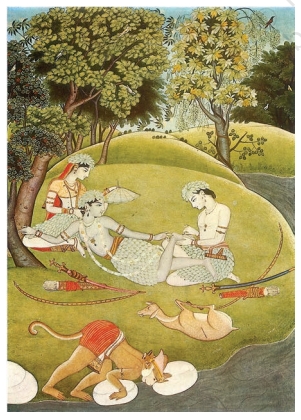
📌 Emergence, Influences, and the Bold Early Pictorial Language of Pahari Art
The origins of the Pahari School are multifaceted, representing a beautiful synergy of external courtly influences, notably Mughal and Rajasthani, with robust indigenous aesthetics.
External Influences and the Dominance of the Basohli Style
While the precise circumstances of its beginning remain unclear, it is widely accepted that the styles of the Mughal and Rajasthani courts played a significant, shaping role in the genesis of the Pahari style. The earliest manifestation is recognized as the striking Basohli-like idiom.
- (i) The bold Basohli-like style is regarded as the primary and earliest pictorial language to emerge from these hill courts, characterized by vibrant colors and stylized forms.
- (ii) Contributing factors included the familial ties that many Hill Rajas maintained with the powerful courts of Rajasthan.
- (iii) Furthermore, the increasing availability of examples of Provincial Mughal style paintings played a key role in the formal development of the local Pahari artistic tradition.
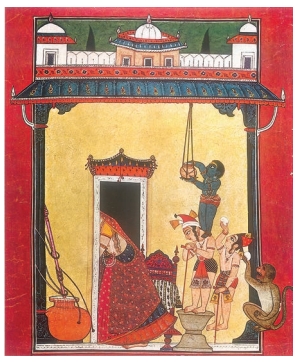
Krishna Steals Butter - Bhagwat Purana - An endearing artwork of child Krishna's playful act of stealing butter, symbolizing his mischievous charm as narrated in the Bhagwat Purana. This exemplifies the religious and devotional themes prevalent in the Pahari School. B. N. Goswamy's Groundbreaking Attribution: Focusing on Family, not Region
The historian B. N. Goswamy provided a critical framework for understanding Pahari painting by shifting the focus from constantly changing territories to the enduring influence of specific artistic families.
- (a) He famously attributed the profound evolution of Pahari paintings to the family of the master artist Pandit Seu (Shiv), thereby tracing stylistic continuity across generations and courts.
- (b) This family-based approach was proposed as a solution to the instability of regional attribution, successfully addressing the challenge posed by fluid political boundaries and fragmented documentation.
- (c) Goswamy's research argued that works created in the predominantly adhered to the expressive Basohli idiom, while a significant and graceful transition towards the Kangra style characterized the works of the .
📌 Stylistic Transformation, Mughal Naturalism, and Varied Idioms
The mid-eighteenth century marked a period of intense artistic dynamism, where different Pahari centers developed their own distinct stylistic idioms, heavily influenced by the sophisticated realism of Mughal art.
Mid-Century Stylistic Idioms and External Molding of Pahari Art
The transformations witnessed during the were not uniform; instead, they led to the flowering of several varied stylistic idioms across the various Pahari artistic centers, showcasing local adaptation and innovation.
- (i) The introduction and subsequent response to Mughal paintings within the courts of the Pahari kingdoms significantly influenced the training and output of local artists.
- (ii) The sophisticated naturalism characteristic of the Mughal paintings held strong appeal for the Pahari artists.
- (iii) This naturalistic influence profoundly shaped the compositional techniques and aesthetic rendering in Pahari art, leading to greater refinement and detail.
📌 Core Themes, Artistic Innovations, and Culmination in the Kangra Phase
Pahari artists excelled in depicting devotional and courtly life, pioneering innovative aesthetic prototypes that reached their peak refinement in the subsequent Kangra phase.
Creation of New Prototypes and Compositional Refinement
The thematic range of Pahari paintings was broad, covering daily life, courtly rituals, and religious narratives, while introducing groundbreaking aesthetic norms for human figures.
- (a) Thematic Richness: Subjects spanned from the depiction of daily routines and significant royal occasions to profound religious narratives, making the art accessible and engaging.
- (b) Idealized Forms: A significant innovation was the creation of entirely new prototypes for female forms and the depiction of idealized faces, characterized by delicate features and emotional depth.
- (c) Technical Maturity: The technical skill matured, with certain paintings featuring elaborate decorated margins and highly detailed compositions, eventually evolving into the quintessential technical brilliance of the Kangra phase.
📌 Conclusion: The Enduring Legacy and Academic Importance of Pahari Painting
The Pahari School of Painting remains an indelible chapter in Indian art history, providing a rich chronicle of devotional fervor and courtly patronage in the Western Himalayas. Its stylistic transition—from the passion of Basohli to the grace of Kangra—demonstrates the unique ability of local artists to synthesize Mughal naturalism with indigenous storytelling. For students, studying this school is essential for understanding how political fluidity and cross-cultural artistic exchange shaped one of India's most aesthetically refined miniature traditions.
⚡ Quick Revision Capsule: Pahari School of Painting
Key parameters defining the Pahari School of Painting for examination quick review:
| Parameter | Details & Characteristics | Key Elements |
|---|---|---|
| Time Period | Western Himalayan region | |
| Major Centers | Basohli, Guler, Kangra, Kullu, Chamba, Mankot, Nurpur, Mandi, Bilaspur, Jammu | Independent hill principalities |
| Key Styles | Early bold Basohli idiom to delicate lyrical Kangra style | Mediated by Guler pre-Kangra phase |
| Influences | Mughal naturalism and Rajasthani court connections | Local indigenous folklore and devotion |
| Attribution Approach | Family-lineage approach proposed by B. N. Goswamy | Focus on master artist Pandit Seu |
📝 Summary
The Pahari School of Painting flourished across the Western Himalayas between the . It transitioned from the bold, warm-toned Basohli style to the delicate, lyrical Kangra style, largely guided by artistic family lineages like that of Pandit Seu. Religious epics such as the Bhagwat Purana and daily courtly activities served as primary subjects.
🚀 Quick Revision Points
Essential facts to review before examinations:
- (i) Pahari art originated in the hill states of the Western Himalayas.
- (ii) The earliest style was the intense and vibrant Basohli idiom.
- (iii) B. N. Goswamy introduced family lineage as the basis for attributing Pahari works.
- (iv) Themes heavily featured devotional works like the Bhagwat Purana and Ramayana scenes.
- 💡 Exam Tip: Focus on B. N. Goswamy's family attribution theory (Pandit Seu's family) rather than territorial state boundaries when answering questions on Pahari stylistic development.
❓ Frequently Asked Questions (FAQ)
Q1: What are the main phases of the Pahari School?
A1: The school began with the bold and expressive Basohli phase and reached its peak refinement in the lyrical Kangra phase during the mid-to-late 18th century.Q2: Why is it difficult to classify Pahari paintings by region?
A2: Regional classification is difficult because hill state borders shifted frequently and paintings rarely included dated colophons or clear regional inscriptions.Q3: What was B. N. Goswamy's major contribution to Pahari art history?
A3: B. N. Goswamy shifted scholar focus from unstable geographic borders to family lineages of artists, tracing stylistic progression through master painter lineages like that of Pandit Seu.