The Basohli School of Painting represents the genesis of the vibrant Pahari miniature painting tradition, showcasing dramatic color usage and a distinctive stylized approach in the Hill States. Flourishing prominently under Raja Kirpal Pal (), this artistic style is crucial for students preparing for art history and competitive exams, providing insight into the transition towards the refined Guler-Kangra Kalam and the pervasive themes drawn from Rasamanjari and the Ramayana.
🎯 In this chapter, you will understand:
- The historical origins and patronage of the Basohli School under Raja Kirpal Pal.
- The distinct artistic features, color palettes, and unique materials like beetle wings.
- Key literary and devotional themes including Rasamanjari and the Ramayana.
- The evolutionary shift from Basohli to the Guler–Kangra phase across the Himalayan region.
💡 Why this topic matters: Basohli painting marks the earliest visual style of the Himalayan Hill States and sets the baseline for all subsequent Pahari art traditions.
🧠 Core Idea: Intense primary colors, stylized natural forms, and innovative jewelry techniques combine with classical Sanskrit literature to create a powerful miniature tradition.
Basohli School: The Origins and Distinctive Characteristics of Pahari Painting (1678–1695)
The Basohli School marks the earliest and most visually dramatic artistic expression to emerge from the cluster of Himalayan Hill States. This pioneering style laid the foundation for the entire Pahari painting tradition, distinguishing itself through an unmissable, powerful use of color and deeply stylized figures.
- (i) Basohli is recognized as the definitive starting point of work from the Hill States, setting a powerful precedent for future artistic developments in the region.
- (ii) The style experienced its significant period of patronage and development between and under the rule of the enlightened prince, Raja Kirpal Pal, who actively fostered this unique aesthetic.
Unique Artistic Features: The Bold Style of the Basohli Kalam
The Basohli style is instantly recognizable due to its distinct palette, stylized natural elements, and unique techniques used for representing opulence and jewelry.
Vibrant Color Palette and Stylized Background Techniques
The artists of Basohli were celebrated for their bold, powerful application of colors, moving away from subtle tones to embrace a striking and emotionally resonant palette that defined the entire composition.
- (i) A hallmark of the style is the strong and frequent use of primary colors, especially vibrant red and electric blue, contrasted with warm yellow for background elements.
- (ii) Warm yellows were typically employed for expanses like backgrounds and horizons, creating a sense of heat and drama within the painted narratives.
Ornamentation, Vegetation, and the Use of Beetle Wing Particles
The depiction of jewelry and natural elements showcased a meticulous attention to detail and incorporated unusual, innovative materials to simulate precious stones and pearls, giving the paintings a three-dimensional quality.
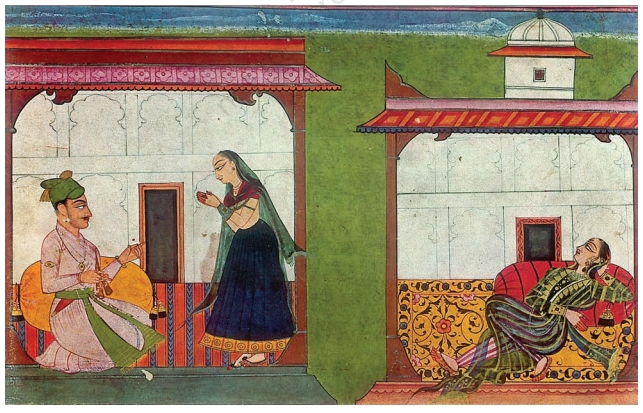
Rasamanjari Bhasoli - A vibrant depiction from the Rasamanjari series, showcasing the themes of love and longing in the Basohli style of Pahari painting. - (a) The treatment of vegetation was highly stylized, often represented in a decorative, almost abstract manner rather than a naturalistic one.
- (b) Artists utilized raised white paint to represent pearls in elaborate ornaments, giving the jewelry a tangible, textured look.
- (c) A singularly unique feature was the use of shiny green beetle wing particles (known as gund) to depict jewelry, remarkably simulating the gleam and hue of emeralds.
Popular Themes and Literary Influences in Basohli Painting
The Basohli painters drew heavily on popular Sanskrit and devotional texts, transforming classical literature into visually stunning narratives that celebrated love, devotion, and royal heroism.
The Dominance of Rasamanjari and Sacred Texts
Literary works that explored the nuances of love, emotion, and divine narratives provided the primary inspiration for the Basohli artists, allowing for rich, expressive compositions.
- (i) The Rasamanjari (A Bouquet of Delightful Flavors) of Bhanu Datta was an extraordinarily favorite theme for the Basohli painters, detailing the various emotional states (Nayak-Nayika Bheda) of lovers.
- (ii) Other significant themes included the philosophical and devotional stories from the Bhagvata Purana and the visualization of musical modes found in the Ragamala series.
Portraiture and Depictions of Royal and Common Life
Beyond sacred texts, the Basohli School captured the reality of their local world through detailed portraits of the royal court and the various personalities that inhabited the surrounding society.
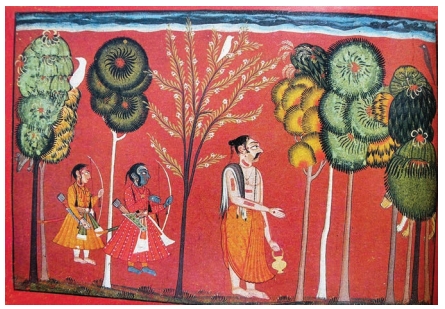
Ram and Lakshmana Following Vishwamitra - A detailed scene portraying the youthful Ram and Lakshmana following sage Vishwamitra to protect his yajna, reflecting their early heroism. - (a) Portraits were common, featuring detailed likenesses of local kings, their consorts, courtiers, and other important social figures.
- (b) Even figures like astrologers, mendicants (holy men), and courtesans were depicted, offering a broad view of the social fabric of the state.
Artistic Influences and the Spread of Basohli Style
The distinctive Basohli aesthetic was not created in isolation but drew upon existing art traditions, and its success led to its rapid dissemination and adaptation across neighboring kingdoms.
- (i) The aesthetics of Basohli paintings show notable similarities with the Chaurpanchashika group of Western Indian paintings, suggesting a shared regional visual language.
- (ii) This style successfully spread to other adjacent Hill States, such as Chamba and Kullu, where it evolved into local variations, collectively known as the Basohli kalam (style).
The Transition to Guler–Kangra Phase: Evolution of Pahari Art
Following the intense and dramatic period of Basohli, the Pahari style began a major evolutionary shift towards a softer, more refined sensibility, leading directly to the famed Kangra School.
The Emergence of a New Artistic Kalam (Style)
Between the and the , a perceptible change in artistic technique and sensibility began to take shape, signaling the move away from Basohli's stark intensity.
- (i) A new style gradually emerged during this period, which is now referred to as the Guler–Kangra phase.
- (ii) This phase was characterized by artists actively experimenting and improvising upon the existing Basohli framework, which eventually culminated in the delicate and lyrical Kangra style.
Geographic Dissemination of the Evolving Pahari Style
This evolving style found patronage across numerous princely states, demonstrating its widespread appeal and influence throughout the entire Himalayan region.
- (a) The style quickly diffused to other significant Hill States, including Mankot, Nurpur, Kullu, Mandi, Bilaspur, Chamba, Guler, and the eventual namesake, Kangra.
⚡ Quick Revision Capsule: Basohli School Key Concepts
A structured quick-reference breakdown of the key elements, timelines, and features of the Basohli School of Painting.
| Category | Key Details & Terminology | Historical & Cultural Impact |
|---|---|---|
| Primary Patronage | Raja Kirpal Pal () | Established Basohli as the founding center of Pahari art. |
| Visual Characteristics | Primary colors (red, blue), yellow backgrounds, gund beetle wings | Created intense, textured, and dramatic visual compositions. |
| Key Literary Texts | Rasamanjari by Bhanu Datta, Ramayana, Bhagvata Purana | Explored divine narratives and emotional states (Nayak-Nayika Bheda). |
| Evolutionary Phase | Transitioned into the Guler–Kangra phase () | Shifted from bold intensity to softer, lyrical miniatures. |
Famous Texts and Narrative Detail in Basohli-Kullu Depictions
The Ramayana, a cornerstone of Indian epic literature, was meticulously illustrated, allowing artists to showcase their skill in depicting complex human emotions and intricate details of character and setting.
The Sanskrit Epic Ramayana as a Favored Narrative
The tales of Lord Rama, duty, and exile provided rich, emotionally charged subject matter for the Pahari painters, especially in the Basohli and Kullu centers.
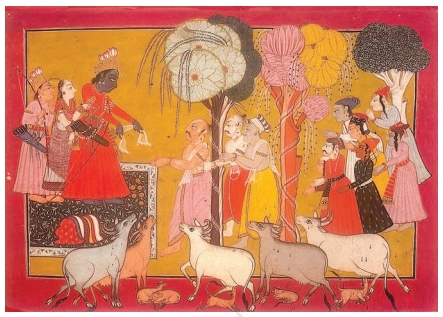
Ram Gives Away His Possessions - An illustration of Lord Ram in a moment of sacrifice, embodying his values of detachment and duty from the Ramayana. - (i) The epic Ramayana was one of the foremost favored texts, with illustrated series being highly popular, particularly in Basohli and Kullu.
- (ii) Specific, significant moments were captured, such as the poignant scene of Rama giving away his possessions before embarking on his exile, embodying his detachment and adherence to duty.
Artistic Precision in Character and Setting Detail
The artists demonstrated a high degree of technical skill by ensuring every character, prop, and detail contributed to the narrative authenticity, making the paintings deeply engaging.
- (a) Characters, ranging from Brahmins and courtiers to commoners, were represented with careful distinction and appropriate social markings.
- (b) Minute artistic details were flawlessly executed, including the transparency of garments, specific tilak marks, elaborate jewelry, and the weapons carried by the heroic figures.
- (c) Even the natural setting was symbolic, with animals like wolves and tigers being precisely portrayed to represent the dangers and wildness of the forest and, by contrast, the courage of the princes traversing it.
📝 Summary
The Basohli School of Painting remains a cornerstone in the study of Indian art, establishing the distinctive and dramatic style of Pahari miniature painting in the Hill States under Raja Kirpal Pal during . Its bold use of color, unique technique involving shiny beetle wings, and pervasive narrative themes from Rasamanjari and the Ramayana make it historically invaluable. For students, understanding the Basohli kalam is essential for tracking the evolution of North Indian painting, as it provides the foundational context for the later, more delicate Guler-Kangra masterpieces.
🚀 Quick Revision Points
Essential facts to review before examinations:
- (i) Basohli is the oldest center of Pahari painting, patronized by Raja Kirpal Pal ().
- (ii) Key stylistic markers include intense primary colors, yellow horizon backgrounds, and raised white paint for pearls.
- (iii) The use of iridescent green beetle wing pieces (gund) simulated precious emeralds.
- (iv) Primary literary inspirations include Bhanu Datta's Rasamanjari, the Ramayana, and Bhagvata Purana.
- 💡 Exam Tip: When answering questions on Pahari art, emphasize how Basohli's bold, fiery color palette and beetle-wing ornamentations served as a stepping stone to the softer, highly lyrical Guler-Kangra style.
❓ Frequently Asked Questions (FAQ)
Q1: What is the most unique material used in Basohli paintings?
A1: Basohli artists uniquely incorporated pieces of shiny green beetle wings (called gund) to simulate the texture and sparkle of emeralds on painted jewelry.Q2: Which royal patron is most closely associated with the flourishing of Basohli painting?
A2: Raja Kirpal Pal () was the chief patron who fostered the distinct Basohli kalam.Q3: What literary text was a favorite subject for Basohli miniature painters?
A3: Bhanu Datta's Rasamanjari was a major favorite, along with the Ramayana and Bhagvata Purana, depicting emotional romantic states (Nayak-Nayika Bheda).