
The Ajanta Caves, located in the Aurangabad District of Maharashtra, stand as an incredible highlight of ancient Indian rock-cut architecture and Buddhist art. This UNESCO World Heritage site holds great value for students studying ancient history and Indian art and culture. It preserves the primary surviving wall paintings from two distinct eras: the Second Century BCE and the Fifth Century CE. These paintings showcase the life of the Buddha and various stories from the Jataka Tales.
🎯 In this chapter, you will understand:
- The architectural layout and historical phases of the Ajanta Caves.
- The differences between Hinayana and Mahayana rock-cut design traditions.
- The artistic style, natural pigments, and narrative themes of the Ajanta murals.
- The key icons and sculptures, including Padmapani, Vajrapani, and the Mara Vijaya panel.
💡 Why this topic matters: Ajanta gives us a complete view of how Indian painting and rock-cut sculpture developed over seven centuries.
🧠 Core Idea: These 29 caves served as Buddhist monasteries and prayer halls, transformed by skilled artisans into detailed visual libraries of Buddhist teachings.
Ajanta Caves: Ancient Indian Rock-Cut Buddhist Architecture and Mural Paintings ( - )
A Glimpse into the Ancient Buddhist Monastic Complex
The Ajanta Caves comprise 29 rock-cut structures carved into a horseshoe-shaped cliff. Historically, these caves served as peaceful monastic retreats and centers for study and worship built across two major periods.
- (i) The earliest caves, mainly Cave Nos. 10 and 9, were created during the initial construction phase between the Second and First Century BCE. These early structures belong to the Hinayana tradition.
- (ii) The second and larger construction phase took place around the Fifth Century CE. Artisans crafted impressive caves like Cave Nos. 19 and 26, which reflect the Mahayana tradition.
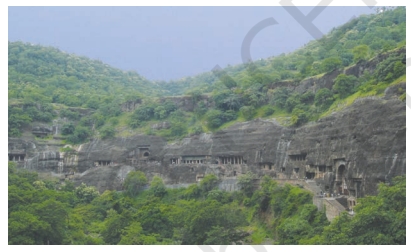
Ajanta Caves - A view of the Ajanta Caves, an ancient rock-cut complex famous for its Buddhist sculptures and murals, depicting the life of the Buddha and Jataka tales. - (iii) The site features two main types of functional layouts: Chaitya halls (prayer halls) and Vihara caves (monastic residences). Both types contain detailed sculptures and murals that capture daily life and spiritual stories from ancient India.
Chronological and Typological Classification of the Ajanta Cave Complex
The 29 caves are categorized into three main architectural and chronological groups, helping us follow the growth of Buddhist rock-cut architecture in India.
The Early Phase Caves ()
This early period reflects the Hinayana school of Buddhism. During this era, artists represented the Buddha using symbols like footprints or steeples rather than human figures. These caves have simple, practical designs.
- (i) This group includes Caves 10, 9, 12, and 13, which form the foundation of the Ajanta legacy.
The Transitional and Later Mahayana Phase ()
Work restarted under the support of the Vakataka dynasty, marking a shift to the Mahayana school. Artists began sculpting and painting human figures of the Buddha and Bodhisattvas, leading to larger and more decorated caves.
- (i) The transition period is seen in caves like 11, 15, 6 (upper and lower), and 7, showing gradual changes in layout and style.
- (ii) The later phase covers most of the caves, including the grand prayer halls 19 and 26. These combined Vihara-chaitya caves grew larger and more detailed.

Sculpture Panel in Ajanta Cave - A detailed sculpture panel from the Ajanta Caves, depicting intricate carvings of Buddha and his disciples in serene meditation. - (iii) Key additions to these later Vihara-chaitya layouts included wide pillared verandas, large main halls, and rows of private cells for monks, with a dedicated Buddha shrine carved in the rear wall.
Distinct Architectural Design: Chaitya and Vihara Caves
The builders of the Ajanta Caves carefully adapted the natural basalt rock into massive sacred spaces with distinct designs for prayer and daily living.
- (a) Chaitya Caves: Prayer halls like Caves 19 and 26 feature sculpted outer entrances decorated with figures of the Buddha and Bodhisattvas. They use a curved, apsidal-vault-roofed design inside.
- (b) Vihara Caves: These halls served as living quarters for monks. They feature wide pillared verandas surrounding a central space with small side rooms. Some caves (such as 5, 14, 23, 24, 28, and 29) were left incomplete, showing how workmen carved out the stone.
The Distinguished Patrons of Ajanta Caves: Vakataka Kings and Feudatories
The construction of the elaborate later caves at Ajanta was made possible by royal support from leaders linked to the Vakataka Kingdom.
Key Patrons and Their Dedicated Contributions
Inscriptions on the cave walls record the specific names of leaders and officials who funded individual cave projects.
- (i) Varahadeva: The Prime Minister under Vakataka King Harishena who paid for the carving and artwork of Cave 16.
- (ii) Upendragupta: A local ruler under the Vakatakas who funded a group of structures including Caves 17–20.
- (iii) Buddhabhadra: A devoted follower who oversaw the creation of Cave 26.
- (iv) Mathuradasa: The patron who funded the artwork inside Cave 4.
The Masterpieces of Ajanta Paintings: Artistic Evolution and Technique
The Ajanta murals are famous worldwide as highlights of ancient Indian wall painting, showing changes in technique, style, and narrative presentation over time.
The Early Phase Paintings: Simplicity and Naturalism
The oldest surviving paintings show a simple approach focused on natural shapes and direct lines.
- (i) Caves 9 and 10 contain wall paintings made with a simple set of earth pigments arranged in clear, straight lines.
- (ii) Human figures from this early era have a broad and naturalistic look, featuring direct forms with minimal decoration.
The Later Phase Paintings: Precision, Elegance, and Rhythmic Contour
Murals painted in the Fifth Century CE show the mature Ajanta style, known for expressive outlines and detailed shading.
- (i) Paintings in Caves 1, 2, 16, and 17 are admired for their precision, elegance, and dynamic vitality.
- (ii) Artists used flowing, rhythmic lines and dark outlines to give depth and form to figures.
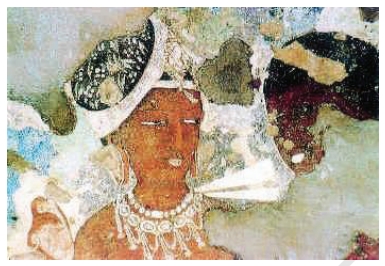
Painting of Apsara in Ajanta Caves - A delicate depiction of an Apsara, or celestial nymph, in the Ajanta Caves, showcasing the artistry and grace of ancient Indian painting techniques. 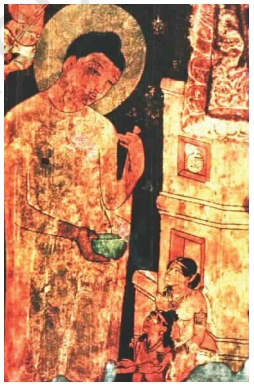
Painting of Buddha Yashodhara Rahul in Ajanta Caves - A painting from the Ajanta Caves depicting Buddha with his wife Yashodhara and son Rahul, showing familial connections in early Buddhist art. - (iii) Painters used natural tones like brown, yellow ochre, and green to paint diverse crowds of people across large wall scenes.
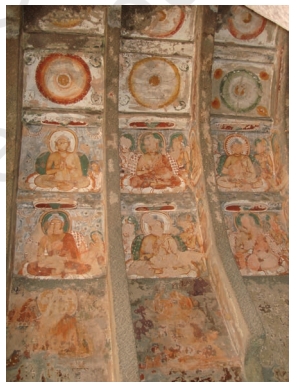
Painted Ceiling in Ajanta Caves - The beautiful painted ceilings in the Ajanta Caves, showcasing exquisite depictions of Buddhist themes and vibrant color usage. 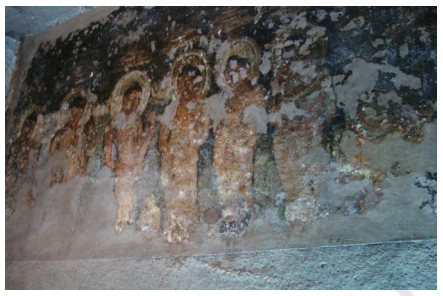
Paintings in Cave No 9 in Ajanta Caves - The exquisite murals inside Cave No 9 at Ajanta, illustrating various Buddhist teachings and stories with vibrant color and fine detail.
Artistic Style, Techniques, and Figural Depiction
The painting techniques at Ajanta shifted over time from solid, heavy forms to lighter, graceful figures.
- (a) Early figures look solid and heavy, while later figures appear lighter and more relaxed, giving a sense of smooth movement.
- (b) Painters created three-dimensional depth by blending painted architecture with landscape background details and showing figures in natural poses.
Iconography and Narrative Themes: Jataka Tales and Buddha’s Life
The main purpose of the Ajanta murals was to illustrate stories from Buddhism, focusing on the past lives of the Buddha to share moral lessons.
Major Narratives and Key Motifs
The cave walls function like large painted books, displaying key events from the life of the Buddha as well as scenes from the Jatakas and Avadanas.
- (i) Wall paintings depict events such as the Buddha’s birth, enlightenment, and first sermon alongside traditional moral stories.
- (ii) Famous painted stories include the Simhala Avadana, the Mahajanaka Jataka, and the Vidhurpundita Jataka.
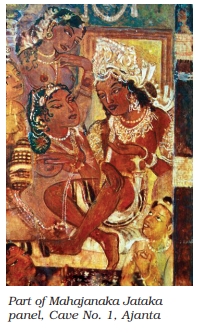
Part of Mahajanka Jataka Panel - A fragment of the Mahajanka Jataka panel, depicting scenes from the life of the Buddha, as shown in ancient Indian art at Sanchi. - (iii) Individual figures of Padmapani (Lotus Holder) and Vajrapani (Thunderbolt Holder) in Cave 1 are widely recognized as artistic triumphs.
- (iv) In Cave 10, the painting of the Chaddanta Jataka uses surrounding hills and trees to separate different parts of the story on the same wall.
Painting of the Bodhisattva in Cave No. 1 at Ajanta: Padmapani and Vajrapani Iconography
The Iconic Bodhisattva Painting in Cave No. 1: A Masterpiece of Late 5th Century CE Art
The painting of Padmapani Bodhisattva inside Cave No. 1 dates to the . Located on the back wall near the inner shrine, it remains one of the best-known wall paintings at Ajanta.
- (i) The paintings in Cave No. 1 display high artistic skill and remain better preserved than artwork in many other caves.
- (ii) Subtle differences in painting style across Cave 1 suggest that different worker guilds completed different sections over time.
Detailed Iconography of Padmapani Bodhisattva
The figure of Padmapani combines spiritual expression with precise body detail, creating a peaceful image of compassion.
Posture, Modelling, and Three-Dimensional Volume
The artist used traditional body poses and soft shading lines to make the figure look rounded and lifelike.
- (a) The figure holds a padma (lotus) with a slight bend in the body known as the tri-bhanga (triple bend) pose.
- (b) Smooth shading along the edges merges soft lines into the main figure, creating a clear three-dimensional look.
- (c) Highlights applied to the forehead and cheeks, along with a angled view of the right hand, make the figure look solid.
Facial Features and Regal Adornment
Delicate facial details and royal jewelry highlight the figure's divine nature.
- (i) The head tilts gently left with half-closed, elongated eyes, a clear nose, and a soft chin.
- (ii) A large, detailed crown sits atop the head.
- (iii) A beaded necklace circles the neck with fine highlights matching the face.
- (iv) Clear lines defining the nose and lips add a sense of weight to the facial structure.
Torso, Hands, and Compositional Elements
Broad shoulders and carefully placed hands balance the figure, surrounded by smaller supporting characters.
- (a) The figure features broad shoulders and a rounded torso framed by smooth, flowing lines.
- (b) The right hand holds the sacred lotus, while the left hand rests open near the waist.
- (c) Smaller attendant figures fill the background around the main image.
- (d) Fine lines painted onto the body thread show the detail and texture of the cloth.
Thematic Context: Vajrapani and the Guardian Motif
The Padmapani mural forms a balanced pair with the painting of Vajrapani Bodhisattva, acting together as protectors of the inner shrine.
Vajrapani Bodhisattva: Padmapani’s Counterpart
On the opposite side of the doorway stands Vajrapani Bodhisattva, serving as the second shrine guardian.
- (i) Vajrapani is identified by the vajra (thunderbolt) in his hand and his ornate crown.
- (ii) This figure shares the same detailed style and color tones as Padmapani.
- (iii) Placing Padmapani and Vajrapani together as shrine guards is a shared pattern across Ajanta's caves.
Major Painted Narratives: Mahajanaka and Umag Jataka
The surrounding walls showcase wide narrative murals focused on core Buddhist stories.
- (a) The main wall contains scenes from the Mahajanaka Jataka, the largest single story scene in Cave No. 1.
- (b) Additional space is dedicated to scenes from the Umag Jataka.
⚡ Quick Revision Capsule: Key Ajanta Caves Summary
This reference table highlights key facts, caves, and artwork from the Ajanta complex for quick review.
| Feature / Aspect | Hinayana Phase () | Mahayana Phase () |
|---|---|---|
| Primary Caves | Caves 9, 10, 12, 13 | Caves 1, 2, 4, 16, 17, 19, 26 |
| Buddha Representation | Symbolic (stupa, footprints) | Human / Sculptural form (murti) |
| Key Patrons | Early regional rulers | Vakataka Dynasty (King Harishena, Varahadeva) |
| Art Style | Simple outlines, natural proportions | Dynamic movement, shaded contours, rich pigments |
| Famous Features | Early linear murals in Cave 9 & 10 | Padmapani mural (Cave 1), Mara Vijaya (Cave 26) |
Mara Vijaya Theme in Ajanta: The Monumental Sculptural Panel in Cave No. 26
The Epic Sculpture of Mara Vijaya: Triumph of Enlightenment over Temptation
The Mara Vijaya scene presents the Buddha’s victory over the demon Mara right before achieving enlightenment. This event is carved into a massive stone panel inside Cave No. 26.
- (i) The panel is located on the right wall of Cave No. 26, near the large figure showing the Mahaparinibbana (Great Passing Away).
- (ii) The sculpture presents the internal struggle and ultimate victory of the Buddha over desire and distraction.
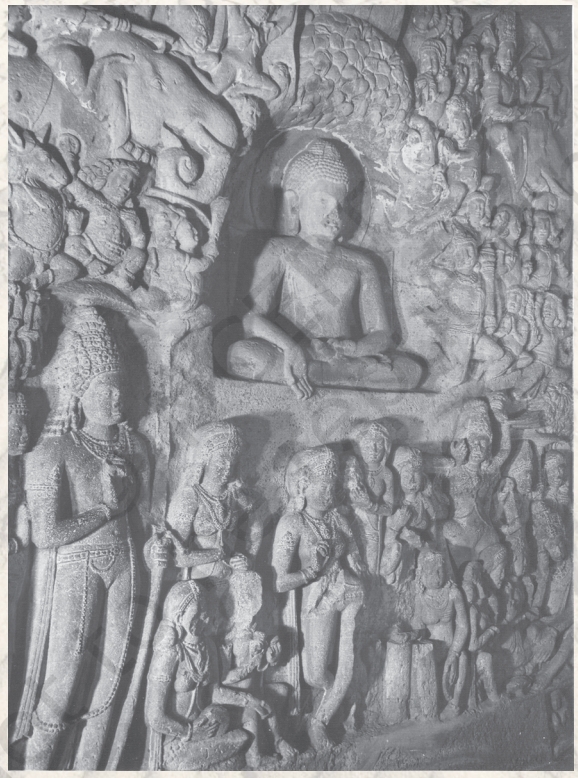
Sculpture of Maravijaya Ajanta Cave - A sculpture from the Ajanta Caves depicting Maravijaya, where the Buddha overcomes Mara, symbolizing the victory of enlightenment over temptation.
Iconography and Dynamic Composition of the Mara Vijaya Panel
The carving is known for its energetic group arrangement surrounding the quiet, central figure of the Buddha.
Buddha’s Central Position and the Earth Witness Gesture
The layout centers on the calm figure of the Buddha seated amidst the surrounding chaos.
- (i) The Buddha sits in the center in the padmasana (lotus pose). His right hand touches the ground in the Bhumisparsha Mudra (Earth-Touching Gesture), calling the earth to witness his past good deeds.
- (ii) Mara stands nearby with his army and daughters, trying to break the Buddha’s deep focus.
Mara’s Army and the Narrative Flow
The panel shows a clear sequence of events from attack to final retreat.
- (a) Members of Mara’s army are carved with unusual animal faces, representing destructive desires.
- (b) The top half shows the army marching forward aggressively, while the bottom section shows them retreating peacefully after their defeat.
- (c) At the lower left, Mara is shown sitting silently in thought after failing to disturb the Buddha.
Stylistic Features and Craftsmanship
The panel shows high technical skill and regional carving styles from ancient Maharashtra.
- (i) The arrangement contains moving figures carved in varied poses that create a sense of action.
- (ii) Carved dancers at the base add energy to the scene through their angled body positions.
- (iii) The carved leaves of the Bodhi tree behind the head signal the moment of enlightenment.
- (iv) Facial features on some soldiers match carving styles from the nearby Vidarbha region, showing that artisan guilds from different areas worked together at Ajanta.
📝 Summary
The Ajanta Caves remain a vital landmark for studying ancient Indian art and Buddhist history. Across two major construction phases from the to the , artists and monks created a lasting collection of stone architecture, paintings, and sculptures. Key works like the Padmapani painting in Cave 1 and the Mara Vijaya panel in Cave 26 showcase the artistic skill supported by the Vakataka rulers.
🚀 Quick Revision Points
Essential facts to review before examinations:
- (i) Location: Aurangabad District, Maharashtra (UNESCO World Heritage Site).
- (ii) Total Caves: 29 rock-cut caves split into Chaityas (prayer halls) and Viharas (monasteries).
- (iii) Two Phases: Early Hinayana () and Later Mahayana ( under Vakatakas).
- (iv) Main Motifs: Life of Buddha, Jataka Tales, and figures of Padmapani and Vajrapani.
- 💡 Exam Tip: Focus on distinguishing between Hinayana caves (symbolic representation, Caves 9, 10, 12, 13) and Mahayana caves (human idols of Buddha, Vakataka patronage, Caves 1, 2, 16, 17, 19, 26).
❓ Frequently Asked Questions (FAQ)
Q1: What are the main differences between Chaitya and Vihara caves at Ajanta?
A1: Chaitya caves served as curved prayer halls with steeples, while Vihara caves served as residential halls for monks with small living cells surrounding a central room.Q2: Who were the main royal patrons during the second phase of Ajanta?
A2: The second phase was mainly funded by rulers and officials of the Vakataka Dynasty, including Prime Minister Varahadeva and local king Upendragupta.Q3: What is the significance of the Bhumisparsha Mudra in the Mara Vijaya panel?
A3: The Bhumisparsha Mudra (Earth-Touching Gesture) represents the Buddha calling the earth to witness his spiritual purity and right to reach enlightenment.
