Embark on a captivating journey through India's diverse folk and modern art forms, exploring the rich tapestry of traditions like Mithila, Warli, and Gond paintings. These regional artistic expressions, deeply rooted in culture and ritual, offer profound insights into India's heritage. This detailed study is essential for students preparing for competitive exams, offering a comprehensive understanding of India's ancient and contemporary cultural landscape and painting traditions.
🎯 In this chapter, you will understand:
- The history, themes, and natural techniques behind Mithila (Madhubani) and Warli tribal art.
- Regional styles such as Gond, Sawara, and Pithoro ritualistic wall paintings.
- Storytelling scroll traditions including Pata Chitra of Bengal and Odisha, and Phads of Rajasthan.
- Sculptural heritage methods like Dhokra lost-wax metal casting and regional terracotta clay art.
💡 Why this topic matters: Indian folk art and craft forms reflect our country's social history, local spiritual beliefs, and deep bond with nature, forming a core section in general study examinations.
🧠 Core Idea: Traditional Indian visual art spans across flat wall paintings, portable scroll artwork, lost-wax metal casting, and earthen terracotta sculptures passed down through generations.
Exploring India's Rich Folk and Modern Art Forms: A Glimpse into Cultural Heritage and Painting Traditions
A rich lineage of artistic expression, spanning from ancient terracotta to vibrant contemporary folk paintings, defines India's cultural narrative.
The artistic traditions of India are a vivid reflection of its diverse geographical and socio-cultural fabric, utilizing mediums like clay, metal, and organic colors to narrate epic tales, depict rituals, and celebrate everyday life. The sheer variety ensures a continuous and dynamic tradition of Indian painting and sculptural forms.
- (i) The foundation of this tradition includes ancient forms like
Terracotta Drawings and wall murals, which laid the groundwork for later elaborate styles.
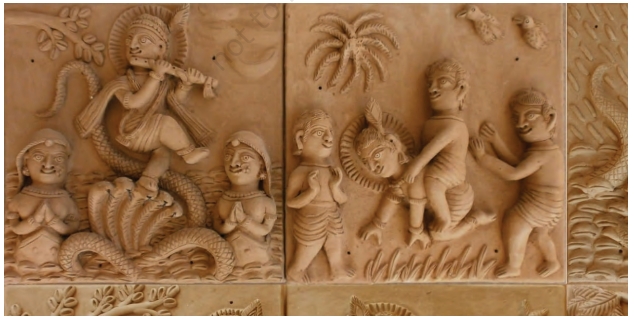
Terracotta Drawings on Wall - Ancient art form using fired clay, often depicting mythological scenes and everyday life, found in several parts of India. - (ii) Key contemporary folk painting styles, vital for exam preparation, include the
Mithila (Madhubani) from Bihar and the minimalist Warli from Maharashtra.
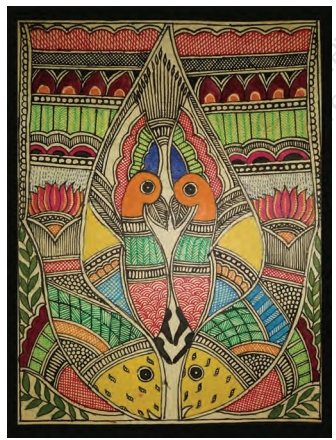
Mithila Paintings - Traditional folk paintings from Bihar, known for their intricate patterns, vibrant colors, and depiction of mythological themes. - (iii) The spectrum also covers regional masterpieces like Pithoro of Gujarat/Madhya Pradesh, Pabuji ki Phad and Pichhwai of Rajasthan, Gond and Sawara of Madhya Pradesh, and the Pata Chitra of Odisha and West Bengal.
The Enchanting World of Mithila (Madhubani) Paintings: History, Themes, and Technique
Originating from the ancient region of Mithila in Bihar, this art form, also known as Madhubani, is primarily an expression of women's devotion and celebration, characterized by intricate detail and vivid colors.
The Sacred Origin and Cultural Significance of Mithila Art
The Mithila painting tradition is intrinsically linked to the legendary land of Videha, the birthplace of Princess Sita. Its origin is popularly traced back to the time of her marriage to Lord Rama, suggesting a long-standing ceremonial purpose. It is a tradition predominantly upheld by the women of the region, who meticulously create these figures and designs for auspicious, ceremonial occasions, most notably weddings, reinforcing its role as a vital social and spiritual practice.
- (i) The art is named after the district capital, Madhubani, but its cultural reach extends across the historic Mithila region.
- (ii) Paintings are strategically placed within the domestic space, including the central or outer courtyards, the eastern part of the house (which often houses the Kuladevi or family deity), and the southern part of the house (reserved for significant spiritual images).
- (iii) The kohbar ghar (inner room) is adorned with particularly magnificent paintings carrying metaphoric and tantric connotations, essential for rituals associated with marriage and fertility.
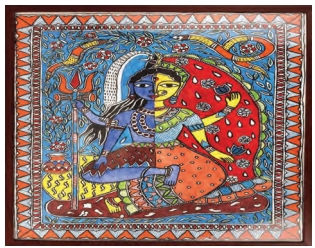
Mithila Paintings - Another example of the Mithila art form, illustrating the richness of the tradition with symbols of nature, gods, and cultural motifs.
Vibrant Themes and Traditional Techniques of Madhubani Art
The narrative tapestry of Madhubani paintings is richly woven with themes from Hindu mythology and the bounty of nature. The depictions are not merely decorative but serve as powerful symbols of life, divinity, and prosperity.
- (a) Mythological Depictions: Common themes include episodes from the Bhagvata Purana and the Ramayana, along with portraits of major deities such as Shiva-Parvati, Durga, Kali, and the sacred Rasa-Lila of Radha and Krishna.
- (b) Symbolism in Art: These paintings are profound symbols of love, passion, fertility, eternity, well-being, and prosperity, reflecting the deep-seated spiritual beliefs of the community.
- (c) Nature's Role and Technique: Elements of nature—including gods, animals, birds, and flowers—are used not only as subjects but also to meticulously fill empty spaces, creating the characteristic dense and intricate patterns. The artists traditionally use bamboo twigs as brushes and derive their vibrant colors naturally from mineral stones, and organic materials like phalsa, kusum flowers, and turmeric.
Warli Painting of Northern Maharashtra: Simplicity, Rituals, and the Mother Goddess
The Warli painting tradition, originating from the Warli community of Northern Maharashtra, is a striking example of simple yet profound tribal art, using basic geometric shapes to narrate the rhythm of daily life and rituals.
The Community Focus and Ritualistic Chowk of Warli Art
Central to the creation of Warli art are the married women of the community, who create elaborate paintings called Chowk specifically for special, sacred occasions. This ritualistic art is deeply associated with rites of passage and seasonal cycles, including the rituals of marriage, fertility, harvest, and sowing seasons, making it a continuous chronicle of the community’s life.
- (i) The most significant figure in the Chowk paintings is the mother goddess, Palaghat, who is the central symbol of fertility and represents the corn goddess Kansari.
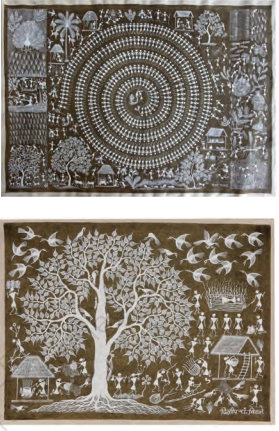
Warli Paintings - Traditional tribal art from Maharashtra, depicting nature, animals, and daily life through simple geometric shapes and figures. - (ii) Surrounding Palaghat are vibrant scenes of everyday community life, encompassing activities like hunting, fishing, farming, and even modern urban life, captured through simple geometric forms (circles, triangles, squares).
- (iii) The paintings are created on the earthy walls of homes using a humble medium: rice flour paste, and the artists utilize bamboo sticks, often chewed at the end, as their paintbrushes. Their purpose is deeply spiritual—to promote fertility, avert diseases, propitiate spirits, and fulfill the demands of ancestors.
- (i) The most significant figure in the Chowk paintings is the mother goddess, Palaghat, who is the central symbol of fertility and represents the corn goddess Kansari.
Gond, Sawara, and Pithoro: Diverse Tribal and Folk Painting Styles
Beyond Mithila and Warli, other tribal communities, notably the Gonds, Sawaras, and Rathva Bhils, contribute immensely to India's folk art heritage through their distinct painting styles.
Gond Paintings: The Colorful World of Nature Worship (Madhya Pradesh)
The Gonds of Madhya Pradesh possess a profound and rich tradition where the worship of nature is paramount. Their paintings are vivid, colorful representations where animals, humans, and flora are often depicted in transformed or stylized forms, serving as a visual record of their myths and connection to the environment.
- (i) Votive paintings are frequently created on the walls of huts, illustrating devotional scenes such as Krishna with cows surrounded by gopis carrying pots.
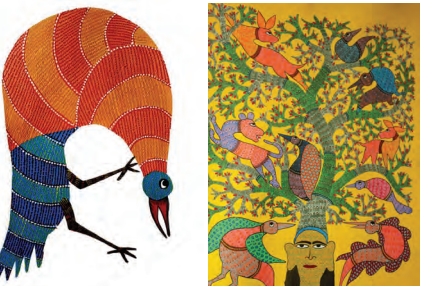
Gond Paintings - A tribal art form from Madhya Pradesh, known for its intricate dot patterns and vibrant colors, depicting the relationship between humans, animals, and nature.
- (i) Votive paintings are frequently created on the walls of huts, illustrating devotional scenes such as Krishna with cows surrounded by gopis carrying pots.
Pithoro Paintings: Cosmography of the Rathva Bhils (Gujarat and Madhya Pradesh)
The Pithoro painting tradition originates from the Rathva Bhils of Gujarat and Madhya Pradesh. These are large, striking wall paintings created for ceremonial or thanksgiving occasions, serving a devotional purpose.
- (a) Cosmographic Structure: The paintings are organized into distinct sections, primarily featuring rows of horse-rider deities that symbolize their understanding of the cosmos.
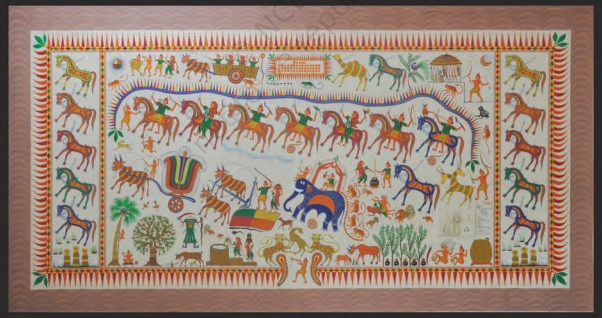
Pithoro Paintings - Traditional folk art from Gujarat, often used in the worship of the Pithoro deity, showcasing vibrant and symbolic imagery. - (b) Depiction Levels: The upper section typically represents the divine and celestial sphere, including gods, heavenly bodies, and mythical creatures, while the lower section grounds the narrative in earthly scenes, showing a wedding procession, deities, kings, animals, and farmers.
- (a) Cosmographic Structure: The paintings are organized into distinct sections, primarily featuring rows of horse-rider deities that symbolize their understanding of the cosmos.
Pata Chitra and Phads: The Scroll Painting and Storytelling Traditions
Scroll paintings, known by various regional names like Pata, Pachedi, or Phad, are unique folk art forms common across Gujarat, Rajasthan, Odisha, and West Bengal, serving as portable visual aids for itinerant storytellers and bards.
Pata Chitra: Storytelling on Cloth (Odisha and Bengal)
Pata Paintings are a vibrant tradition in states like Odisha and West Bengal. The Bengal patas are painted on cloth and are specifically used as visual aids by the Patuas (performers), who travel across villages, displaying the paintings while narrating religious and mythological stories, ensuring the perpetuation of oral traditions. Similarly, the Puri patas from Odisha focus on devotional themes, often depicting the festival attires and episodes from the myths of Lord Jagannath.
- (a) Bengal Pata:These focus on religious and mythological narratives, characterized by their detailed strokes and vibrant colors.
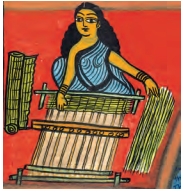
Bengal Pata Paintings - Traditional scroll paintings from Bengal, depicting religious and mythological stories in vibrant colors and detailed strokes. - (b) Puri Patas:These focus on Hindu deities and the Jagannath Temple tradition.
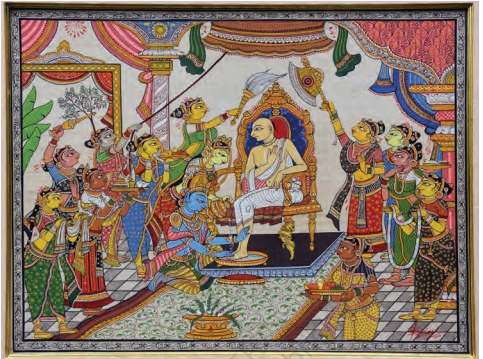
Puri Patas Paintings - Religious paintings from Odisha, depicting Hindu deities, particularly from the Jagannath Temple tradition. - (c) Technique and Durability of Patachitras: The process involves preparing small strips of cotton cloth by coating them with soft white stone powder and a glue made from tamarind seeds. After the borders and figures are sketched, flat colors (white, black, yellow, red) are applied. Critically, the painting is held over a charcoal fire and coated with lacquer to make it water-resistant and glossy. The colors are all organic and locally sourced, with black from lamp black, yellow from haritali stone, red from hingal stone, and white from powdered conch shells.
- (a) Bengal Pata:
Phads of Rajasthan: Honoring Hero-Deities with Painted Scrolls
The Phads of Rajasthan are long, horizontal cloth scrolls painted primarily to honor the folk deities, known as bhomias, of the pastoral communities around Bhilwara. These communities' worship patterns are focused on safeguarding their livestock. The Phads thus celebrate hero-deities who sacrificed their lives to protect cattle from robbers, with prominent figures including Gogaji, Jejaji, Dev Narayan, Ramdevji, and Pabhuji.
- (i) The Role of Bhopas: The scrolls are carried by bhopas (itinerant bards) who perform night-long narratives and devotional songs, illuminating the images on the Phad with a lamp as they tell the story.
- (ii) The Painters: Phads are traditionally painted by the Joshis, a caste of painters who are also miniature painting specialists from the courts of Rajasthan kings.
⚡ Quick Revision Capsule: Indian Folk Art & Sculptural Styles
A structured quick review of key Indian regional art forms, their geographic origins, primary mediums, and distinct features:
| Art Form | Region / Origin | Key Characteristics & Materials |
|---|---|---|
| Mithila (Madhubani) | Mithila, Bihar | Women-led, bamboo twigs, natural dyes, tantric motifs (kohbar ghar). |
| Warli | Northern Maharashtra | White rice paste on mud walls, geometric shapes, mother goddess Palaghat. |
| Gond | Madhya Pradesh | Intricate dots and lines, nature worship, stylized flora and fauna. |
| Pithoro | Gujarat & Madhya Pradesh | Rathva Bhil ceremonial wall paintings featuring horse-rider deities. |
| Pata Chitra | Odisha & West Bengal | Cloth scrolls, tamarind seed paste, lacquer coat, used by traveling Patuas. |
| Phad | Rajasthan (Bhilwara) | Long scroll paintings of pastoral hero-deities (bhomias), sung by bhopas. |
| Dhokra | Chhattisgarh (Bastar), MP, Odisha | Ancient lost-wax metal casting (cire perdue) using clay, wax, and bronze. |
| Terracotta | Pan-India (Assam, Tamil Nadu, etc.) | Hand-modeled or wheel-spun fired clay sculptures for rituals and storage. |
📝 Summary
The study of India's folk and modern art forms, including key styles like Mithila, Warli, Gond, Pata Chitra, and the sculptural traditions of Dhokra Casting and Terracotta, is fundamentally important for understanding the nation's cultural continuity. These art expressions, deeply embedded in ritual and community life, are irreplaceable windows into India's spiritual and social history. For students preparing for competitive exams, a comprehensive knowledge of these regional painting and sculptural traditions and their unique techniques is crucial for mastering the topic of Indian culture and heritage.
🚀 Quick Revision Points
Essential facts to review before examinations:
- (i) Madhubani art uses bamboo brushes and natural dyes, tied historically to Princess Sita's wedding in Mithila.
- (ii) Warli art relies on white rice flour paste to paint geometric harvest scenes and the goddess Palaghat.
- (iii) Pata Chitra scroll paintings are made water-resistant using a charcoal fire and lacquer coating.
- (iv) Dhokra metal casting uses the ancient lost-wax technique (cire perdue) practiced by 'ghadwas' artisans.
- 💡 Exam Tip: Focus on linking each art form with its specific state, community, ritual purpose, and natural materials used (e.g., Warli = Maharashtra + Rice Paste; Dhokra = Bastar + Lost-Wax Bronze).
❓ Frequently Asked Questions (FAQ)
Q1: What is the primary difference between Mithila and Warli art forms?
A1: Mithila art from Bihar uses vibrant colors and depicts complex mythological scenes, whereas Warli art from Maharashtra uses a single white color (rice paste) on mud walls with simple geometric shapes depicting daily tribal life.Q2: What is the lost-wax technique used in Dhokra casting?
A2: The lost-wax method (cire perdue) involves building a clay core, wrapping it in wax, covering it with clay layers, heating it to melt the wax out, and pouring molten metal into the hollow cavity.Q3: Who are the Bhopas in the context of Rajasthani Phad paintings?
A3: Bhopas are itinerant priest-bards who carry long painted cloth scrolls (Phads) across villages, performing night-long singing and storytelling sessions about local pastoral deities.