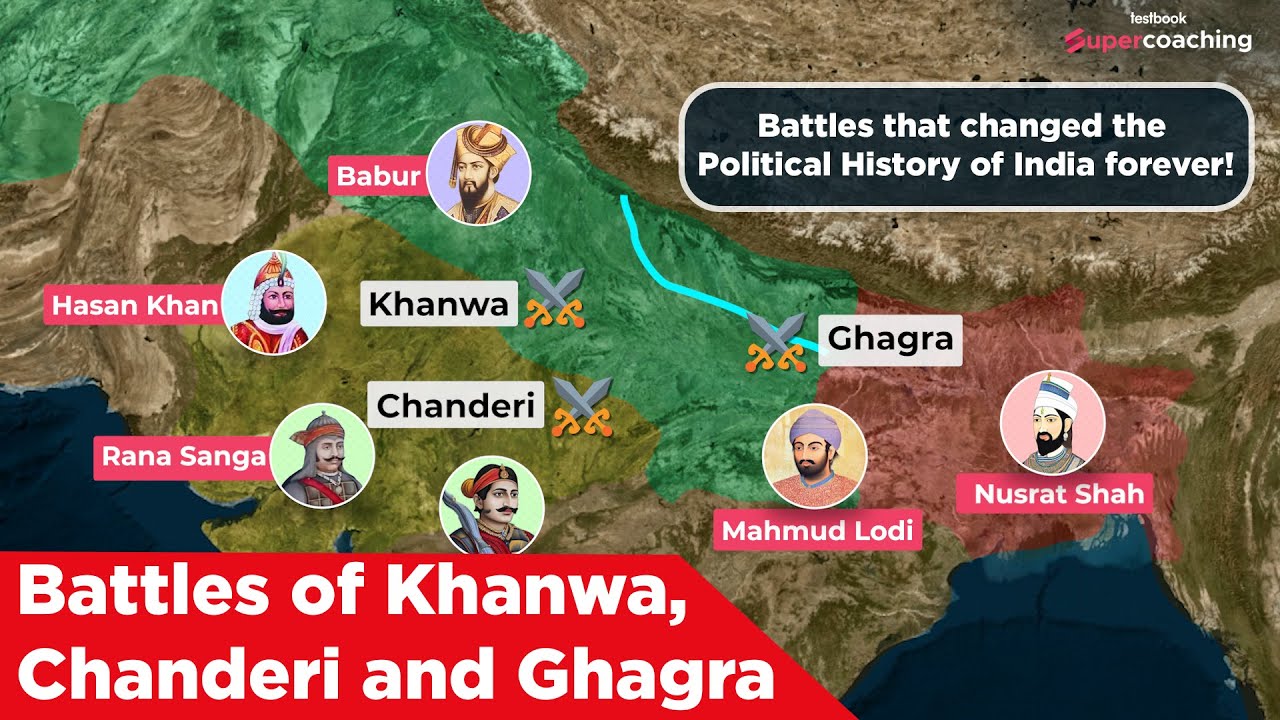
The Battle of Khanwa in marks a pivotal moment in Indian history, deeply rooted in the fierce struggle for dominance between the ambitious Mughal ruler Babur and the formidable Rajput chieftain Rana Sanga. This monumental conflict, fought for supremacy in the strategically vital regions of Rajasthan and Malwa, was instrumental in the rapid consolidation of the burgeoning Mughal Empire in the Indo-Gangetic plain. Understanding the intricate dynamics, military innovations, and political fallout of this battle is absolutely crucial for students preparing for history exams, providing invaluable insights into the transformative period of early Mughal-Rajput relations and the foundation of Mughal authority in India.
🎯 In this chapter, you will understand:
- The political background and catalysts that led to the clash between Babur and Rana Sanga.
- The innovative military strategies, including gunpowder artillery and Tulgama tactics, used by Babur.
- The fierce resistance of the Rajput confederacy and the ultimate outcome of the battle.
- The long-term impact on Mughal rule, Rajput unification, and the follow-up siege of Chanderi.
💡 Why this topic matters: The Battle of Khanwa shifted the balance of power in northern India, converting Babur's initial victory at Panipat into a lasting empire rather than a temporary raid.
🧠 Core Idea: Modern military technology and disciplined flanking tactics overcame a numerically superior coalition, cementing central authority in the Delhi-Agra belt.
Overview of the Khanwa Battle: Babur vs. Rana Sanga and the Consolidation of Mughal Power (1527)
The clash between Babur and Rana Sanga was a desperate contest for ultimate sovereignty in northern India, critically shaping the trajectory of early Mughal governance.
The immediate catalyst for the battle was the escalating tension arising from both rulers' expansionist ambitions over the provinces of Rajasthan and Malwa. Rana Sanga's influence, buoyed by Rajput power, had aggressively expanded to the threshold of Piliya Khar near the crucial city of Agra, posing an existential threat to Babur's newly won empire following the First Battle of Panipat. Babur, fresh from his victory, was determined to secure his foothold in the fertile Indo-Gangetic valley.
- (i) The conflict was fundamentally a contest between the established Rajput power of Rana Sanga and the nascent power of Babur for regional supremacy in Rajasthan and Malwa.
- (ii) Rana Sanga's widespread influence extended perilously close to the imperial city of Agra, which was perceived by the Mughals as a direct, unacceptable threat to the stability of Babur's newly founded empire.
- (iii) The Mughal emperor, Babur, publicly accused Sanga of a breach of a prior agreement—a strategic move to justify the ensuing war.
- (iv) Sanga successfully mobilized a significant coalition, with numerous disillusioned Afghan and various Rajput rulers joining forces to challenge the Mughals under his banner.
- (v) To boost the morale of his own troops, who were wary of the large Rajput force, Babur declared the war a jihad (holy war) against the infidels and dramatically prohibited the consumption and sale of wine across his territories.
- (vi) Employing sophisticated defensive measures, Babur fortified his position at Khanwa, strategically utilizing a defensive shield of wagon barricades (Araba) chained together and protected by deep trenches.
The Intense Battle of Khanwa: Mughal Strategy, Artillery Use, and Flanking Tactics
The decisive confrontation at Khanwa was a testament to the superiority of Babur’s innovative military strategy, involving the calculated use of gunpowder artillery, precise central offensive maneuvers, and effective tactical flanking, which together delivered a conclusive Mughal victory.

Babur’s Revolutionary Military Tactics and Technological Advantage
Despite commanding forces significantly smaller in number compared to the vast army of Rana Sanga, Babur's success rested entirely on his revolutionary adoption of modern warfare techniques, particularly his superior use of artillery and the Tulgama flanking strategy.
- (i) Crucially, Babur commanded smaller forces in total number when compared directly to the immense combined army led by Rana Sanga and his confederates.
- (ii) The devastating accuracy and firepower of the Mughal artillery, positioned defensively behind the wagon lines, systematically weakened and demoralized Sanga's advancing troops, a technology the Rajputs lacked.
- (iii) The central offensive was skillfully executed through the gaps in the chained wagons, allowing highly mobile cavalry and riflemen to engage the enemy, a formation characteristic of Babur’s military genius.
Rana Sanga’s Flanking Attempts and Rajput Fierce Resistance
The Rajput forces, known for their immense bravery and ferocity, launched relentless and fierce attacks, particularly targeting the Mughal army's vulnerable flanks, seeking to overwhelm the defensive structure through sheer manpower and courage.
- (a) Sanga's forces initiated aggressive and fierce assaults, concentrating their attacks heavily on the flanks of Babur's defensive formation.
- (b) These concerted efforts aimed specifically to breach and entirely break the technologically superior Mughal defensive lines constructed of chained wagons and trenches.
- (c) However, despite the intensity of the assault, the Rajput attacks were ultimately repelled and neutralized by the timely and disciplined execution of Babur’s tactical flanking maneuvers (Tulgama) by his mobile cavalry units.
The Decisive Outcome: Solidification of Mughal Rule
The skillful combination of the Tulgama flanking maneuvers, which enveloped the Rajput army, and the constant, devastating bombardment from the Mughal artillery led directly to the inevitable and decisive victory for Babur.
- (i) The perfectly synchronized flanking maneuvers, executed in tandem with the effective use of artillery and musketry, culminated in Babur’s conclusive victory over the formidable Rajput confederacy.
- (ii) This victory at Khanwa fundamentally set the stage for the deep and irreversible Mughal consolidation across the entirety of northern India.
- (iii) The battle powerfully demonstrated the overwhelming effectiveness and lethality of the modern warfare techniques, including gunpowder and mobile cavalry, which were pioneered and introduced to the subcontinent by Babur.
Outcome of the Khanwa Battle: Profound Implications for Indian History
Babur’s definitive victory at Khanwa fundamentally altered the political power structure in northern India, effectively terminating Rana Sanga's ambitious dream of unifying Rajasthan under one Rajput banner and permanently solidifying Mughal authority in the critical Delhi-Agra region.
The Tragic Aftermath for Rana Sanga and Rajput Aspirations
While the valiant Rana Sanga managed to narrowly escape the battlefield, the dream of a unified Rajput confederacy under his leadership was shattered forever.
- (i) Though Rana Sanga escaped the immediate consequences of the battle, his reign was tragically cut short when he was later poisoned by his own disgruntled nobles who opposed his further campaigns against Babur.
- (ii) His demise effectively spelled the end of the widespread, ambitious efforts to consolidate and unify Rajasthan and central India under a single, strong Rajput political leadership against the Mughals.
Babur’s Aggressive Consolidation in Northern India
Following the elimination of the most potent threat from the Rajputs, Babur was free to significantly strengthen and expand his rule, transforming the Delhi-Agra region into the undisputed core of the nascent Mughal Empire.
- (a) The victory significantly strengthened Mughal rule and administrative control over the crucial and highly strategic Delhi-Agra region.
- (b) Babur conquered several key forts, including Gwalior, immediately enhancing his military presence and securing vital lines of communication and supply.
- (c) He subsequently captured the powerful fortress of Chanderi, a move that irrevocably shifted the regional power dynamics in favor of the Mughals.
Managing the Persistent Afghan Threats Post-Khanwa
Despite the grand success against the Rajputs, Babur's consolidation efforts still required careful strategic planning due to the continuous presence of formidable Afghan rivals.
- (i) Even after the victory over Sanga, Babur had to continuously adjust his military campaigns and focus, as the ongoing Afghan threats, particularly in the eastern parts of the empire, required immediate attention and management.
The Battle of Chanderi: Sealing Mughal Power in Central India (1528)
A crucial follow-up to Khanwa was Babur’s swift military action against Medini Rai, the powerful Rajput chief controlling the strategic fortress of Chanderi, which further cemented Mughal control across northern India.
Campaign Against Medini Rai and the Sacrifice at Chanderi
The siege of Chanderi encountered fierce and unwavering resistance, culminating in an act of mass ritual sacrifice by the Rajput defenders rather than submission to the invading Mughal forces.
- (i) A brutal and fierce resistance was encountered at Chanderi from the Rajput garrison under Medini Rai, demonstrating the deep commitment of the defenders.
- (ii) The subsequent Mughal victory led to massive casualties, tragically culminating in the defenders performing Jauhar (ritual self-immolation) and Saka (last stand).
- (iii) This strategic victory over Chanderi significantly cemented Babur’s expanding influence and absolute authority across a major part of northern India, integrating Malwa into the Mughal domain.
⚡ Quick Revision Capsule: Key Battles of Early Mughal Consolidation
A quick comparative overview of the major military engagements fought by Babur to establish and secure Mughal rule in India.
| Battle | Key Opponents | Strategic Outcome |
|---|---|---|
| First Battle of Panipat () | Babur vs. Ibrahim Lodi | Ended the Delhi Sultanate; established initial Mughal foothold in Northern India. |
| Battle of Khanwa () | Babur vs. Rana Sanga & Rajput Confederacy | Neutralized the major Rajput threat; secured the Delhi-Agra region. |
| Battle of Chanderi () | Babur vs. Medini Rai | Overcame Malwa's resistance; weakened Rajput strongholds in Central India. |
| Battle of Ghagra () | Babur vs. Mahmud Lodi & Afghan Chiefs | Subdued eastern Afghan resistance, securing eastern borders of the empire. |
📝 Summary
The tandem of the pivotal Khanwa Battle () and the subsequent Battle of Chanderi () were absolutely critical milestones in the life of Babur, unequivocally establishing his authority and securing the foundation of the Mughal Empire in northern India. These events provide essential case studies for students preparing for Indian history exams, demonstrating strategic warfare, the groundbreaking impact of Mughal artillery and gunpowder, and the fierce nature of Rajput resistance. They highlight the decisive shift of power in the Delhi-Agra region from regional powers to the centralizing authority of the Mughals.
🚀 Quick Revision Points
Essential facts to review before examinations:
- (i) The Battle of Khanwa () was fought between Babur and Rana Sanga of Mewar.
- (ii) Babur used the Araba (chained wagon barricades) and Tulgama (flanking attack) military systems alongside gunpowder artillery.
- (iii) Babur declared the conflict a jihad and renounced wine to motivate his troops.
- (iv) The Battle of Chanderi () against Medini Rai consolidated Mughal authority over Malwa and Central India.
- 💡 Exam Tip: Questions often ask about Babur's tactical innovations. Always highlight the combined use of artillery (cannons) with the Tulgama flanking strategy and Araba (wagon line) defense!
❓ Frequently Asked Questions (FAQ)
Q1: Why was the Battle of Khanwa more decisive than the First Battle of Panipat?
A1: While Panipat defeated the Delhi Sultanate, Khanwa crushed the powerful Rajput confederacy led by Rana Sanga, eliminating the primary challenge to Mughal supremacy in Northern India.Q2: What was the Tulgama system used by Babur?
A2: Tulgama was a tactical maneuver where the army was divided into central, left, right, and flanking units to encircle the enemy from the sides and rear while heavy artillery bombarded them from the front.Q3: What happened at the Battle of Chanderi in 1528?
A3: Babur besieged the fort of Chanderi held by Medini Rai. Upon defeat, the Rajput women performed Jauhar and the soldiers made a final stand (Saka), bringing Malwa under Mughal control.