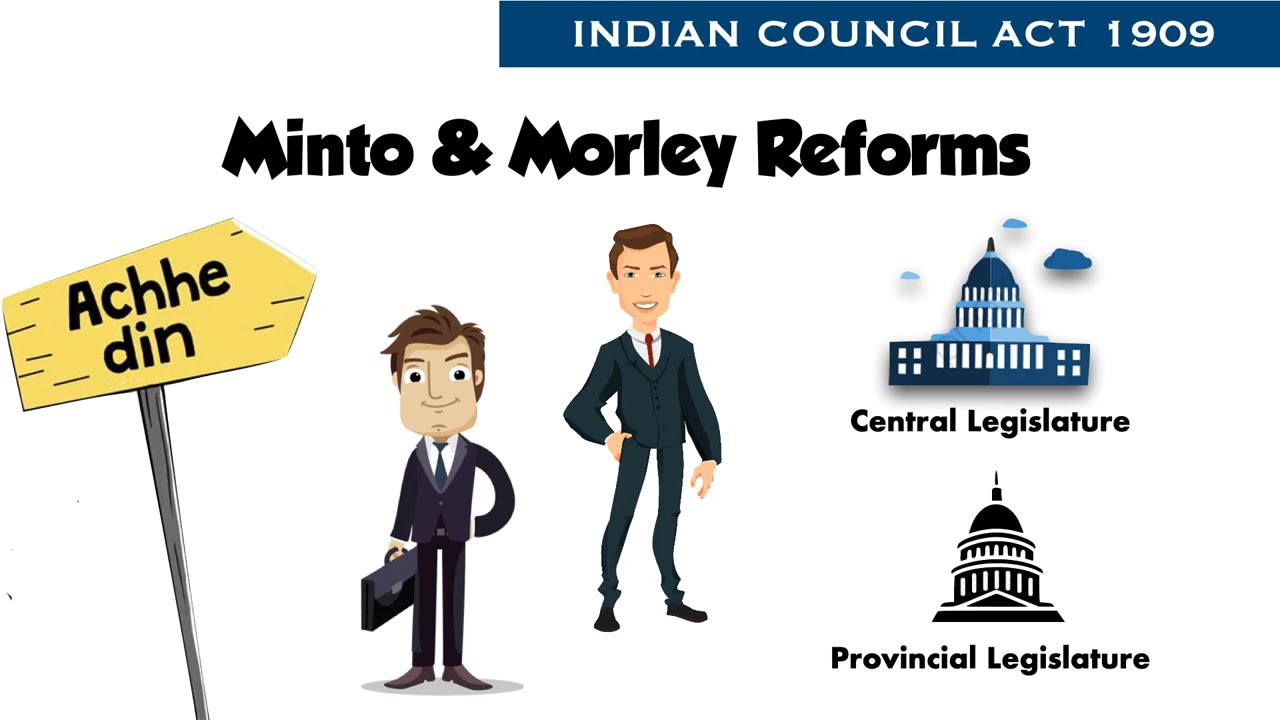
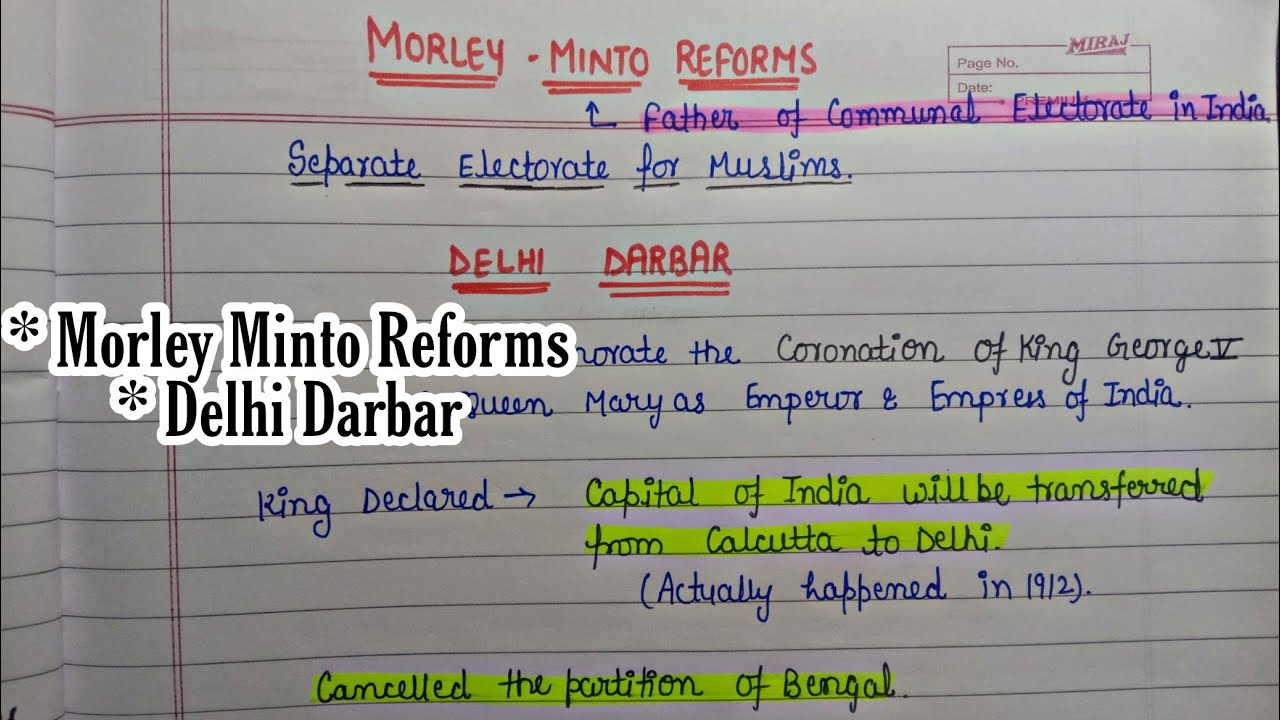
The Morley-Minto Reforms of marked a critical turning point in British colonial policies in India. These reforms introduced separate electorates for Muslims, expanded legislative councils, and attempted to address growing political demands. However, critics saw them as a calculated strategy of divide and rule that hindered Indian nationalism. Understanding the reforms is essential for students preparing for competitive exams like the UPSC, as it highlights key constitutional developments, communal politics, and colonial governance.
🎯 In this chapter, you will understand:
- The political conditions that led to the passage of the Act.
- How separate electorates were institutionalized for Muslim voters.
- The structural expansion and operational limits of legislative councils.
- The long-term impact of colonial policies on Indian national unity and constitutional history.
💡 Why this topic matters: It explains the origin of communal electorates in modern Indian constitutional history and reveals how colonial governance shaped political identities.
🧠 Core Idea: The British combined minor political concessions with institutionalized communal divisions to manage rising nationalist sentiment while maintaining ultimate imperial control.
Morley-Minto Reforms of 1909: Constitutional Provisions, Communal Electorates, and Political Impact
The Morley-Minto Reforms of attempted to introduce constitutional changes, but ended up creating lasting communal divisions in Indian politics.
At the start of the , the British Raj faced a growing wave of Indian nationalism. To handle this, colonial officials used a two-part strategy: win over moderate political leaders by expanding legislative bodies, while dividing nationalist unity through official communal quotas.
- (i) These reforms were strongly influenced by the Simla Deputation of , which gave British officials an opportunity to foster a distinct political identity for Indian Muslims.
- (ii) A defining feature was the separate electorate system for Muslims, which fundamentally changed representative politics across the subcontinent.
- (iii) The reforms expanded legislative councils at both central and provincial levels, though real authority stayed firmly with the British executive.
Historical Background and Political Precursors: The Path to the 1909 Reforms
The movement toward the Act developed through the interplay between growing Congress demands and British attempts to address emerging communal claims.
The Rise of Muslim Political Demands and the Simla Deputation
During a period of tense political energy, colonial administrators encouraged a group of Muslim elites to submit their demands, giving official support to communal representation.
- (i) In , a delegation of Muslim elites led by Agha Khan met Lord Minto, the Viceroy, to request safeguards for their community's interests.
- (ii) They requested separate electorates and representation beyond their actual proportion of the population.
- (iii) Following this meeting, the All-India Muslim League was established in under Nawab Salimullah of Dacca, forming a permanent political organisation.
Moderate Congress Diplomacy and Gokhale’s Mission to England
While communal groups sought special protections, the Indian National Congress worked through diplomatic channels for democratic progress within the system.
- (i) Gopal Krishna Gokhale traveled to England to confer with John Morley, the Secretary of State for India, regarding administrative changes.
- (ii) He presented the Congress demand for self-government similar to other British colonies, hoping for genuine movement toward parliamentary representation.
Key Legislative Provisions and Structural Changes: Analyzing the Act of 1909
The reforms created a tiered framework of representation that broadened participation on paper, but relied on indirect selection and restricted voting rights.

Expansion of Legislative Councils and Indian Participation
The Act focused heavily on increasing council membership to present a more representative structure while keeping final authority with the British.
- (i) The elective principle was introduced for non-official members, marking a shift from purely nominated appointments.
- (ii) Membership in the Imperial and Provincial Legislative Councils was expanded to include more members in an advisory role.
- (iii) An Indian member was appointed to the Viceroy’s Executive Council for the first time when Satyendra Sinha joined in .
The Institutionalization of Communal Separate Electorates
The most debated measure of the reforms was separating voters according to religion, specifically for the Muslim community.
- (i) Separate electorates for Muslims were created in central and provincial councils, meaning Muslim representatives were chosen exclusively by Muslim voters.
- (ii) In the Imperial Legislative Council, 8 out of 27 elected non-official seats were reserved specifically for Muslim candidates.
- (iii) Income requirements for Muslim voters were set lower than those for Hindu voters, creating unequal eligibility standards between communities.
Limitations of Electoral Powers and the Indirect Voting Mechanism
Despite council expansion, practical legislative authority remained limited, preventing the formation of a true cabinet-style government.
- (i) Elections were mostly indirect, relying on local bodies and provincial assemblies to act as electoral colleges.
Fiscal and Administrative Constraints of Councils
Members faced strict boundaries regarding financial decisions and executive oversight.
- (i) Council members could submit resolutions, ask questions, and discuss budget items, but had no authority to control financial allocations.
- (ii) The reforms did not establish a responsible government, leaving executive officers unaccountable to elected representatives.
Evaluation of the Reforms: Contemporary Criticism and Historical Impact
Many contemporary figures and later scholars viewed the reforms as limited concessions aimed at extending colonial rule by encouraging political division.
- (i) Lord Morley reflected on the policy's purpose, noting that while reforms might not preserve imperial rule indefinitely, little else remained to try.
- (ii) The later Montford Report noted that these measures isolated Muslim voters and created hurdles to broader national integration.
- (iii) Jawaharlal Nehru described the electoral system as overly complex and indirect, limiting genuine popular representation.
The Legacy of Divide and Rule and Future Constitutional Evolution
The Act established official communal representation within Indian statutory law, creating precedent for subsequent political structures.
- (i) The Act formally embedded communal quotas into state institutions, an arrangement that influenced political relations in the following decades.
- (ii) It reflected the administrative strategy of balancing different political interests to reduce unified opposition.
- (iii) Despite these drawbacks, it provided a structural reference point for future legislation, such as the Government of India Act of 1919.
⚡ Quick Revision Capsule: Morley-Minto Reforms 1909
Key details and structural features of the Act for quick review:
| Aspect | Key Provision / Change | Historical Impact |
|---|---|---|
| Primary Objective | Pacify Moderate nationalist leaders and address growing political activity. | Broadened legislative councils without surrendering core executive control. |
| Communal Electorates | Granted separate electorates and lower voting qualifications for Muslim voters. | Officially recognized religious identity as a basis for electoral politics. |
| Executive Council | Appointed Satyendra Sinha as the first Indian in the Viceroy's Executive Council. | Set an early precedent for Indian participation at top executive levels. |
| Electoral Method | Indirect voting through local bodies and provincial organizations. | Kept voters distant from direct legislative representation. |
| Future Relevance | Influenced subsequent constitutional frameworks, including the Government of India Act of 1919. | Established patterns of legislative representation used throughout the late colonial period. |
📝 Summary
The Morley-Minto Reforms of 1909 expanded legislative bodies and introduced separate electorates for Muslims, marking a major moment in Indian politics. While offering limited consultative roles, they did not grant genuine self-governance and instead reinforced communal divisions. For students preparing for competitive examinations, these reforms help clarify constitutional developments, electoral policies, and early colonial administration.
🚀 Quick Revision Points
Essential facts to review before examinations:
- (i) Simla Deputation (): Delegation led by Agha Khan requesting reserved representation for Muslims.
- (ii) Muslim League: Founded in under Nawab Salimullah of Dacca.
- (iii) Executive Council Inclusion: Satyendra Sinha became the first Indian member in .
- (iv) Historical Analysis: Evaluated critically in documents like the Montford Report for its impact on national integration.
- 💡 Exam Tip: When answering questions on the Act, distinguish clearly between the expansion of advisory powers in legislative councils and the lack of true executive accountability.
❓ Frequently Asked Questions (FAQ)
Q1: What were the Morley-Minto Reforms of 1909?
A1: They were a series of constitutional changes enacted by the British Parliament that expanded legislative councils in India and introduced separate electoral seats for Muslim voters.Q2: Why were separate electorates controversial?
A2: Because they made voting eligibility dependent on religious identity, which critics argued hindered the growth of a unified national movement.Q3: Who was the first Indian appointed to the Viceroy's Executive Council under these reforms?
A3: Satyendra Sinha was appointed to the Viceroy's Executive Council in .