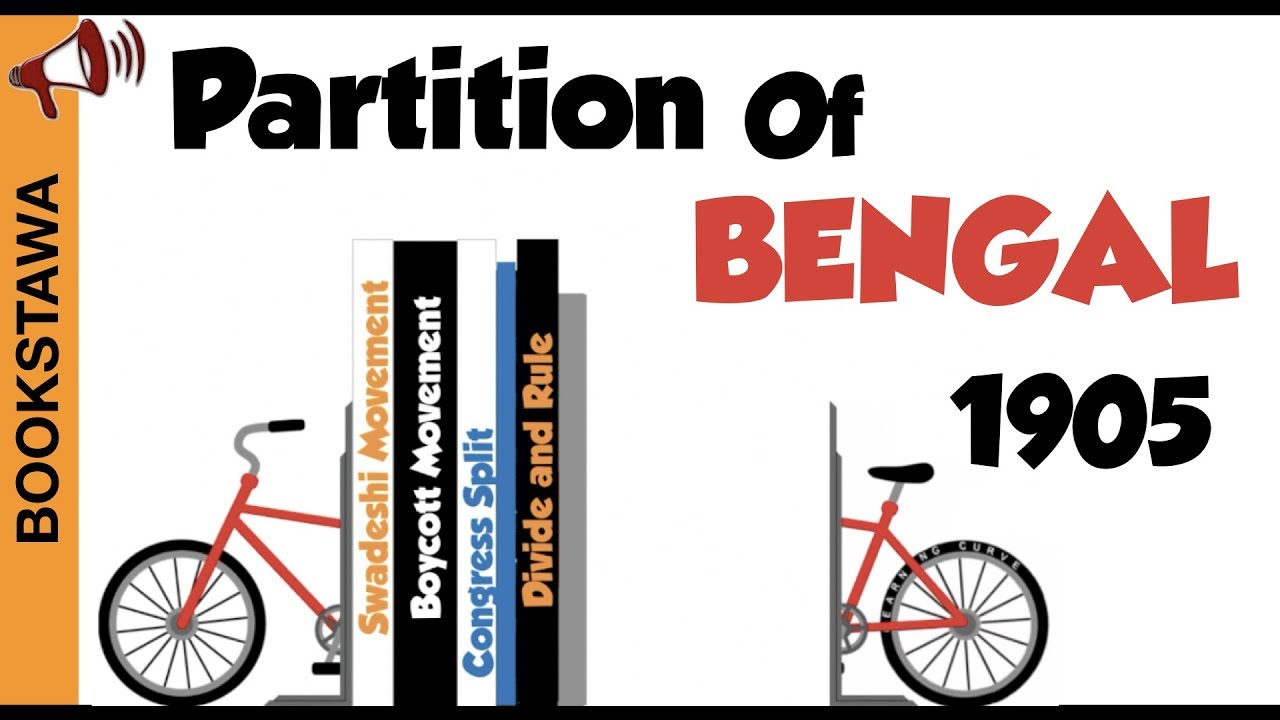
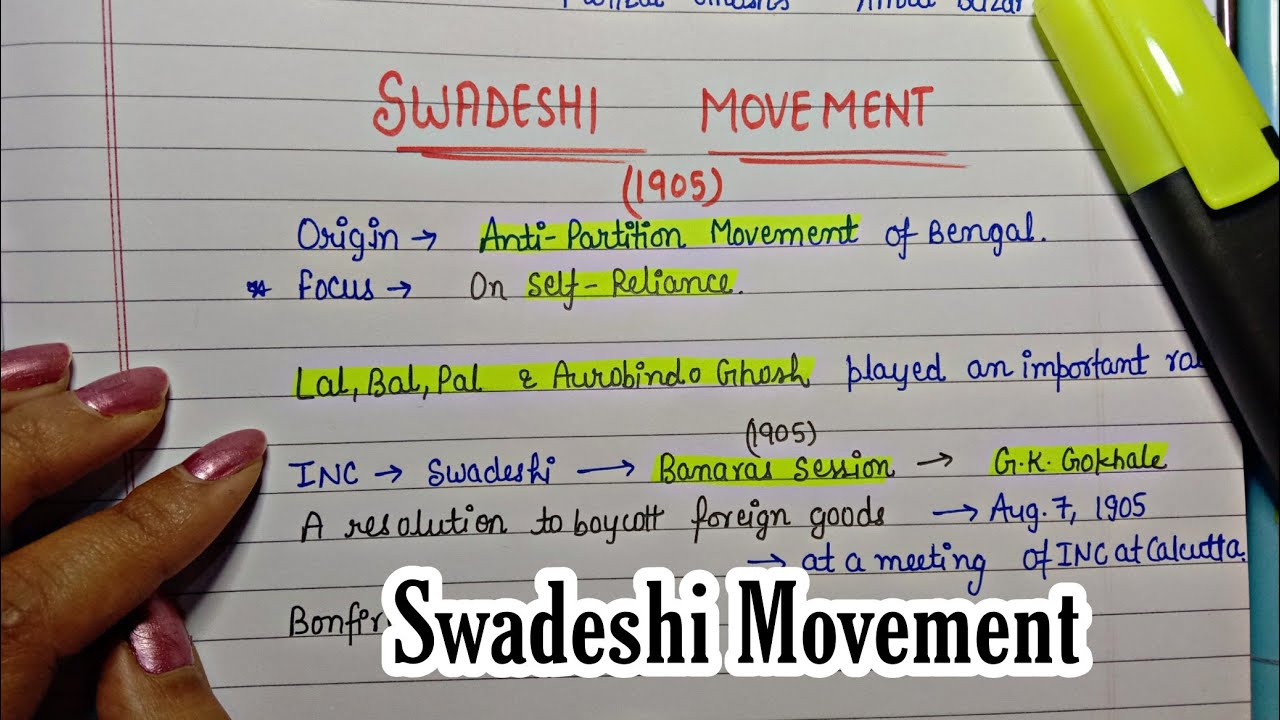
The Swadeshi and Boycott Movement, a key milestone in the Indian freedom struggle, started as a strong response to the British decision to partition Bengal in . This movement brought together large groups of the Indian population—including students, women, and workers—to stand against British rule using economic and political methods. For exams like UPSC, SSC, and other government tests, learning about this era is essential because it marks a shift from peaceful petitions to a powerful mass movement for Indian independence.
🎯 In this chapter, you will understand:
- How the partition of Bengal in sparked the Swadeshi Movement.
- The difference between early Moderate methods and later Militant Nationalist tactics.
- How students, women, workers, and leaders across India joined the protest.
- The long-term impact of Swadeshi (self-reliance) on India's struggle for freedom.
💡 Why this topic matters: It shows how ordinary people united to challenge colonial power through economic boycott and self-reliance.
🧠 Core Idea: Boycotting foreign goods and promoting Indian-made products created a strong sense of national unity and self-respect.
Genesis of the Swadeshi & Boycott Movement: The Partition of Bengal (1905)
The Swadeshi Movement was started because of strong public anger against the British government's choice to divide Bengal. The British Raj wanted to weaken growing national pride by breaking up the Bengali heartland. This was not just for simple administration, but a planned step to divide Indian unity in the early .
- (i) The partition plan was announced in . It aimed to form a new province called Eastern Bengal and Assam with its center at Dacca, while leaving a smaller province of Bengal centered at Calcutta.
- (ii) Lord Curzon's administration claimed the move was for "administrative convenience" to manage a huge population of , but the real purpose was to divide the Bengali population.
- (iii) The hidden plan was to weaken Bengali speakers, who were leading national awareness, by turning them into a minority and creating a religious divide between a Hindu-majority Western Bengal and a Muslim-majority Eastern Bengal.
Anti-Partition Campaign (1903–1905): The Peaceful Protest Movement
Before adopting stronger methods, the initial movement relied on the Moderate belief in legal requests, public speeches, and written petitions.

Moderate Leadership and Methods Against Partition
The early struggle was guided by educated leaders who believed they could persuade the British government through clear facts and logical appeals.
- (a) This peaceful campaign was led by respected leaders like Surendranath Banerjea, K.K. Mitra, and Prithwishchandra Ray.
- (b) Their working style was based on "Petitions, Prayers, and Protests." They organized large public meetings and used newspapers such as Hitabadi, Sanjibani, and Bengalee to inform people and send requests to the British Parliament in England.
The Era of Militant Nationalism (1905–1909): Swadeshi and Boycott Movement
When the British government ignored peaceful protests and officially carried out the partition in , the movement turned into a more active and assertive struggle.
Key Events & Spread of the Swadeshi Movement
Moving from petitions to an active Boycott was a major shift that directly hit the economic interests of British rule.
The spread of the Swadeshi Movement from Bengal to Maharashtra, Punjab, Delhi, and Madras. - (i) The movement was officially started on , at a big meeting in Calcutta Townhall, where people pledged to stop using foreign cloth from Manchester and salt from Liverpool.
- (ii) On , when partition took effect, people observed a day of mourning. They fasted, bathed in the holy Ganga, walked barefoot, and sang Rabindranath Tagore's patriotic song Amar Sonar Bangla.
- (iii) The Swadeshi message quickly spread beyond Bengal: Bal Gangadhar Tilak led the movement in Poona and Bombay, Lala Lajpat Rai and Ajit Singh in Punjab, Syed Haider Raza in Delhi, and Chidambaram Pillai in Madras.
Participation of Different Sections of Society in the Swadeshi Movement
A remarkable part of this movement was how it involved diverse groups, turning from an elite protest into a real mass struggle.
Students' Role in the Swadeshi & Boycott Movement
Young students became the primary force of the movement, spreading the message and encouraging people to boycott foreign goods.
- (i) Students actively stood outside shops selling foreign items across Bengal, Maharashtra, and South India (including Guntur and Salem) to discourage buyers.
- (ii) Even when British authorities issued strict orders like the Carlyle Circular to punish student protestors, their spirit remained strong.
Women's Participation in the Indian Freedom Struggle
Women stepped out of household seclusion to join public marches and protests, showing a big societal change.
- (a) For the first time, middle-class women joined street processions and picketing outside shops selling imported goods.
- (b) Their active involvement in set an example for future mass actions led by Mahatma Gandhi.
Muslims and the Swadeshi Movement
Muslim participation included both strong national support and challenges caused by British dividing policies.
- (i) Patriotic leaders like Barrister Abdul Rasul, Liaqat Hussain, and a young Maulana Azad actively supported Swadeshi.
- (ii) At the same time, the British government encouraged upper-class Muslim leaders to stay separate, which contributed to the founding of the Muslim League in .
Labour Unrest and Trade Union Movements
Workers also participated as economic boycotts led to strikes in foreign-owned businesses.
- (i) Major strikes in brought about early worker groups, such as the Railwaymen's Union.
- (ii) Leaders like Subramania Siva in Tuticorin and Ajit Singh in Rawalpindi helped organize factory workers for national goals.
⚡ Quick Revision Capsule: Swadeshi & Boycott Movement
A summary table covering key leaders, locations, and events of the movement:
| Region / Aspect | Key Leaders Involved | Main Actions / Highlights |
|---|---|---|
| Bengal | Surendranath Banerjea, Rabindranath Tagore, K.K. Mitra | Protest rallies, singing Amar Sonar Bangla, boycotting foreign textiles |
| Bombay & Poona | Bal Gangadhar Tilak | Organized Ganesh and Shivaji festivals to spread national awareness |
| Punjab | Lala Lajpat Rai, Ajit Singh | Mobilized peasants and industrial workers in Rawalpindi |
| Delhi | Syed Haider Raza | Led public meetings and advocated for local goods |
| Madras | Chidambaram Pillai, Subramania Siva | Founded the Swadeshi Steam Navigation Company in Tuticorin |
📝 Summary
The Swadeshi and Boycott Movement of was a major event that changed the path of the Indian freedom struggle. Even though the partition was not cancelled immediately, the movement shifted national strategy from small petitions to mass public action. It introduced self-reliance (Swadeshi) as a strong tool against foreign rule, led to the Surat Split in , and showed the true strength of united resistance.
🚀 Quick Revision Points
Essential facts to review before examinations:
- (i) Partition of Bengal was announced in and took effect on .
- (ii) The official boycott declaration happened on , at Calcutta Townhall.
- (iii) Key slogans included Vande Mataram and songs composed by Rabindranath Tagore.
- (iv) The movement encouraged domestic industries, national education boards, and native shipping companies.
- 💡 Exam Tip: Remember the regional leaders and their centers (e.g., Tilak in Bombay/Poona, Lajpat Rai in Punjab, Pillai in Madras) as these are frequently asked in matching-type questions.
❓ Frequently Asked Questions (FAQ)
Q1: When was the Swadeshi Movement officially declared?
A1: It was formally declared on , during a public meeting at Calcutta Townhall.Q2: What does the term Swadeshi mean?
A2: Swadeshi means "of one's own country." It emphasized using goods produced within India to build economic self-reliance.Q3: Who composed the song Amar Sonar Bangla during this movement?
A3: It was written by Rabindranath Tagore to inspire national unity during the anti-partition protests in .