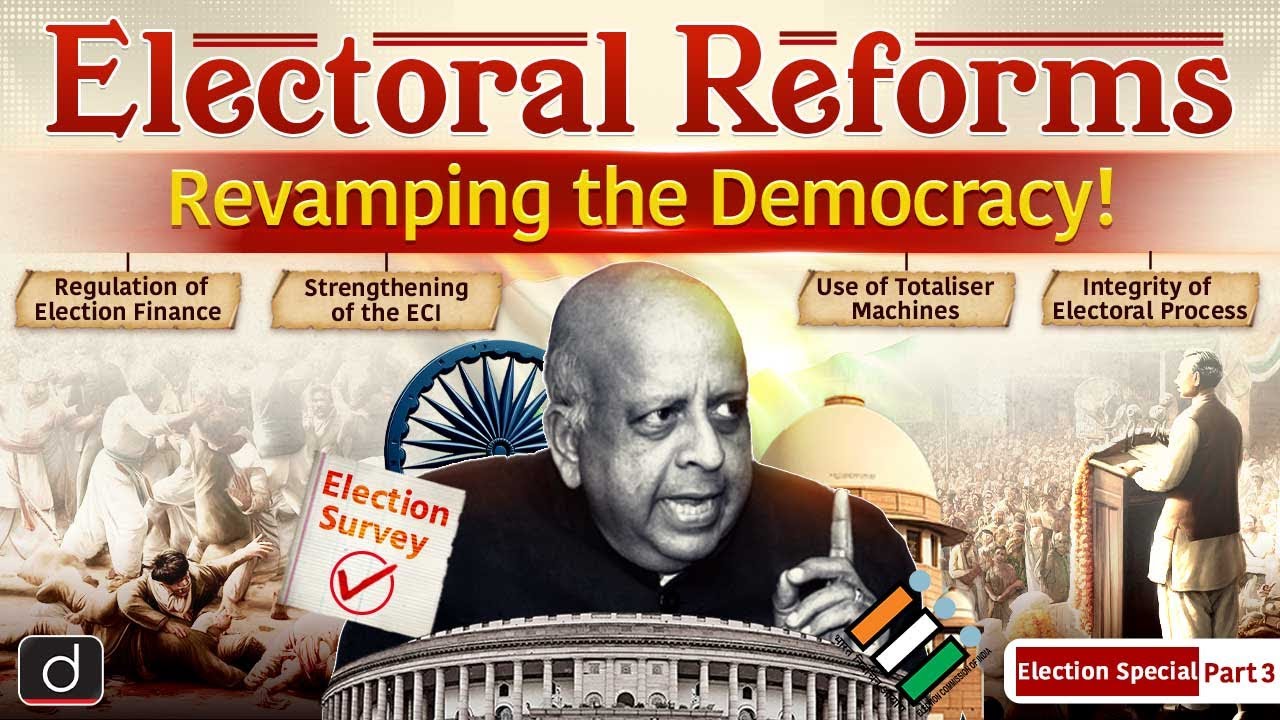
The evolution of electoral reforms since the late has fundamentally strengthened the democratic fabric of India, making the voting process more inclusive and secure through the 61st Constitutional Amendment Act and the 1996 reform package. For students and aspirants of Indian polity, understanding these shifts—from lowering the voting age to the implementation of Electronic Voting Machines (EVMs)—is essential for mastering the history of Dinesh Goswami Committee recommendations and modern election management.
🎯 In this chapter, you will understand:
- How the voting age was reduced from to to include youth in decisions.
- The transition from paper ballots to digital voting using Electronic Voting Machines (EVMs).
- Legal protections established to prevent booth capturing and bogus voting using EPIC cards.
- Key recommendations of the Dinesh Goswami Committee implemented during the electoral reforms.
💡 Why this topic matters: Electoral reforms transform how citizens choose their leaders. Knowing these legal changes helps us understand how elections in India became fair, efficient, organized, and accessible to every citizen.
🧠 Core Idea: Between and , India updated its election rules to allow younger voters, stop cheating at polling stations, introduce modern voting technology, and make sure elections run smoothly without unfair disruptions.
Electoral Reforms (–): Lowering Voting Age, EPIC, EVMs and Key Measures
The journey of modernizing India's democracy began with a bold move to empower the younger generation, ensuring their voices resonated in the decision-making process of the country. Lowering the voting age gave millions of young citizens the power to participate directly in national and state governance.
The Dawn of Youth Participation via the 61st Constitutional Amendment Act, 1988: This key constitutional change officially lowered the voting age across all national and state elections in India.
- (i) The voting age was reduced significantly from down to for all elections pertaining to the Lok Sabha and various State Legislative Assemblies.
- (ii) This landmark reform was specifically designed for bringing the massive youth demographic of the country into the active political process, allowing them to shape the nation's future through their franchise.
- (iii) The amendment recognized that citizens were mature enough to participate in the democratic selection of their representatives.
Ensuring Impartiality: Deputation of Electoral Roll Staff to the Election Commission
To maintain the sanctity of voter lists, a structural shift in personnel management was introduced during the late . Government staff working on election duties were officially placed under the direct authority of the independent election authority during election periods.
- (i) A critical rule was established stating that all officials and staff tasked with the preparation, revision, and correction of electoral rolls would be deemed to be on deputation to the Election Commission.
- (ii) Under this legal framework, these personnel function exclusively under the control, superintendence and discipline of the Election Commission, preventing local political interference in roll maintenance.
Filtering the Ballot: Increase in Number of Proposers to Discourage Frivolous Candidates
In an effort to streamline elections and ensure only serious contenders entered the fray, the official requirements for candidate nominations were tightened by requiring more supporters to sign the nomination papers.
- (i) For prestigious nominations to the Rajya Sabha and State Legislative Councils, the law increased the number of electors required to sign as proposers to ten per cent of electors of the constituency or ten electors, whichever is less.
- (ii) This threshold serves as a vital filter to discourage non-serious individuals from filing nominations, thereby reducing the clutter of frivolous candidates on the ballot.
The Technological Leap: Introduction and Early Use of Electronic Voting Machines (EVMs)
The transition from paper ballots to digital precision marked a new era in the efficiency and security of the Indian electoral system. Electronic voting made casting votes faster, made counting simple, and stopped paper ballot tampering.

- (i) Specific legal provisions were woven into the law to facilitate and legitimize the use of EVMs across various levels of elections.
- (ii) The first experimental use of these machines took place in , targeting selected constituencies during Assembly polls in Rajasthan, Madhya Pradesh, and Delhi.
- (iii) By , the state of Goa became a pioneer by using EVMs for its entire Assembly general election, proving the operational viability of the technology on a large scale.
Securing the Booth: Definitions and Legal Countermeasures Against Booth Capturing
To protect the integrity of the vote, the law was updated to provide strict responses to illegal seizures of the polling process. Strong punishments and immediate poll cancellations were introduced to stop lawbreakers from stealing votes.
- (i) Comprehensive provisions were added to allow for the adjournment of poll or the complete countermanding of an election should booth capturing be detected.
Legal Scope of Booth Capturing
The law defines booth capturing through several specific aggressive actions that undermine the democratic process:
- (a) The act of seizing a polling station and forcing the polling staff to surrender ballot papers or voting machines.
- (b) Physically occupying a polling station to permit only one's own supporters to cast votes while excluding others.
- (c) Using threats or violence to prevent legitimate electors from reaching the polling station to exercise their rights.
- (d) The illegal seizure of locations specifically designated for the counting of votes.
Verification and Identity: Electors’ Photo Identity Card (EPIC) Scheme
In the early , a massive administrative undertaking began to ensure that every voter could be uniquely identified at the polling booth. Providing photo identification stopped dishonest individuals from pretending to be someone else to cast fake votes.
- (i) In , the Election Commission launched a nationwide initiative to issue photo identity cards (EPIC) to curb the twin menaces of bogus voting and impersonation.
- (ii) The foundational basis for these cards is the electoral roll, which undergoes annual revision with serving as the qualifying date.
- (iii) Every Indian citizen who reaches the age of by the qualifying date is entitled to be entered into the roll and subsequently receive an EPIC.
- (iv) The issuance of EPICs is structured as an ongoing, continuous scheme to capture new voters and rectify previous omissions in the system.
The Reform Package: Legacy of the Dinesh Goswami Committee
Following the recommendations of the committee led by Dinesh Goswami, a series of transformative amendments were codified in to refine election procedures. These reforms systematically improved ballot designs, candidate qualifications, campaign rules, and safety near polling centers.
- (i) Historical Context: The Goswami Committee examined deep-seated electoral shortcomings, leading to several implementations in that remain in force today.
Categorization and Order of Candidates on Ballots
To provide clarity to voters, the reforms standardized how candidates appear on the ballot paper and official notices.
- (a) Candidates are strictly categorized into three tiers:
- (i) Candidates representing recognised political parties.
- (ii) Candidates representing registered-unrecognised political parties.
- (iii) Other independent candidates.
- (b) Within each tier, names are listed alphabetically, and the categories themselves always appear in the fixed order mentioned above.
- (a) Candidates are strictly categorized into three tiers:
Disqualification for Insults to National Honour
Upholding the dignity of national symbols became a prerequisite for those seeking to represent the people in government.
- (a) Any individual convicted of an offence under the Prevention of Insults to National Honour Act, 1971—including insults to the National Flag or the Constitution—is disqualified from contesting elections.
- (b) This disqualification remains in effect for a period of six years from the date of conviction.
Dry Days: Prohibition on the Sale of Liquor
To ensure a peaceful and sober voting environment, strict regulations were placed on the distribution of intoxicants during voting periods.
- (a) The sale or distribution of liquor in any public or private establishment within a polling area is prohibited for the leading up to the close of the poll.
- (b) Penalties for violation are severe, involving imprisonment for up to , a fine of up to , or both.
Standardizing Nominations: Proposer Requirements
The reforms differentiated the nomination process based on the political backing of the candidate.
- (a) If a candidate is not sponsored by a recognised party, their nomination must be subscribed by 10 registered electors of that constituency.
- (b) Conversely, a candidate from a recognised political party requires only one proposer to validate their nomination.
Revised Procedure Upon the Death of a Candidate
Modernizing the process ensured that the death of a candidate would no longer cause unnecessary and massive delays to the entire election.
- (a) Previously, a death resulted in an automatic countermanding; however, the reforms ended this practice to prevent stalling the democratic process.
- (b) If the deceased belonged to a recognised party, the party is given seven days to propose a replacement candidate.
Mandatory Time Limits for Holding By-Elections
To ensure that constituencies do not remain unrepresented for long periods, specific timeframes were established for filling vacancies.
- (a) By-elections must now be conducted within six months of a vacancy occurring in the House.
Exceptions to the Six-Month Rule
- (i) If the remaining term of the member is less than one year, a by-election is not mandatory.
- (ii) If the Election Commission and Central Government determine that holding an election within the window is not feasible due to specific certified difficulties.
Empowering Labor: Paid Holidays on Polling Day
The law was updated to ensure that the economic necessity of work does not prevent a citizen from casting their vote on election day.
- (a) All employees in any trade or business, including daily wagers, are legally entitled to a paid holiday on the day of the poll.
- (b) Failure by an employer to comply can lead to a fine of up to .
- (c) An exception exists if the employee's absence would cause "substantial loss" or "danger" in the specific line of work.
Limitations on Multi-Constituency Contesting
To prevent the logistical burden of multiple by-elections when one candidate wins in more than one area, candidate limits were imposed.
- (a) A candidate is prohibited from contesting from more than two Parliamentary or Assembly constituencies during a single general election.
- (b) These same restrictions apply to biennial elections and by-elections for the Rajya Sabha and State Legislative Councils.
Maintaining Peace: Prohibition on Arms Near Polling Stations
Security measures were bolstered to prevent intimidation and violence in the vicinity of the voting booths.
- (a) Carrying arms near a polling station is now a cognizable offence, carrying a penalty of up to in prison.
- (b) Weapons found in violation are confiscated, and the offender faces the cancellation of their arms licence.
- (c) Exemptions are strictly limited to authorized personnel like the Returning Officer, Presiding Officer, and the police on duty.
Streamlining the Campaign Window
The time allowed for active campaigning was shortened to increase election efficiency and reduce related costs.
- (a) The minimum gap between the last date of withdrawal and the date of the poll was reduced from 20 days to 14 days.
⚡ Quick Revision Capsule: Electoral Reforms Comparison
A quick comparison of key electoral reform measures introduced between and :
| Reform Feature | Key Standard / Limit | Primary Purpose |
|---|---|---|
| Voting Age Reduction | Lowered from to | Empower youth demographic participation |
| EVM Introduction | Tested in , full state in (Goa) | Modernize voting and ensure fast counting |
| EPIC Scheme | Launched in | Eliminate voter impersonation and bogus voting |
| Liquor Prohibition | before close of poll | Ensure peaceful, sober polling environment |
| By-Election Time Limit | Must hold within | Prevent long-term lack of representation |
| Multi-Seat Restriction | Maximum 2 constituencies per candidate | Reduce unnecessary by-elections |
| Campaign Period Gap | Reduced from to | Cut election expenses and logistical delay |
📝 Summary
These systemic electoral reforms implemented between and were pivotal in creating a transparent and robust voting mechanism in India. By following the Dinesh Goswami Committee suggestions, India successfully integrated Electronic Voting Machines (EVMs) and EPIC cards into its framework. For students, mastering these acts and the transition to a lower voting age provides a critical perspective on how India protects its democratic integrity against booth capturing and frivolous candidacies.
🚀 Quick Revision Points
Essential facts to review before examinations:
- (i) The 61st Constitutional Amendment Act, 1988 lowered the voting age to .
- (ii) EPIC photo ID cards were introduced in to combat voter impersonation.
- (iii) The Dinesh Goswami Committee (1990) laid the groundwork for major legal reforms.
- (iv) Candidates are restricted to contesting a maximum of two constituencies in any general election.
- 💡 Exam Tip: Remember that EVMs were first tested experimentally in in Rajasthan, Madhya Pradesh, and Delhi, and used for an entire state assembly election in Goa in .
❓ Frequently Asked Questions (FAQ)
Q1: Which constitutional amendment lowered the voting age in India?
A1: The 61st Constitutional Amendment Act, 1988 reduced the voting age from to .Q2: What is the maximum number of constituencies a candidate can contest in an election?
A2: Under the electoral reforms, a candidate can contest from a maximum of two parliamentary or assembly constituencies.Q3: What committee's recommendations formed the base for the 1996 electoral reform package?
A3: Recommendations from the Dinesh Goswami Committee formed the foundation for the electoral reforms package.