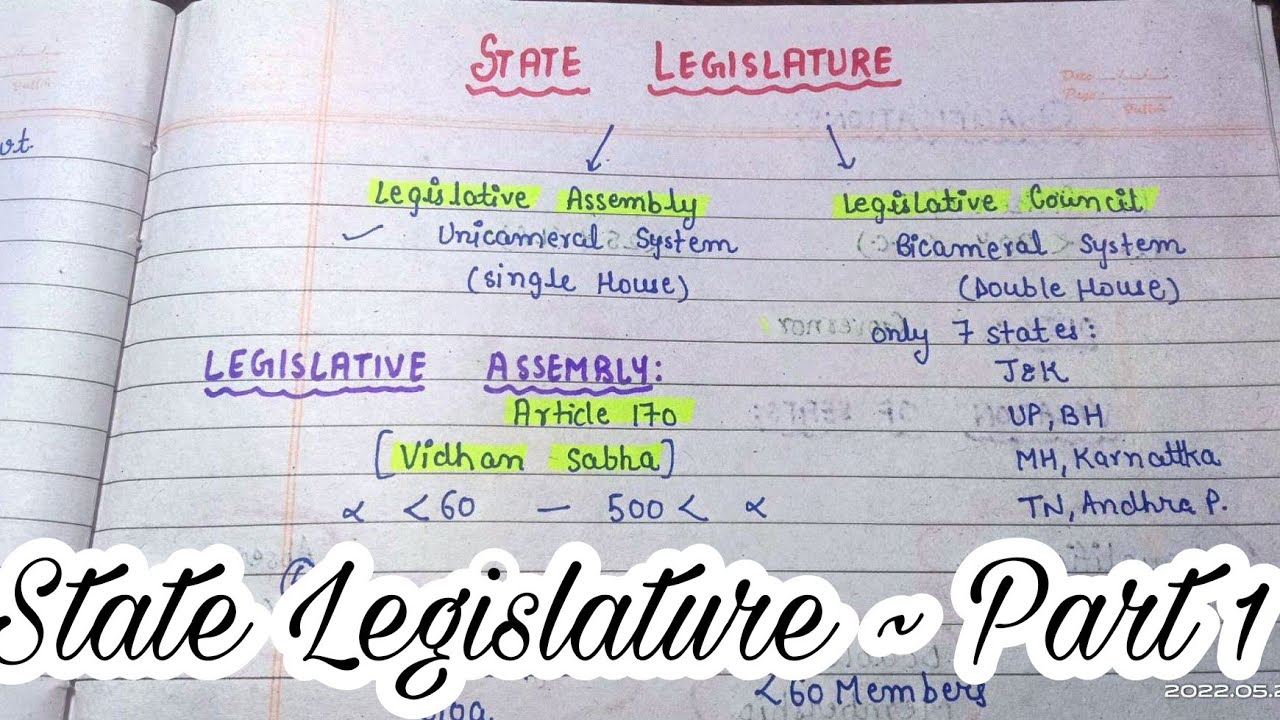
This comprehensive analysis explores the Constitutional Position of the State Legislative Council and explains how it works alongside the Legislative Assembly. In every state with a bicameral legislature, there are two houses: the Legislative Assembly, also called the Vidhan Sabha, and the Legislative Council, also called the Vidhan Parishad. The Assembly is directly elected by the people, while the Council is created to provide advice, review, and a second look at laws. Understanding where the two houses have equal powers, and where the Assembly clearly has more power, is essential for students preparing for Civil Services and State PSC exams, especially in Indian Polity and State Legislature Acts.
🎯 In this chapter, you will understand:
- The areas in which the State Legislative Council and Legislative Assembly have equal powers.
- Why the Legislative Assembly is more powerful in money matters, ordinary law-making, and control over the government.
- How the State Legislative Council differs from the Rajya Sabha.
- The main criticisms of the Council and the reasons why it can still be useful in state governance.
💡 Why this topic matters: The State Legislative Council is often called the Upper House of a state legislature, but it does not enjoy the same importance as the Rajya Sabha at the Centre. Knowing its limited powers helps students understand why the directly elected Assembly remains the real centre of power in a state and how the Constitution balances advice, review, and democratic control.
🧠 Core Idea: The State Legislative Council can take part in law-making, discussion, and review, but it cannot permanently block the will of the Legislative Assembly. Its position is therefore revisory and advisory rather than equal or supreme.
Constitutional Position of the State Legislative Council Compared to the Assembly
Delving into the intricate relationship between the two chambers of the State Legislature, we find a unique power dynamic. The operational authority of the State Legislative Council in relation to the Legislative Assembly is not uniform; it changes according to the type of law, the subject being discussed, and the kind of control being exercised over the government. In simple words, the Council is not always equal to the Assembly, and it is not always weaker either. Its strength depends on whether the matter is an ordinary bill, a money bill, the state budget, or the survival of the Council of Ministers.
To understand this relationship clearly, students should remember one basic principle: the Assembly represents the direct choice of the voters, so the Constitution gives it the final say in most important matters. The Council, on the other hand, is meant to add experience, expertise, and careful review to the legislative process. It can suggest changes, delay Bills for a limited period, and discuss public issues, but it usually cannot stop the Assembly from finally deciding an issue.
- (i) The narrative of state governance begins with the shared responsibilities of both houses in ordinary law-making.
- (ii) However, the story shifts significantly when financial matters and the survival of the government come into play.
- (iii) The following sections provide a detailed breakdown of these constitutional nuances for a better academic overview.
A. Spheres where the Council is Equal to the Assembly
In several administrative and legislative areas, the Council works almost hand-in-hand with the Assembly. In these matters, both houses can take part, express their views, and perform important functions. This does not mean that the Council can always force its decision on the Assembly, but it does mean that the Council is not completely excluded from these areas. Its participation helps ensure that laws and government actions receive more than one level of examination before they finally take effect.
Shared Legislative and Executive Functions
The State Legislative Council maintains a significant voice in the initiation of laws and the oversight of state-run institutions. This shared role creates a check-and-balance system. When both houses examine a proposal, report, or appointment-related matter, the chances of careless decisions becoming law are reduced. The Council can question policies, highlight practical problems, and bring specialised knowledge into the discussion.
- (i) Introduction and passage of ordinary bills: Both houses have the right to initiate non-money bills. This means that a normal Bill, which does not deal only with taxation, borrowing, or expenditure from the Consolidated Fund, may begin in either the Assembly or the Council. However, if a deadlock arises between the two houses, the Assembly’s decision prevails. The Council may delay the Bill, but it cannot permanently reject it.
- (ii) Approval of Ordinances: When the Governor issues an ordinance while the legislature is not in session, the ordinance has the same force as an Act for a temporary period. To continue as law, it must be approved by both houses when the legislature meets again. Thus, the Council has an equal role in deciding whether an ordinance should continue.
- (iii) Selection of Ministers: The Chief Minister and other Ministers can be chosen from either house. A Minister who is a member of the Council can still hold office and take part in government work. However, collective responsibility remains strictly to the Assembly. This means that the Council of Ministers must enjoy the confidence of the Assembly, not the Council.
- (iv) Reviewing Reports: Both houses discuss reports from the State Finance Commission, State Public Service Commission, and the Comptroller and Auditor General of India. These reports contain important information about public finance, recruitment, administration, and government auditing. Discussion in both houses helps bring such matters into public attention.
- (v) Jurisdiction Extension: Both houses must agree on matters relating to the extension of jurisdiction of the State Public Service Commission. This is an area where the Council’s consent is necessary, so its role is genuinely equal.
B. Spheres where the Council is Unequal to the Assembly
Despite being called the “Upper House,” the Council often finds itself in a weaker position compared with the Assembly. This happens because the Assembly is directly elected by the people and therefore carries the stronger democratic mandate. The Constitution deliberately gives the Assembly greater control over money, the budget, the Council of Ministers, and the final passage of Bills. The Council’s role is mainly to review, advise, and delay—not to overrule.
Financial Limitations and Money Bills
The field of state finance is almost entirely the domain of the Legislative Assembly. Money is at the heart of governance because taxes, government spending, loans, and budget allocations affect every citizen. For this reason, the Constitution keeps financial control mainly with the house that is directly elected by the people. The Council has very limited room to intervene in these matters.
- (i) Money Bill restrictions: A Money Bill can only be introduced in the Assembly. The Council is barred from initiating it. This ensures that proposals involving taxation, borrowing, or expenditure begin in the house most directly connected to the voters.
- (ii) Lack of veto power: The Council cannot amend or reject a Money Bill. It is obligated to return the Bill within . It may only make recommendations, which the Assembly may accept or reject.
- (iii) Assembly sovereignty: The Assembly can choose to ignore any recommendations made by the Council on financial matters. Even if the Council suggests changes, the Bill is still deemed passed by the Assembly in the form it approves.
- (iv) The Speaker’s word: The Speaker of the Assembly holds the final authority to certify whether a Bill qualifies as a Money Bill. Once the Speaker certifies it, that decision is final for the purposes of the legislative procedure.
Legislative Deadlocks and Budgetary Roles
In the standard legislative process, the Council functions more as a revisory body than a blocking one. Its purpose is to ensure that laws receive careful thought, not to stop the will of the people’s representatives indefinitely. This is why the Council can slow down a Bill only for a fixed period. After that period, the Assembly’s decision becomes final.
- (i) Passage of ordinary Bills: The Assembly holds the final word. The Council can delay an ordinary Bill for a maximum of : three months when the Bill is first sent to it, and one month if the Assembly passes it again and sends it back. After this, the Bill is deemed to have been passed by both houses in the form approved by the Assembly.
- (ii) Budgetary oversight: While the Council can discuss the annual budget, it is forbidden from voting on demands for grants. In other words, it may talk about how public money is being used, but it cannot approve or reject the financial demands of the government.
- (iii) Originating Bills: If an ordinary Bill originating in the Council is rejected by the Assembly, it dies immediately and becomes void. The Council cannot revive it or force the Assembly to reconsider it.
Political and Constitutional Constraints
The Council’s influence on the executive branch and broader constitutional processes is notably restricted compared with its lower-house counterpart. The Assembly can question ministers, pass a no-confidence motion, and ultimately decide whether the government continues in office. The Council can criticise and debate, but it cannot remove the government. Similarly, in elections and constitutional amendments, the Council’s role is either absent or limited.
Executive Accountability
- (i) The Council cannot pass a No-Confidence Motion. The Council of Ministers is responsible only to the Assembly. If the Assembly withdraws its support, the government must resign or seek a fresh mandate.
- (ii) The Council can only debate and criticise government policies. It can ask questions, highlight failures, and express public concern, but it does not have the power to topple the government.
Electoral and Amendment Exclusions
- (a) The Council is excluded from the election of the President of India. Only elected members of Parliament and elected members of State Legislative Assemblies take part in that election.
- (b) It has no role in electing Rajya Sabha representatives from the state. Those representatives are elected by the members of the State Legislative Assembly.
- (c) Regarding Constitutional Amendment Bills, the Council’s role is non-binding. The Assembly’s ratification, where required, is what counts for the amendment process.
- (d) Its very survival depends on the will of the Assembly. The Assembly can recommend the abolition of the Council to Parliament, and Parliament may then create or abolish the Council by law.
Council vs Rajya Sabha: A Comparison
A common misconception is that the Council is to the Assembly what the Rajya Sabha is to the Lok Sabha. The comparison looks natural because both are second chambers, but the reality is quite different. The Rajya Sabha has a much stronger constitutional position than the State Legislative Council. It represents the states in the federal structure of India and has important powers in ordinary legislation, constitutional amendments, and certain emergency-related matters.
The Weakness of the Second Chamber
The Legislative Council is far weaker than the Rajya Sabha. While the Rajya Sabha enjoys equal powers in almost all areas, except money matters, the Council remains subordinate in every respect. The Council cannot act as an equal partner in law-making because the Assembly can ultimately override its objections.
- (i) The Rajya Sabha represents federalism by giving states a voice in the Union Parliament. The Council does not perform the same federal role within a state.
- (ii) Heterogeneous composition: The Council is composed of various elected and nominated groups, including teachers, graduates, local-body members, and persons nominated by the Governor. This makes it less homogeneous than the Rajya Sabha.
- (iii) Democratic precedence: Following the British system, where the House of Commons is more powerful than the House of Lords, the Council is designed to yield to the popularly elected chamber.

Criticism and Utility of the Council
The existence of the Legislative Council is often a subject of intense debate among political scientists, lawmakers, and students of governance. Supporters say it improves the quality of law-making, while critics say it adds cost and delay without adding real power. Both views are important because they explain why some states have a Council and others do not.
Criticism as a “Secondary Chamber”
Many critics view the Council as an unnecessary expense or a “white elephant” in the state’s budget. They argue that if the Council cannot finally decide laws or control the government, its practical value may be limited. Critics also point out that maintaining a second house requires money for salaries, staff, buildings, and administrative expenses.
- (i) It is often labelled a costly ornamental body with no real power to stop the Assembly.
- (ii) It frequently serves as a refuge for defeated politicians, allowing them to enter the legislature or become Ministers without directly facing the electorate.
The Utility of Expert Scrutiny
Despite its flaws, the Council serves as a “house of elders” that brings a different perspective to the law-making process. It can include experienced administrators, teachers, graduates, and other professionals who may not wish to contest direct elections. Their experience can help improve the quality of debate and identify problems that may be missed in the Assembly.
- (i) Preventing hasty legislation: It acts as a brake on hasty, ill-considered legislation by providing an extra layer of debate before a Bill becomes law.
- (ii) Professional representation: It allows professionals and experts, nominated by the Governor, to contribute to governance without facing the pressures of direct elections.
⚡ Quick Revision Capsule: State Legislative Council vs Legislative Assembly
The table below gives a simple comparison of the main powers of the two houses. It is useful for quick revision before examinations, especially for questions on the State Legislature, Money Bills, and the position of the Vidhan Parishad.
| Area | Power of the Legislative Council | Power of the Legislative Assembly |
|---|---|---|
| Ordinary Bills | Can introduce, discuss, and delay ordinary Bills. | Has the final say; its decision prevails in a deadlock. |
| Money Bills | Cannot introduce, amend, or reject a Money Bill; must return it within . | Can introduce, amend, and finally pass Money Bills. |
| Budget | Can discuss the annual budget but cannot vote on demands for grants. | Can discuss and vote on demands for grants. |
| Council of Ministers | Can debate and criticise government policies. | Controls the government through collective responsibility and no-confidence motions. |
| Constitutional role | Has limited or non-binding participation in constitutional matters. | Plays the decisive role in elections and constitutional amendment procedures. |
📝 Summary
The relationship between the State Legislative Council and the Legislative Assembly highlights a deliberate constitutional design in which the popularly elected house holds supremacy. The Council can contribute to debate, review Bills, discuss reports, and provide a platform for experienced persons, but it cannot override the Assembly. Its power is limited by rules such as the rule for Money Bills and the maximum delay it can impose on ordinary Bills. This topic is vital for students to understand the checks and balances within state governance and the working of the State Legislature.
🚀 Quick Revision Points
Essential facts to review before examinations:
- (i) The Council can initiate ordinary Bills, but the Assembly’s decision is final if there is a deadlock.
- (ii) A Money Bill can be introduced only in the Assembly and must be returned by the Council within .
- (iii) The Council can discuss the budget but cannot vote on demands for grants.
- (iv) The Council is weaker than the Rajya Sabha and does not represent federalism in the same way.
- (v) The Council cannot remove the Council of Ministers because the government is responsible only to the Assembly.
- (vi) The Assembly can recommend the abolition of the Council to Parliament.
- 💡 Exam Tip: Remember the phrase “delay, discuss, but not decide.” The Council may delay ordinary Bills for up to four months and discuss money matters, but the Assembly has the final authority in nearly every important case.
❓ Frequently Asked Questions (FAQ)
Q1: Can the State Legislative Council reject a Money Bill?
A1: No. The Council cannot reject or amend a Money Bill. It can only make recommendations and must return the Bill to the Assembly within .Q2: Why is the Legislative Assembly more powerful than the Legislative Council?
A2: The Assembly is directly elected by the people, so it has a stronger democratic mandate. It controls money Bills, the budget, and the Council of Ministers, and its decision prevails in ordinary legislative deadlocks.Q3: Is the State Legislative Council equal to the Rajya Sabha?
A3: No. The Rajya Sabha has much stronger powers and represents federalism at the national level. The Council is subordinate to the State Legislative Assembly in every important respect.