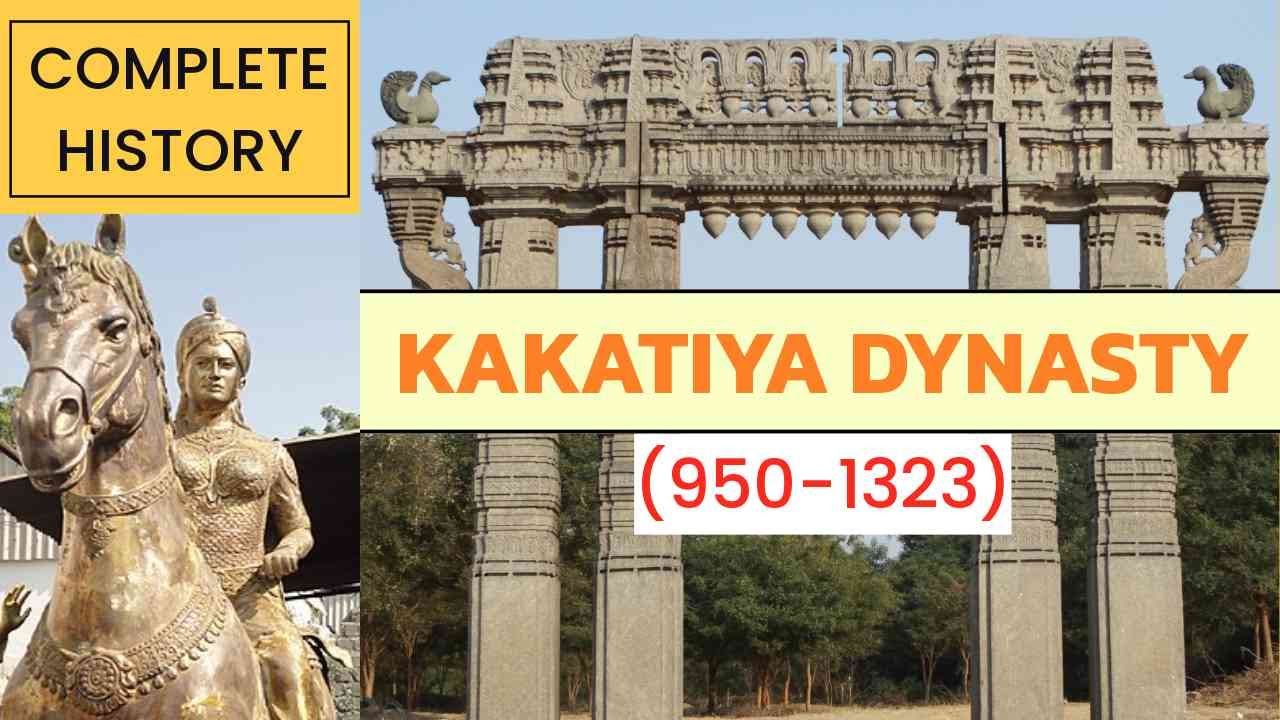
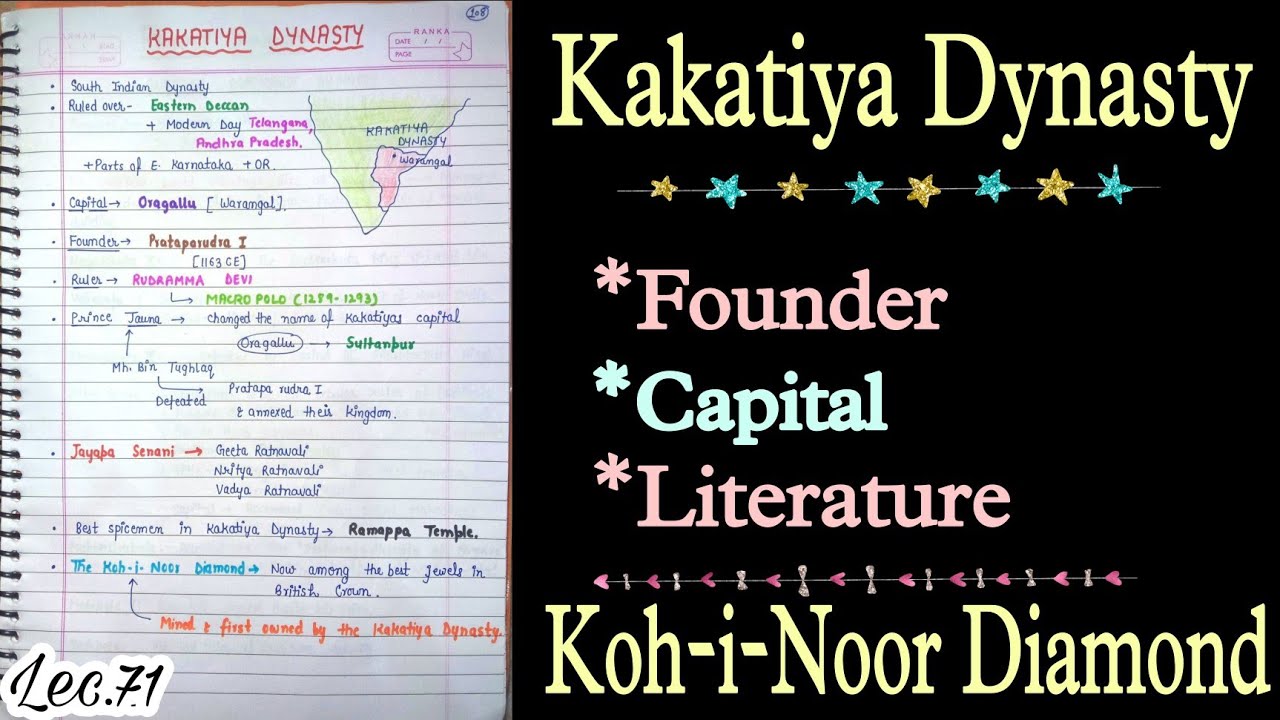
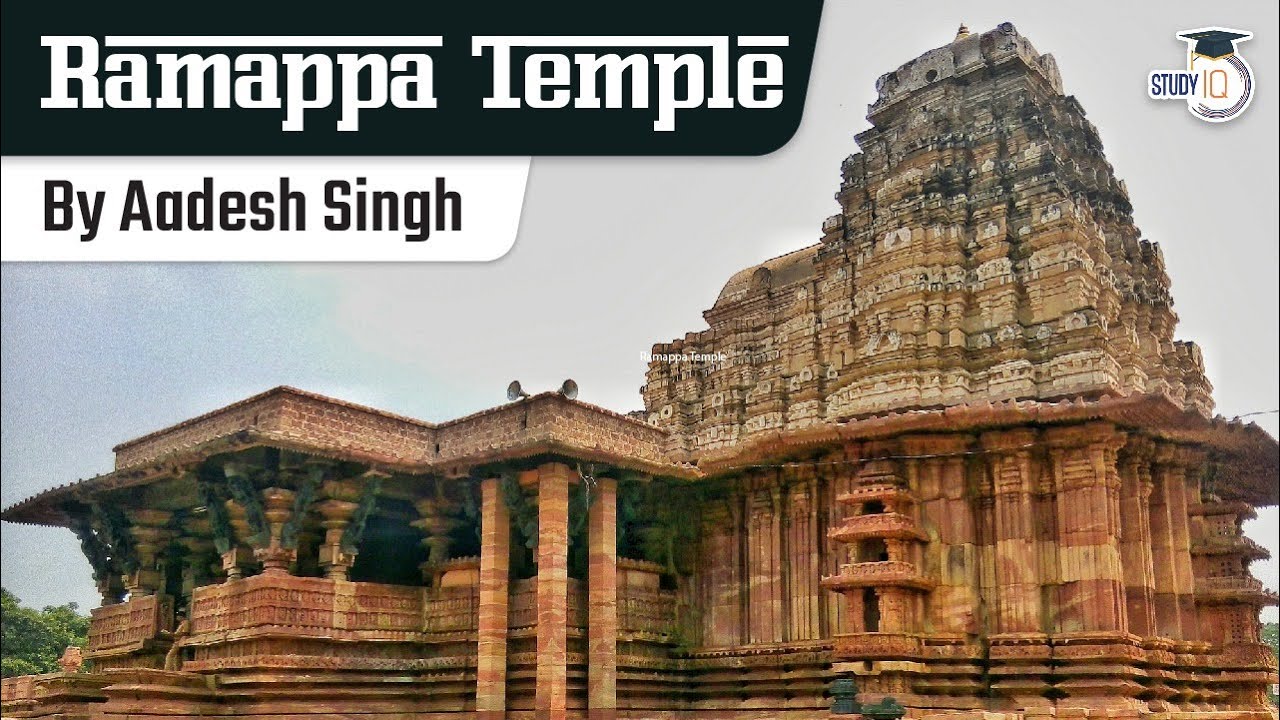
The Kakatiya dynasty forms a crucial chapter in the medieval history of Southern India, particularly in the Andhra and Telangana regions. Rising from modest origins as regional subordinates in the town of Kakati, these rulers initially served major powers like the Rashtrakutas and the Western Chalukyas of Kalyani. Over time, through exceptional military service and strategic maneuvers, they established a fully sovereign state in AD 1158 under Rudradeva. The dynasty is famous for its administrative efficiency, the innovative Nayamkara military system, a shift toward merit-based leadership over rigid caste lines, and groundbreaking governance exemplified by Rudramadevi, the first woman ruler of Andhra. Their rule transformed regional politics, unified Telugu-speaking territories, and established Warangal as a premier center of power until the final invasion by the Delhi Sultanate in AD 1323.
In this chapter, you will understand:
- The geographic origins, family name epigraphy, and dual religious devotion of the Kakatiyas.
- The step-by-step political evolution from feudatories (Mahamandalesvaras) to a sovereign empire.
- The structure of Kakatiya polity, decentralized governance, and the military Nayamkara system.
- Social mobility, meritocratic leadership among Sudras, and the favorable status of women during this era.
Why this topic matters: Understanding the Kakatiyas is essential for mastering medieval Indian history, state-formation models, regional military innovation, and social mobility dynamics in Deccan polity.
Core Idea: Starting as loyal military commanders and regional governors under imperial powers, the Kakatiyas seized political vacuums to build a unified, sovereign state. Their legacy rests on military fort design, decentralized administration, flexible caste mobility based on personal capability, and memorable leadership under rulers like Ganapatideva and Rudramadevi.
Geographic Spread, Origin, and Early Figures
The identity of the Kakatiyas is deeply tied to their original seat of governance and their early service as valiant military officers under regional suzerains.
Geographic Spread, Origin, and Religious Practices of the Kakatiyas
The name 'Kakatiya' is directly linked to their earliest seat of power, a significant town called Kakati, while their worship practices centered on both a regional goddess and a major Hindu deity.

Kakatiya Dynasty Map - Territorial Extent and Influence of the Kakatiya Empire Epigraphical Evidence on the Origin of the Kakatiya Family Name
The historical records, particularly the revealing Bayyaram tank epigraph, confirm that Venna was the earliest known patriarch of the lineage. He ruled from the town of Kakati, and it was from this significant settlement that his descendants derived their unique family name, thereby being referred to as the Kakatiyas. Multiple inscriptions universally describe them as the Lords of Kakatipura, unequivocally suggesting that Kakati was the pivotal geographic source of their dynastic identity.
- (i) The primary evidence for the dynasty's origin comes from the Bayyaram tank epigraph, which names Venna as the first ruler from Kakati.
- (ii) The title Lords of Kakatipura is frequently mentioned in various inscriptions, reinforcing the importance of the town Kakati.
Religious Devotion to Goddess Kakati and Lord Siva
The literary text Prataparudrayasobhushana, authored by Vidyanatha, sheds light on the Kakatiyas' religious loyalty, asserting that they were staunch devotees of the goddess Kakati, and thus derived their dynastic name from her. In parallel, their religious syncretism is evident in their profound reverence for Svayambhudeva, which is a revered indigenous form of Lord Siva, making them patrons of both Shaktism and Shaivism in the region.
- (a) Literary sources confirm the dynasty's dedication to the goddess Kakati, linking their name to the deity.
- (b) They were also ardent worshippers of Svayambhudeva, a manifestation of Lord Siva, demonstrating a dual religious focus.
Early Kakatiya Figures: Subordinate Status and Recognition
The initial phase of the Kakatiyas' history is marked by their service and valor as subordinates, which gradually elevated their family's standing.
Gundaya Rashtrakuta: A Heroic Commander
The earliest figure to gain significant historical mention was Gundaya Rashtrakuta. His name is importantly recorded in the Mangallu inscription of Danarnava. Gundaya served loyally as a commander under the mighty Rashtrakuta Krishna II, ultimately meeting a heroic death while fighting valiantly against the rival Eastern Chalukyas in a major conflict, thereby establishing a precedent of military service for the family.
- (i) Gundaya Rashtrakuta is the earliest significant figure, documented in the Mangallu inscription.
- (ii) He served as a commander under Rashtrakuta Krishna II and died in battle against the Eastern Chalukyas.
Ereya: Reward and Governorship
In recognition of Gundaya's profound valor and supreme sacrifice, Krishna II duly rewarded his son, Ereya, with the governorship of the Korivi region. This strategic recognition was a pivotal moment, as it significantly elevated the family's status and provided the necessary foundation for their subsequent independent and sovereign rule, making the Korivi region their initial power base.
- (a) Due to Gundaya's heroism, his son Ereya was granted the governorship of the Korivi region.
- (b) This marked the crucial beginning of the family's rise in political influence and administrative status.
Transition to Sovereignty and Key Rulers
After serving for centuries as local subordinates and feudatories, the Kakatiyas transformed into an independent empire during a period of imperial decline in the Deccan.
Transition to Sovereignty: From Feudatory to Independent Rule
The Kakatiyas spent a prolonged period as powerful subordinates before seizing the opportunity to establish themselves as a fully sovereign state.
Kakatiyas as Subordinates and Mahamandalesvaras
During the 9th and 10th centuries, the early Kakatiyas functioned as key subordinates under the dominant Rashtrakutas. Following the decline and subsequent downfall of the Rashtrakuta Empire, they strategically shifted their allegiance, becoming influential feudatories or Mahamandalesvaras under the ascendant Western Chalukyas of Kalyani. Several prominent Kakatiya leaders, including Beta I, Prola I, Beta II, and Prola II, dutifully served under powerful Western Chalukyan emperors like Somesvara I, Vikramaditya VI, Somesvara III, and Jagadekamalla II.
- (i) Initially served the Rashtrakutas during the 9th and 10th centuries.
- (ii) Subsequently became Mahamandalesvaras (feudatories) under the Western Chalukyas of Kalyani.
Rudradeva: Declaration of Independence and Major Victories
The moment for change arrived with the collapse of the Western Chalukyas during the reign of Tailapa III. The visionary Rudradeva, son of Prola II, seized this crucial political vacuum and audaciously declared the dynasty's complete independence in AD 1158. This decisive act marked the beginning of the Kakatiya rule as a fully sovereign power. Ruling from AD 1158 to 1195, Rudradeva is rightly regarded as the true founder of the sovereign Kakatiya lineage, though his successful expansion was eventually checked by the Yadavas of Devagiri.
- (a) Rudradeva declared independence in AD 1158 following the fall of the Western Chalukyas, becoming the founder of the sovereign dynasty.
- (b) The Hanumakonda epigraph (AD 1162) details his victories, including the conquest of coastal Andhra by defeating the Velanaticholas.
- (c) Historical accounts like Jalhana’s Suktimuktavali confirm his eventual defeat by the powerful Yadavas of Devagiri.
Mahadeva: Succession and Political Instability
Lacking a male heir, Rudradeva was succeeded by his brother, Mahadeva, who ruled for a short but challenging period from AD 1195 to 1198-99. Unfortunately, Mahadeva met his end in a fierce battle against the Yadava king Jaitugi. This defeat led to the capture of his successor, Ganapatideva, by the Yadavas. In this critical period of political vacuum and instability, the strong and loyal commander-in-chief, Recharla Rudra, played an indispensable role in maintaining the cohesion of the kingdom until Ganapatideva was eventually released from captivity and could assume the throne.
- (i) Mahadeva succeeded his brother Rudradeva but was defeated and killed by the Yadava king Jaitugi.
- (ii) The subsequent capture of his son Ganapatideva caused a crisis, which was managed by the commander-in-chief Recharla Rudra.
Ganapatideva: Golden Era of Unification and Capital Shift
Reigning from AD 1199 to 1262, the rule of Ganapatideva is celebrated as a golden era for the Kakatiya Empire. He overcame the initial challenges, significantly expanding the kingdom by defeating the Velanati chief Prithviswera and aiding Manumasiddhi to regain the throne of Nellore. However, not all campaigns were successful; his efforts to conquer Kalinga failed, and the defense of Nellore against Jatavarma Sundara Pandya was unsuccessful, leading to the Pandya's coronation at Nellore and Kanchi. His most enduring and strategic achievement was the unification of the entire Telugu-speaking regions and the crucial move of the capital from Hanumankonda to the strategically superior city of Warangal.
- (a) Ruled from AD 1199 to 1262, marking the peak of the dynasty's power.
- (b) Key achievements include defeating Prithviswera and aiding Manumasiddhi, though he failed against Kalinga and Jatavarma Sundara Pandya.
- (c) He is credited with the unification of Telugu-speaking regions and the pivotal shift of the capital to Warangal.
Rudramadevi: The First Woman Ruler of Andhra
In a revolutionary move, the great Ganapatideva, lacking a male heir, appointed his eldest daughter, the formidable Rudramadevi, as his co-regent from AD 1260 to 1262. She officially ascended the throne in AD 1262 and ruled until AD 1289, carving a place in history as the first woman ruler of the Andhra region. Demonstrating exceptional military acumen, Rudramadevi successfully repelled recurrent Yadava attacks and even managed to expand her control as far as Devagiri, as attested by the Bidar epigraph. Tragically, the Chandupatla epigraph records that both Rudramadevi and her loyal general Mallikarjuna met their end in a decisive battle against the rebel leader Kayasta Ambadeva.
- (i) Appointed co-regent (AD 1260-1262) and ruled independently from AD 1262 to 1289, becoming the first woman ruler of the region.
- (ii) Successfully defended against Yadava incursions and expanded territory up to Devagiri.
- (iii) The Chandupatla epigraph details her death in battle against the rebel Kayasta Ambadeva.
Prataparudra: The Final Ruler and the Delhi Sultanate Invasion
Following his grandmother, Rudramadevi, the grandson Prataparudradeva took the throne, ruling from AD 1289 to 1323. He commendably restored the dynasty's prestige by decisively defeating the rebel Kayashta Ambadeva and his Yadava allies. However, his reign coincided with the rising power of the Delhi Sultans, who launched multiple invasions into South India under Alauddin Khilji and later Muhammad bin Tughluq. The inevitable end came in AD 1323 when Prataparudra was defeated by the armies of Muhammad bin Tughluq, marking the final, definitive fall of the Kakatiya dynasty.
- (a) Ruled from AD 1289 to 1323, restoring prestige by defeating Kayashta Ambadeva.
- (b) Faced successive invasions from the Delhi Sultans (Alauddin Khilji and Muhammad bin Tughluq).
- (c) The dynasty ended in AD 1323 with his defeat by Muhammad bin Tughluq’s forces.
Polity, Military Strategy, and Social Structure
The Kakatiyas created a unique political framework that blended decentralized administration with a meritocratic social hierarchy and specialized military defense.
Kakatiya Polity: Administration and Military Strategy
The political structure of the Kakatiyas was a monarchical system, tempered by a strategic degree of decentralization and supported by an innovative military framework.
Monarchy and Succession by Primogeniture
The foundation of the Kakatiya polity was the monarchical system, where the ruler held the ultimate, supreme authority. Crucially, this system was not a rigid, absolute autocracy but allowed for delegated power. Succession generally adhered to the law of primogeniture (succession by the eldest son), with the notable and significant exception being the groundbreaking reign of Rudramadevi, which demonstrated a capacity for merit-based exceptions in leadership.
- (i) The polity was a monarchical system with the ruler holding supreme, but not absolute, power.
- (ii) Succession typically followed the law of primogeniture, with Rudramadevi being a celebrated exception.
Decentralized Governance and Political Theories
A key characteristic of the Kakatiya political system was its significant level of decentralization. The rulers deliberately shared power with subordinates, who enjoyed autonomy in local governance (excluding military affairs). Historian P.V. Prabrahma Sastry noted that this structure successfully prevented an unhealthy excessive concentration of power in the capital. Modern interpretations of the Kakatiya state are varied, with some scholars proposing a feudal system based on a warrior elite and agrarian links, while others, like Burton Stein, suggested a segmentary state model. However, Cynthia Talbot rejected the segmentary model, proposing the region be viewed as a fluctuating political network where power dynamics were governed by personal loyalties, fitting Weber’s patrimonial model more closely.
- (a) Decentralization was a core feature, sharing power with subordinates to prevent concentration.
- (b) Scholars debate whether it was a feudal system or a segmentary state (rejected by Talbot).
- (c) Cynthia Talbot suggests the state functioned as a fluctuating political network based on personal, loyal power relations.
Administrative Organization: Council and Territorial Units
The administration was meticulously structured. The central government saw the ruler assisted by a council of ministers and specialized officials. The kingdom was logically divided into various territorial units for effective local governance. These units, in descending order, included Mandala, Nadu, Sthala, Seema, and Bhumi, all overseen by loyal and appointed officials, ensuring systematic rule from the capital to the local level.

Administrative Hierarchy of Territorial Divisions in the Kakatiya Empire - (i) The ruler was aided by a council of ministers and officials at central and provincial levels.
- (ii) Territorial divisions included Mandala, Nadu, Sthala, Seema, and Bhumi, managed by loyal officials.
Nayamkara System and Military Structure
The formidable military power of the Kakatiyas was based on the innovative Nayamkara system. Under this pivotal structure, military chiefs known as Nayaks were granted territorial fiefs (jagirs) in return for maintaining and leading stipulated military forces. The size of these forces, which included soldiers, horses, and elephants, was directly proportional to the economic value of the assigned fief. Alongside these Nayak forces, the dynasty maintained a professional standing army under commanders directly accountable to the central ruler. Furthermore, forts were strategically critical, categorized into Giridurgas (Hill Forts like Warangal), Vanadurgas (Forest Forts), Jaladurgas (Water Forts), and Sthaladurgas (Land Forts like Warangal), underscoring the dynasty's focus on military strategy and fortification. Cynthia Talbot highlights the fostering of a martial ethos and the strategic patronizing of warrior chiefs as key to their rapid territorial expansion.
- (a) The military was organized around the Nayamkara system, where Nayaks held fiefs (jagirs) for maintaining troops.
- (b) A standing army was maintained in addition to the Nayak forces.
- (c) Forts were vital, categorized as Giridurgas (Hill), Vanadurgas (Forest), Jaladurgas (Water), and Sthaladurgas (Land).
Kakatiya Society: Social Structure, Mobility, and Women's Status
Kakatiya society exhibited a complex structure that was traditionally varna-based but demonstrated a high degree of social mobility and meritocracy in practice.
Varna Division and Merit-Based Leadership
Ostensibly, society was structured on the traditional four Varnas: Brahman, Kshatriya, Vaisya, and Sudra. However, the system was evolving. Sub-castes emerged among Brahmins, who held influential roles as scholars, teachers, commanders (Dandanayakas), and ministers (Amatyas). Crucially, the Sudras gained remarkable prominence, establishing themselves as a powerful new political elite. The key insight of the era was that rulership was no longer exclusively restricted to Kshatriyas; instead, merit and capability in military and administrative roles became the primary determinants of leadership and social status.
- (i) Society was nominally divided into the four Varnas, with Brahmins taking on both priestly and administrative/military roles.
- (ii) Sudras rose to prominence, indicating that rulership was determined by merit and capability rather than strict caste lineage.
Challenging Static Caste Models
While traditional historians often emphasize a rigid, caste-based organization dictated by Brahmanical Dharma, this view is strongly contested by modern research. Historian Cynthia Talbot argues against a static caste-based society, noting that epigraphs show surprisingly little evidence of rigid Varna or Jati classifications. Instead, individual and community identities were frequently established through powerful familial, local, and occupational ties. The inscriptions themselves recognized Sudras as brave and capable rulers, confirming that individual merit in military and administration was the true driving force behind social status.
- (a) Traditional views of a static, caste-based society are challenged by modern historians like Cynthia Talbot.
- (b) Identities were often determined by familial, local, and occupational ties rather than strict Varna.
- (c) Epigraphs confirmed the high status of Sudras who excelled in military and administrative roles.
Status of Women in Kakatiya Society
The position of women during the Kakatiya period appears to have been notably favorable. Women held significant societal roles, often making substantial donations to temples, and were recognized through their familial relationships as wives or daughters of important men. They possessed valuable property rights, including the right to Stridhana (woman's property). Even some temple women (Gudisanis) were the daughters of respected community figures like Nayakas and Settis, and, importantly, marriage was not prohibited for them. Cynthia Talbot concludes that the overall condition of women during the Kakatiya period was likely far better than what is traditionally assumed for medieval Indian society.
- (i) Women held significant roles, made temple donations, and possessed Stridhana property rights.
- (ii) The position of women, including certain temple women (Gudisanis), was likely better than in many contemporary societies.
Quick Revision Capsule: Kakatiya Rulers & Key Historical Milestones
A structured chronological breakdown of key Kakatiya monarchs, their reign periods, and major contributions:
| Ruler / Figure | Reign / Period | Core Historical Significance |
|---|---|---|
| Venna & Gundaya Rashtrakuta | Early Phase (9th-10th Cent.) | Venna established rule from Kakati. Gundaya died heroically serving Krishna II; his son Ereya got the Korivi governorship. |
| Rudradeva | AD 1158 – 1195 | Declared independence in AD 1158. Issued Hanumakonda epigraph (1162); defeated Velanaticholas; defeated by Yadavas. |
| Ganapatideva | AD 1199 – 1262 | Golden era of power; unified Telugu regions; shifted capital from Hanumankonda to Warangal. |
| Rudramadevi | AD 1262 – 1289 | First woman ruler of Andhra (co-regent 1260-1262). Repelled Yadavas; died fighting Kayasta Ambadeva (Chandupatla epigraph). |
| Prataparudra | AD 1289 – 1323 | Restored stability; defeated Ambadeva; fell in AD 1323 to Muhammad bin Tughluq, marking the dynasty's end. |
Summary
The Kakatiya dynasty evolved from regional officers in Kakati into the supreme power of the Andhra and Telangana regions. Founded as a sovereign kingdom by Rudradeva in AD 1158, the state achieved territorial and cultural synthesis under Ganapatideva, who relocated the capital to Warangal. The period broke away from rigid caste orthopraxy by permitting meritocratic ascension for Sudra military leaders and recognizing property rights (Stridhana) for women under iconic leaders like Rudramadevi. Supported by a military apparatus of four fort types and the land-grant Nayamkara system, the kingdom eventually succumbed to Delhi Sultanate invasions under Muhammad bin Tughluq in AD 1323.
Quick Revision Points
Key facts to memorize for examinations:
- (i) The patriarch Venna ruled from Kakati (recorded in Bayyaram tank epigraph), while religious roots trace to Goddess Kakati and Svayambhudeva (Siva).
- (ii) Sovereign state status was achieved in AD 1158 by Rudradeva; capital shifted to Warangal under Ganapatideva.
- (iii) Military administration functioned via the Nayamkara system (Nayaks holding jagirs) and 4 fort classifications (Giridurga, Vanadurga, Jaladurga, Sthaladurga).
- (iv) Rudramadevi was the first woman ruler of Andhra; the dynasty fell in AD 1323 under Prataparudra.
- Exam Tip: Pay special attention to primary inscriptions: Bayyaram tank epigraph (origins), Hanumakonda epigraph (Rudradeva's victories), Bidar epigraph (Rudramadevi's expansion), and Chandupatla epigraph (Rudramadevi's death against Kayasta Ambadeva). Also remember that Cynthia Talbot describes Kakatiya polity as a fluctuating political network rather than a static segmentary state.
Frequently Asked Questions (FAQ)
Q1: What is the significance of the Bayyaram tank epigraph?
A1: The Bayyaram tank epigraph is the primary inscription confirming that Venna was the earliest known patriarch of the Kakatiya lineage ruling from Kakati, proving the geographic origin of their family name.Q2: How did the Nayamkara system operate under Kakatiya rule?
A2: Under the Nayamkara system, military leaders called Nayaks were assigned land fiefs (jagirs). In return, they maintained a specified contingent of troops, cavalry, and elephants proportional to the fief's yield for imperial defense.Q3: Who was the final ruler of the Kakatiya dynasty and how did it end?
A3: The final ruler was Prataparudra (ruled AD 1289–1323). The dynasty came to an end in AD 1323 after his defeat by the forces of the Delhi Sultanate under Muhammad bin Tughluq.