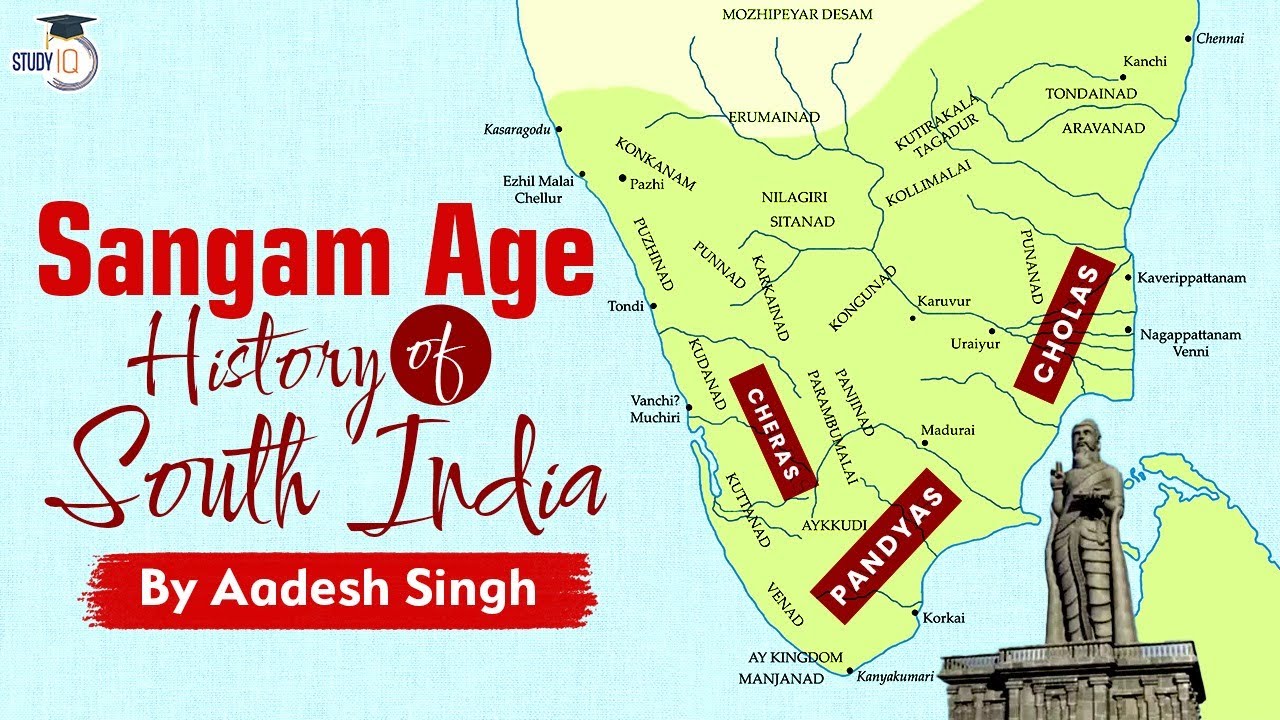
The classical literature of ancient Tamil Nadu, widely known as Sangam literature, provides a detailed reflection of early South Indian society, state formation, and cultural exchange. Through thousands of verses composed by diverse poets, these texts capture a dynamic world where local chieftaincies evolved into structured kingdoms. The poems reveal how political leaders used grand religious ceremonies to solidify their authority, how trade routes linked southern ports with far-off empires, and how war shaped the ethics of kingship. Understanding these works helps us look beyond political timelines and see how culture, geography, and governance interacted across the ancient Indian subcontinent.
In this chapter, you will understand:
- The role of Vedic sacrifices in legitimizing royal power in ancient Tamil Nadu
- Geographical awareness and historical references to northern empires like the Nandas and Mauryas
- The heroic tradition, famous battlefields, and moral codes governing Sangam warfare
- Socio-economic structures, long-distance maritime trade, and the eventual codification of Tamil poetry
Why this topic matters: This material offers direct primary source evidence of ancient state building, cultural synthesis between North and South India, and early maritime trade. It forms an essential foundation for historical analysis and competitive examination preparation.
Core Idea: Classical Tamil literature records a vibrant society where Chera, Chola, and Pandya rulers legitimized their authority through Vedic rituals and heroic warfare. The poetry combines detailed geographical knowledge of distant regions with vivid depictions of daily life, economic trade, and deep artistic patronage.
Vedic Rituals and Legitimization of Power in Ancient Tamil Nadu
The performance of Vedic sacrifices became a prominent feature in the Tamil region, primarily driven by contact with northern India and the migration of the Brahmanas, serving as a powerful tool for royal legitimacy. Ancient Tamil poems explicitly describe these ceremonies, which gained traction as southern rulers interacted with northern traditions and sought ideological ways to strengthen their sovereignty.
Rulers across the deep south embraced these rituals to showcase their piety and authority:
- (i) The Chera kingPalyanai Selkelukuttuvan is famously described in the Patitrupathu (3:21) as meticulously conducting grand Vedic sacrifices, with thick smoke rising so high that it seemed to touch the sky.
- (ii) Similarly, the Pandya kingPalyanai Yaga Salai Mudukudumi Peruvazhuthi and the Chola kingRajasuyam Vetta Perunarkilli placed strong emphasis on elaborate Vedic rituals, using these ceremonies to integrate northern ideas and effectively legitimize their royal rule over expanding territories.
Documentation of Vedic Sacrifices in Classical Tamil Poetry
Important works such as Maduraikanchi and Akananuru document the growing significance and execution of Vedic rituals within early Tamil society.
Royal Patronage of Rituals and Brahmanas
These literary works confirm that major kings and regional chieftains alike extended patronage to learned priests and actively funded religious ceremonies.
- (i) In Maduraikanchi (759-760), King Neducheliyan was urged to perform grand sacrifices, following the prestigious example set by his ancestor, Palsalai Mudukudumi.
- (ii) An Akananuru poem (13) highlights a sacrifice sponsored and conducted by the local chieftain Panni of the Kodai region, proving that such practices extended beyond major royal dynasties to smaller regional leaders.
- (iii) Furthermore, several poems in Purananuru (6, 9, 15, 361) emphasize learned Brahmanas performing complex Vedic sacrifices, underscoring their established role in the ceremonial life of the Sangam period.
Recording Regions Outside the Ancient Tamil Region
Classical Sangam literature is not confined to the boundaries of the Tamil country. It frequently refers to powerful rulers and geographical markers far beyond its immediate borders, demonstrating that ancient poets possessed remarkable subcontinental awareness.

Geographical Awareness: From Himalayas to Kumari
The vast geographic references preserved in these verses show that poets viewed the Indian subcontinent through a unified geographical perspective.
- (a) Purananuru 3 describes the domain of the Pandya kingPalyagasalai Mudukudumi Peruvazhuthi as stretching metaphorically from the Himalayas in the north down to Kumari (Kanyakumari) in the south, bounded by eastern and western seas.
- (b) Frequent references to the sacred River Ganga appear in works like Pattinapalai (190), Perumpaanatruppadai (429-433), and Natrinai (7), describing its descent from high mountains toward the ocean.
- (c) The Himalayas are repeatedly invoked in verses like Purananuru 132, where northern peaks are paired with the southern Ays kingdom to represent structural balance.
Sources of Information for Distant Regions
The detailed geographical and cultural descriptions embedded in Sangam poetry suggest that Tamil poets acquired their knowledge through active communications and exchange networks.
- (i) Crucial information reached the south through traveling traders, seasoned explorers, and devout pilgrims, whose firsthand reports were captured and artisticly preserved by court poets.
The Northern Kings and the Mauryan Presence in Sangam Literature
Beyond local dynamics involving the Pandyas, Cheras, and Cholas, classical poetry contains clear historical memories of powerful northern empires, confirming economic and political contact with imperial centers in the north.
Tribes and Chieftains in Northern Tamil Regions
Poets recorded details about border tribes and local chieftains ruling areas adjacent to Tamil lands, covering parts of present-day Andhra Pradesh and Karnataka.
- (a) Tribes such as the Aruvars, Oliyar, and Vatakar are explicitly named alongside descriptions of skirmishes between Tamil kings and northern chieftains who spoke non-Tamil languages.
The Legendary Wealth of the Nandas
The verses preserve memories of the immense riches associated with the Nanda dynasty, which ruled from Magadha before the rise of the Mauryas.
- (i) Akananuru poems (251, 265) mention the Nanda capital of Pataliputra and recount traditions of vast wealth accumulated and hidden beneath the waters of the River Ganges.
References to the Mauryas and Their Southern Invasions
Direct mentions of the Mauryan Empire provide compelling evidence of their military expeditions toward the southern peninsula.
Artistic representation of heavy Mauryan chariots described in Sangam poetry - (a) Akananuru (69) describes heavy Mauryan chariots whose iron-trimmed wheels cut deep tracks through rocky terrain, illustrating their military strength.
- (b) The same poem records Mauryan military aid extended to the Kosars against the King of Mokur (251), revealing direct involvement in regional geopolitics.
- (c) Furthermore, Purananuru (175) references Mauryan chariots decorated with white parasols and banners, while Akananuru (281) describes their southern campaigns supported by northern Vatukars.
The Seven Benevolent Chieftains and Their Generosity
A cherished theme in classical Tamil verse is the praise of the Seven Benevolent Chieftains (Kadai Ezhu Vallalgal). These rulers were celebrated not for territorial conquests, but for their boundless generosity and ethical patronage of arts and literature.
The Seven Pillars of Generosity: Pari, Kari, and Others
The chieftains—Pari, Kari, Ori, Pegan, Ay, Athiyaman, and Nalli—stand out as enduring cultural icons of selfless giving.
- (i) Verses in Purananuru (158) and Sirupaanatruppadai (84-115) record how these leaders gifted horses, lands, and entire villages to traveling poets and bards without hesitation.
Poetess Auvaiyar, the Patronage of Athiyaman, and Sugarcane Traditions
The famous poetess Auvaiyar shared a deep bond with Chieftain Athiyaman of Tagadur, composing moving praise for his courage and kindness.
- (a) According to Purananuru (99), Athiyaman’s ancestors introduced sugarcane cultivation to Tamil Nadu—a tradition noted later by historical observations like those in William Logan'sMalabar Manual.
Ancestral and Mythological Lineages as Royal Glorification
Poets regularly connected local rulers to prestigious mythological lineages to heighten their royal status and spiritual authority.
- (i) In Perumpaanatruppadai, the ruler Tondaiman is praised as a descendant of Lord Vishnu, surrounding his reign with divine legitimacy.
- (ii) This practice of tracing royal lineage to divine ancestors continued into later centuries, as seen in the official inscriptions of the Pallava dynasty.
Vivid Depiction of Battlefields and Warfare in Classical Tamil Poetry
Classical Tamil poetry offers realistic and intense depictions of battlefields, military tactics, and the human cost of warfare. While Akam (internal/love) poetry treats war as a backdrop, Puram (external/public) poetry focuses directly on hero stones, warrior vows, and victory celebrations.
The Battle of Venni Parantalai and Karikala’s Victory
The Battle of Venni Parantalai was a turning point for the Chola dynasty, establishing the dominance of the young king Karikala.
Karikala Chola's Triumph and the Chera's Honorable Death
In this engagement, Karikala defeated a combined force of two major kings and eleven local chieftains, securing his throne.
- (a) Akananuru 246 describes defeated war drums left abandoned on the field as Karikala emerged victorious.
- (b) Akananuru 55 records that the defeated Chera king, ashamed of receiving a wound in his back, chose ritual suicide (Vadakkirutthal) by facing north.
- (c) In Akananuru 66, a poetess praises the Chera king’s honorable death, honoring his strict adherence to the ancient warrior code.
The Battle of Vagaiparantalai and Karikala’s Consolidation
Building on his success at Venni, Karikala further solidified his rule at the Battle of Vagaiparantalai.
Karikala’s Defeat of Nine Rulers at Vagaiparantalai
During this clash, Karikala routed a coalition of nine allied leaders, forcing them to surrender their royal emblems (Akananuru 125).
- (i) Porunaratruppadai (139-146) compares Karikala’s victory over the combined Chera and Pandya armies to a lion cub overpowering a full-grown elephant on its very first hunt.
The Battle of Aalankanam and Pandya Seliyan’s Oath
The Battle of Aalankanam remains one of the most celebrated conflicts in Sangam literature, pitting the young Pandya kingSeliyan against a coalition of seven rivals.
Seliyan Defeats the Coalition in a Single Day
The opposing alliance brought together the Chera and Chola kings alongside chieftains Tithiyan, Elini, Erumaiyuran, Irunkovenman, and Porunan.
- (a) Before the battle, Seliyan swore an oath recorded in Purananuru 72, declaring that if he failed to crush his foes, his subjects should brand him a bad king.
- (b) Purananuru 79 describes Seliyan’s charge like an enraged elephant bursting into opposing ranks.
- (c) Ultimately, Seliyan routed his enemies in a single day, capturing their royal parasols (Purananuru 25, 76; Akananuru 36).
Recording Live Events and Contemporary Social Commentary
Beyond legendary tales, Sangam poems record direct, eyewitness observations of political events and moral dilemmas as they unfolded.
Poet Condemns Chola King: An Appeal to Conscience
The moral authority of poets is vividly illustrated in Purananuru 46.
- (i) A poet publicly reprimanded a Chola king who planned to execute the young sons of a defeated rival under elephant hooves.
- (ii) By invoking the king's ancestor Sibi—who sacrificed his own flesh to save a dove—the poet convinced the ruler to spare the innocent children.
The Lament of Pari’s Daughters and the Bard's Duty
The tragic loss of Chieftain Pari produced deep personal grief preserved in literary laments.
- (a) In Purananuru 112, Pari’s daughters mourn how a single full moon brought the destruction of their father and his mountain fort.
- (b) The poet Kapilar took personal responsibility for the orphaned daughters, traveling to neighboring courts to arrange suitable marriages (Purananuru 200-202).
A Poetess's Prayer for King Evvi: A Real-Time Concern
The deep bond between bards and patrons is highlighted in Purananuru 233, where a poetess prays fervently that rumors of King Evvi’s battlefield injury are untrue.
Socio-Economic Conditions and the Sangam Period Lifestyle
Classical verses provide valuable ethnographic details regarding agriculture, local crafts, daily diets, and extensive maritime commerce.
Flourishing Trade, Commerce, and the Port of Muziris
The text describes vibrant internal markets alongside busy international trade routes connecting southern ports with Rome and the Mediterranean world.
- (i) This overseas trade is corroborated by Greco-Roman accounts such as the Periplus Maris Erythraei and geography texts by Ptolemy.
- (ii) At the busy Chera port of Muziris, local pepper was traded for incoming Roman gold brought by ships (Akananuru 149, Purananuru 343), pointing to an active maritime trade network operating alongside domestic barter exchanges.
Occupations, Production, and the Barter System
Poetry mentions various specialized trades including weaving, metalworking, salt manufacturing, and pearl diving.
- (a) The barter system served as the primary medium of exchange, with grain, salt, textiles, and spices traded across different eco-zones (Tinai).
Conclusion: Sangam Poets, Codification, and Historical Relevance
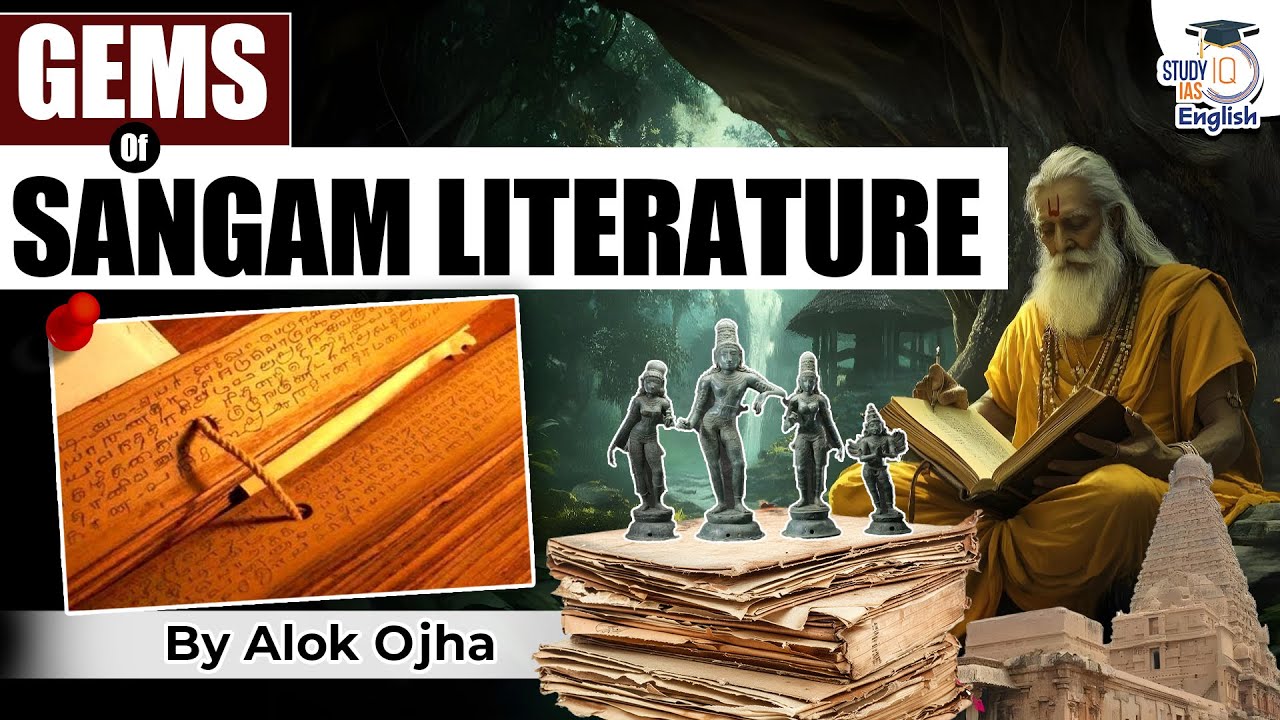
The classical poems were originally oral compositions created across different eras before being gathered, sorted, and preserved during medieval times through systematic codification and redaction.
The Codification of Sangam Literature
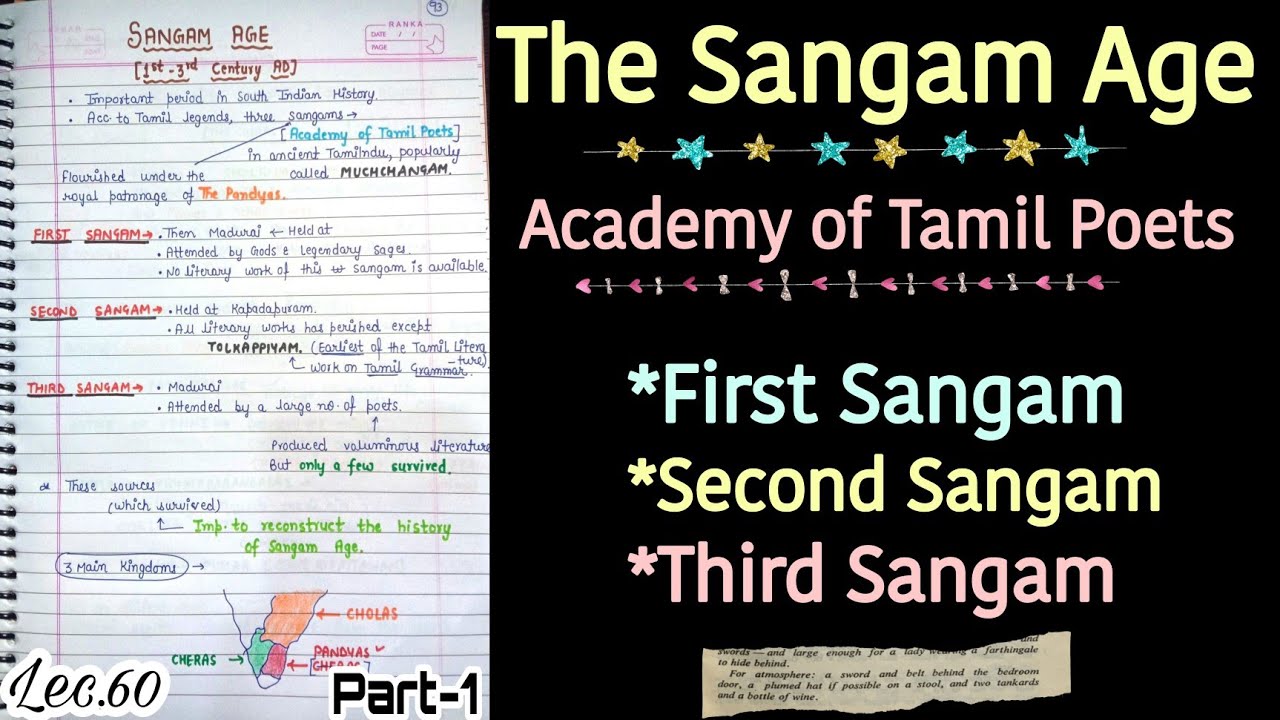
While the term "Sangam" originally referred to a Jaina assembly founded by Vajranandi, an 8th-century commentary on Iraiyanar Akapporul established the legendary account of three formal literary academies.
- (i) Scholars gradually collected individual verses, organizing them into thematic anthologies with descriptive headers and explanatory notes.
- (ii) The editor Perutevanar played a key role in compiling these collections and adding invocatory verses, converting oral poetry into enduring written literature.
The Importance of Tamil Historical Heritage for Students
Studying the history of ancient Tamil Nadu through Sangam literature reveals how political authority, social values, and economic commerce developed in South India. These poems offer firsthand evidence regarding the early Chera, Chola, and Pandya dynasties, the introduction of Vedic ceremonies, and prosperous maritime trade with foreign lands. For students preparing for competitive exams, mastering this material is essential, as it highlights key historical processes like state formation, cultural integration, and socio-economic growth in ancient South India.
Quick Revision Capsule
Key historical themes, primary evidence, and core features from classical Tamil literature:
| Historical Theme | Primary Literary Sources | Core Significance & Findings |
|---|---|---|
| Vedic Sacrifices | Patitrupathu, Maduraikanchi, Purananuru | Used by southern rulers to legitimize power and build cultural links with northern traditions. |
| Northern Contact | Akananuru (69, 251, 281), Purananuru (175) | Preserves details regarding Nanda riches at Pataliputra and Mauryan military campaigns in the south. |
| Royal Generosity | Purananuru, Sirupaanatruppadai | Celebrates Seven Chieftains (Pari, Athiyaman, etc.) for supporting bards and public welfare. |
| Famous Battles | Purananuru (25, 72, 76), Akananuru (55, 246) | Documents major engagements like Venni and Aalankanam along with ethical warrior codes. |
| Maritime Commerce | Akananuru (149), Greco-Roman accounts | Highlights trade centered at ports like Muziris, exchanging Indian spices for Roman gold. |
Summary
Classical Tamil literature provides a rich primary record of early South Indian civilization. Through thousands of verses, it documents the rise of early kingdoms, political legitimization through rituals, and ethical standards governing warfare and governance. The poems demonstrate broad geographic awareness, detailed records of northern empires, and an active maritime trade network linking Tamil ports to the wider world. Preserved through medieval compilation, these works remain a vital window into ancient subcontinental history.
Quick Revision Points
Key facts to remember for examination review:
- (i) Rulers like Chera Palyanai and Pandya Mudukudumi used Vedic sacrifices to establish royal legitimacy.
- (ii) Sangam poems show subcontinental awareness, mentioning the Himalayas, Ganga, Nandas, and Mauryan chariots.
- (iii) The Seven Chieftains were celebrated for generosity, including Athiyaman's introduction of sugarcane cultivation.
- (iv) Major battles like Venni and Aalankanam illustrate political rivalries and heroic codes like ritual suicide facing north.
- Exam Tip: When answering questions on ancient South Indian history, use specific poem citations (such as Purananuru or Akananuru) to support points about trade, Mauryan contacts, and royal legitimization.
Frequently Asked Questions (FAQ)
Q1: How did Vedic sacrifices function in ancient Tamil society?
A1: Vedic sacrifices were performed by major kings and local chieftains to demonstrate piety, gain social prestige, and legitimize political power as cultural contacts between northern and southern India expanded.Q2: What evidence exists in Sangam texts regarding the Mauryan Empire?
A2: Poems in Akananuru and Purananuru mention heavy Mauryan chariots cutting through rock, their alliance with the Kosars, and their military incursions into southern territories.Q3: What was the economic significance of the port of Muziris?
A3: Muziris was a major Chera port where foreign merchants traded Roman gold for local black pepper and luxury goods, serving as a hub for international maritime trade.