The Pandya Dynasty stands among the earliest and most enduring Tamil ruling houses in South Indian antiquity. For students preparing for civil service examinations, examining this kingdom provides essential clarity on the political growth, maritime influence, and regional power struggles of the peninsular south. Ranging from the early Sangam Era up through the late medieval centuries, Pandyan history is marked by continuous military rivalries against the Cholas, Cheras, Pallavas, and Chalukyas. Grasping the trajectory of their rule requires breaking down their timeline into three pivotal phases: the early Sangam rulers, the First Pandyan Empire emerging in the , and the imperial Second Pandyan Empire of the medieval period.
In this chapter, you will understand:
- The literary and foreign records attesting to early Pandyan antiquity.
- The etymological origin theories surrounding the royal title Pandya.
- The political trajectory spanning the Sangam Age, First Empire, and Second Empire.
- The tri-partite geopolitical rivalries between the Pandyas, Pallavas, and Chalukyas.
Why this topic matters: Pandyan history forms a vital core of ancient and medieval South Indian polity, art, and administrative history, making it a recurring focus in competitive examination syllabi.
Core Idea: The Pandyas maintained an exceptionally long political presence in Madurai, navigating periods of obscurity under Kalabhra rule, reviving as an imperial power twice, and ultimately falling due to bitter internal succession disputes in the 14th century.
History, Rise, and Decline of the Pandya Dynasty in South India: Ancient Kingdom
The historical roots of the Pandya dynasty stretch deep into early antiquity. While exact dates of their earliest origins remain debated among modern historians, their cultural footprint across ancient India is indisputable.
- (i) The term Pandya does not carry a single universally accepted root, leading to diverse linguistic and historical interpretations.
- (ii) Written evidence of their early kingdom appears across ancient Sangam literature, the epics Ramayana and Mahabharata, and the Sri Lankan chronicle Mahavamsha.
- (iii) Foreign observations also verify their ancient status, including references in the administrative treatise Arthashastra by Kautilya and the historical account Indica by the Greek envoy Megasthenes during his stay at the court of Chandragupta Maurya.
The Mysterious Origin of the Term 'Pandya': Scholarly Debates
The name Pandya carries deep historical resonance, with various traditional theories tying it to ancestral heritage and martial values.

Etymological Interpretations of the Pandya Name
Linguists and historians suggest that the term may stem from the northern lineage Pandava. Alternatively, local linguistic tradition connects it to the Tamil word Pandia, which denotes an old or ancient land.
- (i) A warrior-focused theory connects the title to the Tamil word Pandi, meaning bull, representing physical power and authority.
- (ii) Under this view, early rulers used this descriptive title to project military strength and sovereign legitimacy over their territories.
- (iii) Historical records note that Kulashekharan was the first monarch to officially adopt Pandya as a formal royal title, establishing a practice followed by all later rulers.
Three Historical Phases of Pandya Rule: Imperial Transition
Scholars divide Pandyan history into three broad operational phases to trace their shifting territorial control and political power across the southern peninsula.
Early Pandyas: The Pandyas of the Sangam Age and Their Contemporaries
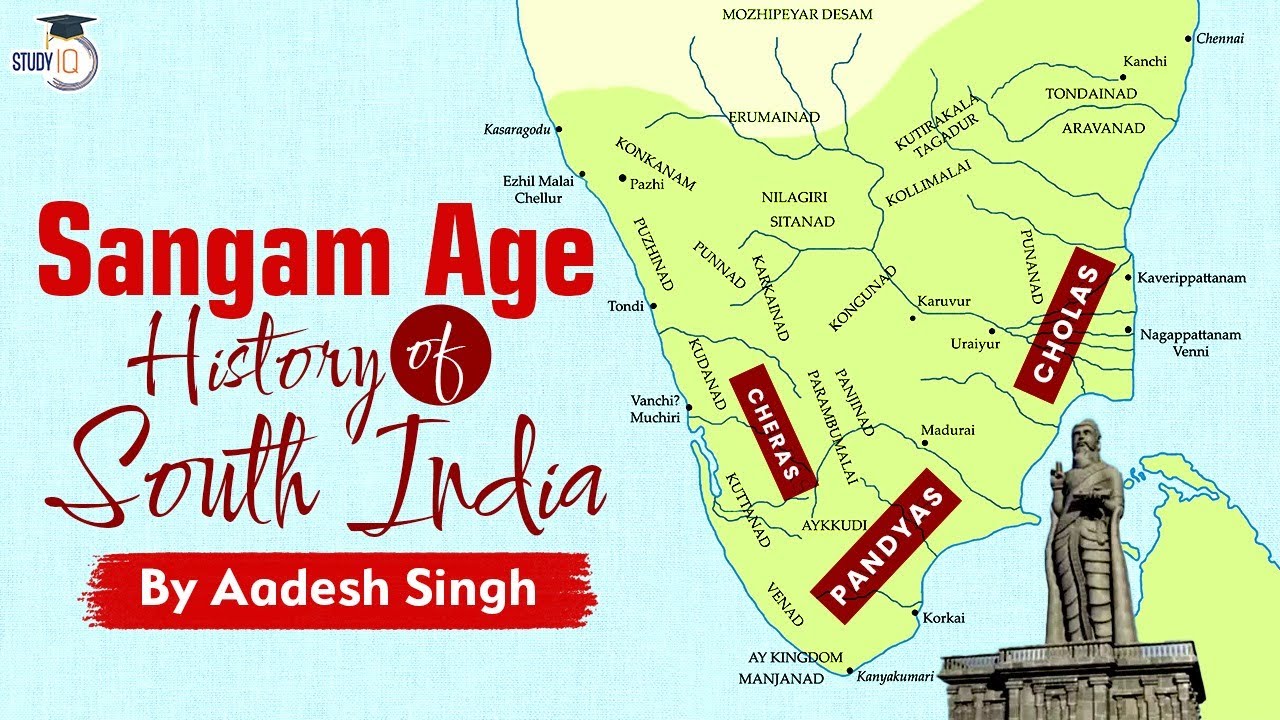
The earliest recorded lineage consists of the Early Pandyas during the Sangam Age. They ruled from Madurai while competing continuously with the neighboring Cheras and Cholas for supremacy in the Tamil country.
- (i) This initial phase was interrupted by the political rise of the Kalabhras, who temporarily displaced traditional regional monarchies.
- (ii) After regaining power, the Pandyas re-established their northern boundary along the Kaveri River, bordering the Pallava kingdom.
- (iii) Prominent early rulers include Palyagasalai Mudukudumi Peruvaludi and Neduncheliyan I (known as Ayyappudai Kadantha Neduncheliyan), whose deeds are memorialized in Ilango Adigal's classic text Silappatikaram.
- (iv) The most celebrated Sangam ruler was Nedunchelian II, who defeated a joint coalition of Chola and Chera chieftains at the decisive Battle of Talaiyalanganam.
The First Pandyan Empire: Resurgence and the Chola Challenge
The First Pandyan Empire was founded by Kadungon in the CE, ending Kalabhra dominance and restoring sovereign Tamil rule.
- (a) Monarchs of this era assumed formal coronation titles like Maravarman and Sadayavarman (reflecting devotion to Lord Shiva) or the epithet Sadaiyan.
- (b) King Arikesari Maravarman expanded the borders by overcoming Chera resistance and capturing their monarch.
- (c) His successor Kochadaiyan Ranadhiran defended his borders against the northern Chalukyas of Badami and the Western Gangas.
- (d) Later, Maravarman Rajasimha I led campaigns against the Pallava king Nandivarman II and the Chalukyas.
This imperial era ended when Maravarman Rajasimha III was defeated by the rising Chola ruler Parantaka I, who captured Madurai and took the title Maduraikonda. This inaugurated a period of Chola dominance during the .
Territorial shifts between Madurai and Tanjore during the First Empire era - (i) The First Empire concluded when Vira Pandya was slain by Aditya Karikala, son of Chola ruler Parantaka Chola II.
Second Pandyan Empire: Peak and Collapse of Chola Rule
After centuries of Chola oversight, the Pandya dynasty dramatically re-asserted its independence in the , creating the expansive Second Pandyan Empire.
Maravarman Sundara Pandyan: The Revivalist and Chola Submission
This renaissance was launched by Maravarman Sundara Pandyan, who forced Chola king Kulothunga Chola III to submit, turning the tide of regional politics.
- (i) The empire reached its highest peak under Jatavarman Sundara Pandyan, who led military campaigns deep into neighboring territories.
- (ii) His expeditions extended control over parts of the Telugu country, Kalinga (modern Odisha), and northern Ceylon.
- (iii) Even with support from the Hoysalas, the weakened Chola state could not resist Pandyan expansion.
- (iv) The final collapse of Chola authority came under Maravarman Kulashekhara Pandyan I, who defeated Rajendra Chola III and his Hoysala allies.
Pandyan Civil War: Internal Strife and Dynastic Downfall
Following these major achievements, the kingdom fractured internally due to a war of succession among royal princes.
- (a) A dispute erupted between brothers Vira Pandya and Sundara Pandya, sons of Maravarman Kulashekhara Pandyan I.
- (b) This internal conflict shattered royal unity, inviting external intervention and ending Pandyan imperial supremacy.
The Three-Way Struggle: Pandya, Pallava, and Chalukya Conflicts
The early medieval period in South India was defined by a ongoing dynamic struggle between three major regional powers seeking territorial dominance.
Pallava-Chalukya Dominance and Pandya Emergence
Initially, power was split between the Chalukyas of Vatapi and the Pallavas of Kanchi. Pallava king Mahendravarman I held territory near the Krishna River, while Chalukya ruler Pulakesin II dominated the upper Deccan.
- (i) The revival of Pandyan strength under Madurai turned this dynamic into a triangular conflict for peninsular control.
- (ii) The Pandyas repeatedly targeted the agricultural wealth of the Kaveri Delta.
- (iii) To weaken the Pallavas, Pandyan kings formed strategic alliances with Chalukya monarchs, such as Arikesari Parankusa Maravarman I allying with Vikramaditya I.
- (iv) Pandyan armies also fought neighboring Chera forces and launched overseas campaigns into Ceylon.
- (v) Following victories against Chera forces, King Jayantavarman (ruling from to ) took the commemorative title Vanavan.
Pandyan Diplomatic Interference and Pallava Response
Beyond military actions, Pandyan rulers frequently interfered in Pallava court politics to weaken their rival.
- (a) King Maravarman Rajasimha I supported political claimants like Chitramaya against ruling Pallava kings.
- (b) His continuous military victories earned him the title Pallava Bhanjana (Breaker of the Pallavas).
- (c) To protect his realm, Pallava ruler Nandivarman II secured a marriage alliance with Reva, daughter of Rashtrakuta/Chalukya line ruler Dantidurga.
- (d) Despite this coalition, Pandyan incursions remained a regular feature of early medieval southern politics.
This web of alliances and military campaigns illustrates the fluid geopolitical reality of South India during this historical period.
Pandya Dynasty Historical Summary
A quick reference breakdown of the major Pandyan phases, key rulers, and core outcomes:
| Historical Era | Key Monarchs | Primary Historical Significance |
|---|---|---|
| Sangam Age | Palyagasalai Mudukudumi Peruvaludi, Nedunchelian II | Early urban centers, Battle of Talaiyalanganam victory, patronage of classical Tamil literature. |
| First Empire (6th-10th C.) | Kadungon, Arikesari Maravarman, Rajasimha III | Ended Kalabhra dominance; long wars with Pallavas and Chalukyas; ultimate defeat by Parantaka I Chola. |
| Chola Overlordship (10th-12th C.) | Local Pandyan Princes | Subordination under imperial Cholas; intermittent rebellions in Madurai region. |
| Second Empire (13th-14th C.) | Maravarman Sundara Pandyan, Jatavarman Sundara Pandyan I | Dismantled Chola power; expanded rule into Andhra and Ceylon; golden age of South Indian trade and architecture. |
| Dynastic Decline (14th C.) | Vira Pandya, Sundara Pandya | Civil war between royal brothers led to foreign invasions and political fragmentation. |
Summary
The history of the Pandya Dynasty presents a remarkable narrative of survival and resurgence across more than a millennium. From their early roots in the Sangam Age to their expansion during the First and Second Imperial periods, the Pandyas shaped the cultural and political map of South India. Their continuous wars with the Cholas, Cheras, Pallavas, and Chalukyas highlight the dynamic nature of peninsular statecraft. Understanding key rulers, decisive battles like Talaiyalanganam, and the civil war that led to their final decline provides students with a solid foundation in ancient and medieval Indian history.
Quick Revision Points
Essential facts to review before examinations:
- (i) Early foreign sources attesting to the Pandyas include Megasthenes' Indica and Kautilya's Arthashastra.
- (ii) King Kadungon restored Pandyan sovereignty in the CE by ending Kalabhra control.
- (iii) Jatavarman Sundara Pandyan I marked the highest territorial expansion of the Second Empire in the .
- (iv) Internal succession strife between Vira and Sundara Pandya directly accelerated the final downfall of the state.
- Exam Tip: Focus closely on the timeline transition from Kalabhra rule to Kadungon's revival, as well as the key titles adopted by monarchs (e.g., Maduraikonda by Parantaka I, Pallava Bhanjana by Rajasimha I) for objective exam questions.
Frequently Asked Questions (FAQ)
Q1: Who was the founder of the First Pandyan Empire?
A1: Kadungon founded the First Pandyan Empire in the late 6th century CE by ending the rule of the Kalabhras in the Tamil region.Q2: What was the significance of the Battle of Talaiyalanganam?
A2: The Battle of Talaiyalanganam was a major Sangam-era conflict where the Pandyan king Nedunchelian II successfully defeated a joint alliance of the Cholas, Cheras, and five smaller chieftains.Q3: What caused the collapse of the Second Pandyan Empire?
A3: The Second Pandyan Empire collapsed primarily due to a bitter succession civil war between the brothers Vira Pandya and Sundara Pandya, which weakened the state and invited external interventions.