
During the peak of the Indus Valley Civilization (circa ), ancient craftspeople created remarkable works of art in stone and bronze that showcased an advanced grasp of human anatomy, metal casting, and realistic sculpting techniques.
🎯 In this chapter, you will understand:
- The refined execution and anatomical precision of ancient Indus Valley stone statues.
- Key details of iconic stone artifacts like the Red Sandstone Male Torso and the Priest-King Bust.
- The metallurgical technique known as lost-wax casting used for ancient bronze works.
- Famous bronze statues, including the Dancing Girl of Mohenjodaro and regional animal figurines.
💡 Why this topic matters: Indus Valley stone and metal artifacts display technical skills and artistic realism that were centuries ahead of many contemporary ancient civilizations.
🧠 Core Idea: Despite making only a small number of stone and bronze objects, Harappan sculptors achieved extraordinary realism and mastered complex casting techniques like cire perdue.
🗿 Stone Statues and Sculptures: Epitome of Anatomical Accuracy in the Indus Valley
Despite their limited number, the stone sculptures unearthed from the IVC are stunning examples of technical precision, capturing anatomical detail and three-dimensional volume that are seldom seen in contemporary ancient art.
Stone Statues: The Refined Red Sandstone Torso and the Enigmatic Priest-King Bust
The few surviving stone carvings are testaments to the sculptors’ remarkable proficiency, showcasing a deep understanding of human anatomy and the ability to work in hard, resistant materials, thus cementing their status as high art forms.
- (i) The sculptures, while scarce, are noted for their exceptional refinement and technical execution, proving the sculptors’ mastery over form and the intricacies of material handling.
- (ii) Two particularly important and iconic finds exemplify this high-art tradition: the Red Sandstone Male Torso discovered at Harappa and the Bust of a Bearded Man, famously known as the Priest-King, excavated at Mohenjodaro.
- (iii) The Bearded Priest sculpture, with its notably serene and composed demeanor, is frequently interpreted by scholars as reflecting a figure of high symbolic or religious standing, possibly engaging in deep meditation, offering a rare glimpse into Harappan spiritual life.
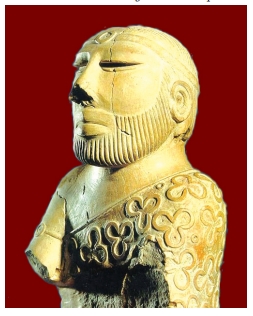
Stone Statue of Bearded Priest - A world-renowned sculpture depicting a contemplative, bearded figure, one of the most distinctive human figures from the Indus Valley Civilization. - (iv) The details on the Priest-King's face are meticulously executed, including his characteristically elongated, half-closed eyes, a carefully and neatly trimmed short beard, and stylized, decorative shell-like ears.
- (v) Additional stylistic features of this prominent Priest-King artifact include his hair tied back with a fillet (headband), an armlet worn on the right arm, and impressions of a distinctively embroidered or patterned shawl draped elegantly over the left shoulder.
Bronze Casting: The 'Lost Wax' Technique and the Iconic Dancing Girl
The inhabitants of the Indus Valley Civilization were true pioneers in bronze casting, skillfully employing the advanced ‘lost wax’ technique (or cire perdue) to create complex, hollow metal sculptures, thus establishing their remarkable metallurgical supremacy.
- (i) The ‘lost wax’ technique is an intricate process: it involves first crafting a detailed model in wax, then encasing it entirely in clay, and heating the assembly to melt the wax and drain it out, finally pouring molten metal (bronze) into the resulting precisely hollow mould.
- (ii) The undisputed most famous outcome of this technique is the iconic Dancing Girl Statue discovered at Mohenjodaro, an approximately four-inch-high figure celebrated globally for its portrayal of lively movement, confident posture, and undeniable grace.
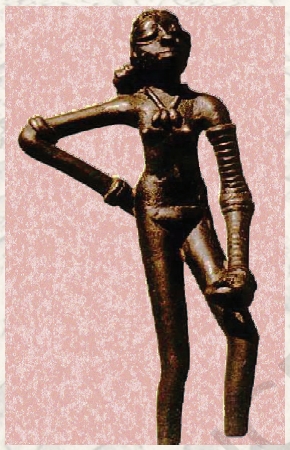
Bronze Dancing Girl - The iconic bronze sculpture from Mohenjodaro, famous for its confident posture and lost wax casting technique. - (iii) Beyond human figures, animal sculptures were also widely popular and expertly rendered, notably the powerful Buffalo (distinguished by its high, arched back and magnificent sweeping horns) and the Goat, both executed with exceptionally fine anatomical detail.
- (iv) Other notable bronze artifacts include a Copper Dog and Bird found at the major port city of Lothal, and the characteristically strong-looking Bronze Bull discovered at the Kalibangan site.
- (v) This sophisticated tradition of metal sculpture did not abruptly end but impressively continued well into the Late Harappan Sites, with key examples recovered from places such as Daimabad, proving the technological endurance of this highly refined craft.
⚡ Quick Revision Capsule: Harappan Stone and Bronze Sculptures
This quick summary table highlights key artifacts, their materials, discovered locations, and distinctive artistic features.
| Artifact Name | Material & Method | Discovery Site | Key Artistic Details |
|---|---|---|---|
| Priest-King Bust | Steatite / Stone Carving | Mohenjodaro | Elongated half-closed eyes, short trimmed beard, headband, right armlet, embroidered shawl over left shoulder. |
| Male Torso | Red Sandstone | Harappa | Remarkable naturalistic shaping and refined anatomical precision. |
| Dancing Girl | Bronze (cire perdue / lost wax) | Mohenjodaro | Four-inch figure showing a confident posture, expressive gesture, and dynamic posture. |
| Bronze Bull & Animals | Bronze Casting | Kalibangan, Lothal | Strong anatomical detailing seen in animals like bulls, goats, buffaloes, dogs, and birds. |
| Late Harappan Bronzes | Bronze Casting | Daimabad | Demonstrates that bronze casting traditions continued long into later Harappan periods. |
📝 Summary
The sculptors of the Indus Valley Civilization during mastered both stone carving and metallurgy. Iconic works like the Priest-King of Mohenjodaro and the Dancing Girl showcase an unprecedented combination of fine anatomical detail, spiritual symbolism, and early technological innovation through the lost-wax casting technique.
🚀 Quick Revision Points
Essential facts to review before examinations:
- (i) Harappan artisans mastered three-dimensional proportions and anatomical realism in stone carving.
- (ii) The cire perdue (lost-wax) technique was used to cast hollow bronze sculptures.
- (iii) Key stone finds include the Red Sandstone Male Torso (Harappa) and the Priest-King Bust (Mohenjodaro).
- (iv) Major bronze finds include the Dancing Girl (Mohenjodaro), Copper Dog and Bird (Lothal), and Bronze Bull (Kalibangan).
- 💡 Exam Tip: Pay special attention to the difference between site discoveries: the Priest-King and Dancing Girl were found at Mohenjodaro, the Red Sandstone Torso was found at Harappa, and the Bronze Bull was found at Kalibangan.
❓ Frequently Asked Questions (FAQ)
Q1: What is the lost-wax technique used in the Indus Valley?
A1: The lost-wax technique (or cire perdue) is a metal-casting method where a model is sculpted in wax, coated in clay, heated to drain the wax, and filled with molten bronze.Q2: Where was the iconic Dancing Girl bronze statue discovered?
A2: It was excavated at the major ancient city of Mohenjodaro.Q3: What unique features are carved onto the Priest-King bust?
A3: The Priest-King features half-closed eyes, a neatly trimmed beard, a headband, a right-arm armlet, and a patterned shawl over his left shoulder.
