
The development of Buddhist art during the Kushan period marked a pivotal transition, especially from the , when the Buddha was first represented in a human form. The emergence of the Gandhara, Mathura, and Sarnath Schools of Art represents a critical phase for competitive exam preparation, showcasing a fusion of indigenous and Hellenistic influences in ancient Indian sculpture.
🎯 In this chapter, you will understand:
- How Buddhist art moved from symbolic representations to making sculptures of the Buddha in human form.
- The key features of the Gandhara School and its mix of Greek, Roman, and local artistic styles.
- The local Indian roots of the Mathura School and how it used the early Yaksha style to design the Buddha image.
- The refined elegance of the Sarnath School and the major stylistic differences between Mathura, Sarnath, and Gandhara art.
💡 Why this topic matters: Understanding these three art schools helps students grasp how external cultural contacts and native traditions shaped early Indian iconography, religion, and regional aesthetics.
🧠 Core Idea: Starting in the , artists in northern and northwestern India began portraying the Buddha as a human being rather than using symbols like footprints or wheels, creating distinct regional artistic styles that influenced Indian art for centuries.
Evolution of Indian Buddhist Sculpture: Mathura, Sarnath, and Gandhara Schools of Art, c. 1st Century CE Onwards
The dawn of the witnessed an artistic renaissance in major production centers like Gandhara (located in modern-day Pakistan), Mathura in Northern India, and Vengi in Andhra Pradesh. This era is historically significant as it marked the monumental decision to depict the Buddha not merely through symbols, but in a complete human (anthropomorphic) form in both Mathura and Gandhara.
- (i) The served as the foundational period when major centers of art production became highly active, signifying a clear shift in religious and artistic patronage.
- (ii) Key centers—Gandhara, Mathura, and Vengi—emerged as crucial hubs for sculpture creation, influencing the artistic landscape across the Indian subcontinent.
- (iii) The most significant transformation was the depiction of the Buddha in human form, moving away from the earlier symbol-only tradition of representing him through objects like the Bodhi tree or the Dharma Chakra.
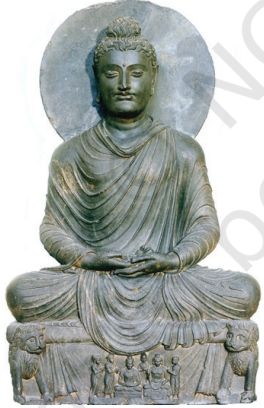
The Gandhara School: A Fusion of Hellenistic and Local Artistry
The Gandhara School of Art became renowned for its unique blend of artistic traditions, heavily influenced by Western classical styles, resulting in a distinctive style of Buddhist sculpture.
The Greco-Buddhist Synthesis in Gandhara Sculpture
The sculptural tradition of Gandhara is defined by a remarkable confluence of artistic elements, drawing inspiration from Bactrian, Parthian, and local Gandhara styles. This fusion gave birth to an art form often termed Greco-Buddhist art, characterized by its naturalism and detailed execution.

Bodhisattva Gandhara - A majestic Bodhisattva sculpture from Gandhara, distinguished by its Hellenistic style, featuring graceful drapery folds and deeply serene expressions, symbolizing the core Buddhist ideal of compassion. - (i) Hellenistic Influence: The images of the Buddha prominently display Hellenistic features, particularly in the rendering of facial details (such as wavy hair, straight nose, and muscled physique) and the depiction of posture.
- (ii) Naturalistic Drapery: A key hallmark is the realistic and naturalistic folds of the drapery (robes) worn by the figures, closely resembling Greek and Roman statuary.
- (iii) Detailed Expression: The sculptures are celebrated for their detailed facial expressions and bodily features, giving the figures a strong sense of realism and natural depth.
The Mathura School: An Indigenous and Prolific Artistic Tradition
Mathura established a powerful and distinctly indigenous sculptural tradition that became the dominant artistic influence spreading across the northern regions of India, characterized by its robust and sensual modeling.
Distinctive Iconography and the Yaksha-Modeled Buddha Image
The Mathura School's initial imagery was deeply rooted in local tradition. The Buddha image itself was innovatively developed by modeling it after the earlier, powerful, and monumental statues of Yaksha figures, establishing a uniquely Indian aesthetic for the divine.
- (i) Yaksha Prototype: The Buddha image was a continuation of the Yaksha model, resulting in a figure with broad shoulders and a powerful, standing posture.
- (ii) Diverse Deities: Besides the Buddha, the school was highly prolific in creating early images of Jain Teerthankars, as well as portraits of rulers, notably the famous headless statue of King Kanishka.
- (iii) Hindu Iconography: The artistic scope was broad, encompassing images of major Hindu deities, including Vaishnava gods (like Vishnu) and Shaiva deities (such as lingas and mukhalingas), illustrating its status as a multi-religious art center.
Evolutionary Style: From Bold Carvings to Sensual Forms and Transparent Drapery
The sculptural style of Mathura demonstrated a clear evolution over centuries, initially characterized by its volumetric boldness and eventually moving towards greater refinement and slenderness. The figures were typically presented with round and smiling faces, projecting boldly from the surface.
- (a) Early Style (Boldness and Volume): Early carvings were characterized by bold, large volumes that distinctly projected from the picture plane, giving the figures a sense of powerful immediacy. Garments were clearly visible, usually covering only the left shoulder.
- (b) Mid-Period (Sensuality): Around the , the sculptures transitioned, becoming notably more sensual and fleshy in their execution, a popular aesthetic trend that continued its prevalence well into the .
- (c) Late Style (Slenderness and Transparency): By the , the aesthetic shifted towards producing more slender figures with a refined physique. The drapery was integrated and depicted as virtually transparent, clinging to the body.
The Sarnath School: Emphasizing Simplicity and Refinement
Emerging as another crucial center of artistic production in Northern India, alongside Mathura and Kosambi, the Sarnath School developed a highly refined style that prioritized grace and simplicity in the depiction of the Buddha.
Key Aesthetic Traits: Plain Drapery and Minimally Ornamented Halo
The sculptures from Sarnath are immediately recognizable for their distinct approach to the Buddha's attire and the halo surrounding his head, focusing on understated elegance and spiritual focus.
- (i) Transparent Drapery: A defining feature is the plain, transparent drapery (robes) covering both shoulders of the Buddha, contrasting with Mathura's earlier style of covering only one shoulder.
- (ii) Minimal Halo Ornamentation: The halo encircling the head is typically characterized by minimal ornamentation, prioritizing a simple, unadorned aesthetic over the highly decorative halos seen in Mathura.
Comparing the Buddha Images: Mathura vs. Sarnath Sculptural Differences
A comparative study of the Buddha images from these two indigenous centers highlights key stylistic differences, which are essential for understanding the regional variations in ancient Indian art history.
- Mathura's Drapery and Halo: The Mathura School consistently depicted prominent drapery folds in its sculptures, especially in earlier periods, and utilized highly decorated and ornate halos.
- Sarnath's Simplicity and Elegance: The Sarnath School, in contrast, focused on simplicity, employing virtually plain, transparent drapery that appears fused to the body, complemented by minimally ornamented halos.
Important Art Sites and The Legacy of Sculptural Trends
The influence of these schools extended beyond the immediate centers, establishing a sculptural sensibility that persisted in later periods across the subcontinent.
Significant Sites and Key Museum Collections
Beyond the Gangetic valley heartland, sites like Devnimori in Gujarat became important centers for art production, demonstrating the wide geographical spread of this artistic tradition. The best examples of these early sculptures are preserved and exhibited across India.
- (i) Key Art Production Sites: The artistic influence reached sites such as Devnimori in Gujarat, demonstrating the tradition's spread outside the core northern regions.
- (ii) Major Museum Collections: Noteworthy early sculptures from the Gandhara, Mathura, and Sarnath Schools are preserved and displayed in major museums located in Mathura, Sarnath, Varanasi, New Delhi, Chennai, and Amaravati.
The Enduring Aesthetic: Transparent Drapery in Later Sculpture
The later trends, particularly those perfected by the Mathura and Sarnath Schools, set a lasting standard for sculptural forms. In the subsequent centuries, the aesthetic preference for slender forms with transparent drapery became a dominant and pervasive sensibility in Indian statuary.
⚡ Quick Revision Capsule: Key Comparison of Art Schools
Here is a quick comparison table summarizing the core differences between the three major art schools of ancient India:
| Feature | Gandhara School | Mathura School |
|---|---|---|
| Primary Influence | Foreign (Greco-Roman / Hellenistic) | Purely Indigenous (Native Indian) |
| Core Material | Blue-grey schist stone and Stucco | Spotted red sandstone |
| Depiction of Buddha | Wavy hair, sharp features, Greek-style heavy robes | Muscular body, broad shoulders, modeled after Yaksha statues |
| Religious Focus | Mainly Buddhist art | Multi-religious (Buddhist, Jain, and Hindu deities) |
| Halo and Drapery | Heavy drapery with realistic folds; plain halo | Ornate halos; robes covering one shoulder initially, moving to transparent drapery |
📝 Summary
The study of the Gandhara, Mathura, and Sarnath Schools of Art, flourishing from the , is fundamentally important for understanding the evolution of ancient Indian sculpture. This period marked the revolutionary shift to representing the Buddha in human form and demonstrates the profound interplay between indigenous traditions (Mathura and Sarnath) and external influences (Gandhara). For students preparing for exams, mastering these distinctive traits is crucial for accurately answering questions on art, culture, and Buddhist iconography in India.
🚀 Quick Revision Points
Essential facts to review before examinations:
- (i) The marked the shift from symbolic (aniconic) art to making Buddha statues in human (anthropomorphic) form.
- (ii) Gandhara art combined Greek features with Indian Buddhist ideas to create Greco-Buddhist art.
- (iii) Mathura art used local traditions and the broad-shouldered Yaksha model to shape its early divine figures.
- (iv) Sarnath art is famous for its simple elegance, unadorned halos, and transparent robes covering both shoulders.
- 💡 Exam Tip: When answering questions about Buddha sculptures, always compare how robes are drawn (heavy folds in Gandhara vs. single shoulder in early Mathura vs. plain transparent robes covering both shoulders in Sarnath) and how halos are decorated!
❓ Frequently Asked Questions (FAQ)
Q1: When did artists start making sculptures of the Buddha in human form?
A1: This major change began around the during the Kushan period, mainly in the Mathura and Gandhara art regions.Q2: What is the main difference between Gandhara and Mathura art styles?
A2: Gandhara art was heavily influenced by Greek and Roman art (Hellenistic style), while Mathura art developed from local Indian traditions using the Yaksha statue design.Q3: What makes Sarnath Buddha statues easy to identify?
A3: Sarnath statues are known for their calm expressions, plain transparent robes covering both shoulders, and simple halos with very little decoration.
