Embark on a detailed exploration of the Manuscript Painting Tradition in India, a critical field for Art History students and competitive exam preparation. We delve into how ancient texts, such as the Third Khanda of the Vishnudharmottara Purana from the , laid down the foundational canons (Chitrasutra) that influenced diverse styles, including the vibrant Western Indian School of Painting and the flourishing Jain manuscript illustrations, providing essential insights into pre-Mughal indigenous art forms.
🎯 In this chapter, you will understand:
- The canonical foundations of visual arts from the ancient text Vishnudharmottara Purana.
- The Shadanga (Six Limbs) of Indian painting and how miniature styles differ from wall murals.
- The step-by-step creation of thematic manuscript sets and the role of the colophon.
- The patron-driven evolution of the Western Indian School and its distinct stylistic features.
💡 Why this topic matters: Understanding early Indian manuscript traditions provides vital context for how native artistic techniques survived, adapted, and influenced later courtly styles across the Indian subcontinent.
🧠 Core Idea: Ancient textual guidelines systematically directed the development of handheld book illustrations, merging spiritual narratives with highly structured visual art rules.
Foundations, Canons, and Evolution of Indian Manuscript and Miniature Paintings (Pre-Mughal Era)
The art of image-making and painting was codified in ancient texts, setting the enduring standards for all subsequent Indian artistic schools. The philosophical and technical principles governing Indian visual arts, particularly painting, were meticulously documented, ensuring a continuous tradition of artistic excellence and consistency across centuries and regions.
- (i) The Third Khanda of the Vishnudharmottara Purana, a significant Sanskrit text, contains a crucial section known as the Chitrasutra, which functions as the authoritative sourcebook for the canons of painting and image making (pratima lakshana).
- (ii) These ancient canons meticulously described not only the philosophical and conceptual underpinnings of art but also the practical aspects, encompassing techniques, essential tools, choice of materials, and appropriate surfaces for artistic creation.
- (iii) The Chitrasutra's directives became the widely accepted blueprint, guiding artists through various periods and significantly influencing the aesthetics and methodologies of virtually every major style and school of painting that developed across India.
The Chitrasutra: Unveiling the Six Limbs (Shadanga) of Indian Painting Canons
The canons of painting, as detailed in the Chitrasutra, established six key components, or ‘limbs,’ that define artistic perfection, offering a comprehensive guide to mastering the visual arts.
Technical and Aesthetic Components of the Chitrasutra
The ancient text offered detailed instruction on creating life-like and emotionally resonant artwork, emphasizing precise measurements, vibrant expression, and compelling composition.
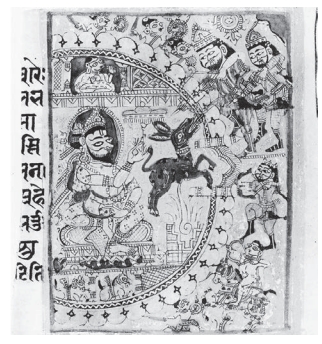
Kalakacharya Katha - A depiction of the life and teachings of Kalakacharya, a revered figure in Jain traditions, often highlighted for his moral and philosophical contributions. - (i) The Khanda comprehensively addresses complex concepts, including the application of perception, techniques for perspective, and methods for achieving the three-dimensionality of human figures in two-dimensional space.
- (ii) It defined the essential 'limbs' of painting, such as: Roopbheda (delineation of looks or appearance), Pramana (adherence to correct measurements, proportions, and structure), and Bhava (capturing the essence of expressions and emotions).
- (iii) Further limbs included Lavanya Yojana (achieving aesthetic composition and grace), Sadrishya (maintaining visual resemblance to the subject), and Varnikabhanga (masterful use of brushwork and colors). These rules formed the unifying artistic language of ancient Indian painting.
Miniature Paintings and Manuscript Illustrations: Context and Purpose
Miniature paintings developed as a distinct tradition, serving a purpose different from large-scale murals, primarily functioning as illustrations to sacred or literary texts.
- (a) Miniature Paintings: Distinguished by their relatively smaller size, these artworks were explicitly designed to be hand-held and appreciated up close, contrasting sharply with mural paintings that adorned the walls of homes and palaces. They were never meant for wall display, preserving their intimate nature.
- (b) Manuscript Illustrations: These are essentially the pictorial translations of narrative or poetic works, drawing content from revered epics, canonical texts, and literary or music texts, effectively combining written word with visual storytelling.
- (c) The relationship between image and text is symbiotic: the handwritten text is typically positioned either directly above the painting or on the reverse side of the folio, ensuring the narrative context is never lost.
Manuscript Creation and Challenges in Art History Reconstruction
The process of creating and preserving illustrated manuscripts was highly systematic, though the dispersal of these works over time has created significant challenges for art historians.
Thematic Sets and the Colophon's Importance in Manuscripts
Manuscript painting was an endeavor of methodical organization, where texts like the Ramayana or Bhagavata Purana were transformed into comprehensive, illustrated sets.
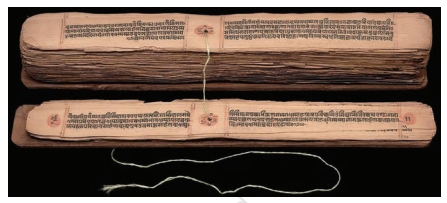
Sravakapratikramasutra of Vijaysimha - A detailed manuscript from Mewar, documenting the religious practices and rituals prescribed in Jainism, particularly for the Sravakas (lay followers). - (i) These illustrations were carefully conceived in coherent thematic sets, where each individual folio corresponds to a specific part of the original source text (e.g., Mahabharata, Gita Govinda, Ragamala).
- (ii) Upon completion, a full set was traditionally wrapped in cloth and stored meticulously in bundles within the library (or bhandar) of the royal patron or wealthy sponsor.
- (iii) The most critical page for historical authentication is the colophon page, which contains vital details about the commission, including the name of the patron, the artist or scribe, and the precise date/place of completion; its absence often forces scholars to speculate on chronology.
Reconstruction Difficulties in Painting History
The journey of reconstructing the definitive history of early Indian paintings is fraught with difficulties due to the chronological gaps and the scattering of original works.
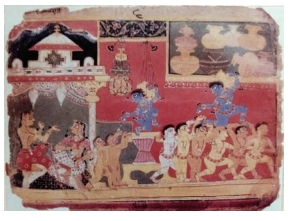
Mitharam Bhagwata Purana - An artwork from the Bhagavata Purana, showcasing the mythological stories and divine legends that are central to Hindu teachings and philosophy. - (a) A major hurdle is the scarcity of dated sets, with many crucial manuscripts remaining undated, complicating the establishment of a clear timeline for the evolution of different styles.
- (b) Over time, many folios have been separated from their original, complete sets and are now dispersed across various public museums and private collections globally, making it challenging to establish their original context and chronology.
- (c) Art historians are frequently compelled to assign hypothetical timeframes to these undated works, basing their conclusions primarily on careful analysis of stylistic features and available circumstantial evidence.
Western Indian School of Painting: Jain Patronage and Distinct Artistic Style
The Western Indian School flourished prominently, driven by the patronage of powerful trading communities, especially the Jain community, leading to a unique stylistic development.
Patronage and Key Illustrated Jain Texts
The immense wealth generated by commerce in the western regions, particularly Gujarat, empowered merchants and traders to become highly influential patrons of artistic and religious works.
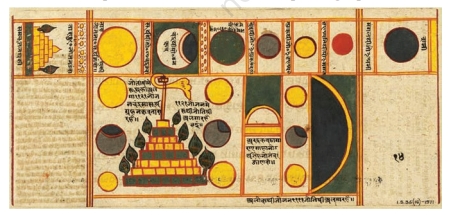
Planetary Bodies and Distances - A cosmological representation from the Sangrahini Sutra, illustrating the distances and relationships between celestial bodies in the Jain universe. - (i) The Jain community emerged as the most significant sponsor, leading to the prolific illustration of texts centering on Jainism. This practice was deeply rooted in the concept of shaastradaan (the pious donation of books).
- (ii) This tradition extensively promoted illustrated paintings that were carefully housed and preserved in the well-maintained libraries (bhandars) of Jain monasteries, ensuring the survival of these delicate works.
- (iii) Prominent Jain canonical texts that were richly illustrated include the Kalpasutra (detailing the lives of the 24 Tirthankaras), the Kalakacharyakatha (narrating the story of Acharya Kalaka), the Uttaradhyana Sutra (containing the teachings of Mahavir), and the cosmological Sangrahini Sutra.
Stylistic Elements and Evolution of Jain Paintings
Jain paintings were marked by a distinctive schematic style, brilliant color palette, and the gradual incorporation of outside influences, such as Sultanate architecture.
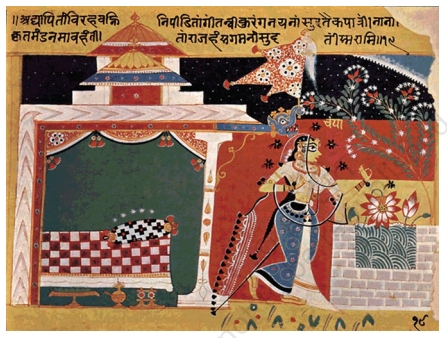
Chaurpanchasika - A classical Jain manuscript from Gujarat, representing key religious verses of the Chaurpanchasika, emphasizing themes of devotion and spiritual practice in Jainism. - (a) Early Jain paintings were executed on palm leaves, which required specialized treatment and were inscribed using sharp calligraphic devices, before the introduction of paper in the .
- (b) The visual language was often schematic and simplified, with the painting space intentionally divided into distinct sections to allow for the sequential depiction of multiple narrative incidents within a single frame.
- (c) Key stylistic traits include the liberal use of bright colors, a strong focus on intricate textile patterns, and landscape features that were merely suggestive rather than highly detailed or realistic.
- (d) The creative period for this school is generally cited between and , during which a shift occurred from simple iconic representations to more elaborate scenes incorporating landscapes, figures in dance poses, and musicians.
Architectural and Secular Influences in Pre-Mughal Art
The Western Indian School, active in regions like Gujarat, Mandu, Jaunpur, and Patan, began to show clear political and architectural influences.
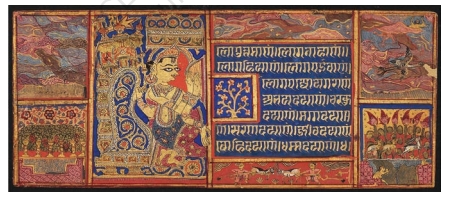
Indra Praising Devasano - An illustration from the Kalpasutra, showing the moment when King Indra praises the divine assembly, symbolizing reverence in Jain mythology. - Sultanate Influence: The presence of distinct architectural elements, such as Sultanate domes and pointed arches, within the paintings provides vital art historical evidence of the prevailing political environment and cultural exchange in these regions.
- Secular Paintings: Running parallel to the well-documented religious tradition was a secular, religious, and literary painting tradition patronized by feudal lords and wealthy citizens during the and .
- Indigenous Traditions: These secular works are critically important as they represent the vibrant indigenous artistic traditions that were actively thriving across the country just before the transformative emergence of the influential Mughal and later Rajasthani court styles.
⚡ Quick Revision Capsule: Indian Manuscript & Miniature Painting Traditions
A structured quick-reference guide highlighting key aspects, timelines, and features of the pre-Mughal manuscript traditions.
| Aspect / Feature | Description & Key Details | Historical Context / Sources |
|---|---|---|
| Foundational Canons | Codified laws governing proportions, tools, and visual aesthetics (Shadanga) | Vishnudharmottara Purana () |
| Miniature Format | Small-scale, handheld illustrations designed for close study, paired directly with written text | Narrative & Religious Manuscripts |
| Western Indian School | Characterized by vibrant colors, schematic layouts, angular facial features, and elaborate textiles | Patronized by wealthy Jain merchants () |
| Primary Medium Evolution | Transition from treated palm leaves to paper around the | Monastic collections (bhandars) |
| Authentication Marker | The colophon page providing artist names, dates, locations, and patrons | Final folios of complete manuscript sets |
📝 Summary
The study of the Manuscript Painting Tradition, rooted in the foundational principles of the Chitrasutra from the , is indispensable for understanding the depth of Indian Art History. These paintings, particularly those from the Western Indian School and Jain canonical texts, highlight the critical role of patronage and the evolution of a sophisticated indigenous style over centuries. For students and aspirants preparing for exams, mastering the details of miniature paintings, their unique stylistic features, and the challenges in their historical reconstruction provides a robust foundation in pre-Mughal art forms.
🚀 Quick Revision Points
Essential facts to review before examinations:
- (i) The Chitrasutra outlines the six limbs (Shadanga) essential for mastering painting and sculpture.
- (ii) Miniature manuscript paintings were meant for intimate, handheld viewing rather than wall display.
- (iii) The practice of shaastradaan led to the creation and preservation of vast library collections (bhandars).
- (iv) Missing colophon pages complicate the process of establishing exact dates and chronological timelines.
- 💡 Exam Tip: Pay special attention to the transition from palm leaf to paper in the and the role of colophon pages when answering questions on pre-Mughal art history.
❓ Frequently Asked Questions (FAQ)
Q1: What is the significance of the Chitrasutra in Indian art history?
A1: It serves as the primary ancient sourcebook found within the Vishnudharmottara Purana, establishing canonical rules for proportions, expressions, materials, and painting techniques.Q2: What role did the Jain community play in preserving manuscript art?
A2: Through the practice of shaastradaan (pious donation of texts), wealthy merchants commissioned numerous illustrated copies of sacred texts and preserved them in temple libraries called bhandars.Q3: Why are colophon pages important to art historians?
A3: A colophon page provides concrete evidence of a manuscript's origins, detailing the patron, scribe, date, and location of completion, which prevents historical speculation.