Embark on a captivating journey into the world of prehistoric rock paintings, an essential topic for students preparing for history and culture exams. This artistic heritage, dating back to the Old Stone Age (Palaeolithic Age), offers clear insights into early human life, making sites like Bhimbetka and Lakhudiyar vital archaeological records of the evolution of human art and survival long before written records began.
🎯 In this chapter, you will understand:
- The origins and cultural meaning of prehistoric cave paintings in India.
- The discovery made by Archibald Carlleyle and how rock art spread across the Indian subcontinent.
- Distinct features of key sites like Lakhudiyar and the UNESCO World Heritage site of Bhimbetka.
- The artistic changes from the Upper Palaeolithic to the Mesolithic and Neolithic periods.
💡 Why this topic matters: Prehistoric rock art shows the very first steps of creative human thought, providing visual proof of daily life, hunting methods, and social rituals before written language existed.
🧠 Core Idea: Early humans used natural earth pigments to document their natural surroundings, social gatherings, and spiritual beliefs directly onto rock walls.
Unveiling India's Ancient Canvas: Prehistoric Rock Paintings and Early Human Culture
These remarkable artworks, painted on the walls and roofs of natural rock shelters, mark humanity's earliest steps into visual art and creative expression during .
- (i) Created long before written language, paper, or books existed, these simple cave drawings were the primary way early humans communicated and shared ideas.
- (ii) Using natural pigments like red ochre, early humans turned plain caves into active historical records that showed animals, human forms, daily routines, and symbolic marks.
- (iii) The era of these earliest artworks is known around the world as the Old Stone Age or Palaeolithic Age, laying the groundwork for later cultural development.
The Pioneering Discovery of Rock Art in India
The discovery of prehistoric art in India came earlier than many famous findings across the world, establishing the region as a major center for Stone Age cultural history.
Archibald Carlleyle and India's First Find
The credit for finding the very first prehistoric rock paintings in India belongs to the archaeologist Archibald Carlleyle. His discoveries confirmed India's key place in global ancient art history.
- (i) This major discovery was made by Carlleyle between , twelve full years before the famous European cave paintings at Altamira in Spain were discovered.
- (ii) These early artworks show that prehistoric people did not paint just to make their shelters look nice, but also to keep a visual record of their daily experiences and ideas.
- (iii) Typical subjects included active animal scenes, people going about their routines, simple geometric shapes, and symbols connected to their social or spiritual beliefs.
Geographical Spread of Ancient Indian Rock Art
Prehistoric rock art is spread across many states in India, proving that diverse communities across the land shared similar artistic traditions.
- (a) Large groups of rock shelters with paintings are found in states like Madhya Pradesh, Uttar Pradesh, Andhra Pradesh, Karnataka, Bihar, and the Kumaon hills of Uttarakhand.
- (b) These places offer a continuous story of early human life, with the oldest examples starting in the Upper Palaeolithic period.
- (c) Finding art in so many different places shows how natural and widespread the urge for creative expression was during the Stone Age.
Major Prehistoric Rock Art Sites: Lakhudiyar and Bhimbetka
Two main sites stand out in Indian rock art history: Lakhudiyar in northern India and the world-famous Bhimbetka in central India. Each gives us a clear look at different artistic styles and topics.
Lakhudiyar Rock Shelters in Uttarakhand
The Lakhudiyar site (meaning "one lakh caves") sits along the River Suyal in the Kumaon hills. It features a varied collection of art grouped into three main categories, reflecting the social life and surrounding environment of its people.
- (i) The paintings are grouped into three main styles: detailed human shapes, various animals (such as foxes, long-snouted animals, and lizards), and clear geometric patterns (wavy lines, rectangles, and groups of dots).
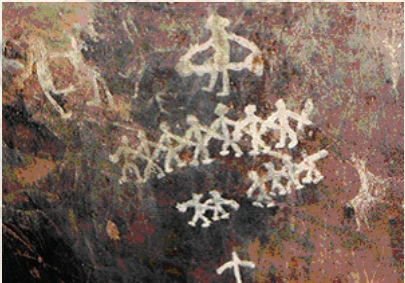
- (ii) A common design is the drawing of hand-linked dancing human figures, pointing to group celebrations or vital prehistoric ritual activities.
- (iii) The early artists used three main colors: black, red ochre, and white. The oldest layers were painted in black, while red and white paints were added over them in later times.
Bhimbetka: The Global Canvas of Madhya Pradesh
The Bhimbetka rock shelters in the Vindhya hills of Madhya Pradesh form the most famous and largest site for Indian rock art, recognized globally for its size and long history.
- (i) Found in by the archaeologist V.S. Wakankar, the location includes nearly eight hundred rock shelters, with about five hundred containing painted art.
- (ii) The themes are wide-ranging, featuring hunting scenes, dances, music, animal fights, honey collection, body decoration, and sacred events, providing a complete look at prehistoric life.
- (iii) The paintings are divided into seven historical periods. The first three phases—Period I (Upper Palaeolithic), Period II (Mesolithic), and Period III (Chalcolithic)—are the most essential for understanding early Indian art.
- (iv) Many generations painted over these same rock surfaces, leaving up to 20 layers of paintings in some shelters and showing continuous use over thousands of years.
Chronological Evolution: Bhimbetka Paintings (Palaeolithic to Mesolithic)
The paintings at Bhimbetka clearly show how human life, art styles, and daily needs changed during the transition from the Upper Palaeolithic to the Mesolithic Period.
Upper Palaeolithic Artistic Style (Period I)
Art from this earliest stage is marked by large sizes and simple lines, focusing on huge animal forms and basic human outlines that reflect a life centered on basic survival.
- (i) The drawings are mostly made of simple lines, showing large animals like bisons, elephants, tigers, and rhinoceroses alongside simple stick-like human figures.
- (ii) Painters used mainly green and dark red paints. Green was generally used for drawing dancers, while dark red was used for hunters, showing an early form of color choice for different topics.
- (iii) While some were painted using light washes, most figures were filled with geometric patterns, marking an early step toward symbolic artwork.
Mesolithic Period: Complexity and Realism (Period II)
The Mesolithic Period was the busiest age for cave painting. It produced the largest number of artworks, which were smaller in size than earlier Palaeolithic drawings but showed far more detail and variety.

Mesolithic Hunting Scene - A dynamic prehistoric painting showing early humans hunting bison, illustrating Mesolithic art and changing hunting methods during the Stone Age. - (a) Dominant Themes:Hunting scenes are most common, showing people working in groups and carrying weapons like barbed spears, bows, and arrows. Some scenes even show people setting traps.
- (b) Animal Depictions: Artists drew almost every animal they saw, from large bisons and tigers to small lizards, fish, and squirrels, showing moments of fear, hunting, or gentle care.
- (c) Human and Social Life: Human shapes were drawn in stylized ways, showing community dances, routine chores like gathering fruit and honey, and both clothed and unclothed human figures.
- (d) Color and Preservation: Mesolithic artists used many colors, including white, red ochre, yellow, green, and black. Made from natural minerals like haematite (red) and chalcedony (green), these colors survived for thousands of years because of a natural chemical reaction with the rock surface.
⚡ Quick Revision Capsule: Prehistoric Rock Paintings
Use this table to quickly review key historical periods, locations, artistic traits, and main themes of prehistoric Indian rock art.
| Period / Site | Key Locations & Discoverers | Main Characteristics & Colors |
|---|---|---|
| Upper Palaeolithic (Period I) | Bhimbetka (Madhya Pradesh) | Colossal linear animal figures, stick humans; green (dancers) and dark red (hunters) pigments. |
| Mesolithic (Period II) | Bhimbetka, central Indian rock shelters | Smaller, highly detailed figures; hunting scenes with barbed spears and traps; natural mineral colors (haematite, chalcedony). |
| Lakhudiyar Site | River Suyal, Kumaon hills (Uttarakhand) | Three main groups: humans, animals, patterns; iconic hand-linked dancing figures in black, red ochre, and white. |
| Key Discovery Milestone | Archibald Carlleyle () | First discovery of prehistoric rock paintings in India, preceding the famous Altamira findings in Spain. |
| Neolithic & Later Art | Kupgallu, Piklihal, Tekkalkota (Karnataka / Andhra Pradesh) | Focus on cattle, domesticated bulls, horses, and settled agricultural life themes. |
📝 Summary
Prehistoric rock paintings in India represent an invaluable record of human thought, social evolution, and creative effort stretching across . From the early discoveries by Archibald Carlleyle in to the vast rock art galleries of Bhimbetka surveyed by V.S. Wakankar in , these artworks give us a direct look into early human life. By examining styles from the Palaeolithic, Mesolithic, and Neolithic ages, we can trace how early societies moved from simple survival to complex social traditions and organized art.
🚀 Quick Revision Points
Essential facts to review before examinations:
- (i) First Indian rock art discovered by Archibald Carlleyle () in India, predating European cave discoveries.
- (ii) Lakhudiyar in Uttarakhand features three distinct artistic categories, famous for hand-linked dancing figures.
- (iii) Bhimbetka was discovered by V.S. Wakankar in and contains nearly 800 rock shelters with multi-layered paintings.
- (iv) Green paint was mainly used for dancers and red for hunters during the Upper Palaeolithic period.
- 💡 Exam Tip: Focus on the differences between Upper Palaeolithic and Mesolithic styles for exams. Palaeolithic art features large, linear figures with limited colors, while Mesolithic art features smaller, action-filled group hunting scenes with varied natural pigments.
❓ Frequently Asked Questions (FAQ)
Q1: Who discovered the first prehistoric rock paintings in India?
A1: The first prehistoric rock paintings in India were discovered by archaeologist Archibald Carlleyle in , twelve years before the discovery of Altamira in Spain.Q2: What are the main features of the Lakhudiyar rock paintings?
A2: Lakhudiyar in Uttarakhand features drawings of human figures, animals, and geometric designs. Its most famous motif is a series of hand-linked dancing figures painted in black, red ochre, and white.Q3: Why are the Bhimbetka rock shelters so important in Indian history?
A3: Bhimbetka, discovered by V.S. Wakankar, contains hundreds of painted rock shelters spanning from the Upper Palaeolithic to the Historical period. Its multi-layered paintings provide invaluable evidence regarding the evolution of human art and culture.