
The Bharhut Sculptures mark a key turning point in early Indian art history. Known for their distinct storytelling style and changing artistic methods during the post-Mauryan period, these ancient stone carvings date back to the . They offer clear glimpses into Buddhist Jataka stories and everyday life from that era. Today, many of these valuable pieces are kept in the Indian Museum, Kolkata, making them essential study material for students learning about art history and ancient culture.
🎯 In this chapter, you will understand:
- How Indian art shifted from large standalone statues to detailed carved story panels.
- The techniques sculptors used to create depth and movement in low-relief carvings.
- The main features of Yaksha figures and traditional male headgear of the time.
- How Buddhist Jataka tales were visually taught through stone carvings.
💡 Why this topic matters: Bharhut represents the bridge between early wooden/stiff stone traditions and the fully rounded, dynamic sculptures of later Indian periods.
🧠 Core Idea: Early artisans used tilted perspectives, low reliefs, and rich moral stories to turn stone walls into visual books for pilgrims.
Bharhut Sculptures: Stylistic Evolution and Narrative Art in the Post-Mauryan Era (c. )
These sculptures show a clear shift in Indian artistic expression, changing from massive individual statues into detailed relief panels that tell complete stories. The earliest Buddhist art at Bharhut set a clear design style that went on to inspire stone carving across major sacred sites in Ancient India. Moving from simple figures to multi-layered stories shows how rapidly craft skill grew during this age.
- (i) The human forms are mostly tall and linear, taking direct inspiration from the upright stance of earlier, powerful Yaksha and Yakshini figures from the Mauryan period.
- (ii) A key visual detail is carving depth in low relief, meaning images were carved close to the flat background, which made early figures look flat and two-dimensional.
- (iii) To work around the flat look of low relief, carvers cleverly used a tilted perspective. This angled view created an illusion of real depth and space, helping viewers follow the narrative scenes clearly.
Stylistic Characteristics and Evolving Relief Technique in Bharhut Art
The art at Bharhut shows how carvers steadily improved their skill, moving over time from simple front-facing carvings to more natural, well-shaped human figures.
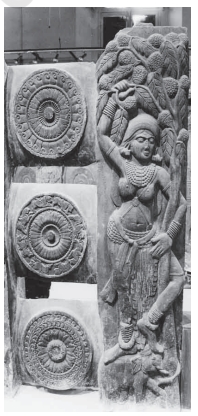
Figure Composition and Progression of Narrative Complexity
Early story panels focused on showing the main event clearly with only a few main figures. As sculptors gained confidence, they added richer backgrounds and more characters to their work.
- (i) Older story panels purposefully used a fewer number of characters, keeping the viewer focused directly on the primary action and key figures.
- (ii) Later panels added additional characters, creating fuller scenes that gave more context to each event.
- (iii) Sculptors also began combining multiple events that happened in one place into a single long panel, demonstrating a smooth way to tell a continuous story in stone.
Space Maximization and Realism in Sculptural Carvings
Artists used creative methods to make the best use of limited stone space. This clever spatial management eventually led to deeper carvings that showed realistic body shapes and natural movement.
- (a) At first, to save surface space, details like folded hands were carved flat against the chest to match the shallow relief level.
- (b) As techniques developed, later panels began showing the natural projections of hands and limbs, making figures look more active and life-like.
- (c) Carving depth transformed from early shallow surfaces into deep carvings with clear body weight, achieving naturalistic representations of people and animals alike.
Iconography and Regional Presence of Bharhut Style
The artistic style born at Bharhut shaped work at several other major historical sites, creating a shared design language across the .
- Yaksha and Yakshini Figures: Figure design directly inherited traits from the Mauryan period tradition of large Yaksha and Yakshini guardian figures linked to nature and growth.
- Wider Geographical Influence: Examples of this early style appear not just at Bharhut, but also across Bodhgaya, Sanchi Stupa-2, and Jagayyapeta, showing how widespread this artistic movement became.
- Distinct Male Headgear: A clear feature on male figures from the is a detailed, carefully tied or knotted headgear.
Narrative Reliefs: Jataka Stories and The Communicative Pictorial Language
The standout achievement of Bharhut is how its narrative reliefs shared detailed Buddhist lessons using clear picture stories, making complex Jataka stories easy for all visitors to understand.
Key Depictions of Buddha's Life Events
The life of Gautam Buddha and his past lives (Jataka stories) form the primary subject matter, carved with care by Bharhut craftspeople to teach core moral values.
- (i) Queen Mayadevi’s Dream: This panel shows the conception of Siddhartha Gautam. The mother, Queen Mayadevi, rests on a couch while a great elephant descends from above to mark the sacred moment.
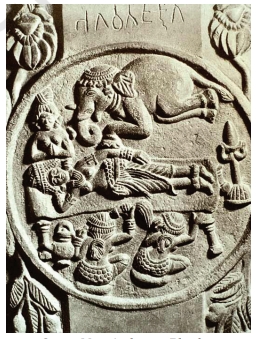
Queen Maya Dream Barhut - A depiction of Queen Maya's dream, an important narrative in Buddhist tradition, shown in a sculpture from Barhut, a significant site of early Indian art. - (ii) Ruru Jataka: This story teaches honesty and warns against ungratefulness. It shows the Boddhisattva deer saving a drowning man, who later breaks his promise and betrays the deer to the king for a reward.
- (iii) Including these moral Jataka stories formed an integral part of decorating stone stupas, helping both to beautify the site and to clearly teach moral lessons to everyday people.
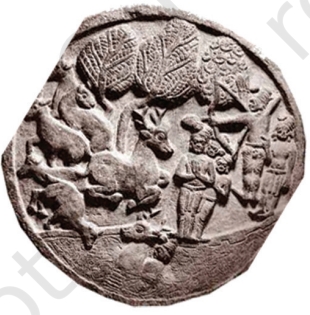
Jataka Panel Barhut - A Jataka panel from Barhut, illustrating the Buddha's past lives, a key element in early Buddhist storytelling through art.
- (i) Queen Mayadevi’s Dream: This panel shows the conception of Siddhartha Gautam. The mother, Queen Mayadevi, rests on a couch while a great elephant descends from above to mark the sacred moment.
⚡ Quick Revision Capsule: Bharhut Sculptures
A structured breakdown of features, techniques, and narrative methods in early Post-Mauryan art:
| Feature Category | Key Art Characteristics | Historical Significance |
|---|---|---|
| Primary Era | (Post-Mauryan Period) | Marks the origin of structural narrative art in India. |
| Carving Technique | Low relief evolving into deep relief with tilted perspective | Helped overcome flat stone limits to show realistic depth. |
| Human Form Style | Tall, linear figures inspired by early Yaksha imagery | Shows strong stylistic ties to earlier Mauryan stone statues. |
| Primary Theme | Jataka Stories and events from the Buddha's life | Taught moral concepts through visual storytelling on stupa railings. |
| Main Location | Originally Bharhut; now preserved in the Indian Museum, Kolkata | Serves as a main reference point for studying early Indian iconography. |
📝 Summary
The legacy of Bharhut Sculptures centers on artistic innovation and rich historical records. Created during the , these early Buddhist carvings used low relief depth and clever tilted perspective techniques to build the foundations of Indian figure design. For students, studying Bharhut clarifies how Indian art moved from heavy Mauryan period statues to the detailed story panels seen in later centuries. Today, key artifacts showing these Jataka stories are preserved in the Indian Museum, Kolkata, remaining an essential source for understanding ancient culture and art evolution.
🚀 Quick Revision Points
Essential facts to review before examinations:
- (i) Transitioned art from single statues to continuous narrative relief panels.
- (ii) Used tilted perspective to create visual depth on shallow stone surfaces.
- (iii) Depicted early male figures with distinct knotted headgear.
- (iv) Popularized moral tales like Ruru Jataka and Queen Mayadevi's Dream on stupa architecture.
- 💡 Exam Tip: When writing exam answers on Post-Mauryan art, always highlight how 'tilted perspective' solved the spatial limitation of low-relief carving.
❓ Frequently Asked Questions (FAQ)
Q1: What historical period do the Bharhut Sculptures belong to?
A1: They date back to the during the post-Mauryan era.Q2: What is the significance of the tilted perspective in Bharhut art?
A2: It allowed sculptors to overcome flat low relief surfaces and create a sense of depth and three-dimensional space in story panels.Q3: Where can most surviving Bharhut sculptures be viewed today?
A3: Most original carvings are preserved and displayed in the Indian Museum, Kolkata.
