
Explore the ancient Buddhist and Jain rock-cut architecture and the gradual evolution of the Buddha image across prominent centers such as Guntapalle, Udaigiri-Khandagiri, Mathura, and Sarnath. Spanning from the to the , these varied regional styles reveal essential insights into early Indian art and culture, making them vital subjects for students preparing for competitive examinations in history and archaeology.
🎯 In this chapter, you will understand:
- How rock-cut monastic spaces developed across Eastern India in Andhra Pradesh and Odisha.
- The indigenous, fleshy sculptural form of the Buddha created during the Kushana period at Mathura.
- The Greco-Roman and Western Asian influences blended into the Gandhara style Buddha head from Taxila.
- The refined, spiritual aesthetic and transparent drapery seen in the Gupta period Sarnath Buddha.
💡 Why this topic matters: Understanding these early regional art forms helps students grasp how religious beliefs, trade, and royal support shaped India's classic architectural and sculptural heritage.
🧠 Core Idea: Between the and the , Indian craftsmen transitioned from carving rock-cut caves to creating expressive, iconic human forms of the Buddha, developing distinct regional styles across Mathura, Gandhara, and Sarnath.
Regional Diversity in Buddhist Caves and Sculpture: Eastern India, Mathura, and Gandhara ( – )
A thriving tradition of rock-cut architecture grew across Eastern India, focused mainly on Buddhist establishments. At the same time, major carving centers like Mathura and Gandhara guided how the visual portrayal of the Buddha image changed over time.
The history of rock-cut caves and standalone statues shows how deep religious faith led to lasting artistic traditions. These works display clear regional styles and iconographic developments throughout the Indian subcontinent.
- (i) The coastal areas of Andhra Pradesh and Odisha grew into key centers for Buddhist cave architecture, featuring unique building methods and artistic designs.
- (ii) The growth of Mathura as a leading sculptural hub, particularly under the Kushana Period, introduced a native, full-bodied style for depicting the Buddha.
- (iii) At the same time, the Gandhara region created a blended artistic approach, combining Greco-Roman styles with Indian religious symbols, marking an important turning point in sculpture history.
Early Rock-Cut Cave Tradition in Eastern India: Andhra Pradesh and Odisha
The eastern coastal region of India contains archaeological sites that showcase the early phase of rock-cut architecture. These sites differ noticeably from Western Indian caves in both size and overall plan.
Guntapalle Buddhist Caves in Eluru District, Andhra Pradesh
The Guntapalle site offers a rare combination of structural forms. It is one of the few places containing both built-up brick structures and carved rock-cut caves, giving a full picture of early Buddhist monastic life.
- (i) Architectural Synthesis:Guntapalle stands out because it combines freestanding stupa buildings and vihara monasteries with rock-cut caves, showing a clear shift in ancient construction methods.
- (ii) Chaitya Hall Design: Its rock-carved chaitya cave features a circular room housing a central stupa and a carved chaitya arch over the entrance. However, it is much smaller than the huge halls found in Western India.
- (iii) Vihara Characteristics: The vihara caves are rectangular rooms with vaulted ceilings. They have single or double stories but do not include large central assembly halls. Their exterior walls are decorated with ornamental chaitya arches. The earliest carvings date back to the , while later additions consist mainly of vihara-style rooms.
Minor and Major Andhra Pradesh Buddhist Sites: Rampaerrampallam and Anakapalli
In addition to Guntapalle, other locations in Andhra Pradesh confirm the widespread growth of Buddhist monastic centers, including one site that contains a massive rock-carved stupa.
- (a) Rampaerrampallam: This location features small rock-cut excavations and several rock-cut stupas scattered across nearby hills, indicating smaller monastic communities.
- (b) Anakapalli Stupa: Situated near Vishakhapatnam and dating to the , this site is historically famous for holding the largest rock-cut stupa in India, surrounded by numerous small votive stupas carved around the hill.
Udaigiri-Khandagiri Caves: Early Rock-Cut Tradition in Odisha
Located near Bhubaneswar, the Udaigiri-Khandagiri Caves display the earliest rock-cut cave tradition in Odisha. These caves stand out due to their connection with Jain monks and the royal backing of the Kharavela Jain kings.
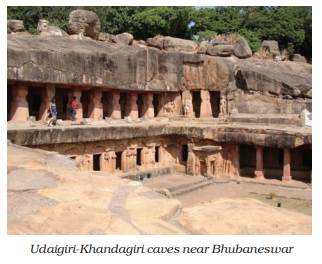
Udaigiri Khandgiri Caves Bhubaneswar - The caves at Udaigiri and Khandgiri, featuring rock-cut architecture and inscriptions, showcasing the religious art and culture of the 1st century BCE. - (i) Architectural Style: These caves are mostly single-room excavations. Some are carved directly out of large boulders to look like animal forms. They frequently feature pillared verandas leading into inner cells, with decorative chaitya arches carved above the cell openings.
- (ii) Jain Patronage and Inscriptions: Important inscriptions found on-site credit their creation to the Kharavela Jain kings, confirming their use by Jain monks during the .
- (iii) Sculptural Dynamics: The figures carved here show full natural volume and active movement, filling the carved spaces with energy and demonstrating high carving quality.
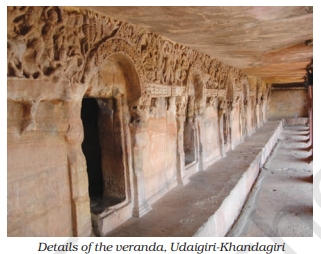
Udaigiri Khandgiri Details of Veranda - A detailed view of the veranda carvings at Udaigiri and Khandgiri caves, reflecting ancient Indian architectural and sculptural styles. - (iv) Later Additions: Additional caves were carved into the hills during the , proving that the site remained religiously active over many centuries.
Mathura Sculptural Style: The Indigenous Kushana Period Buddha Image
Mathura developed into an extraordinarily creative sculpture center, creating an earthy artistic style that peaked during the Kushana Period and heavily shaped Indian religious iconography.
Seated Buddha Image from the Katra Mound: Iconography and Stylistic Features
The famous Buddha image uncovered at Katra Mound dates to the . It serves as a classic example of the Mathura school, blending strength, compassion, and native artistic traditions.
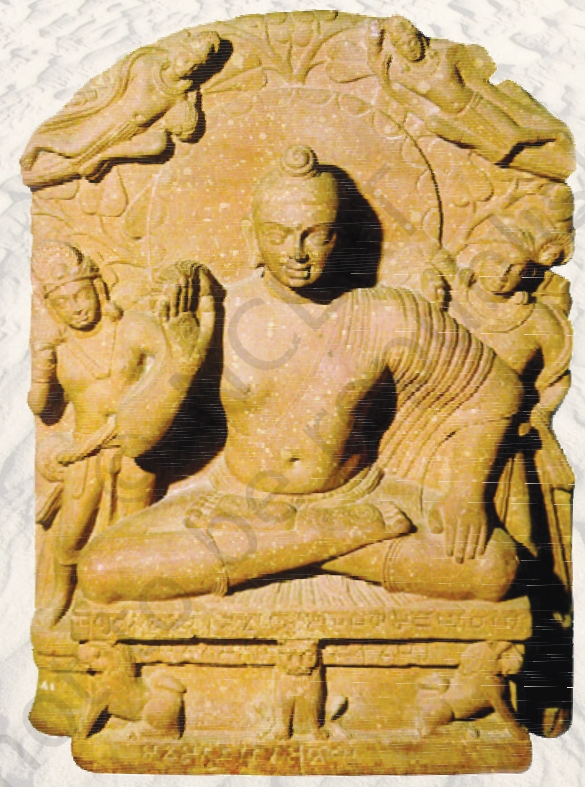
Seated Buddha Katra Mound Mathura - A famous image of the Buddha seated in meditation, discovered at the Katra Mound in Mathura, representing the early phase of Gandhara art. - (i) Posture and Mudra: The Buddha sits in padmasana (cross-legged lotus posture) on a lion throne. His right hand is raised in abhayamudra (gesture granting fearlessness), while his left hand rests on his left thigh, expressing calm reassurance.
- (ii) Fleshy Volume and Garment: The figure has a full, powerful physique with wide shoulders and firm muscle detail characteristic of Mathura artists. The sanghati (monastic robe) covers only one shoulder, wrapping tightly around the upper body to show the natural form beneath.
- (iii) Hair and Attendants: The head features a raised hair knot called an ushnisha. The Buddha is flanked by two crowned Bodhisattva attendants: Padmapani (holding a lotus) and Vajrapani (holding a thunderbolt).
- (iv) Halo and Movement: A large halo decorated with simple geometric lines surrounds the head. Two flying figures carved above the halo add a sense of lively motion, replacing earlier stiff carving styles with natural rhythm.
Significance of the Mathura Buddha Sculpture
This statue stands as a clear benchmark of Kushana Period artwork from Mathura. Its stylistic and iconographic features are essential for tracking how the Buddha's image evolved in later Indian art.
- Evolving Aesthetics: The statue highlights an earthy and natural appearance through soft muscle contours, rounded features, and a friendly facial expression with full cheeks, guiding future artistic styles.
Buddha Head from Taxila (Gandhara Region): Greco-Roman Hybridization
The Buddha Head from Taxila dates to the Kushana period around the . Originating from the Gandhara region (in modern Pakistan), it exhibits a unique hybridized artistic style heavily influenced by Greco-Roman sculpture techniques.
Stylistic Features of the Gandhara Buddha Head from Taxila
The Gandhara style introduced distinct traits that differed from Mathura art by focusing on clear linear details, realistic facial features, and dramatic light-and-shadow effects.
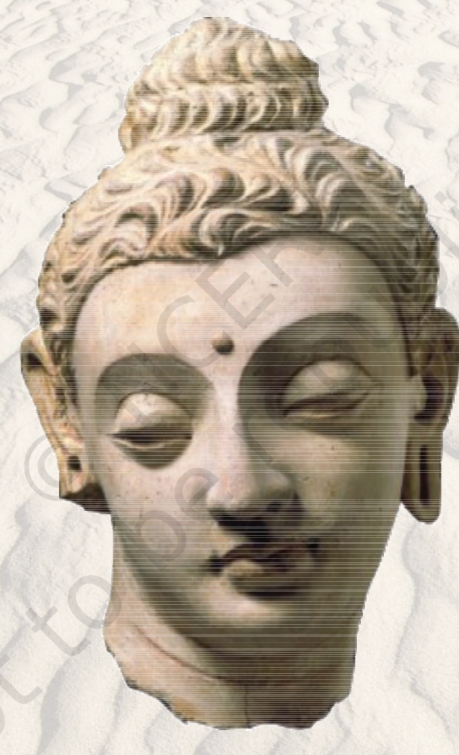
Buddha Head Taxila - A striking sculpture of a Buddha head from Taxila, reflecting the fusion of Gandharan and Indian artistic traditions during the Kushan period. - (a) Hair and Eyes: The hair is rendered in thick, sharp curls carved with crisp lines. The broad forehead pairs with eyes that are half-closed and slightly raised, giving a peaceful, meditative look.
- (b) Facial Anatomy: Unlike the plump cheeks seen in Mathura, the Gandhara face displays elongated earlobes and sharp facial contours, producing a smooth surface finish.
- (c) Expressiveness and Naturalism: The sculpture shows deep expressiveness. Careful carving around the eye sockets and bridge of the nose uses light and shadow to create a strong sense of three-dimensional realism.
Cultural Synthesis in Gandhara Art: Achaemenian, Parthian, and Bactrian Traits
Artwork from Gandhara highlights cultural sharing, effectively absorbing ideas from Western and Central Asian regions while maintaining a distinct identity for Buddhist iconography.
- (i) Hybridized Style: These sculptures combine artistic elements from Achaemenian, Parthian, and Bactrian traditions, most clearly seen in their Greco-Roman facial features.
- (ii) Distinctive Treatment: Even with external influences, the final presentation remains uniquely Gandharan, creating a successful blend of Eastern and Western art forms used widely across Buddha figures, Bodhisattvas, and Jataka story panels.
Buddha Image from Sarnath: The Epitome of Gupta Period Refinement
Carved from soft Chunar sandstone during the , the Buddha Image from Sarnath is widely considered the highest achievement of Gupta-era art. It symbolizes dhammachackrapravartana (turning the wheel of law) and reflects deep spiritual peace and technical skill.
Iconography and Dhammachackrapravartana Symbolism
The Sarnath Buddha visually captures the critical moment of the Buddha's first sermon through symbols that clearly convey his teachings.
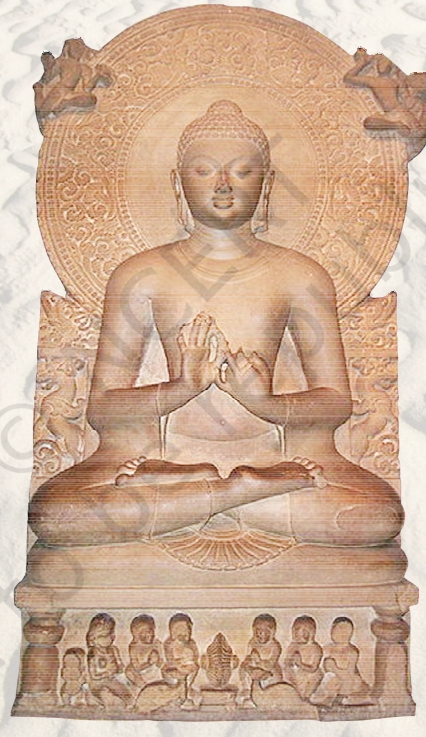
Seated Buddha Sarnath - A well-known statue of the Buddha seated in a meditative pose, symbolizing the moment of enlightenment, found in Sarnath, Uttar Pradesh. - (a) Mudras and Posture: The Buddha sits in padmasana with his hands held in the dhammachackrapravartana mudra (teaching hand posture) just below his chest, marking his first discourse at Sarnath.
- (b) Throne Panel Detail: The lower panel of the throne shows a central chakra (wheel) flanked by a deer on each side and listening disciples, directly illustrating the preaching of the dhamma.
Artistic Refinement and the Transparent Drapery Style
This statue demonstrates classical Gupta Period beauty through its slim proportions, smooth outlines, and seamless transparent drapery.
- (i) Body and Drapery: The body is slender and well-proportioned with gentle, flowing lines. The monastic robe clings so closely to the skin that it looks transparent, showing smooth physical contours and master-level carving skill.
- (ii) Facial Features: The face is oval with peaceful, half-closed eyes. The neck displays two delicate incised lines indicating neck folds, while the hair knot (ushnisha) is carved with small circular curls.
- (iii) Decoration and Halo: The back of the throne features rich floral and vine patterns arranged in neat circles. The large halo remains mostly plain in the middle to keep full visual focus on the Buddha's face.
Legacy of Sarnath Buddha and the Nibbana Ideal
Gupta statues from Sarnath are central to understanding how ancient sculptors portrayed the Buddha as an ideal spiritual guide who reached complete inner peace.
- Spiritual Ideal: Sculptors aimed to show the Buddha not merely as a god, but as an enlightened human who attained nibbana (freedom from anger and desire), emphasizing deep calm and grace.
- Continued Style: Features like smooth surface carving, sheer robes, and subtle posture balance seen in seated and standing statues (such as those at Dharmarajika Stupa) set the standard for later art across Asia.
⚡ Quick Revision Capsule: Regional Styles of Buddha & Cave Art
A side-by-side comparative breakdown of key ancient Indian architectural and sculptural traditions:
| Region / School | Time Period & Patronage | Key Features & Iconography |
|---|---|---|
| Guntapalle & AP Sites | – | Mix of rock-cut caves and built stupas; includes India's largest rock-cut stupa at Anakapalli. |
| Udaigiri-Khandagiri | (King Kharavela) | Rock-cut caves for Jain monks in Odisha; feature chaitya arches and active figure carvings. |
| Mathura School | (Kushana Period) | Native fleshy volume, Katra Mound Buddha, abhayamudra, lion throne, and one-shoulder robe. |
| Gandhara School | (Kushana Period) | Greco-Roman facial features, Taxila Buddha head, sharp curly hair, half-closed eyes, linear naturalism. |
| Sarnath School | (Gupta Period) | Chunar sandstone, dhammachackrapravartana mudra, transparent clinging robes, serene expression. |
📝 Summary
The development of ancient Indian art from rock-cut caves at Guntapalle and Udaigiri-Khandagiri to the distinct sculpture schools of Mathura, Gandhara, and Sarnath highlights remarkable creative growth. Mastering the native fleshy Mathura style, the Greco-Roman influenced Gandhara head from Taxila, and the peaceful Gupta Sarnath Buddha is essential for students studying Indian heritage and competitive exam syllabi.
🚀 Quick Revision Points
Essential facts to review before examinations:
- (i) Guntapalle in Andhra Pradesh uniquely combines freestanding structures with circular rock-cut chaitya halls.
- (ii) Udaigiri-Khandagiri caves near Bhubaneswar were dedicated to Jain monks under the patronage of King Kharavela.
- (iii) The Katra Mound Buddha from Mathura showcases an indigenous, full-bodied figure seated on a lion throne.
- (iv) The Taxila Buddha head represents Gandhara art with sharp wavy hair, half-closed eyes, and Greco-Roman influence.
- (v) Sarnath Gupta statues carved from Chunar sandstone feature clinging transparent drapery and the teaching gesture.
- 💡 Exam Tip: Pay close attention to hand gestures (abhayamudra vs. dhammachackrapravartana mudra) and drapery styles (one-shoulder heavy folds in Mathura/Gandhara vs. smooth transparent robes in Sarnath Gupta art) when answering competitive exam questions.
❓ Frequently Asked Questions (FAQ)
Q1: What makes the Guntapalle caves unique in early Indian rock-cut architecture?
A1: Guntapalle is unique because it features both built-up brick structures and carved rock-cut caves on the same site, including circular chaitya halls and double-storey viharas.Q2: How does the Gandhara Buddha head from Taxila differ from the Mathura Buddha style?
A2: The Taxila Gandhara head features Greco-Roman physical realism, sharp wavy hair, and sharp facial features, whereas the Mathura style uses a rounded, fleshy face with native Indian artistic features.Q3: What does the Sarnath Buddha sculpture symbolize?
A3: The Sarnath Buddha depicts the historical moment of dhammachackrapravartana (the Buddha's first sermon), shown by his teaching hand gesture and the wheel-and-deer motif on the throne base.
