
The Ellora Caves show a wonderful mix of three main religions of ancient India: Buddhism, Hinduism, and Jainism. Located in the Aurangabad District of Maharashtra, these 34 rock-cut caves were carved between the and the . Famous worldwide for their mixture of artistic styles and grand building designs, they are a key topic for students learning about Indian art, history, and culture. The site gives us a clear look at how different faiths lived side by side while creating great art.
🎯 In this chapter, you will understand:
- How Buddhist, Hindu, and Jain traditions lived together at Ellora.
- The key architectural highlights of Vajrayana Buddhist caves like Cave 12.
- The grand single-rock structure of the famous Kailash Temple (Cave 16).
- The ornate details found in the later Jain rock-cut caves.
💡 Why this topic matters: Ellora stands as a physical proof of religious tolerance and artistic mastery in ancient India, making it a favorite subject in competitive exams.
🧠 Core Idea: Over six centuries, artists cut through solid basalt hills to build 34 unique religious temples from three major faiths.
📌 Ellora Caves: A Study in Stylistic Eclecticism and Multi-Religious Rock-Cut Architecture (5th–11th Century CE)
The large complex at Ellora sits near Aurangabad and serves as a long historical record of peace between different faiths and smart building ideas over six hundred years.
This impressive group has 34 main caves cut directly into basalt cliffs. They are divided by religion, showing different sides of spiritual life in post-Gupta and medieval times.
- (i) The caves lie about 100 kilometers from the well-known Ajanta Caves, forming an important cultural trip route in Maharashtra.
- (ii) The site is neatly split into three main groups: Buddhist (Caves 1–12), Brahmanical/Hindu (Caves 13–29), and Jain (Caves 30–34).
- (iii) Built from the to the , the timing of these builds shows changing political support and evolving religious art, making it useful for students.
📌 The Magnificent Buddhist Caves at Ellora: Insights into Vajrayana Deities
The first group of twelve caves belongs to Buddhism. They mostly feature the Vajrayana (Tantric) phase, seen in their huge size and many statue figures.
Artistic Expression and Deity Representations in Buddhist Caves
The Buddhist caves have large designs that often feature massive pillars and multi-floor plans, showing the strength of monk orders at that time. The inner shrines hold huge statues of the Buddha.

Seated Buddha at Chaitya Hall Ellora - A Buddha sculpture seated in a prayerful pose at the Chaitya Hall in Ellora, reflecting the grandeur of Indian cave temple architecture. - (i) These works stand out because they feature many Vajrayana Buddhist deities, showing a change from earlier Hinayana and Mahayana art.
- (ii) Famous figures carved here include Tara, Mahamayuri, Akshobhya, Avalokiteshwara, Maitrya, and Amitabha.
- (iii) Main Buddha statues usually have two Bodhisattvas by their side: Padmapani (holding a lotus) and Vajrapani (holding a thunderbolt).
Cave No. 12: The Dhevarwada – A Triple-Storey Architectural Marvel
Cave No. 12, also called Tin Thal (three floors), is a great example of late Buddhist rock-cut architecture. Its grand size makes it a key topic for students.
- (a) The sheer height of this three-floor cave shows how skilled the stone carvers were at that time.
- (b) The cave is filled with carvings of important figures like Tara, Avalokiteshwara, and various Manushi Buddhas (human Buddhas).
- (c) The inclusion of Dhyani Buddhas—like Vairochana, Akshobhya, Ratnasambhava, and Amoghasiddhi—shows a clear link to Vajrayana ideas.
📌 The Monumental Brahmanical Caves at Ellora: The Dominance of Shaivism and Vaishnavism
Caves 13 to 28 show the return of Brahmanical (Hindu) traditions, mostly built under the Rashtrakuta dynasty. These caves are known for their big rooms and strong, expressive story sculptures from holy texts.
Themes and Sculptural Dynamics of Hindu Caves
The Brahmanical caves mostly focus on Shaivism (Lord Shiva), while also showing scenes from Vaishnavism (Lord Vishnu).
- (i) Famous stories of Lord Shiva are carved clearly, like Ravana shaking Mount Kailash, Andhakasuravadha (defeating the demon Andhaka), and the holy wedding of Kalyanasundara.
- (ii) The art uses monumental sculptures carved deep into the rock to give figures a realistic, 3D look.
- (iii) Scenes of Lord Vishnu focus on his ten avatars, carved with great detail.
Architectural Masterpieces: Kailash Temple (Cave 16), Cave 29, and Cave 21
These caves hold some of the best structural works in Indian history, especially the massive Kailash Temple.
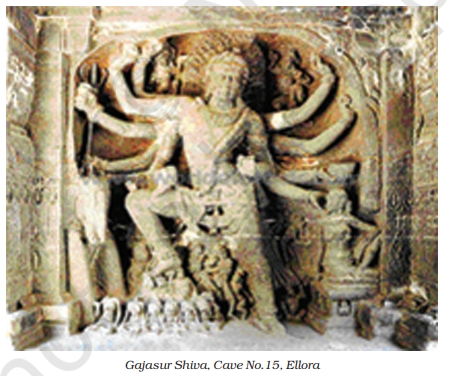
Gajasur Shiva Cave at Ellora - The Gajasur Shiva Cave, featuring detailed rock-cut sculptures of the elephant-headed deity, part of Ellora's monumental temples. Kailash Temple (Cave No. 16): The Single-Rock Marvel
- (a) The Kailash Temple was cut from top to bottom out of a single huge rock—a rare work of engineering worldwide.
- (b) It is a complete temple ground made to look like Mount Kailash, the home of Lord Shiva.

Courtyard of Kailash Temple at Ellora - The grand courtyard of the Kailash Temple in Ellora, carved out of a single rock, exemplifying the ingenuity of Indian rock-cut architecture.
Cave 29 (Dhumarlena) and Cave 21 (Rameswara)
- (i) Cave No. 29 (Dhumarlena) looks similar in plan to the main Shiva cave at Elephanta Caves.
- (ii) Cave No. 21 (Rameswara) is liked for its detailed statues of river goddesses and divine couples.
📌 The Later Jain Caves at Ellora: Characterized by Ornate Decorative Forms
The last five caves (30–34) belong to the Jain faith. Cut around the , they show a style focused on small, detailed carvings.
Jain Iconography and Stylistic Features
Though smaller than the Buddhist or Hindu caves, the Jain caves have a clear look with rich decorations and focus on the Tirthankaras.
- (i) They feature highly ornate decorative forms with deep relief details.
- (ii) The artwork focuses on holy discipline and pictures of Jain Tirthankaras.
📌 Artistic Contributions and Cultural Significance of Ellora Caves
The site shows how different work groups shared ideas across ancient regions, proving how India's cultures mixed together.
The Role of Regional Artistic Guilds and Stylistic Diversity
The variety of artwork found at Ellora came from workers joining together from different areas.
- (i) Sculptures show styles brought in by artists from regions like Vidarbha, Karnataka, and Tamil Nadu.
- (ii) This mix makes Ellora an unparalleled site in India's rock-cut history.
📌 Ellora Caves Conclusion: Importance for Art History Students
Built between the and , the Ellora Caves stand as a sign of India's multi-religious harmony and skills in rock-cut architecture. The shift from Buddhist to Hindu and then Jain styles—ending with the grand Kailash Temple (Cave 16)—gives students a complete view of ancient culture for exam preparation.
⚡ Quick Revision Capsule: Ellora Caves Grouping
A fast overview of the cave arrangements and major features across the site:
| Cave Group | Cave Numbers | Key Highlights & Features |
|---|---|---|
| Buddhist Group | Caves 1–12 | Focuses on Vajrayana figures, Bodhisattvas, and the 3-storey Cave 12 (Tin Thal). |
| Hindu / Brahmanical Group | Caves 13–29 | Built under Rashtrakutas; includes Cave 16 (Kailash Temple), Cave 21, and Cave 29. |
| Jain Group | Caves 30–34 | Carved around ; features ornate carvings of Tirthankaras. |
📝 Summary
Cut into basalt hills between the , Ellora presents 34 caves celebrating three major religions. Supported by dynasties like the Rashtrakutas and built by artists from across India, it stands as an architectural wonder topped by the top-down carved Kailash Temple.
🚀 Quick Revision Points
Essential facts to review before examinations:
- (i) Total of 34 caves cut into basalt cliffs in the Aurangabad District.
- (ii) Divided into Buddhist (1–12), Hindu (13–29), and Jain (30–34) groups.
- (iii) Cave 16 (Kailash Temple) is a single-rock top-down excavation.
- (iv) Cave 12 (Tin Thal) is a grand three-storey Buddhist structure.
- 💡 Exam Tip: Remember that Cave 16 was carved top-to-bottom from a single rock under Rashtrakuta patronages.
❓ Frequently Asked Questions (FAQ)
Q1: How many caves are there at Ellora and how are they divided?
A1: There are 34 major caves: Caves 1–12 are Buddhist, Caves 13–29 are Hindu, and Caves 30–34 are Jain.Q2: What makes Cave 16 unique?
A2: Cave 16, known as the Kailash Temple, was carved from top to bottom out of a single monolithic rock face.Q3: Which dynasty sponsored many of the major Hindu caves at Ellora?
A3: The Rashtrakuta dynasty sponsored major Hindu excavations, including the Kailash Temple.
