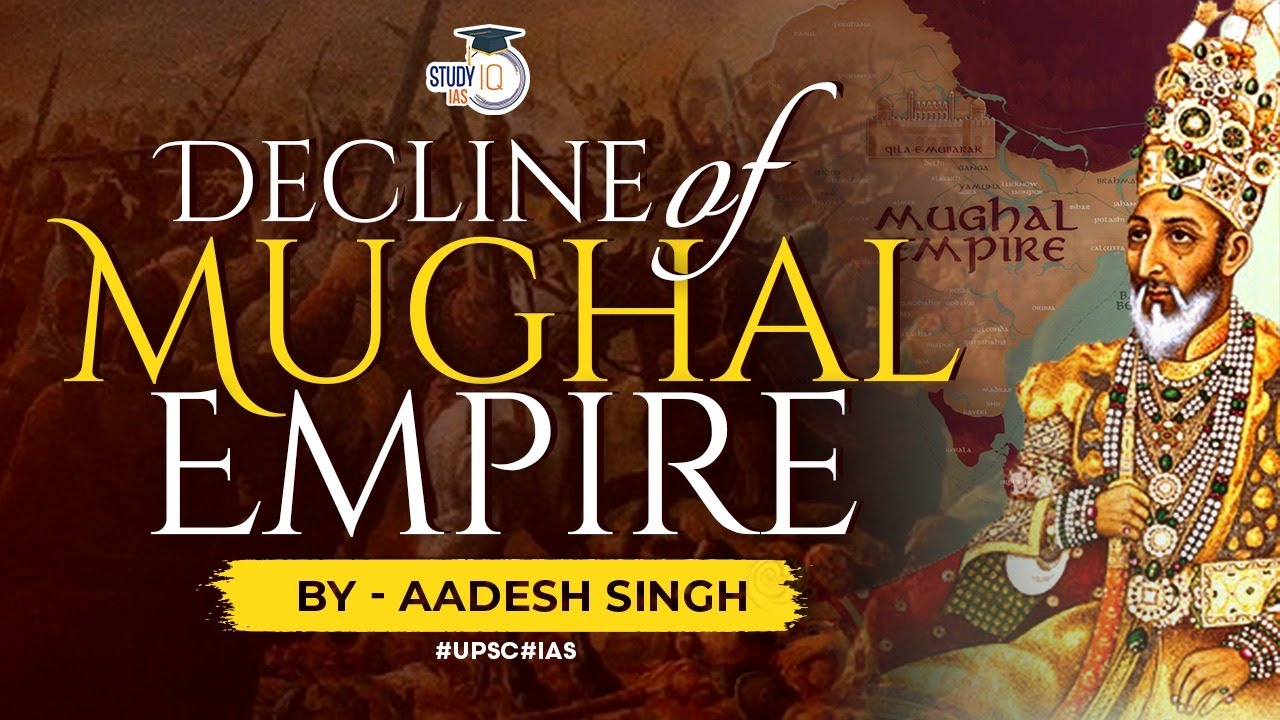
The story of the decline of the mighty Mughal Empire is a crucial chapter in Indian history, commencing significantly after the death of Emperor Aurangzeb in . Understanding the major causes behind the Mughal decline, including the complex interplay of Aurangzeb’s policies, escalating economic and social factors, and the rise of a corrupt nobility, offers invaluable context for students preparing for history exams and competitive examinations, providing insights into the fragmentation of central authority and the rise of regional successor states.
🎯 In this chapter, you will understand:
- The main political and administrative causes behind the fall of the Mughal Empire.
- How Aurangzeb’s policies and long military campaigns impacted governance.
- The economic stress caused by the crisis in the jagirdari and mansabdari systems.
- The rise of regional powers like the Marathas and the resulting central breakdown.
💡 Why this topic matters: It marks the transition of India from a unified imperial power into fragmented regional kingdoms, paving the way for foreign colonial rule.
🧠 Core Idea: The decline was not caused by a single event, but by structural flaws, economic stress, corrupt governance, and long-drawn strategic errors.
📌 Major Causes Behind the Decline of the Mughal Empire: A Historical Analysis (Post-Aurangzeb Period)
Following the death of Emperor Aurangzeb, political instability and factional fighting weakened central authority. This internal conflict created opportunities for local leaders and provincial governors to claim power, leading to the gradual breakup of the empire.
- Political Instability and Factionalism: The Cracks in Central Authority
After Aurangzeb's death, the Mughal court turned into a center for political tricks and group fights. This internal weakness allowed governors to break away and rule independently.
- (i) Ambitious provincial governors in regions like Bengal, Awadh, and Hyderabad started ruling independently, carving out separate states from the empire.
- (ii) Continuous raids by the Marathas expanded beyond the Deccan into the northern plains, exposing the weak military strength of the central government.
- (iii) The complete breakdown of imperial power became clear in when the Persian ruler Nadir Shah captured the Mughal emperor Muhammad Shah and looted Delhi, ruining the empire's wealth and prestige.
📌 Aurangzeb’s Policies: Examining Their Long-Term Impact on Imperial Governance
Although the final breakdown happened after his death, many actions taken by Aurangzeb placed severe political, financial, and administrative strain on the empire throughout the .

The Myth Surrounding Shahu’s Conversion and Political Maneuvers
Some claims suggest that Shahu, the grandson of Shivaji, was offered control of the Maratha kingdom only if he converted to Islam. However, modern historical research shows this story lacks factual evidence.
- (i) Claims that Shahu was required to adopt Islam to rule are not supported by reliable historical records.
- (ii) Converting a Hindu prince would have removed his traditional right to inherit leadership, making such an offer politically senseless if the goal was peace.
Historians’ Perspectives: Analyzing Aurangzeb’s Role in the Decline
Scholars continue to debate how much Aurangzeb personally caused the fall of the empire versus broader structural issues that existed before and after his time.
- (a) Scholars disagree on whether the downfall resulted directly from Aurangzeb’s religious and administrative choices or from unavoidable problems after .
- (b) Modern studies look at long-term financial, social, and administrative issues across India rather than blaming a single ruler.
- (c) Global trade shifts and international events during his long reign also influenced the empire's capacity to maintain its strength.
📌 Economic and Social Factors Behind the Mughal Decline: Financial and Agrarian Stress
The economic and social conditions in medieval India played a major role in weakening the empire, especially regarding revenue collection and increasing pressure on farmland.
Trade and Handicrafts: The Paradox of Economic Expansion
Interestingly, trade grew significantly during the due to local business and European sea trade, but this wealth did not keep the state politically stable.
- (i) Trade and commercial activities expanded across India during the late , generating high income in several commercial centers.
- (ii) Local craft workers and manufacturers adapted well to market needs, showing that the economy was active despite political troubles.
Agriculture and Population: Increasing Pressure on the Land
Population growth and rigid land revenue demands put heavy pressure on farmers, leading to an agricultural crisis that was made worse by problems in the jagirdari system.
- (a) Official records show that land under the zabti revenue system increased as the government tried to collect more taxes.
- (b) Farmed land grew over time because of population growth and government efforts to encourage farming.
- (c) Despite vast unused land and a population of around , agricultural progress was limited by administrative and social restrictions.
📌 Administrative Failures and Corrupt Nobility: The Crisis of the Mansabdari System
A major internal weakness was corruption and poor management among the Mughal nobles operating under the mansabdari and jagirdari systems, which destroyed the central government's control.
Inflationary Expansion of Mansabdars: Straining the Treasury
To gain loyalty, the government appointed too many nobles. This created a shortage of land grants (jagirs) and led directly to the jagirdari crisis.
- (i) The total count of mansabdars (officials) rose sharply from 2,069 at Jahangir's accession in to 11,456 during the reign of Aurangzeb, causing a shortage of revenue-yielding land.
Zamindars’ Resistance and the Jagirdari System’s Collapse
Demand for higher tax collection created conflict with local landholders (zamindars), who led peasant revolts against imperial officials.
- (a) Powerful local zamindars fought back against unfair tax demands from land grantees (jagirdars), leading to widespread countryside rebellions.
- (b) Because there were more nobles than available land grants, competition among the elite grew fierce, causing officials to exploit farmers and resist central commands.
📌 Military and Political Failures: Strategic Miscalculations by Aurangzeb
Long, expensive military campaigns, particularly in the Deccan, emptied the imperial treasury and weakened the army, speeding up the collapse of the empire.
The Maratha Challenge: Misunderstanding a Rising Regional Power
Aurangzeb’s decision to fight a prolonged war against the Marathas was a major mistake. He failed to use diplomacy or build lasting alliances with regional leaders.
- (i) Aurangzeb misjudged the strength of the Maratha movement and ignored advice from Jai Singh, who had suggested forming a political agreement with Shivaji.
- (ii) By failing to solve the Maratha issue peacefully, Aurangzeb left the empire exposed to continuous warfare that drained money and soldiers for decades.
Overextension of the Empire: The Burden of Unwieldy Borders
Attempts to conquer the Deccan kingdoms extended the empire's boundaries too far, making effective governance from Delhi impossible.
- (a) Long campaigns in southern India against the Deccan states and Marathas overstretched the empire's army and financial funds.
- (b) The empire became too large for a central ruler to manage, causing central control over far-off provinces to collapse.
⚡ Quick Revision Capsule: Mughal Empire Decline Factors
The following summary table outlines the core causes, key details, and historical outcomes connected to the decline of the Mughal Empire after .
| Factor Area | Primary Cause | Historical Impact |
|---|---|---|
| Political Authority | Weak successors & court fights | Provincial governors in Bengal, Awadh, and Hyderabad formed independent states. |
| Administrative System | Inflation of mansabdars | Official numbers grew from 2,069 in to 11,456 under Aurangzeb, triggering the jagirdari crisis. |
| Agrarian Economy | Over-taxation & zamindar revolts | Land revenue demands sparked widespread rural rebellions that cut off central income. |
| Military Strategy | Prolonged Deccan Campaigns | Drained the royal treasury, overextended military forces, and created permanent conflict with Marathas. |
| Foreign Invasions | Invasion by Nadir Shah () | Capital city looted, imperial prestige destroyed, and central authority permanently broken. |
📝 Summary
The decline of the Mughal Empire was caused by internal administrative failure, economic stress, and costly military mistakes rather than a single event. After the death of Aurangzeb in , weak leadership and court struggles allowed regional governors to break away. A sharp increase in official appointments caused a land grant shortage known as the jagirdari crisis, while high tax demands sparked rebellions among zamindars. Combined with long military campaigns in the Deccan and devastating foreign invasions like that of Nadir Shah in , central authority collapsed, opening the path for regional powers and European colonial forces.
🚀 Quick Revision Points
Essential facts to review before examinations:
- (i) Emperor Aurangzeb’s death in marked the beginning of rapid imperial decay.
- (ii) The total count of mansabdars increased dramatically to 11,456, causing severe land shortages.
- (iii) The Maratha wars and Deccan campaigns drained the financial resources of the empire.
- (iv) Nadir Shah’s raid in exposed the empire's military weakness to the world.
- 💡 Exam Tip: When writing exam answers on the Mughal downfall, balance political issues with economic systems like the jagirdari and mansabdari crises instead of focusing only on Aurangzeb’s personal decisions.
❓ Frequently Asked Questions (FAQ)
Q1: What was the main administrative cause of the Mughal decline?
A1: The main structural cause was the breakdown of the jagirdari system, caused by an unsustainable increase in official appointments without enough land grants to assign them.Q2: How did Nadir Shah's invasion in affect the empire?
A2: The invasion by Nadir Shah destroyed Mughal financial strength, humiliated Emperor Muhammad Shah, and showed local rulers that Delhi could no longer defend itself.Q3: Did trade decline during the collapse of the Mughal Empire?
A3: No, trade and handicraft production actually expanded in the late , showing that economic trade remained active even while central political authority was failing.